
How Annual Leave Accrues in Australia: The Exact Maths Behind Your Payslip
If you've ever stared at the "leave accrued" line on your payslip and wondered where the number actually comes from, this is the explainer. The maths is simpler than it looks — and it always starts with one number: 0.07692.
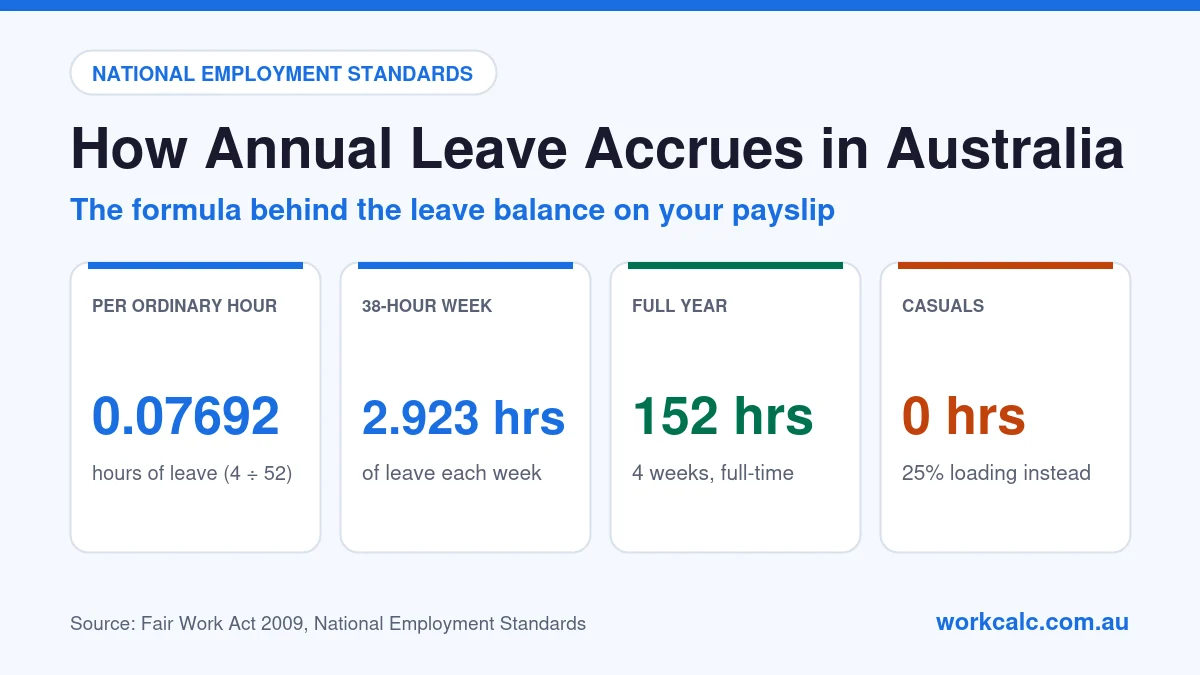
Every Australian payslip showing accrued annual leave is the output of a single calculation: ordinary hours worked × 0.07692. That fraction comes from the National Employment Standards (NES), which gives every permanent employee 4 weeks of paid annual leave per year. Divide 4 by 52 weeks and you get 0.076923 — the rate at which leave accrues for each hour you work.
Key numbers in this article
- 0.07692 — hours of leave accrued per ordinary hour worked (4 ÷ 52)
- 4 weeks per year — the NES baseline for full-time and part-time employees
- 38 hours per week — the standard full-time ordinary hours in Australia
- 152 hours per year — full-time annual leave entitlement (4 × 38)
- 2.923 hours per week — what a 38-hour-per-week employee accrues each week (38 × 0.07692)
- 0 hours — annual leave accrued by casual employees (they receive a 25% loading instead)
The formula on every Australian payslip
The Fair Work Act 2009 contains the National Employment Standards, ten minimum entitlements every permanent Australian employee receives. The fourth of these standards is paid annual leave: 4 weeks of paid leave per year of continuous service, accrued progressively from your first ordinary hour worked.
Payroll systems don't add 4 weeks to your balance once a year. They add a tiny fraction of an hour to your balance every time you work an hour. The fraction is always the same:
This means a full-time employee working a 38-hour week earns 38 × 0.07692 = 2.923 hours of leave per week. Over a full year of 52 weeks that's 152 hours — exactly 4 weeks at 38 hours per week. The maths is internally consistent: whatever your weekly hours, multiply by the accrual factor and multiply that by 52, and you'll always get 4 weeks back.
Where 38 hours comes from
The 38-hour ordinary week is set by the NES as the maximum weekly hours for a full-time employee. Most modern awards adopt 38 as the standard, distributed across either 5 days (7.6 hours per day) or a 9-day fortnight (8.4 hours per day with one rostered day off). Some industries use different numbers — building and construction is often 36 hours, while a handful of awards still reference 40 — but for the vast majority of Australian workers, 38 is the figure your accrual is built around.
Try it yourself
LiveThe widget above does exactly what your payroll system does, with two simplifications: it assumes every hour was paid (no unpaid leave) and that you worked your full ordinary hours every week. In reality, a payroll system applies the accrual factor each pay period to the actual ordinary hours paid that period — but the year-end total comes out to the same number.
Annual leave calculation step-by-step
Let's walk through exactly how a payslip number gets calculated for a typical scenario: a 38-hour-per-week full-time employee paid fortnightly who has been with their employer for 6 months.
- Establish the accrual factor. 4 weeks per year ÷ 52 weeks per year = 0.076923 hours of leave per ordinary hour worked.
- Find the per-pay-period accrual. Fortnightly ordinary hours = 38 × 2 = 76 hours. Per-fortnight accrual = 76 × 0.076923 = 5.846 hours per fortnight.
- Multiply by pay periods worked. 6 months ≈ 13 fortnights. Total accrued = 5.846 × 13 = 75.998 hours.
- Subtract any leave taken. If you've used 2 days (15.2 hours at 7.6 hrs/day): 75.998 − 15.2 = 60.798 hours.
- Convert to days or weeks if you prefer. 60.798 ÷ 7.6 = approximately 8 days, or 60.798 ÷ 38 = approximately 1.6 weeks.
That fortnightly figure of 5.846 hours is what shows up on each payslip as "this period's accrual" — small numbers that compound to 152 hours over a year.
Why your payslip might show a slightly different number
Payroll systems calculate accrual on the ordinary hours actually paid, not the hours you were supposed to work. If you took unpaid leave, or worked overtime (which doesn't accrue), or had a public holiday fall on a non-work day, your fortnight's accrual will be slightly different from the textbook 5.846. The differences are tiny per pay but accumulate over a year.
Annual leave entitlement by hours per week
The 4-week entitlement is identical for full-time and part-time employees, but the absolute number of hours differs because part-timers work fewer ordinary hours. Here's the same formula applied across common arrangements:
| Ordinary hours/week | Accrual per week | Yearly entitlement |
|---|---|---|
| 10 hrs (2 days × 5) | 0.769 hrs/wk | 40 hrs (= 4 weeks) |
| 15 hrs (3 days × 5) | 1.154 hrs/wk | 60 hrs (= 4 weeks) |
| 20 hrs (e.g. 0.5 FTE) | 1.538 hrs/wk | 80 hrs (= 4 weeks) |
| 25 hrs | 1.923 hrs/wk | 100 hrs (= 4 weeks) |
| 30 hrs | 2.308 hrs/wk | 120 hrs (= 4 weeks) |
| 32 hrs (4-day week) | 2.462 hrs/wk | 128 hrs (= 4 weeks) |
| 38 hrs (standard FT) | 2.923 hrs/wk | 152 hrs (= 4 weeks) |
| 40 hrs | 3.077 hrs/wk | 160 hrs (= 4 weeks) |
The "weeks of leave" column is always 4 — that's the NES guarantee. What varies is how many hours of pay 4 weeks represents, because each person's working week looks different. A 3-day-a-week part-timer working 20 hours has the same 4-week entitlement as a 5-day-a-week full-timer working 38 — but 4 weeks of their work is 80 hours, not 152.
Related calculator Part-time? Calculate your entitlement with the dedicated tool →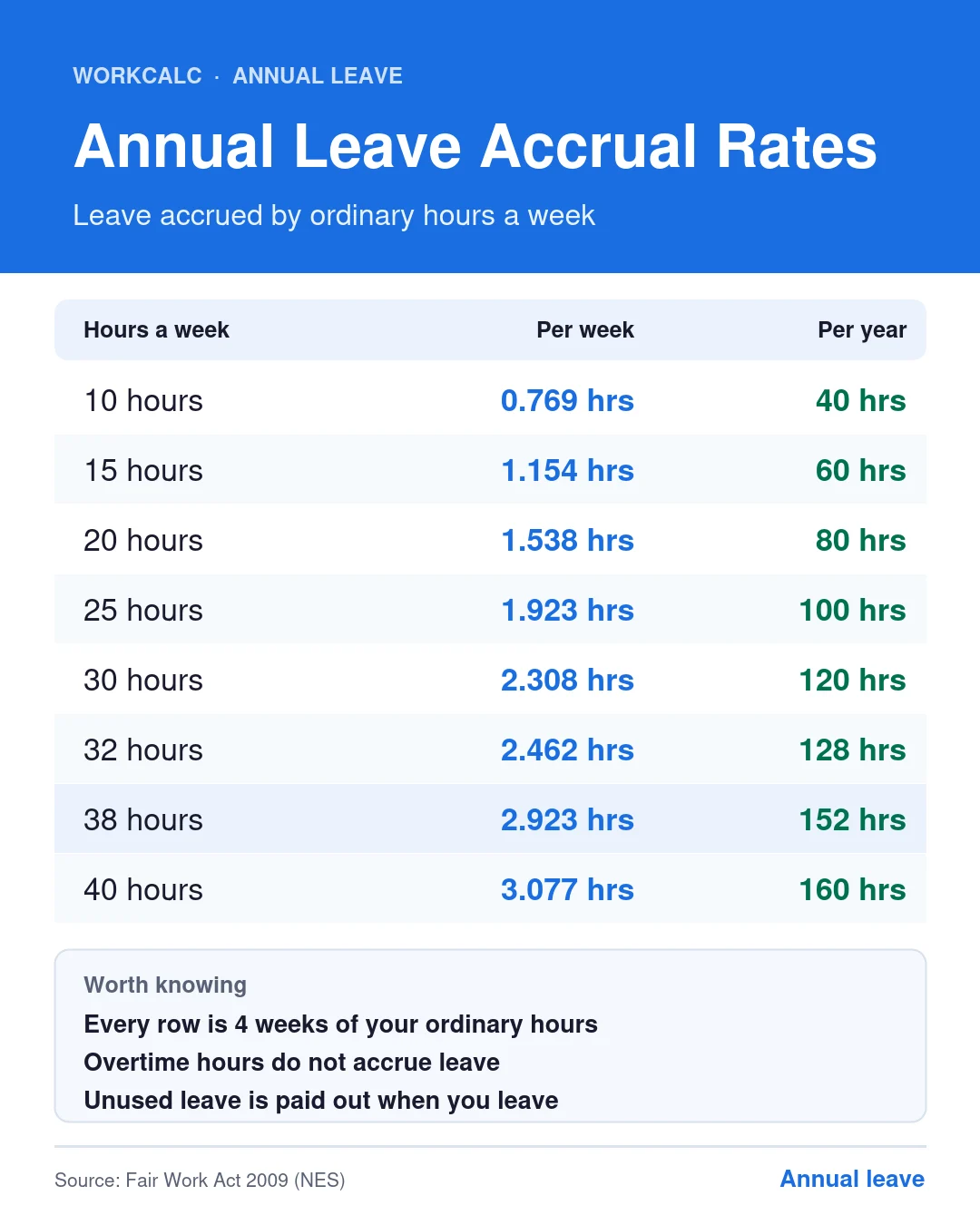
How accrual rules change when you take leave
The accrual factor doesn't pause for everything. The rules for what does and doesn't accrue annual leave are surprisingly important — they explain why two employees doing the "same job" can end up with different leave balances.
Periods that DO accrue annual leave
- Paid annual leave itself — you continue to accrue leave while on leave (yes, your leave earns more leave).
- Paid personal/carer's leave (sick leave) — counts as ordinary hours.
- Paid public holidays that you would normally have worked.
- Paid community service leave (jury duty, emergency services).
- Compassionate leave (2 days per occasion).
- Paid parental leave from your employer (if applicable).
Periods that do NOT accrue annual leave
- Unpaid leave of any kind, including unpaid parental leave beyond 12 months and unpaid carer's leave.
- Periods on workers' compensation — rules vary by state, and some weekly compensation periods do accrue.
- Stand-downs where the employer doesn't pay wages (under section 524 of the Fair Work Act).
- Unpaid suspension as part of disciplinary action.
Government-paid parental leave (paid by Services Australia, not your employer) is in a grey area — accrual generally continues if you're still employed and receiving employer-paid super contributions, but it depends on the arrangement.
What happens to your accrued leave when you leave a job
When you resign, are dismissed or made redundant, every hour of accrued annual leave must be paid out at your ordinary base rate. This is mandatory under section 90 of the Fair Work Act 2009 — your employer cannot withhold it, refuse to pay it, or make you "take it" during a notice period if you don't want to.
The payout calculation is straightforward: balance hours × ordinary hourly rate. Where it gets interesting is the tax. The ATO uses Schedule 7 to determine the withholding rate, which differs depending on why employment ended:
- Resignation, dismissal or cash-out — taxed at your marginal rate using an averaging method.
- Genuine redundancy, invalidity or early retirement scheme — taxed at a flat 32% (concessional rate) on the post-17 August 1993 portion.
For a high-income earner being made redundant, the flat 32% rate is often substantially better than their marginal rate. For a lower-income earner resigning, the marginal-rate method usually produces less tax.
Related calculator Calculate your payout when leaving — including the right tax rate →Leave loading: the 17.5% on top
For most permanent employees covered by a modern award, annual leave isn't paid at the base rate alone when you take it — it's paid at the base rate plus a 17.5% loading. The historical rationale was to compensate workers for not earning overtime or shift penalties while on leave. The 17.5% figure was set in the 1970s and has stuck.
Loading typically applies when you actually take leave, but most awards also require it to be paid on the leave balance when employment ends. So if you're terminating with 152 hours of accrued leave at $30/hour:
- Base payout: 152 × $30 = $4,560
- Leave loading (17.5%): $4,560 × 0.175 = $798
- Gross payout: $5,358 (before PAYG withholding)
Whether loading applies depends on your modern award or enterprise agreement. Some enterprise agreements and employment contracts fold loading into a higher base rate, as long as you end up no worse off. Always check the award that covers your role.
Related calculator 17.5% leave loading on your balance — full calculator with all options →Common payslip errors and how to spot them
Annual leave is one of the more reliable lines on an Australian payslip — payroll software handles the maths automatically — but errors do occur. The most common ones:
- Missing accrual after a leave period. Paid leave (annual, personal/carer's) should continue to accrue annual leave. If your balance freezes during a holiday, payroll has a bug.
- Wrong accrual on changed hours. If you go from 30 to 38 hours mid-year, the accrual factor stays at 0.07692 — but the hours it's applied to should change immediately. Some payroll systems take a pay period to catch up.
- Casual conversions starting balance from origin. A casual who converts to permanent starts accruing from the conversion date, not from when they originally started as a casual. The opposite mistake (starting from today instead of conversion) also happens.
- Overtime hours adding to accrual. Only ordinary hours count. If your accrual rate looks higher than ordinary hours × 0.07692, payroll may be including overtime.
- Public holiday during leave deducted from balance. Public holidays falling within a leave period are treated as public holidays, not annual leave — your balance should not be reduced.
If your payslip looks off by more than a tiny rounding amount, raise it with payroll directly. Provide your start date, hours per week, leave taken (in hours), and your expected balance using the formula in this article. Most disagreements are configuration errors that can be fixed quickly.
Long service leave: the next number to know
Once you understand annual leave accrual, the next entitlement to look at is long service leave (LSL). Where annual leave is a federal NES entitlement that's consistent across Australia, long service leave is governed by each state and territory separately — different qualifying periods, different accrual rates, different pro-rata rules. NSW gives 8.6667 weeks after 10 years. Victoria gives 6.0667 weeks after 7 years. South Australia gives 13 weeks after 10 years. The maths is more complex but follows the same principle: a fraction of ordinary hours per hour worked.
Related calculator Also check long service leave — all 8 states and territories →What happens to my leave when I resign?
When you resign, your employer must pay out every hour of accrued annual leave at your ordinary base rate — this is mandatory under section 90 of the Fair Work Act 2009. Leave loading (typically 17.5%) must be paid on termination if you would have received it when taking leave, even if your award or contract says otherwise.
If you resign, the payout is included in your gross pay on your income statement and tax is withheld using the ATO's Schedule 7 marginal rate method. Your employer splits the payout across a year of pay periods, adds one slice to a normal pay, and withholds the extra tax on that slice for every pay period in the year, so the result is close to the tax at your marginal rate. For a genuine redundancy, a flat 32% is withheld instead.
Your employer cannot refuse to pay out accrued leave, cannot withhold it pending the return of company property, and cannot force you to take leave during your notice period if you don't want to. Calculate your exact payout including tax →
The bottom line
Every line of annual leave maths in Australia traces back to the same four numbers: 4 weeks per year from the NES, 52 weeks per year on the calendar, 0.07692 as the accrual factor (the ratio between them), and 38 hours per week as the standard ordinary work week. From those four numbers you get all the others: 152 hours per year for full-time, 2.923 hours per week, 7.6 hours per day, 20 working days for a 5-day-a-week employee.
Once you've internalised the accrual factor of 0.07692, every other annual leave question becomes solvable. How much will I have in 6 months? Hours worked × 0.07692. What's my payout when I leave? Balance × hourly rate (× 1.175 if loading applies). Is my payslip right? Run the maths against the formula. The transparency is one of the better features of the Australian system — the numbers aren't a mystery, they're just arithmetic.
Disclaimer: This article uses the National Employment Standards as published in the Fair Work Act 2009 and the standard accrual formula used by the Fair Work Ombudsman. Modern awards, enterprise agreements and individual employment contracts can vary the default rules — particularly around leave loading, accrual during unpaid leave, and termination payouts. For binding advice specific to your situation, consult the Fair Work Ombudsman, your award, or a qualified workplace relations professional. WorkCalc Australia is independent and not affiliated with Fair Work or the ATO.
Frequently asked questions about annual leave accrual
Plain-English answers covering the 0.07692 accrual factor, part-time rules, payout treatment, and the maths most people get wrong.
How is annual leave calculated in Australia?
Annual leave is calculated as 4 weeks per year of ordinary hours under the NES. For a 38-hour-per-week full-time employee that's 152 hours (4 × 38). Accrual happens progressively at 0.07692 hours of leave per ordinary hour worked — which is 4 weeks divided by 52 weeks in a year. The same factor applies to part-time employees, just multiplied against their fewer ordinary hours.
What is the 0.07692 number in annual leave calculations?
0.07692 is the NES annual leave accrual factor — the fraction of an hour of leave earned for each ordinary hour worked. It comes from 4 (weeks of leave per year) ÷ 52 (weeks in a year) = 0.076923. Every ordinary hour worked accrues this much leave, regardless of how those hours are spread across the week or what your hourly rate is.
How much annual leave do you accrue per week in Australia?
You accrue (hours per week) × 0.07692 hours of leave per week. For a 38-hour-per-week full-timer: 38 × 0.07692 = 2.923 hours per week. Over a full 52-week year that's 152 hours — exactly 4 weeks at 38 hours per week. The formula scales to any weekly hours.
How is annual leave accrued for part-time employees?
Part-time employees use the same 0.07692 factor, applied to their actual ordinary hours. A part-timer working 20 hours per week accrues 20 × 0.07692 = 1.538 hours per week, or 80 hours over a 52-week year — which equals 4 weeks at their part-time hours. The 4-week entitlement is identical; the absolute hours differ because their working week is shorter.
Why does my payslip show fewer hours of leave than I expected?
The most common causes are: unpaid leave doesn't accrue, so any unpaid absence pauses your balance; overtime doesn't accrue (only ordinary hours); accrual per pay is small (about 2.9 hours per week for a full-timer) so it looks tiny pay-by-pay even though it adds up; and payroll calculates on hours paid, not hours rostered.
Does annual leave accrue while on annual leave?
Yes. Paid annual leave continues to accrue annual leave because you're still being paid for ordinary hours. Paid personal/carer's leave (sick leave) and paid public holidays also continue to accrue. Unpaid leave — including unpaid parental leave and unpaid carer's leave — generally does not accrue.
How does the 4-week NES base translate to days?
It depends on your working pattern. A 5-day-a-week worker gets 4 × 5 = 20 working days of leave per year. A 4-day-a-week worker gets 16 days. A 3-day-a-week worker gets 12 days. The number of weeks doesn't change — the number of days does, because a "week" is measured against your own ordinary work pattern.
What happens to my annual leave when I resign?
Your employer must pay out every hour of accrued annual leave at your ordinary base rate — mandatory under section 90 of the Fair Work Act 2009. Leave loading (17.5%) is generally also payable on termination if it would have applied during employment. If you resign, the payout is included in your gross pay and taxed using the ATO's Schedule 7 marginal rate method. It is only shown as Lump Sum A, with 32% withheld, for genuine redundancy, invalidity or early retirement.