
Sick Leave Calculator Australia
Calculate your sick leave accrual and personal/carer's leave balance instantly. Uses the 1/26 of ordinary hours formula from the National Employment Standards confirmed by the High Court.
Sick leave accrual calculator
Employment Details
Pay Details · optional
Important Unlike annual leave, unused sick leave is generally not paid out when employment ends. Pay details are optional and shown for reference only.
Fill in the highlighted fields below — results will appear instantly.
- Employment start date
- Hours per week
Your Sick Leave Summary
LiveValue of Sick Leave Balance
Reference only — sick leave is not paid out on termination.
Sick leave at a glance
| Ordinary hours | Per week | Per fortnight | Per year |
|---|---|---|---|
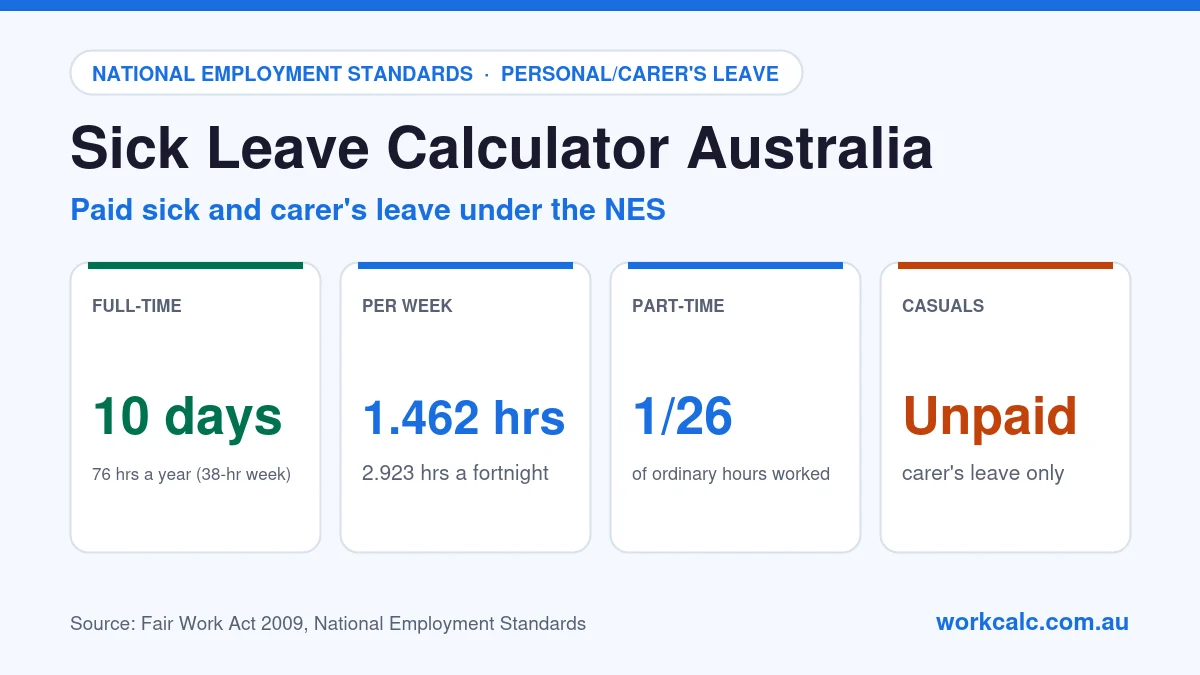
| 38-hour week | 1.462 hrs | 2.923 hrs | 76 hrs (10 days) |
| 40-hour week | 1.538 hrs | 3.077 hrs | 80 hrs (10 days) |
| Part-time | 1/26 of the ordinary hours you work | ||
| Casual | No paid sick leave (unpaid carer's leave only) | ||
Full-time and part-time employees get 10 days of paid personal/carer's leave a year under the NES, accrued as they work. Enter your hours below for your exact balance.
How to calculate sick leave
The 1/26 of ordinary hours formula confirmed by the High Court in Mondelez v AMWU.
Sick leave accrual rate
Every ordinary hour worked accrues 1/26 of an hour of personal/carer's leave.
hours/week × (1 ÷ 26)
Sick leave balance
Multiply accrual rate by weeks of service, then subtract sick leave already taken.
accrual × weeks − taken
Convert to days
Divide the balance in hours by ordinary hours per day to get sick days available.
balance_hrs ÷ hours_per_day
How sick leave is calculated in Australia (the 1/26 formula)
In Australia, sick days — officially known as personal/carer's leave under the National Employment Standards — are calculated as 1/26 of an employee's ordinary hours of work in a year. This formula was confirmed by the High Court of Australia in Mondelez Australia Pty Ltd v AMWU (2020), which clarified that the NES entitlement to "10 days" of personal/carer's leave is measured against ordinary hours, not calendar days.
Accrual happens progressively from each ordinary hour worked, not as a lump-sum annual entitlement. So even on day one of employment, a worker starts accumulating sick leave at a fractional hourly rate. By the end of week one, a 38-hour-per-week employee has accrued 38 ÷ 26 = 1.4615 hours of sick leave — roughly 11.5 minutes of leave per hour worked.
How are sick leave days calculated for full-time employees?
A standard full-time employee working 38 hours per week accrues 76 hours of personal/carer's leave per year. At a standard ordinary day of 7.6 hours (38 ÷ 5), that converts to exactly 10 sick days. Some industries use different ordinary day lengths — for example, a 40-hour-per-week role with 8-hour days accrues 80 hours per year, which is still 10 days (80 ÷ 8 = 10).
How do you calculate sick days for part-time employees?
Part-time employees accrue sick leave on a pro-rata basis using the same 1/26 of ordinary hours formula. A part-time employee working 19 hours per week accrues 19 ÷ 26 = 0.731 hours of sick leave each week, or about 38 hours per year. Spread across 7.6-hour days that's still 5 days per year — half the full-time entitlement, in line with their half-time hours.
Sick leave entitlement by hours per week
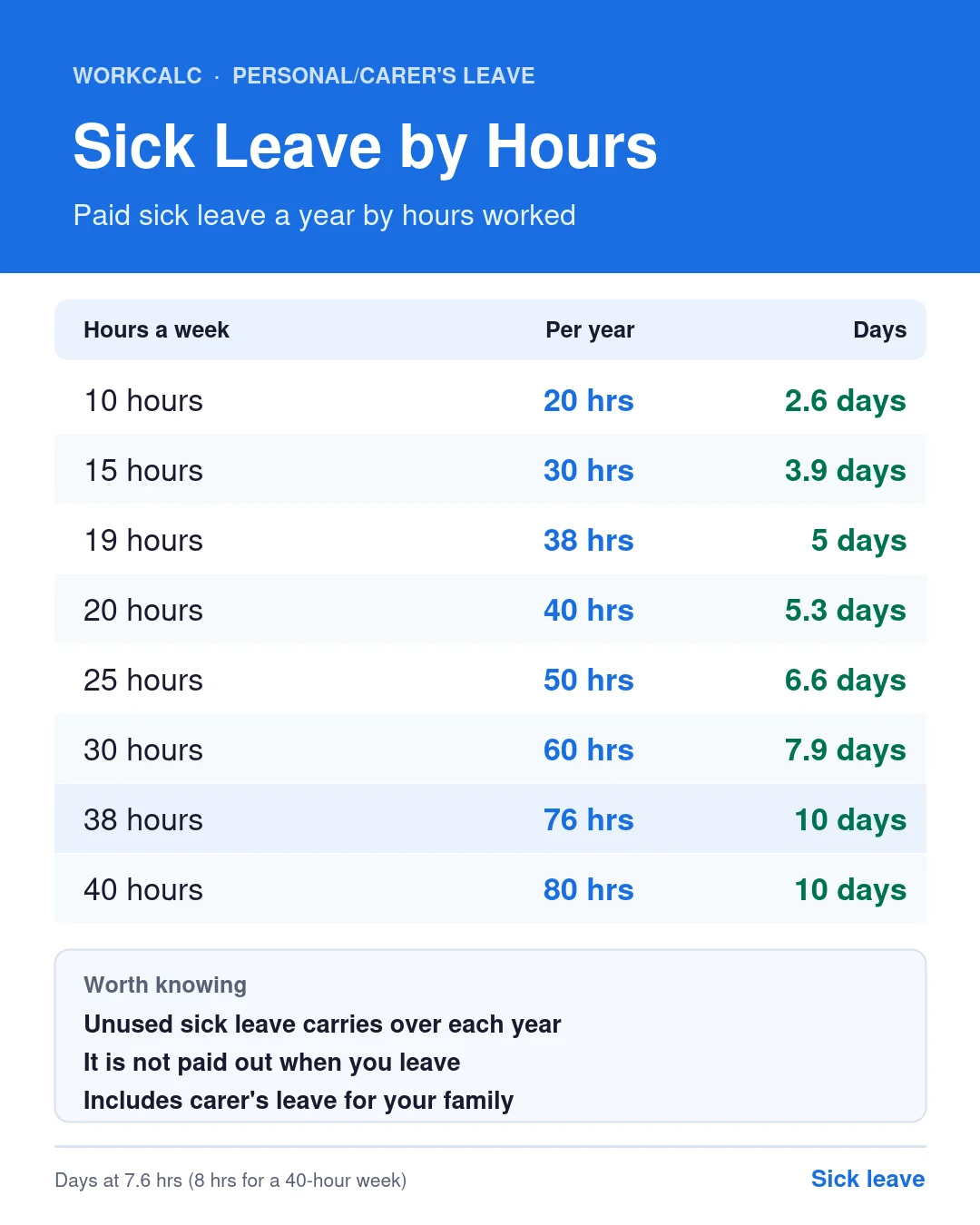
The table below shows the annual sick leave entitlement for several common employment arrangements. All employees (except casuals) accrue using the same 1/26 formula:
| Ordinary hours per week | Sick leave accrued per year | Equivalent in days |
|---|---|---|
| 10 hours (e.g. 2 days × 5) | 20 hours | ~2.6 days at 7.6 hrs |
| 15 hours (e.g. 3 days × 5) | 30 hours | ~3.9 days at 7.6 hrs |
| 19 hours (0.5 FTE) | 38 hours | 5 days at 7.6 hrs |
| 20 hours | 40 hours | ~5.3 days at 7.6 hrs |
| 25 hours | 50 hours | ~6.6 days at 7.6 hrs |
| 30 hours | 60 hours | ~7.9 days at 7.6 hrs |
| 38 hours (standard full-time) | 76 hours | 10 days at 7.6 hrs |
| 40 hours | 80 hours | 10 days at 8 hrs |
Sick leave accrual calculator: the math step-by-step
To calculate sick leave accrual manually, follow these steps:
- Find your weekly accrual rate. Divide your ordinary hours per week by 26. For a 38-hour week: 38 ÷ 26 = 1.4615 hours per week.
- Multiply by weeks of service. Count complete weeks between your start date and today. A 6-month full-time employee has worked ~26 weeks: 1.4615 × 26 = 38 hours accrued.
- Subtract leave already taken. If you've used 2 sick days (about 15.2 hours at 7.6 hrs/day), your current balance is 38 − 15.2 = 22.8 hours, or about 3 days.
- Convert hours to days. Divide your balance in hours by your ordinary hours per day. 22.8 hours ÷ 7.6 hours/day = 3 days available.
The sick day calculator at the top of this page automates all four steps and accounts for unpaid leave periods that don't accrue.
What sick leave covers under the NES
Personal/carer's leave under the NES covers more than just being unwell. The full list of qualifying reasons:
If you were injured or became ill because of your work, you may be entitled to workers compensation instead of using your sick leave. The workers compensation calculator shows the weekly payments in each state.
- Personal illness or injury — the employee themselves is unfit for work. Mental health conditions are included.
- Caring for an immediate family member — caring for a spouse, de facto partner, child, parent, grandparent, grandchild, sibling, or someone in their household who is ill, injured or facing an unexpected emergency.
- Family and domestic violence — 10 days of paid family and domestic violence leave per year (separate entitlement, not deducted from sick leave balance).
- Compassionate/bereavement leave — 2 days per occasion when an immediate family or household member dies or has a life-threatening illness/injury (separate from sick leave).
The Fair Work Ombudsman provides full details at fairwork.gov.au/leave/sick-and-carers-leave.
Sick leave on termination: why it isn't paid out
Unlike annual leave, unused personal/carer's leave is not paid out on termination under the NES. This is one of the most commonly misunderstood points about sick leave. When an employee resigns, is dismissed or made redundant:
- Annual leave — paid out at the ordinary base rate (mandatory under s90 of the Fair Work Act)
- Long service leave — paid out where the qualifying or pro-rata threshold is met (state-by-state rules)
- Personal/carer's leave — generally not paid out. The accrued balance lapses on the last day of employment.
Some modern awards, enterprise agreements or individual contracts may provide for payout in specific circumstances (such as a sick leave bank or insurance scheme), but the NES default is no payout. The practical implication is simple: take your sick leave when you genuinely need it — don't bank it indefinitely hoping for a payout that won't come.
Common mistakes when calculating sick leave
- Using calendar weeks instead of ordinary hours. Sick leave is hour-based via the 1/26 formula. Treating it as "10 days × 7.6 hours = 76 hours" works for standard full-timers but breaks down for irregular roster patterns.
- Forgetting that unpaid leave doesn't accrue. Sick leave accrues during paid leave (annual leave, paid parental leave, sick leave itself) but not during unpaid leave or absences without pay.
- Treating casual loading as sick leave entitlement. Casuals do not accrue paid sick leave under any circumstances — their 25% casual loading exists in lieu of paid leave.
- Expecting payout on termination. Unlike annual leave, sick leave lapses on the last day unless an award, agreement or contract says otherwise.
- Not carrying over balances. Sick leave accumulates indefinitely with no cap. A long-tenured employee may have hundreds of hours saved.
- Confusing carer's leave with compassionate leave. Carer's leave comes from the sick leave balance. The 2 days compassionate leave per occasion is a separate entitlement.
Who this sick leave calculator is for
This tool produces a clean, payroll-style estimate of personal/carer's leave suitable for:
- Employees who want to confirm how many sick days they have available before booking time off or scheduling appointments.
- HR and payroll teams running a second check against an HRIS calculation, particularly for new employees or after changes in hours.
- Bookkeepers reconciling sick leave liability during STP reporting or end-of-year audits.
- Small business owners tracking sick leave accrual across a small team without dedicated HRIS software.
- Employees returning from extended leave who want to understand how their balance was affected.
This sick day calculator uses the NES 1/26 of ordinary hours formula confirmed by the High Court in Mondelez v AMWU. Specific modern awards, enterprise agreements or individual employment contracts may provide better entitlements — always confirm against the instrument that applies to your role. For the official Fair Work guidance, see fairwork.gov.au.
Sick leave calculator FAQs
Plain-English answers covering the 1/26 accrual formula, carer's leave, payout rules and the things that catch most people out.
How are sick days calculated in Australia?
Sick days in Australia are calculated as 1/26 of an employee's ordinary hours of work in a year, confirmed by the High Court of Australia in Mondelez v AMWU (2020). This produces 10 days per year for a full-time employee on standard ordinary hours, and a proportionate amount for part-time employees. A 38-hour-per-week full-timer accrues 76 hours (10 × 7.6) per year.
How many sick days do you get per year in Australia?
Under the NES, full-time employees are entitled to 10 days of paid personal/carer's leave per year. Part-time employees receive a pro-rata amount based on ordinary hours. For example, a part-timer working 19 hours per week receives approximately 5 days (38 hours) per year. Casuals don't accrue paid sick leave but get 2 days of unpaid carer's leave per occasion.
How is sick leave accrued each year?
Sick leave accrues progressively from each ordinary hour worked, at a rate of 1/26 hours per hour (about 0.0385 hours per hour, or roughly 2.3 minutes of leave per hour worked). A full-time 38-hour-per-week employee accrues approximately 1.4615 hours of sick leave per week, which totals 76 hours over a 52-week year. Accrual continues during paid leave but pauses during most unpaid leave.
Do part-time employees accrue sick leave?
Yes. Part-time employees accrue sick leave on a pro-rata basis using the same 1/26 of ordinary hours formula as full-time employees. A part-time worker doing 19 hours per week accrues 19 ÷ 26 = 0.731 hours per week, or 38 hours per year — equivalent to 5 working days at their ordinary hours. The math is identical to full-time; only the hours differ.
Do casuals get paid sick leave in Australia?
No. Casual employees do not accrue paid sick leave under the National Employment Standards. They receive a casual loading (typically 25%) on top of their base hourly rate to compensate for the absence of paid leave entitlements. Casuals are however entitled to 2 days of unpaid carer's leave per occasion to care for an immediate family or household member who is ill, injured or facing an unexpected emergency.
Is unused sick leave paid out on termination?
No. Unlike annual leave, unused personal/carer's leave is generally not paid out when employment ends — whether by resignation, dismissal or redundancy. This is a critical difference from annual leave. Some modern awards, enterprise agreements or contracts may provide for payout in specific circumstances, but the NES default is that sick leave entitlements lapse on the last day. Take it when you genuinely need it.
Does sick leave expire or carry over?
Sick leave does not expire. Any unused personal/carer's leave carries over from year to year with no maximum cap under the NES. An employee who rarely takes sick leave can accumulate a significant balance over many years — long-tenured employees often have hundreds of hours saved. The balance is available to be drawn down for personal illness, carer's responsibilities or other qualifying reasons at any time during continued employment.
How is sick leave calculated for new employees?
Sick leave accrues from the first day of employment, including any probation period. There is no waiting period under the NES. After 6 months of full-time work, an employee will typically have accrued about 5 days (38 hours) of sick leave. After 12 months they will have the full 10-day entitlement, plus any prior accrual.
How do you calculate sick days for fortnightly pay?
Sick leave accrual is calculated at each pay period based on ordinary hours actually worked. For a fortnightly cycle, multiply ordinary hours worked in the fortnight by 1/26. A full-time employee working 76 hours per fortnight accrues 76 ÷ 26 = 2.923 hours of sick leave each pay — equivalent to the same 76 hours per year a weekly-paid full-timer accrues.
What proof is required for sick leave in Australia?
Under the NES, employers can request "evidence that would satisfy a reasonable person" that the leave was for a legitimate reason — typically a medical certificate or statutory declaration. Single-day absences may not always require evidence, but patterns (such as regularly taking Mondays or Fridays off) or longer absences usually do. The certificate doesn't need to disclose the specific illness — only confirm the employee was unfit for work. See our full guide to medical certificates for sick leave for what's actually required and what your employer can and can't ask for.
How much sick leave do you accrue per week?
On a 38-hour week you accrue about 1.462 hours of sick leave (personal/carer's leave) per week, which is 38 ÷ 26. On a 40-hour week it is about 1.538 hours. Part-time employees divide their weekly ordinary hours by 26. Over a full year that adds up to 10 days for a full-time employee.