
Annual Leave Calculator Australia
Calculate annual leave accrual, balance and payout for any ordinary hours — 38-hour week, 40-hour week or part-time. Covers all Australian states: NSW, VIC, QLD, WA, SA, TAS, ACT, NT. Built to the National Employment Standards.
Annual leave accrual calculator
Your Work
Leave Taken & Pay optional
Your Leave Summary
LiveAdd your start date to see the leave you've built up so far.
Estimated Payout
Add your pay to see what your leave balance is worth, for example when it's paid out on leaving a job.
Before tax. Estimates only — see disclaimer below.
Your Time Off
Leave You Need
LiveStatewide public holidays only. Check local and regional holidays with your employer.
Annual leave at a glance
| Ordinary hours | Per week | Per fortnight | Per year |
|---|---|---|---|
| 38-hour week | 2.923 hrs | 5.846 hrs | 152 hrs |
| 40-hour week | 3.077 hrs | 6.154 hrs | 160 hrs |
| Part-time | 0.07692 hrs for every ordinary hour worked (4 weeks ÷ 52) | ||
Every full-time and part-time employee gets 4 weeks of paid annual leave a year under the NES. Use the calculator above for your exact balance and payout.
How the calculation works
Three steps based on the National Employment Standards, using the same method as the Fair Work Ombudsman's leave calculator.
Accrual rate
Leave builds up on the ordinary hours you work: 4 weeks for every 365 days, so each hour earns 28 ÷ 365 = 0.0767 hours. A full year on 38 hours a week is about 152 hours.
hours worked × 28 ÷ 365
Leave balance
Add up the leave earned from your start date (unpaid leave earns none), then subtract annual leave already taken.
earned − taken
Payout & loading
Multiply the balance by your hourly rate, then add leave loading if applicable.
balance × rate × (1 + L%)
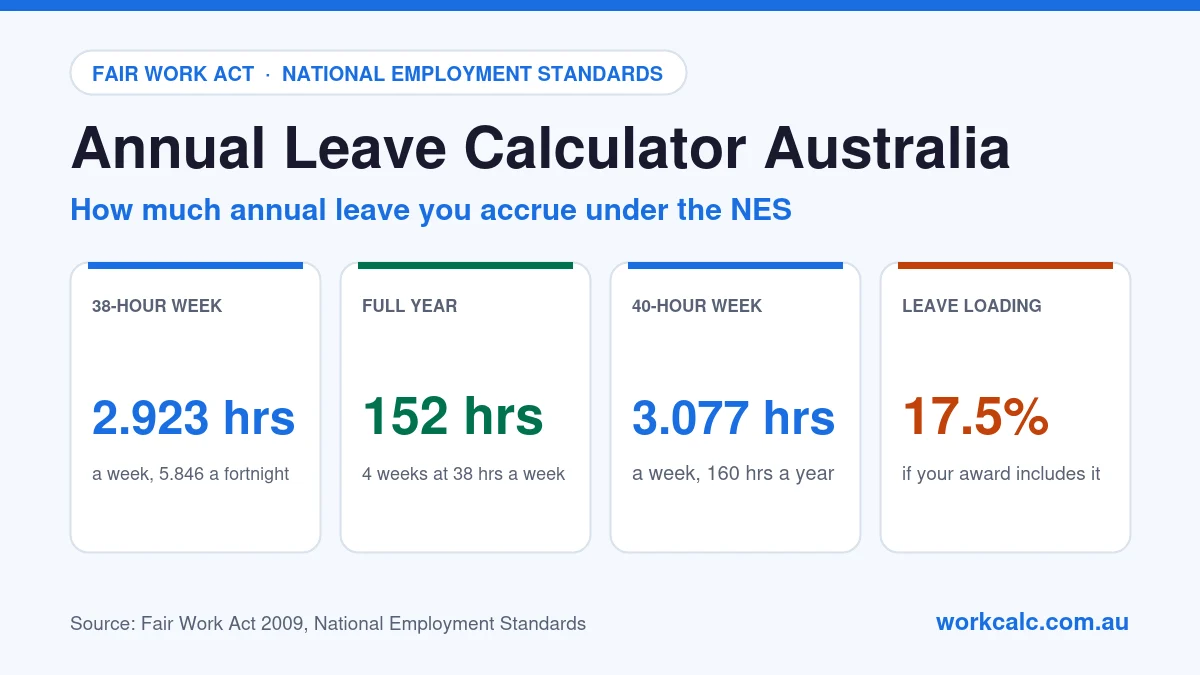
How annual leave is calculated in Australia
In Australia, annual leave entitlements are set by the National Employment Standards (NES), which form part of the Fair Work Act 2009. Under the NES, every full-time and part-time employee accrues a minimum of four weeks of paid annual leave for each year of service. Certain shift workers — typically those required to work on Sundays and public holidays as part of a regular roster — accrue five weeks.
Leave accrues progressively from each ordinary hour worked at a rate of 0.07692 hours per hour (4 ÷ 52). For a standard 38-hour week, this is 2.923 hours per week — or 152 hours over a full year. For a 40-hour week, it is 3.077 hours per week — 160 hours per year. The entitlement is always 4 weeks; only the absolute hours differ based on your ordinary working week. Unused leave carries over from year to year and does not expire.
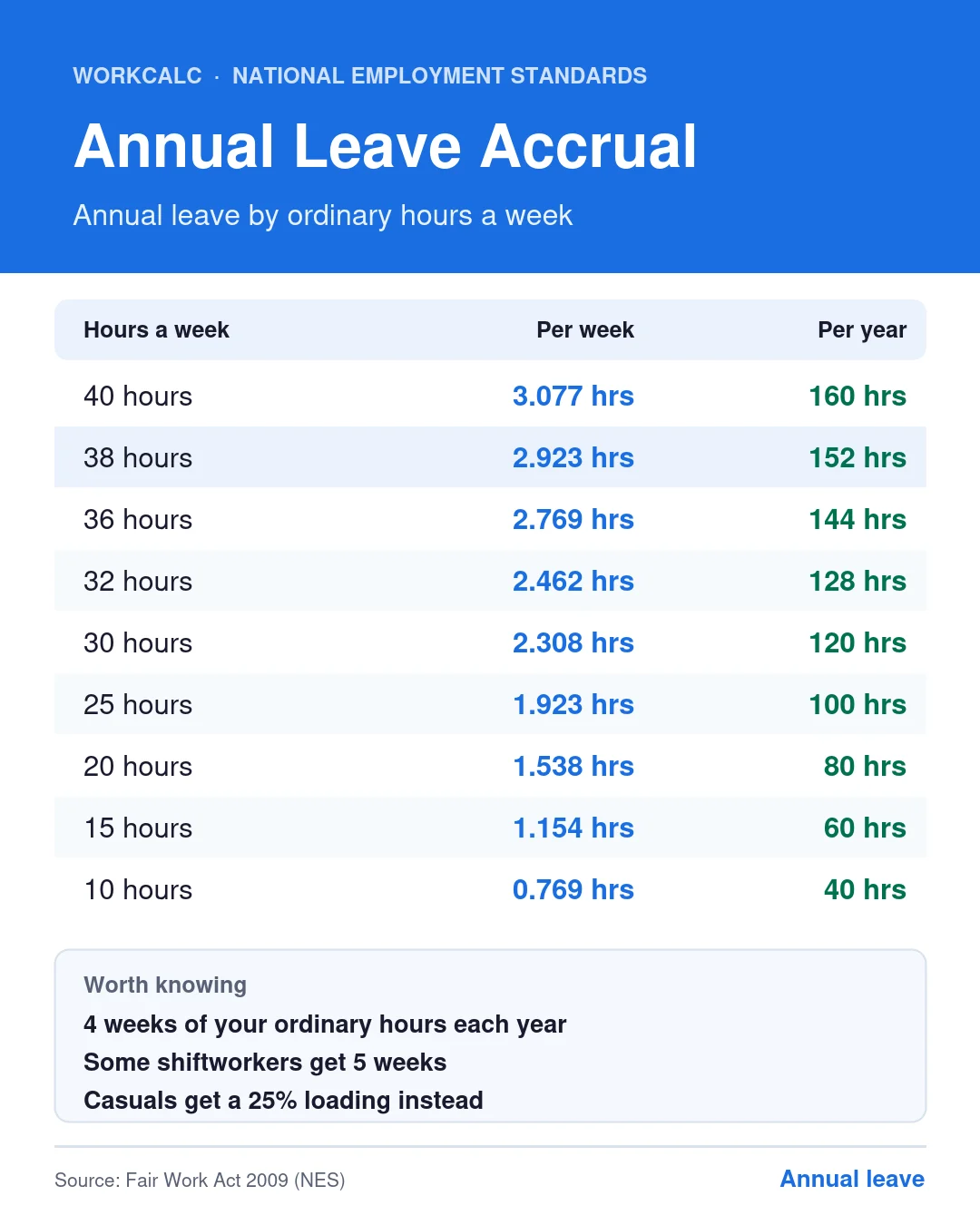
Annual leave accrual for 38-hour and 40-hour weeks
The two most common ordinary-hours arrangements in Australia are 38 hours per week (the NES standard for most modern awards) and 40 hours per week (used in some enterprise agreements and specific industries). The NES formula applies identically to both — only the weekly hours change.
| Ordinary hours/week | Accrual per week | Accrual per fortnight | Annual total |
|---|---|---|---|
| 38 hrs (standard) | 2.923 hrs | 5.846 hrs | 152 hours = 4 weeks |
| 40 hrs | 3.077 hrs | 6.154 hrs | 160 hours = 4 weeks |
| 36 hrs | 2.769 hrs | 5.538 hrs | 144 hours = 4 weeks |
| 32 hrs (4-day week) | 2.462 hrs | 4.923 hrs | 128 hours = 4 weeks |
| 20 hrs (0.5 FTE) | 1.538 hrs | 3.077 hrs | 80 hours = 4 weeks |
The fortnightly accrual figure is what appears on your payslip as "leave accrued this period." For a standard 38-hour employee that's 5.846 hours each fortnight — a number that can look small per pay but compounds to the full 4-week entitlement over a year. To see how the 40-hour vs 38-hour gap adds up over a career, read 38-Hour Week vs 40-Hour Week: How This Changes Your Annual Leave Balance →
Annual leave calculator for NSW, VIC, QLD, WA and all states
Annual leave is a federal entitlement under the Fair Work Act — not a state entitlement. This means the accrual calculation is identical across NSW, VIC, QLD, WA, SA, TAS, ACT and NT. A full-time employee in Sydney and a full-time employee in Melbourne working the same 38 ordinary hours per week both accrue 152 hours of annual leave per year.
Where states differ is public holidays. Each state and territory has its own public holiday calendar, and any public holiday that falls on a day you would ordinarily work is not deducted from your annual leave balance — it's treated as a public holiday instead. The Leave for time off tab in the calculator above uses your state's public holidays to work out how much leave a break will use.
| State / Territory | Annual leave entitlement | Leave governed by |
|---|---|---|
| NSW | 4 weeks (152 hrs at 38 hrs/wk) | Fair Work Act 2009 (NES) |
| VIC | 4 weeks (152 hrs at 38 hrs/wk) | Fair Work Act 2009 (NES) |
| QLD | 4 weeks (152 hrs at 38 hrs/wk) | Fair Work Act 2009 (NES) |
| WA | 4 weeks (152 hrs at 38 hrs/wk) | Fair Work Act 2009 (NES) |
| SA, TAS, ACT, NT | 4 weeks (152 hrs at 38 hrs/wk) | Fair Work Act 2009 (NES) |
Note: Long service leave — which is separate from annual leave — is governed by state legislation and varies by state. Use the Long Service Leave Calculator for state-specific LSL entitlements.
Pro-rata accrual for part-time employees
Part-time employees accrue annual leave on exactly the same proportional basis as full-time staff. An employee working 20 hours per week accrues at the same 0.07692 rate — giving them 80 hours per year, which is 4 weeks of their 20-hour schedule. The entitlement is identical in weeks; only the absolute hours differ. For a dedicated part-time calculator and worked examples for every hours pattern, use the Part-Time Annual Leave Calculator. For the complete guide on part-time rights, read Do part-time employees get annual leave? →
Annual leave loading: how to calculate the 17.5%
Leave loading is an additional payment — most commonly 17.5% — paid on top of your ordinary rate when you take annual leave. It applies where your modern award or enterprise agreement includes it, which covers the majority of Australian employees in retail, hospitality, manufacturing, clerical and trades roles.
The calculation is: hours of leave × ordinary rate × 0.175. For one week at $30/hr on a standard 38-hour week: ordinary pay = $1,140, loading = $199.50, total = $1,339.50.
| Source | What it typically sets |
|---|---|
| Modern award | 17.5% loading; specific exceptions |
| Enterprise agreement | May vary the rate or replace it with higher base pay |
| Individual contract | May contain a higher rate but not less than the award |
| Award-free employment | No automatic entitlement unless contracted |
If you get loading when you take leave, it must also be paid on your leave balance when you resign, even if your award or contract says otherwise. For the complete guide to leave loading including the shift-worker comparison method, read Annual Leave Loading Explained: Who Gets 17.5%, Who Doesn't, and Why → and check whether you're being paid correctly using the Leave Loading Checklist →
Annual leave payout on resignation or termination
When employment ends — whether through resignation, dismissal or redundancy — every accrued but untaken hour of annual leave must be paid out at your ordinary base rate. This is mandatory under section 90 of the Fair Work Act and cannot be withheld for any reason.
- Base rate applies — overtime, bonuses and discretionary payments are excluded.
- Leave loading on termination is generally payable if it would have applied during employment.
- Tax on payout follows ATO Schedule 7 — marginal-rate averaging for resignation, flat 32% concessional rate for genuine redundancy.
- Superannuation is not payable on unused annual leave paid on termination.
Use the Annual Leave Payout Tax Calculator to estimate your net payout including the correct Schedule 7 withholding. For the complete resignation guide, read What Happens to Your Annual Leave When You Resign? →
Common mistakes when calculating leave
- Using calendar days instead of ordinary hours. Accrual is hour-based; using days can mis-state the balance for part-timers or non-standard schedules.
- Forgetting public holidays. Public holidays falling within an approved leave period are not deducted from your leave balance.
- Applying loading where the award excludes it. Some modern awards explicitly remove leave loading on termination — check your instrument.
- Treating casual loading as leave accrual. Casual employees do not accrue annual leave; their 25% casual loading is a separate concept.
- Confusing 38-hour and 40-hour ordinary weeks. The accrual factor is the same but the absolute hours per year differ — 152 vs 160. Always use the ordinary hours defined in your award, not actual hours worked including overtime.
- Ignoring unpaid leave. Periods of unpaid leave (other than community service or paid parental leave) generally do not accrue annual leave.
- Mixing up annual leave and sick leave. Personal/carer's (sick) leave is a separate NES entitlement that accrues at 1/26 of ordinary hours and isn't paid out when you leave. Use the sick leave accrual calculator for that balance.
The Annual Leave Calculator Australia uses the same accrual model the Fair Work Ombudsman publishes for general workplace use. Specific awards and agreements may override these defaults — always confirm against the instrument that applies to your role.
Frequently asked questions
Plain-English answers covering the NES, 38-hour week accrual, state differences, leave loading and payout rules.
How is annual leave calculated for a 38-hour week in Australia?
For a standard 38-hour ordinary week, annual leave accrues at 38 × 0.07692 = 2.923 hours per week. Over 52 weeks that totals 152 hours — exactly 4 weeks at 38 hours per week. The factor 0.07692 comes from 4 weeks ÷ 52 weeks in a year, and applies to every permanent employee under the NES.
What is an annual leave accrual calculator?
An annual leave accrual calculator works out how much paid leave you've earned based on your start date, ordinary hours per week, and any leave already taken. This one uses the same method as the Fair Work Ombudsman's leave calculator: 4 weeks of leave for every 365 days, earned on the ordinary hours you work. It gives your balance in hours and days, plus the payout value if you cash it out or leave your job.
How much annual leave do I get in NSW?
Annual leave in NSW is a federal entitlement under the NES — not a state law. A full-time employee in NSW on a 38-hour week accrues 152 hours (4 weeks) of paid annual leave per year — identical to VIC, QLD, WA and every other state. Choose NSW in the calculator's Leave for time off tab to leave NSW public holidays out of the leave a break will use, because public holidays that fall during approved leave are not deducted from your balance.
How much annual leave do I get in Victoria?
Annual leave in Victoria is governed by the federal Fair Work Act 2009, not Victorian state law. A full-time employee in VIC on a 38-hour week accrues 152 hours (4 weeks) per year — the same as all other Australian states. Victoria has state-specific public holidays (Melbourne Cup, AFL Grand Final Friday) which are not deducted from leave when they fall on a normally worked day.
How do I calculate annual leave accrual?
The formula is: ordinary hours worked × 0.07692. For a 38-hour week: 38 × 0.07692 = 2.923 hours per week. Multiply by weeks worked for the total accrued, then subtract leave already taken for your current balance. For the full step-by-step with worked examples, see How Annual Leave Accrues in Australia.
How much annual leave do you accrue per week on a 40-hour week?
3.08 hours a week (6.15 hours a fortnight). Over a year that adds up to 160 hours, or 4 weeks, which is 8 hours more than a 38-hour employee. Both get the same 4-week entitlement; 4 weeks of a 40-hour schedule is simply more hours. Overtime beyond your ordinary hours does not accrue leave.
How much annual leave do Australians accrue?
Under the NES, full-time and part-time employees accrue 4 weeks of paid annual leave for every 12 months of service. Certain shift workers accrue 5 weeks. The accrual rate is 0.07692 hours per ordinary hour worked. For a 38-hour week that's 152 hours per year; for a 40-hour week it's 160 hours.
What is annual leave loading and how is it calculated?
Leave loading is an extra payment — most commonly 17.5% — on top of your ordinary rate when you take leave. Formula: ordinary hours of leave × rate × 0.175. For one week at $30/hr on 38 hours: $1,140 + $199.50 loading = $1,339.50. It applies if your modern award or enterprise agreement includes it. See the full guide: Annual Leave Loading Explained →
Do part-time employees accrue annual leave?
Yes. Part-time employees use the same 0.07692 accrual factor. An employee on 20 hours per week accrues 20 × 0.07692 = 1.538 hours per week — 80 hours per year, which equals 4 weeks at their part-time hours. Use the Part-Time Annual Leave Calculator for a dedicated part-time view.
Is annual leave paid out when leaving a job?
Yes. Under section 90 of the Fair Work Act, every accrued hour of annual leave must be paid out at your ordinary rate when employment ends — resignation, dismissal or redundancy. Leave loading is also typically payable on termination. Tax is withheld under ATO Schedule 7. Use the Annual Leave Payout Tax Calculator to estimate your net payout.
Can annual leave expire in Australia?
No. Annual leave does not expire and accumulates year to year until taken or paid out on termination. Employers may, under some awards, direct employees with excessive balances (typically 8 weeks or more) to take leave.
Do casual employees get annual leave?
Casual employees do not accrue paid annual leave under the NES. Instead they receive a 25% casual loading on their hourly rate. This is a separate concept from leave loading. For the full comparison of casual vs permanent entitlements, read Permanent Part-Time vs Casual: The Crucial Difference →
Does this calculator cover NSW, VIC, QLD and other states?
Yes. The calculator supports all 8 Australian states and territories. The annual leave accrual formula is identical for all states under the federal NES. In the Leave for time off tab, the state selector leaves that state's public holidays out of the leave you need, because public holidays that fall during approved leave are not deducted from your balance, and these dates vary by state.
How many hours of annual leave do you accrue per fortnight?
On a 38-hour week you accrue 5.846 hours of annual leave per fortnight (76 ordinary hours × 0.07692). On a 40-hour week it is 6.154 hours per fortnight. Part-time employees multiply their fortnightly ordinary hours by 0.07692 — for example, 40 hours a fortnight accrues 3.077 hours.