
Part-Time Annual Leave Calculator Australia
Calculate part-time annual leave entitlement, balance, payout and 17.5% leave loading on a pro-rata basis. Built to the National Employment Standards used by the Fair Work Ombudsman.
Part-time annual leave calculator
Employment Details
Pay Details
Fill in the highlighted fields below — results will appear instantly.
- Employment start date
- Hours per week
- Hourly rate
Your Leave Summary
LiveEstimated Payout
Estimates only — see disclaimer below.
Part-time annual leave at a glance
| Part-time hours | Per week | Per fortnight | Per year |
|---|---|---|---|
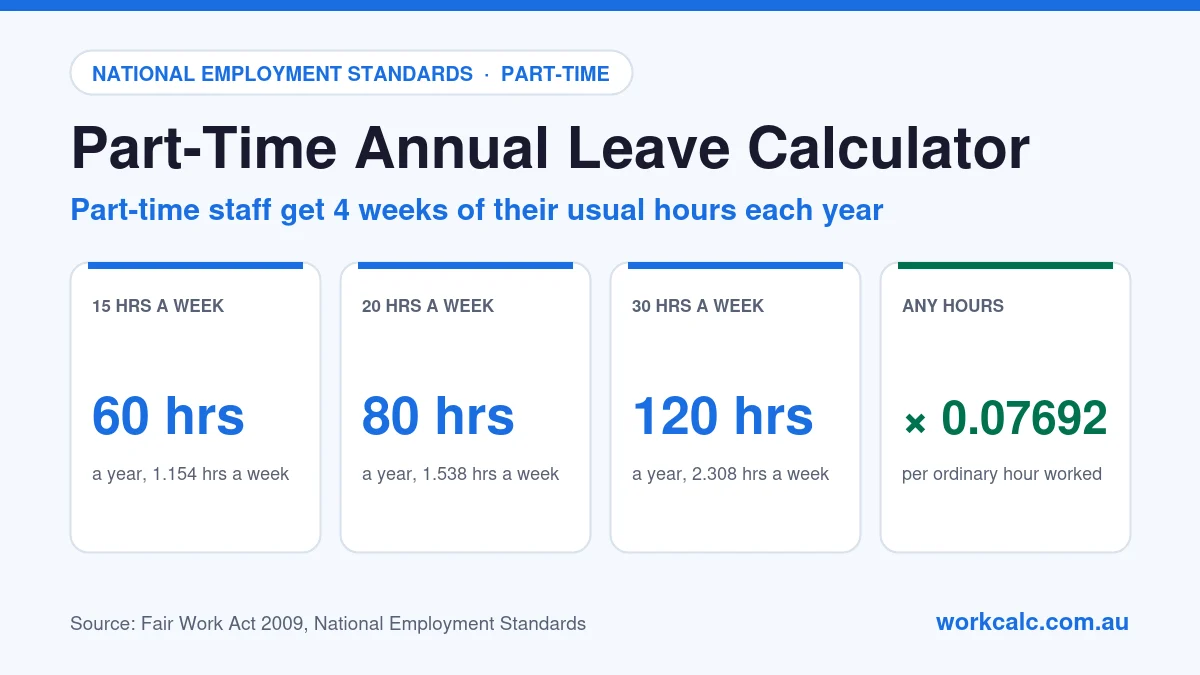
| 15 hrs a week | 1.154 hrs | 2.308 hrs | 60 hrs |
| 20 hrs a week | 1.538 hrs | 3.077 hrs | 80 hrs |
| 30 hrs a week | 2.308 hrs | 4.615 hrs | 120 hrs |
| Any hours | Weekly ordinary hours × 0.07692 (4 weeks ÷ 52) | ||
Every permanent part-time employee gets 4 weeks of paid annual leave a year, measured at their own hours. Enter your hours below for your exact balance and payout.
How part-time annual leave is calculated
The same pro-rata accrual the Fair Work Ombudsman publishes — applied to your ordinary part-time hours.
Pro-rata accrual rate
Every ordinary hour worked accrues 4/52 of an hour of annual leave.
hours/week × (4 ÷ 52)
Leave balance
Multiply the accrual rate by weeks of service, then subtract leave already taken.
accrual × weeks − taken
Payout & loading
Multiply the balance by your ordinary hourly rate, then add leave loading if applicable.
balance × rate × (1 + L%)
The part-time annual leave formula (4 weeks ÷ 52)
In Australia, part-time annual leave is calculated on the same basis as full-time leave — just applied pro-rata to the ordinary hours actually worked. Under the National Employment Standards (NES) in the Fair Work Act 2009, every permanent part-time employee accrues four weeks of paid annual leave per year of continuous service, where a "week" is measured against the employee's own ordinary hours.
The formula is straightforward: for every ordinary hour worked, an employee accrues 4 ÷ 52 = 0.07692 hours of annual leave. A part-time employee working 20 hours per week therefore accrues about 1.538 hours of leave each week, or roughly 80 hours over a full year of service — which equals 4 weeks at their ordinary part-time hours.
What counts as "ordinary hours" for part-time staff
Ordinary hours are the regular hours an employee is contracted to work, excluding overtime. For permanent part-time employees these are usually set out in the employment agreement and remain reasonably predictable each pay period. Hours actually worked — including paid leave taken — accrue annual leave; unpaid leave generally does not.
Part-time annual leave by hours per week
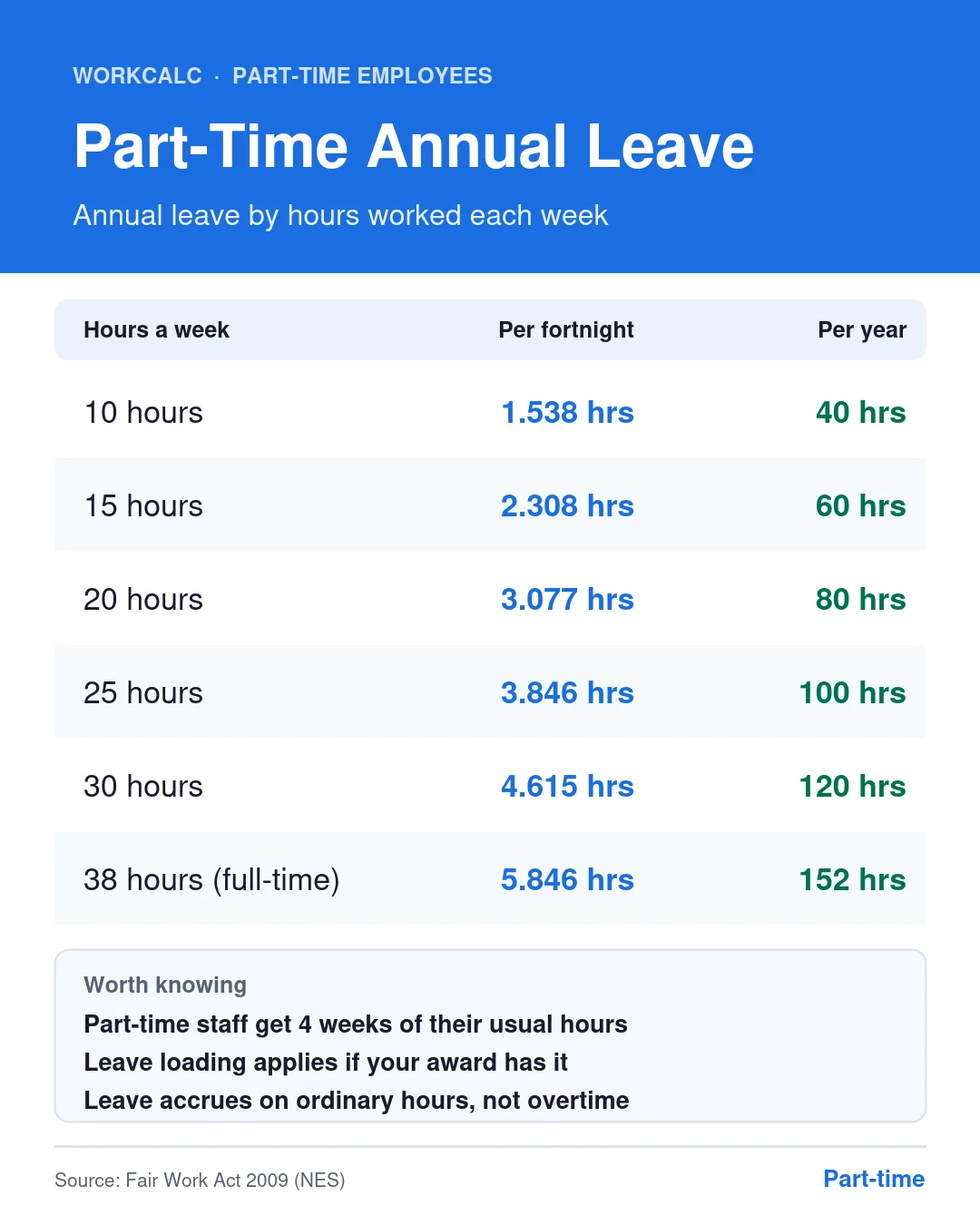
The 4-week entitlement is identical to full-time staff in real terms. The absolute number of leave hours differs because part-time employees work fewer ordinary hours each week. The table below shows the annual leave entitlement for several common part-time arrangements:
| Ordinary hours per week | Leave per week | Leave per fortnight | Leave per year |
|---|---|---|---|
| 10 hours (e.g. 2 days × 5) | 0.769 hrs | 1.538 hrs | 40 hrs |
| 15 hours (e.g. 3 days × 5) | 1.154 hrs | 2.308 hrs | 60 hrs |
| 20 hours (e.g. 4 days × 5) | 1.538 hrs | 3.077 hrs | 80 hrs |
| 25 hours | 1.923 hrs | 3.846 hrs | 100 hrs |
| 30 hours | 2.308 hrs | 4.615 hrs | 120 hrs |
| 38 hours (full-time) | 2.923 hrs | 5.846 hrs | 152 hrs |
Every row equals 4 weeks of leave at that employee's own hours. For what counts as permanent part-time, leave when your hours change and your rights when you resign, see our guide to part-time annual leave rights.
Casual employees do not accrue paid annual leave at all — they receive a casual loading (typically 25%) on top of their hourly rate in place of paid leave entitlements. The calculator above flags this when "Casual" is selected.
Part-time annual leave loading explained
Leave loading is an additional payment — most commonly 17.5% — added on top of the base wage when annual leave is taken. It applies to part-time employees in exactly the same way as full-time staff, with the percentage applied to the part-time employee's ordinary hourly rate multiplied by the hours of leave taken.
Whether loading applies depends on the instrument that governs the employment:
- Modern awards — most include a 17.5% loading on annual leave for permanent part-time staff. Check the award that covers your role.
- Enterprise agreements — may set a different rate or roll the loading into a higher base wage.
- Individual employment contracts — can provide better than the award but not less.
- Award-free roles — leave loading is not automatic and depends on what was agreed.
Part-time annual leave payout on termination
When a permanent part-time employee resigns, is dismissed or made redundant, any unused annual leave must be paid out at the ordinary base rate, in line with section 90 of the Fair Work Act. The payout uses the same pro-rata logic as the accrual: balance hours × ordinary hourly rate, plus any applicable leave loading.
Considerations for payroll teams processing a part-time termination:
- Base rate applies — overtime, allowances and bonuses are excluded unless the award or contract says otherwise.
- Leave loading on termination is generally payable to part-time employees if it would have been paid during employment.
- PAYG tax on unused leave at termination follows the schedules published by the Australian Taxation Office, which differ from the schedules for ordinary leave payments.
- Superannuation is not payable on unused annual leave paid on termination, per current ATO guidance.
Common mistakes when calculating part-time annual leave
- Treating leave as a fixed "20 days" entitlement. The 4-week NES entitlement converts to a different number of working days depending on how the part-time hours are spread. A 3-day-a-week part-timer gets 12 days, not 20.
- Ignoring changes in hours. If ordinary hours change during the year, the accrual rate changes from that date forward. Leave earned at lower hours is still valued at the rate it was earned.
- Using full-time hours in the formula. Always use the part-time employee's actual ordinary hours per week, not 38, when computing accrual.
- Forgetting public holidays. If a public holiday falls on a day the part-timer would ordinarily have worked and they're on approved leave, that day is not deducted from the balance.
- Confusing casual loading with leave entitlement. Casual employees receive a 25% loading in place of paid annual leave — they do not accrue it.
- Applying loading where the award excludes it. Some modern awards remove leave loading on termination — always confirm against the instrument that applies.
Who this part-time leave calculator is for
This calculator produces a clean, payroll-style estimate suitable for:
- Permanent part-time employees who want to confirm their pro-rata balance before requesting leave or resigning.
- HR and payroll teams running a second check on an HRIS calculation for part-time staff.
- Bookkeepers and accountants reconciling part-time leave liability during STP or end-of-year work.
- Managers forecasting leave costs across a part-time team.
- Employees moving between part-time and full-time arrangements who want to understand how each period contributes to their total balance.
This part-time annual leave calculator uses the same NES accrual model published by the Fair Work Ombudsman. Specific awards, enterprise agreements or individual contracts may override these defaults — always confirm against the instrument that applies to your role.
Part-time annual leave FAQs
Plain-English answers covering pro-rata accrual, leave loading, payouts and the rules part-time employees need to know.
How is annual leave calculated for part-time employees in Australia?
Part-time annual leave is calculated on a pro-rata basis using the same accrual factor as full-time staff: 4 weeks ÷ 52 weeks, or about 0.0769 hours of leave for every ordinary hour worked. A part-time employee working 20 hours per week therefore accrues approximately 1.538 hours of leave per week, or 80 hours (4 weeks of their ordinary hours) over 12 months of continuous service.
Do part-time employees get the same annual leave as full-time?
Yes — in real terms. Under the NES, part-time employees receive 4 weeks of paid annual leave per year, the same as full-time staff. The difference is that a "week" equals the part-time employee's ordinary hours. A 20-hour-a-week part-timer gets 80 hours of leave per year; a 38-hour full-timer gets 152 hours. Both represent 4 weeks of their normal work.
How many days of annual leave does a part-time worker accrue per year?
Part-time employees accrue 4 weeks of annual leave per year regardless of weekly hours. The number of working "days" depends on how those hours are spread. A part-timer working 4 days × 5 hours accrues 16 working days of leave per year. A 3-day × 8-hour part-timer accrues 12 working days. Both equal 4 weeks of their ordinary work.
Do permanent part-time employees accrue annual leave from day one?
Yes. Permanent part-time employees begin accruing annual leave from their first ordinary hour worked — there is no waiting period under the NES. Accrued leave carries over from year to year and is paid out on termination if untaken.
How is leave loading calculated for part-time employees?
Leave loading for part-time employees is calculated exactly as for full-time staff: a percentage (most commonly 17.5%) added to the base wage paid during annual leave. The base wage is the part-time employee's ordinary hourly rate × hours of leave taken. Whether loading applies depends on the modern award or enterprise agreement that covers the role.
Is annual leave paid out to part-time employees when they leave a job?
Yes. When a permanent part-time employee resigns, is dismissed or made redundant, any accrued but unused annual leave must be paid out at their ordinary base rate. Leave loading is typically payable on termination if it would have been paid during employment, subject to the applicable award.
Do public holidays affect part-time annual leave?
If a public holiday falls on a day the part-time employee would ordinarily have worked and they are on approved annual leave, that day is treated as a public holiday — not as a day of annual leave. The leave balance is not reduced. If the public holiday falls on a non-working day, it does not affect the part-time employee's leave or pay.
What happens if my part-time hours change during the year?
Annual leave continues to accrue on the actual ordinary hours worked at each period. If a part-time employee increases their hours from 20 to 30 per week mid-year, the higher accrual rate applies from that date forward. Existing accrued hours retain their value at the rate they were earned, so the total balance is the sum of accrual across each period.
Can a part-time employee cash out annual leave in Australia?
In limited circumstances, yes. Cashing out is permitted only if the relevant modern award or enterprise agreement allows it, the agreement is in writing, the employee retains at least 4 weeks of accrued leave after cash-out, and the payment is at the rate that would have applied during leave. Casual employees cannot cash out leave because they do not accrue paid leave.
How is part-time annual leave calculated with irregular hours?
For part-time employees with irregular ordinary hours, leave accrues from each ordinary hour actually worked at the standard 4/52 factor. Payroll systems apply the accrual at each pay cycle based on hours worked that period. For an average estimate, total ordinary hours worked in a year × 0.0769 gives the annual leave entitlement in hours.