
Annual Leave Payout Tax Calculator Australia
Calculate tax on unused annual leave, redundancy payouts and leave cash-outs using ATO Schedule 7 and the 2026–27 marginal tax rates. See your gross payout, PAYG withholding and net take-home in seconds.
Annual leave payout tax calculator
Leave Details
Income & Pay
Fill in the required fields - results update instantly.
- Reason for payout
- Unused leave amount
- Annual salary
Gross Payout
LiveTax Breakdown
Estimate based on 2026–27 ATO rates. Actual withholding may vary - see disclaimer.
How tax on annual leave payouts is calculated
ATO Schedule 7 applies one of two methods depending on why the payment is made.
Calculate gross payout
Multiply unused leave hours by the ordinary hourly rate, then add 17.5% leave loading if applicable.
hours x rate x (1 + L%)Choose tax method
Redundancy, invalidity or early retirement = flat 32%. Resignation, dismissal or cash-out = marginal rate averaging.
Schedule 7 logicApply withholding
Flat method: gross x 32% (30% tax + 2% Medicare). Marginal method: tax on (salary + payout) minus tax on salary.
net = gross - taxHow tax on an annual leave payout works in Australia
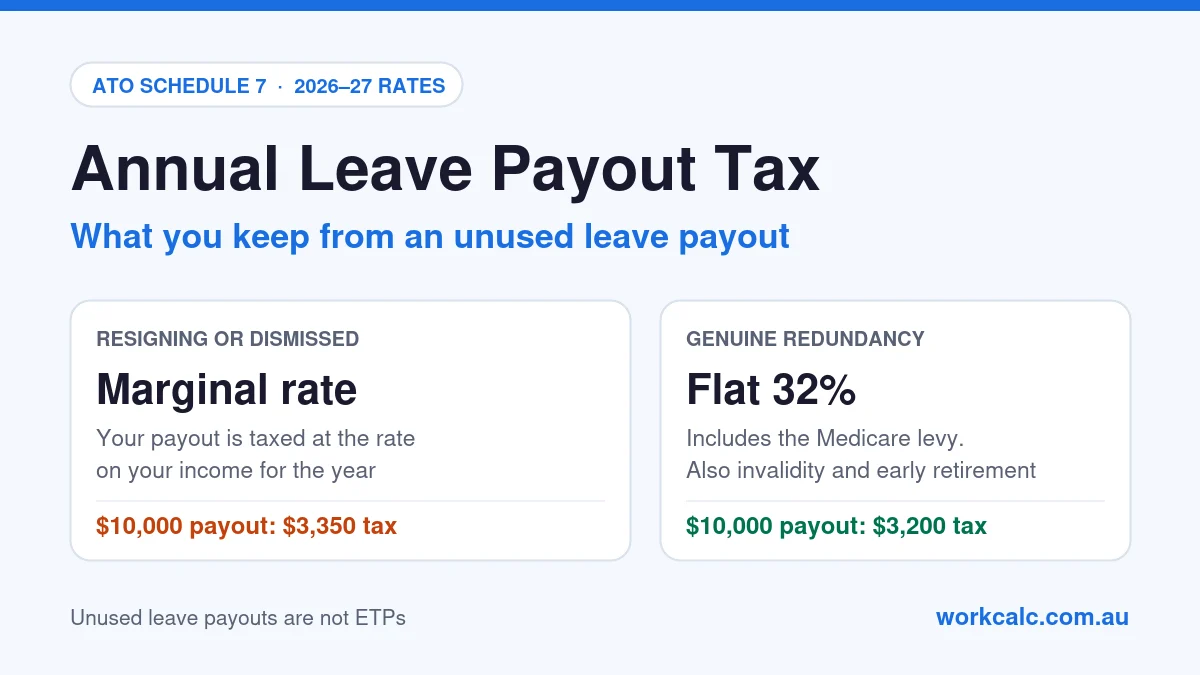
When you receive a payment for unused annual leave, the ATO requires your employer to withhold PAYG tax under Schedule 7. The rate depends on why employment ended. This calculator applies current Schedule 7 logic and 2026–27 tax brackets to estimate how much tax will be withheld.
- Marginal rate (averaging) method - used for resignations, dismissals and cash-outs.
- Flat 32% method - used for genuine redundancies, invalidity and approved early retirement schemes.
Method 1 - Marginal rate (resignation, dismissal, cash-out)
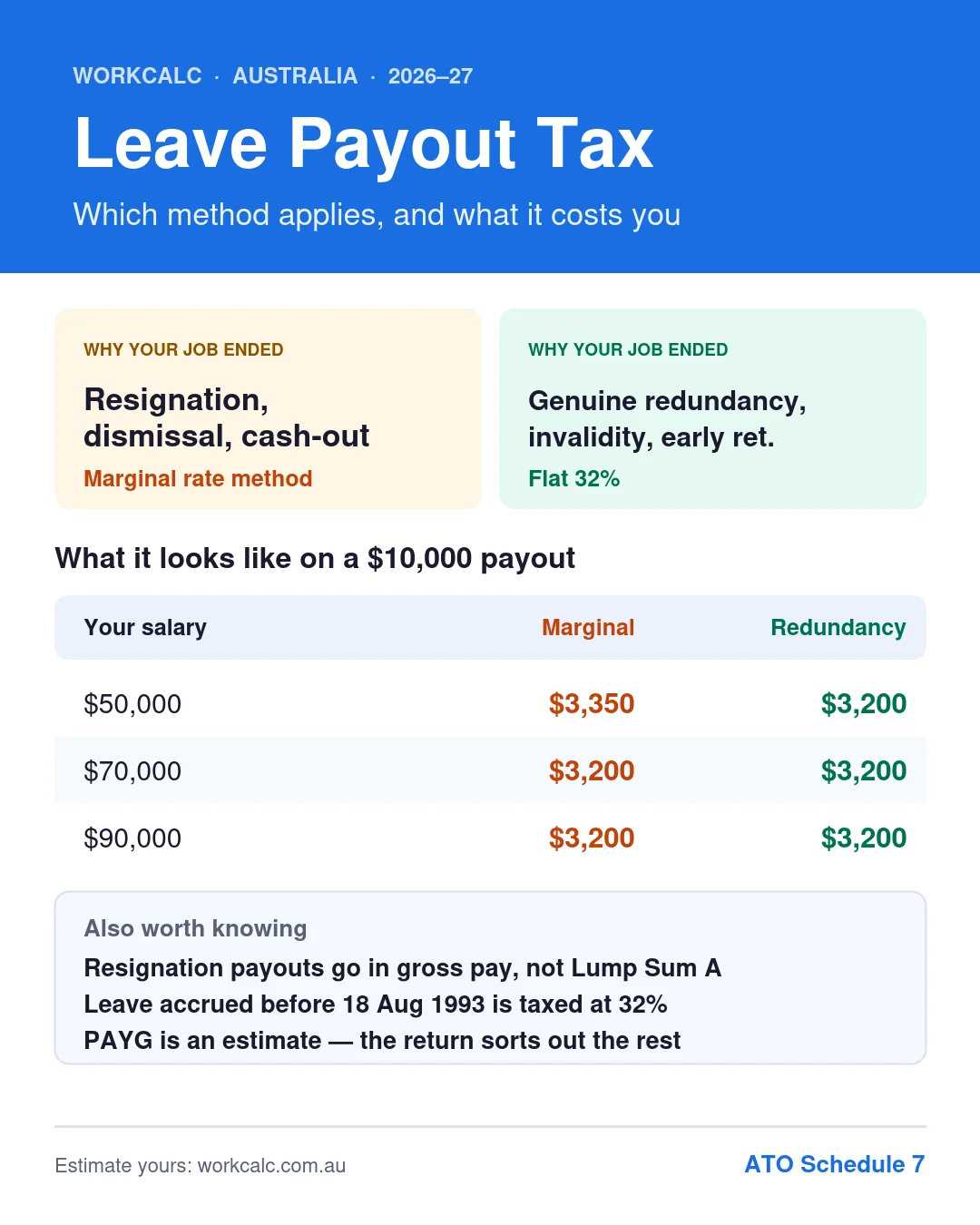
Tax on payout = Tax on (annual salary + payout) minus Tax on (annual salary). The leave is effectively taxed at the bracket it reaches when added to your income. A worker in the 30% bracket pays roughly 32% (30% + 2% Medicare). A worker in the 37% bracket pays roughly 39%.
Method 2 - Flat 32% (genuine redundancy, invalidity, early retirement)
Schedule 7 applies a concessional flat rate of 32% to the entire post-17 August 1993 leave amount, including any leave loading. The 32% comprises 30% income tax and the 2% Medicare Levy. Example: $2,680 gross payout x 32% = $857.60 tax withheld.
2026–27 Australian tax brackets
These are the resident rates the marginal-rate method uses. The 15% rate replaced 16% on 1 July 2026. See the 2026–27 tax brackets and calculator for the full tables, or the pay calculator for your take-home pay.
| Taxable income | Marginal rate |
|---|---|
| $0 - $18,200 | 0% (tax-free threshold) |
| $18,201 - $45,000 | 15% (was 16% in 2025–26) |
| $45,001 - $135,000 | 30% |
| $135,001 - $190,000 | 37% |
| $190,001+ | 45% |
Common mistakes when calculating annual leave payout tax
- Assuming the 32% rate applies to any termination. It only applies to genuine redundancy, invalidity or approved early retirement. Resignation and dismissal use marginal rates.
- Forgetting Medicare Levy on marginal calculations. The 2% Medicare Levy adds to the effective rate. The flat 32% already includes it.
- Mixing the leave payout with ETPs. Unused annual leave is not an employment termination payment (ETP), even when it's paid alongside redundancy pay.
- Confusing withholding with final tax. PAYG is an estimate - actual tax at year-end may produce a refund.
This calculator applies ATO Schedule 7 logic, 2026–27 marginal rates, 2% Medicare Levy and the Low Income Tax Offset. For official guidance see the ATO Schedule 7 page.
Annual leave payout tax FAQs
Plain-English answers covering ATO Schedule 7, redundancy concessions, leave loading and how PAYG withholding works on a leave payout.
How is tax calculated on an annual leave payout in Australia?
Tax depends on the reason for payment. Genuine redundancy, invalidity or early retirement uses a flat 32% rate under ATO Schedule 7. Resignation, dismissal or cash-out uses the marginal-rate averaging method: tax on (annual salary + payout) minus tax on salary alone.
What is the tax rate on unused annual leave at termination?
For genuine redundancy, invalidity or early retirement: flat 32% (30% tax + 2% Medicare) on the post-17 August 1993 portion. For resignation or dismissal: marginal rate using the ATO Schedule 7 averaging method.
How is annual leave taxed when made redundant?
In a genuine redundancy, ATO Schedule 7 withholds a flat 32% (including the Medicare levy) from the whole unused leave payout, including loading. The same applies if you leave because of invalidity or an approved early retirement scheme. The payout is shown as Lump Sum A on your income statement. The 32% is lower than your marginal rate if you earn over $135,000, and about the same for most people earning $45,000 to $135,000.
How is cashing out annual leave taxed in Australia?
Cash-outs while still employed are taxed at marginal rates. ATO Schedule 5 applies using the averaging method: tax on (normal earnings + cash-out) minus tax on normal earnings alone. The cash-out is included in assessable income.
Do I pay Medicare Levy on an annual leave payout?
Yes. The 2% Medicare Levy applies to all taxable income including leave payouts. For the flat 32% concession, the 2% Medicare component is already included in the 32% figure.
Is annual leave payout shown as Lump Sum A on an income statement?
Only in some cases. If you leave because of genuine redundancy, invalidity or an approved early retirement scheme, the unused leave payout, including any loading, is shown as Lump Sum A. Leave accrued before 18 August 1993 is also shown as Lump Sum A. If you resign or are dismissed, leave accrued since 18 August 1993 is included in your gross payments instead, with tax worked out using the Schedule 7 marginal rate method.
Why does my annual leave payout look so heavily taxed?
A leave payout is treated as a lump sum on top of regular salary, pushing it into a higher bracket than ordinary pay. The withholding is an estimate - actual tax at year-end may be lower, resulting in a refund.
Does the 32% flat rate apply to all redundancy leave payouts?
It applies only to leave accrued from 17 August 1993 onwards and only for genuine redundancy, invalidity or early retirement scheme. Pre-17 August 1993 leave has separate legacy treatment.