
Do Part-Time Employees Get Annual Leave? Your Rights in Australia
The most common misconception about part-time leave: that you get less than full-time employees. You don't. You get the same 4 weeks per year — just fewer hours, because your working week is shorter. Here's the exact maths.
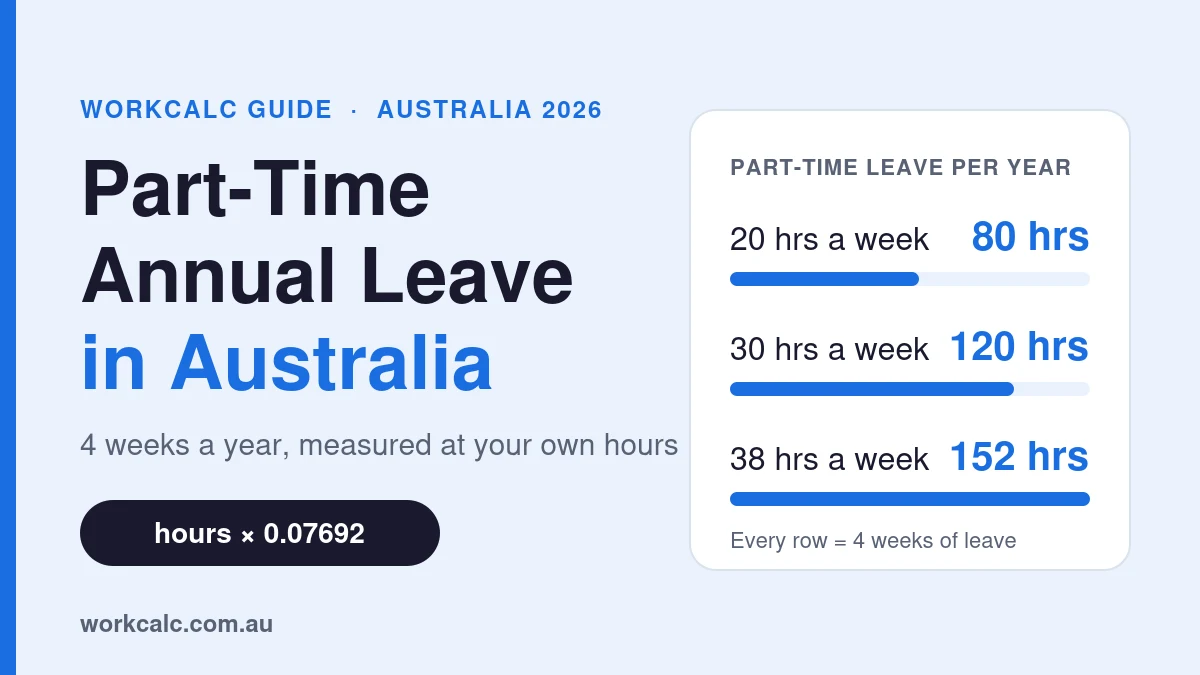
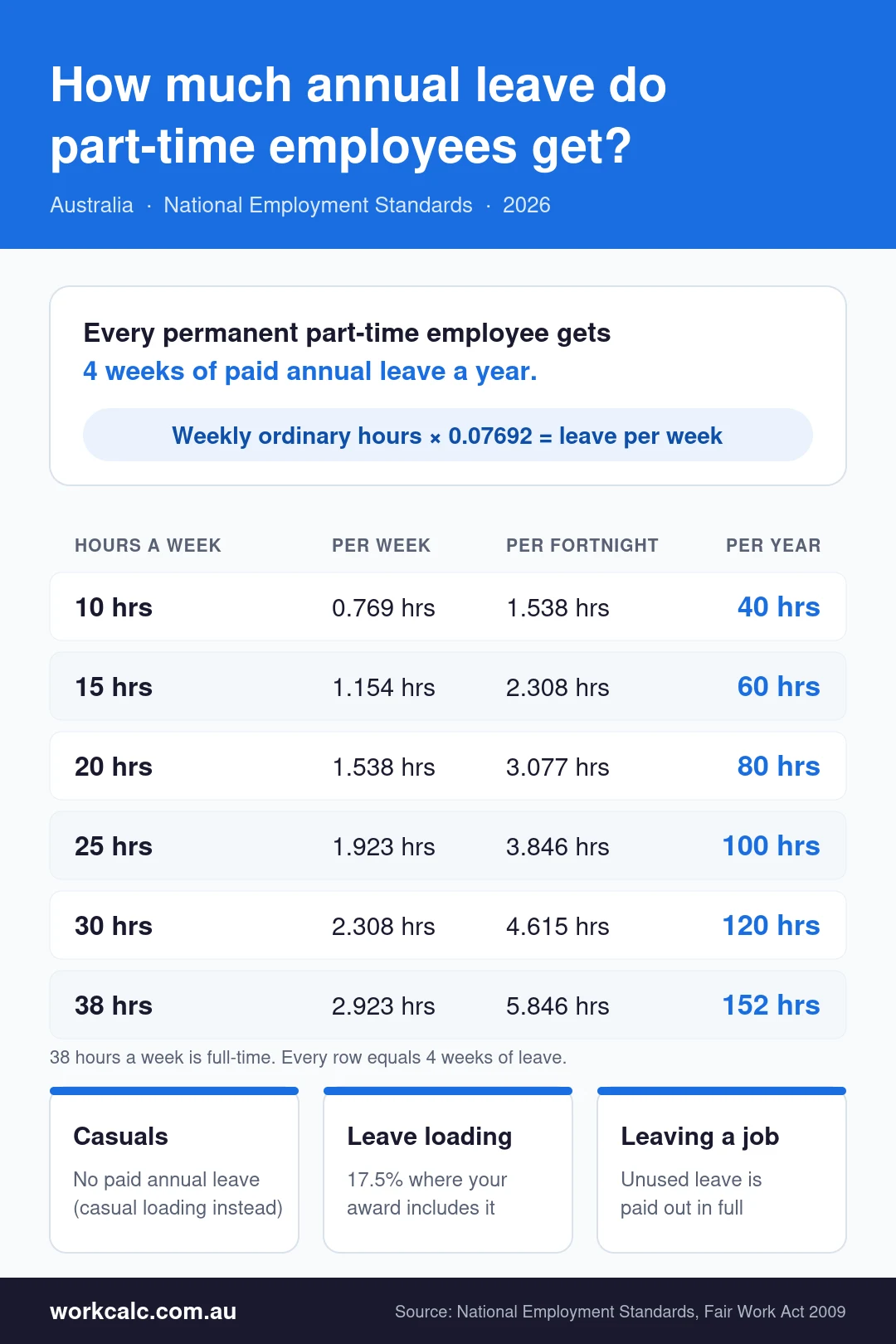
Under the National Employment Standards, every permanent employee in Australia — full-time or part-time — is entitled to 4 weeks of paid annual leave per year. The accrual formula is identical: 0.07692 hours of leave for every ordinary hour worked. The only difference is that part-time employees work fewer ordinary hours per week, so the absolute number of leave hours is smaller. The entitlement in weeks is exactly the same.
Key facts for part-time employees
- Same 4-week NES entitlement — identical to full-time, regardless of how many days you work
- Same 0.07692 accrual factor — 4 weeks ÷ 52 weeks, applied to your actual ordinary hours
- Proportional in hours, equal in weeks — a 20-hour week gives 80 hours/year; a 38-hour week gives 152 hours/year
- Leave is measured in your weeks — one week off is your working week, not a full-timer's 38-hour week
- Same leave loading rights — 17.5% (where award applies) applies to your leave hours at your rate
- Casual employees are different — they usually get a 25% casual loading instead of accrued leave
Part-time entitlements at a glance: what is pro rata and what isn't
The Fair Work Ombudsman says part-time employees get the same minimum entitlements as full-time employees, on a pro-rata basis. Paid leave that builds up with the hours you work is pro rata. Some entitlements are not reduced because you work fewer hours.
| Entitlement (NES) | Part-time amount | Pro rata? |
|---|---|---|
| Annual leave | 4 weeks of your ordinary hours a year (20 hrs a week = 80 hrs) | Yes |
| Paid sick and carer's leave | 10 days of your ordinary hours a year (19 hrs a week = 38 hrs) | Yes |
| Paid family and domestic violence leave | 10 days a year | No, the full 10 days |
| Compassionate leave | 2 paid days per occasion | No |
| Public holidays | Paid for the hours you would normally have worked that day | Only if you are normally rostered on |
| Notice of termination | 1 to 4 weeks depending on service (plus 1 week if you are over 45 with 2+ years' service) | No, same weeks, paid at your ordinary pay |
| Redundancy pay | 4 to 16 weeks depending on service (not payable by small business employers) | No, same weeks, paid at your ordinary pay |
| Long service leave | Set by state or territory law | Usually, based on your ordinary hours |
Work out your own balances with the Part-Time Annual Leave Calculator and the Sick Leave Calculator. Your award or agreement can give you more than these minimums, but not less.
The formula: proportional, not reduced
The Fair Work Act 2009 sets annual leave in weeks, not hours. That means the NES entitlement scales automatically to your working pattern. A part-timer working 3 days a week gets 4 weeks of leave — but 4 weeks of their 3-day schedule, not 4 weeks of a full-timer's 5-day schedule.
Payroll systems implement this through the accrual factor:
Apply that factor to your actual ordinary hours each pay period and your leave balance builds up to exactly 4 weeks of your working pattern by the end of the year. The maths is self-correcting: it doesn't matter if you work 10 hours or 38 — the ratio always produces 4 weeks of your personal schedule.
Side-by-side: full-time vs part-time
The clearest way to see how the formula works across employment types is a direct comparison. Take two employees at the same employer, same award, same start date:
The hours are different. The entitlement in weeks is identical. This is the principle the Fair Work Act calls proportional leave — the same standard, scaled to the employee's own working pattern.
Related calculator Switch to the full-time accrual calculator to compare your hours side-by-side →Your part-time leave accrual — try it live
The widget below calculates your accrual using the NES formula. Enter your actual ordinary hours and how long you've been working — the result is how much leave you've built up.
Part-time leave calculator
LiveAnnual leave by hours per week — full reference table
Whatever your part-time arrangement, the table below shows exactly what your accrual looks like per week and over a full year. Every row produces the same answer in weeks — 4 — because the NES guarantee never changes, only the hours it represents.
| Hrs/week | Days/week | Accrual per week | Annual entitlement | = Weeks |
|---|---|---|---|---|
| 8 hrs | 1 day | 0.615 hrs | 32 hrs | 4 wks |
| 12 hrs | 1.5 days | 0.923 hrs | 48 hrs | 4 wks |
| 16 hrs | 2 days | 1.231 hrs | 64 hrs | 4 wks |
| 20 hrs | 2.5 days | 1.538 hrs | 80 hrs | 4 wks |
| 24 hrs | 3 days | 1.846 hrs | 96 hrs | 4 wks |
| 28 hrs | 3.5 days | 2.154 hrs | 112 hrs | 4 wks |
| 30 hrs | ~4 days | 2.308 hrs | 120 hrs | 4 wks |
| 32 hrs | 4 days | 2.462 hrs | 128 hrs | 4 wks |
| 36 hrs | 4.5 days | 2.769 hrs | 144 hrs | 4 wks |
Are you eligible for permanent part-time leave entitlements?
Not every employee who works part-time hours qualifies for accrued annual leave. Casuals earn a 25% loading instead. The three questions below will tell you where you stand.
How many hours is part-time in Australia?
Part-time means working fewer than 38 ordinary hours a week on hours that are regular or reasonably predictable. The National Employment Standards set no minimum number of weekly hours, so a 10-hour week and a 32-hour week are both part-time.
- Upper limit: fewer than 38 ordinary hours a week. At 38 hours you are full-time.
- Lower limit: none in the NES, but your award may set a minimum shift. The General Retail Industry Award, for example, requires at least 3 consecutive hours a day (clause 10.9).
- Agreed pattern: many awards require your regular days and hours to be agreed in writing when you start.
- Common arrangements: 15 hours (3 days × 5 hours), 19 or 20 hours (0.5 FTE), 22.8 hours (0.6 FTE), 30 hours and 32 hours (4 days × 8 hours).
Whatever your hours, annual leave works the same way: 4 weeks a year at your own ordinary hours. Find your hours in the reference table above or enter them in the part-time annual leave calculator.
What "a week of annual leave" means when you're part-time
This is where part-time employees most often feel short-changed — when they realise their week of leave "uses up" fewer hours than a full-timer's week. But that's exactly correct, and it works in your favour too.
When you take a week of annual leave, your employer deducts your ordinary working hours for that week from your leave balance — not a standardised 38-hour week. If you work Monday to Wednesday (24 hours per week), one week of leave costs 24 hours of your balance. A full-timer taking the same calendar week uses 38 hours of theirs.
This also means public holidays work differently for part-timers. If a public holiday falls on a Tuesday and you only work Monday and Friday, that public holiday has no impact on your leave balance — you weren't going to be working on Tuesday anyway.
Public holidays during leave: the rule that protects you
Under section 116 of the Fair Work Act, a public holiday that falls on a day you would otherwise have worked cannot be counted against your annual leave balance. Your employer must substitute an additional day of leave or pay you for the public holiday — they cannot simply absorb it into your leave.
For part-timers, the key phrase is "would otherwise have worked." If Monday is one of your regular days and Easter Monday falls on it, you are protected. If you don't ordinarily work Mondays, that public holiday simply passes without affecting your entitlements either way.
Annual leave accrual when your hours vary
Some part-time employees don't have fixed weekly hours — they have a minimum guarantee with flexibility around it, or their roster changes from week to week. The NES formula still works; the key is that accrual is calculated on ordinary hours actually paid each pay period, not a theoretical average.
In practice, this means:
- A week you work 15 hours, you accrue 15 × 0.07692 = 1.154 hours of leave.
- A week you work 25 hours, you accrue 25 × 0.07692 = 1.923 hours of leave.
- Over time, your balance reflects exactly the hours you actually worked — no over- or under-counting.
If your employer's payroll uses a fixed weekly-average method rather than the actual-hours method, ensure the average being used is truly representative — typically calculated over the preceding 12 months or the full period of employment if shorter.
Related calculator Starting mid-year? Use the pro-rata annual leave calculator for the exact amount →Leave loading for part-time employees
If your modern award includes leave loading — and most do, at the standard 17.5% rate — it applies to your leave in exactly the same way as it does for full-timers. The loading is calculated on your ordinary time rate, applied to the hours of leave taken.
For a part-timer on $28/hour working 20 ordinary hours per week taking one week's leave:
- Leave hours taken: 20 hours
- Ordinary pay for leave: 20 × $28 = $560
- Leave loading (17.5%): $560 × 0.175 = $98
- Total leave payment: $658 (before tax)
A full-timer on the same rate would receive $1,250.20 for the same calendar week ($1,064 ordinary pay plus $186.20 loading) — not because the entitlement is better, but because their week is 38 hours. The loading percentage itself is identical.
Related calculator Check your leave loading entitlement — full calculator with all award options →What happens to your leave when you resign or are made redundant
The payout rules for part-time employees on termination are identical to those for full-time employees. Every hour of accrued but untaken annual leave must be paid out at your ordinary base rate — plus leave loading if applicable under your award. This is mandatory under section 90 of the Fair Work Act 2009.
The calculation is straightforward: accrued hours × hourly rate (× 1.175 if loading applies). Tax is withheld under the ATO's Schedule 7 marginal-rate averaging method if you resign, and the payout is included in your gross pay on your income statement.
Related guide Made redundant instead of resigning? See how the leave payout and entitlements differ →Do I actually get the same leave as full-time staff?
Yes — and no. The legal entitlement is identical: 4 weeks per year under the National Employment Standards. What differs is the absolute number of hours, because 4 weeks of your shorter working week is fewer hours than 4 weeks of a 38-hour week.
So a 20-hour-per-week part-timer gets 80 hours of annual leave per year. A 38-hour-per-week full-timer gets 152. Both have taken exactly 4 weeks. Neither has more or less of the entitlement — they have more or less of the hours, which is a function of how much they work.
The Fair Work Ombudsman explicitly states the entitlement is proportional, not reduced. If your employer is suggesting part-time employees receive fewer weeks of leave than full-timers, they are incorrect and potentially in breach of the NES. Confirm your entitlement with the Fair Work Ombudsman →
Accrual during leave, sick days and public holidays
Annual leave continues to accrue during periods of paid leave — including when you're actually on annual leave. The rules for part-time employees are the same as for full-timers:
- Paid annual leave — accrues annual leave (you earn leave while taking leave).
- Paid personal/carer's leave — accrues annual leave at your ordinary hours for that period.
- Paid public holidays on your working days — accrue annual leave.
- Unpaid leave of any kind — does not accrue annual leave.
- Workers' compensation — varies by state; some weekly compensation periods do accrue, others don't.
Part-time employees accrue paid sick leave the same proportional way, at 1/26 of their ordinary hours (the sick leave calculator works out your balance). If you work on a public holiday, see how public holiday pay works for part-time employees.
If you work irregular hours and take paid personal leave for a day you would have worked 4 hours, your annual leave accrues on those 4 ordinary hours — the actual hours you were absent for, not a standardised daily rate.
The bottom line for part-time workers
The NES treats part-time and full-time permanent employees identically when it comes to the entitlement. The formula — 0.07692 hours of leave per ordinary hour worked — makes no distinction. A 20-hour-a-week employee accrues leave at exactly the same rate as a 38-hour-a-week employee; the absolute hours in their balance are just smaller, because their ordinary week is shorter.
What matters most in practice: make sure your employer is applying the accrual factor to your actual ordinary hours, not a notional full-time rate. If your payslip's leave accrual line doesn't match hours worked × 0.07692, ask payroll to explain the difference. Most errors are configuration mistakes, quickly fixed once identified.
Disclaimer: This article reflects the National Employment Standards as set out in the Fair Work Act 2009. Modern awards, enterprise agreements and individual contracts can vary some provisions — particularly leave loading on termination and accrual rules during workers' compensation. For binding advice on your specific situation, consult the Fair Work Ombudsman, your relevant award, or a qualified workplace relations professional. WorkCalc Australia is independent and not affiliated with Fair Work or the ATO.
Frequently asked questions about part-time annual leave
Plain-English answers on the 0.07692 rate, proportionality, casual vs permanent, and what happens when things change mid-year.
How is annual leave calculated for part-time employees in Australia?
The formula is identical to full-time: ordinary hours worked × 0.07692. That factor is 4 weeks ÷ 52 weeks — the NES annual leave entitlement expressed as a fraction of an hour of leave per ordinary hour worked. A part-timer on 20 hours accrues 20 × 0.07692 = 1.538 hours per week. Over 52 weeks that's 80 hours — exactly 4 weeks of their 20-hour schedule.
Do part-time employees get the same leave as full-time staff?
Yes — in weeks. The NES gives every permanent employee 4 weeks of paid annual leave per year, regardless of hours. The number of hours differs because the working week differs. A part-timer on 20 hours gets 80 hours per year; a full-timer on 38 hours gets 152 hours. Both represent 4 weeks of their respective working patterns. Neither has fewer weeks of leave.
What is a permanent part-time employee for leave purposes?
A permanent part-time employee works fewer than 38 ordinary hours per week on an ongoing basis with agreed, regular hours. They receive all NES entitlements — including annual leave, sick leave, and parental leave — on a proportional basis. This contrasts with casual employees, who have no guaranteed hours and receive a 25% loading in lieu of leave entitlements.
How does annual leave work for employees with irregular hours?
The 0.07692 factor applies to the ordinary hours actually paid each pay period. A week on 15 hours accrues 1.154 hours; a week on 25 hours accrues 1.923. Over time the balance reflects actual hours worked. If your employer uses a weekly-average method, ensure the average covers at least the past 12 months to be representative.
Can a part-time employee take a "week" of leave?
Yes. One week of annual leave deducts your ordinary working hours for that week from your balance — not 38 hours. If you work 24 hours per week, one week off costs 24 hours. A public holiday falling on a day you don't ordinarily work does not affect your balance either way.
Does leave loading apply to part-time employees?
Yes, where the modern award includes it. The 17.5% loading applies to your ordinary rate on leave hours taken — the percentage is identical to full-time, just applied to your smaller number of leave hours. Check your relevant modern award to confirm whether loading applies, as some awards have absorbed it into higher base rates.
What happens to a part-time employee's leave on termination?
Every accrued hour must be paid out at your ordinary base rate — plus loading if applicable under your award. This is mandatory under section 90 of the Fair Work Act 2009, and the rules are the same for part-timers and full-timers. The payout is taxed under ATO Schedule 7: at your marginal rate if you resign, or a flat 32% for a genuine redundancy.
If I increase my hours mid-year, how does my accrual change?
Your accrual adjusts immediately from the first pay period on your new hours. The 0.07692 factor stays the same; it's simply multiplied against a higher number of ordinary hours. Your prior balance stays as-is; future accrual is faster. Check your payslip after the first full pay period on your new hours to confirm payroll has updated correctly.
How many hours is part-time in Australia?
Part-time in Australia means working fewer than 38 ordinary hours a week on regular or reasonably predictable hours. There is no minimum number of weekly hours in the National Employment Standards, but your award may set a minimum shift, such as 3 consecutive hours a day under the General Retail Industry Award.
Can a casual employee become permanent part-time?
Yes. Under the employee choice pathway, a casual who has worked for at least 6 months (12 months with a small business employer) can tell their employer in writing that they want to become permanent if they believe they no longer meet the definition of a casual employee. Annual leave then accrues from the date they become permanent.
What entitlements do part-time employees get, and which are pro rata?
Part-time employees get the same NES entitlements as full-time employees, on a pro-rata basis. Annual leave (4 weeks a year) and paid sick and carer's leave (10 days a year) are pro rata to your ordinary hours. Some entitlements are not reduced: 10 days of paid family and domestic violence leave, 2 days of compassionate leave per occasion, and the number of weeks of notice and redundancy pay, which are paid at your ordinary pay.