
38-Hour Week vs 40-Hour Week: How This Changes Your Annual Leave Balance
Two hours a week doesn't sound like much. But over a career it changes your leave balance, your payout value, and how many days off you're actually entitled to. Here's the exact difference — and why it matters more than most employees realise.
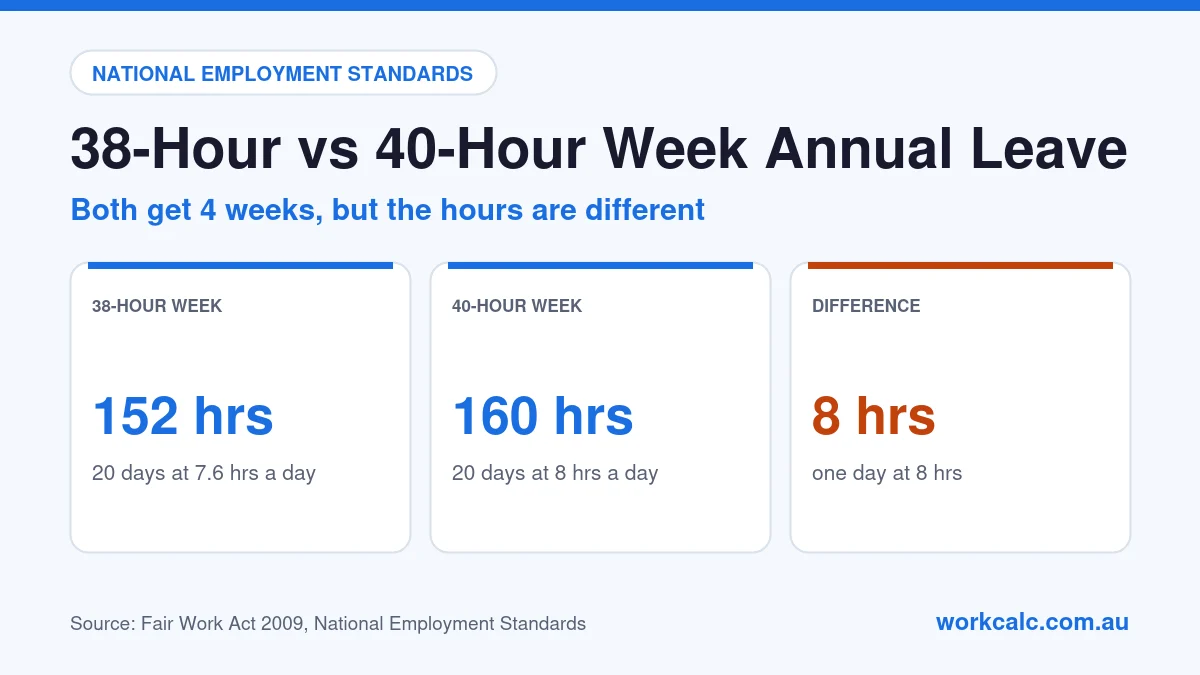
Australia's National Employment Standards entitle every permanent employee to 4 weeks of annual leave per year. But "4 weeks" means different things depending on how many hours you work each week. A 40-hour-week employee ends up with 160 hours of leave per year. A 38-hour-week employee gets 152. That 8-hour gap — one full working day — compounds over years of employment and shows up clearly in your final payout when you leave.
The numbers at a glance
- Same accrual factor for everyone: 0.07692 hours of leave per ordinary hour worked
- 38-hr week: 152 hours / year = 20 days (5-day week) = 4 weeks
- 40-hr week: 160 hours / year = 20 days (5-day week) = 4 weeks
- The difference: 8 hours per year — exactly one working day at 8 hrs/day
- Overtime doesn't count — only ordinary hours defined in your award accrue leave
- Your award sets your ordinary hours — not your actual start and finish times
The one formula that explains everything
The Fair Work Act doesn't set leave in hours — it sets leave in weeks. Four weeks per year, accrued progressively. The conversion to hours happens through a single factor:
The only variable is what you multiply it by. A 38-hour employee multiplies by 38. A 40-hour employee multiplies by 40. The factor never changes — your ordinary hours do. That's why the entitlement is always 4 weeks regardless of your schedule, but the hours total differs.
If you want to understand this formula in depth — where 0.07692 comes from and how payroll systems apply it every pay period — the full explainer is at How Annual Leave Accrues in Australia: The Exact Maths Behind Your Payslip.
Live comparison: select your hours
Use the widget below to see exactly how your ordinary weekly hours translate into annual leave — per week, per year, and in dollar value if you enter your rate.
The full comparison table
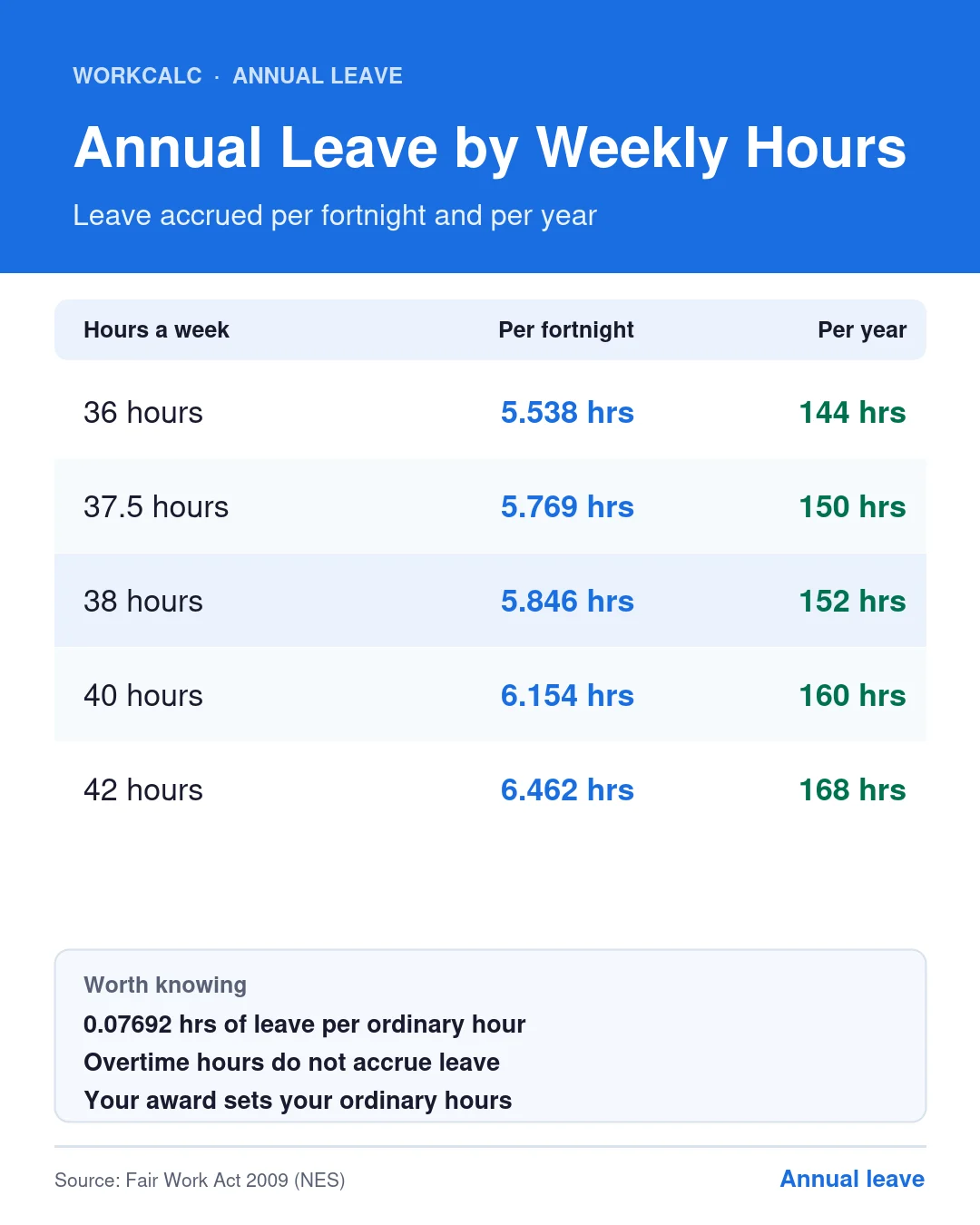
Here's how common ordinary-hours arrangements compare side by side — including the accrual per fortnight, which is what actually appears on most Australian payslips.
| Ordinary hrs/wk | Accrual/week | Accrual/fortnight | Annual total | Days/yr (÷ 8) |
|---|---|---|---|---|
| 36 hrs | 2.769 hrs | 5.538 hrs | 144 hrs | 18 days |
| 37.5 hrs | 2.885 hrs | 5.769 hrs | 150 hrs | 18.75 days |
| 38 hrs (standard) | 2.923 hrs | 5.846 hrs | 152 hrs | 20 days |
| 40 hrs | 3.077 hrs | 6.154 hrs | 160 hrs | 20 days |
| 42 hrs | 3.231 hrs | 6.462 hrs | 168 hrs | 21 days |
Notice that 38-hour and 40-hour employees both show 20 days per year — because their day length differs (7.6 hrs vs 8 hrs). The days column uses ÷ 8 for simplicity, but in practice you convert using your own ordinary hours per day, not a standardised 8.
Why your award sets the number — not your timesheet
This is the most misunderstood part of leave accrual. Your annual leave does not accrue based on how many hours you actually work each week. It accrues based on the ordinary hours defined in your modern award or enterprise agreement.
If your award sets 38 as your ordinary week but you routinely work 44 hours, your leave still accrues on 38. The extra 6 hours are overtime — paid at a penalty rate, but earning no leave. This is true even if your employer has you on a flat salary that implicitly covers overtime.
Common award ordinary hours by industry
| Award / Industry | Ordinary hrs/wk | Annual leave (hrs) |
|---|---|---|
| Most awards (default NES) | 38 hrs | 152 hrs |
| Building & Construction General On-site Award | 36 hrs | 144 hrs |
| Some enterprise agreements | 40 hrs | 160 hrs |
| 9-day fortnight arrangement | 38 hrs (76/fortnight) | 152 hrs |
The 9-day fortnight: same leave, different schedule
A popular working arrangement — especially in local government, some professional services, and large corporates — is the 9-day fortnight. Employees work 76 ordinary hours across 9 days instead of 10, banking a rostered day off (RDO) every second Friday.
The key point for leave: RDOs are not annual leave. They're a compressed-hours arrangement. Your annual leave still accrues on your 38 ordinary hours per week (76 per fortnight), and your balance is still 152 hours per year. When you take a week of annual leave during an RDO fortnight, only the days you would have worked that week are deducted from your balance — the scheduled RDO is not charged.
Related guide Part-time hours? See how the same 0.07692 factor applies proportionally to any schedule →What the 8-hour difference is worth in dollars
Eight hours per year might not sound significant. But it accumulates — and it matters most at the moment you leave a job, because every accrued hour gets paid out at your ordinary rate.
| Hourly rate | 38-hr payout (152 hrs) | 40-hr payout (160 hrs) | Difference |
|---|---|---|---|
| $25/hr | $3,800 | $4,000 | $200 |
| $35/hr | $5,320 | $5,600 | $280 |
| $45/hr | $6,840 | $7,200 | $360 |
| $60/hr | $9,120 | $9,600 | $480 |
| $80/hr | $12,160 | $12,800 | $640 |
Add leave loading (17.5% where it applies) and the difference grows further. Over a 10-year career at $45/hr, that 8-hour annual gap represents $3,600 in payout value — plus the compounding effect of having more leave available to actually take.
Related calculator Calculate your payout when leaving — including the right tax rate for your situation →Shift workers: a different calculation entirely
Shift workers whose rosters include regular weekend or public holiday shifts may be entitled to 5 weeks of annual leave instead of 4 — under section 87(1)(b) of the Fair Work Act. This applies where the employee is a shift worker as defined by their modern award, regularly rostered on Sundays and public holidays.
For those employees the accrual factor changes: 5 ÷ 52 = 0.09615 hours of leave per ordinary hour worked. A 38-hour shift worker accrues 190 hours per year, not 152. If you think this applies to you, check your modern award's definition of "shift worker" — it's more specific than simply working irregular hours.
My contract says 40 hours but my award says 38 — which one counts for leave?
Your modern award's ordinary hours set the baseline. If your award says 38 hours is the ordinary week, your leave accrues on 38 hours — regardless of what your employment contract states, and regardless of how many hours you actually work.
Where an enterprise agreement has been made and it sets 40 hours as ordinary hours, those 40 hours accrue leave. An individual contract cannot reduce award entitlements, but a properly made enterprise agreement can set different terms provided they pass the Better Off Overall Test.
If your contract states 40 hours and you're covered by a standard award at 38, the extra 2 hours per week are likely overtime — paid at a penalty rate, but not accruing leave. Check your payslip: your leave accrual line should match your ordinary hours multiplied by 0.07692. Verify your balance with the accrual calculator →
Checking your own payslip
The quickest way to confirm your leave is accruing correctly is to apply the formula to your own numbers. Take the ordinary hours shown on your payslip for that period and multiply by 0.07692. That should match the "leave accrued this period" line exactly.
If it doesn't, the most common explanations are:
- Your payroll system is including overtime hours in the accrual calculation — it shouldn't be.
- Your ordinary hours on the system don't match your award — often a setup error when you started.
- You had unpaid leave that period — unpaid hours don't accrue.
- Rounding — payroll systems round to varying decimal places; small differences per pay are normal.
If the difference is consistent and significant, raise it with payroll in writing. Provide your award's ordinary hours, your expected accrual per the formula, and the actual figure on your payslip. Most discrepancies are fixed in one payroll cycle.
Related calculator Part-time? Calculate your entitlement with the dedicated part-time leave tool → Also check Also check long service leave — your ordinary hours affect that entitlement too →Disclaimer: This article reflects the National Employment Standards under the Fair Work Act 2009. Ordinary hours are set by modern awards and enterprise agreements — always check your specific award for the correct figure. For binding advice, consult the Fair Work Ombudsman or a qualified workplace relations professional. WorkCalc Australia is independent and not affiliated with Fair Work or the ATO.
Frequently asked questions: 38 vs 40 hour week leave
Plain-English answers on accrual rates, overtime, award hours, and what your payslip should show.
Does working 40 hours a week give you more annual leave than 38 hours?
Yes — in absolute hours, not in weeks. Both get 4 weeks per year. But 4 weeks of a 40-hour schedule is 160 hours, while 4 weeks of a 38-hour schedule is 152 hours. The difference is 8 hours — one extra working day at 8 hrs/day — per year.
What is the annual leave accrual rate per hour in Australia?
0.07692 hours of leave per ordinary hour worked. This is 4 weeks ÷ 52 weeks and applies to every permanent employee regardless of their ordinary hours — 36, 38, 40 or anything else set by their award.
How many hours of annual leave does a 38-hour week employee get per year?
152 hours per year — 38 × 0.07692 × 52. Per fortnight the accrual is 5.846 hours. This equals exactly 4 weeks at 38 ordinary hours per week, or 20 working days at 7.6 hours per day.
Does overtime count toward annual leave accrual?
No. Only ordinary hours under your award accrue annual leave. If you work 44 hours but your award ordinary week is 38, your leave accrues on 38 hours only. The 6 hours of overtime are paid at a penalty rate but earn no leave — regardless of how overtime is structured in your pay arrangement.
If my award says 40 hours ordinary, do I get more leave than someone on 38 hours?
Yes — 160 hours per year versus 152. If your modern award or enterprise agreement defines 40 hours as your ordinary week, all 40 hours accrue leave. That's 8 extra hours of leave per year — worth one additional working day annually.
How does a 9-day fortnight affect annual leave accrual?
It doesn't reduce your accrual. A 9-day fortnight compresses 76 ordinary hours into 9 days. Your leave still accrues on those 76 hours per fortnight (38 per week). RDOs are not leave — they're a rostered break. When you take annual leave during a 9-day fortnight cycle, only the days you would have worked that week are deducted from your balance.
Do shift workers get more annual leave than day workers?
Potentially. Shift workers regularly rostered on Sundays and public holidays may be entitled to 5 weeks of annual leave instead of 4 under section 87(1)(b) of the Fair Work Act. The accrual factor becomes 5 ÷ 52 = 0.09615. Check your modern award's specific definition of "shift worker" — not all employees working shifts qualify.
My contract says 40 hours but my award says 38 — which counts for leave?
Your modern award's ordinary hours are the baseline. A contract cannot reduce award entitlements. If your award sets 38 as ordinary and your contract says 40, the extra 2 hours are likely overtime — paid at a penalty but not accruing leave. An enterprise agreement made under the Fair Work Act can legitimately set different ordinary hours provided it passes the Better Off Overall Test.