
Public Holiday Pay Rates & Calculator (2026)
Calculate the penalty rate, effective hourly rate and total pay for working a public holiday under any Australian modern award. Covers hospitality, retail, fast food, clerks, manufacturing and more.
Public holiday rate calculator
Work Details
Pay Details
Fill in the highlighted fields below — results appear instantly.
- Modern award
- Hours worked
- Hourly rate
Public Holiday Pay Summary
Live—
Pay Breakdown
Gross estimate — PAYG tax applies on top.
How to calculate public holiday pay
Three steps. The penalty rate is set by your modern award.
Find your award rate
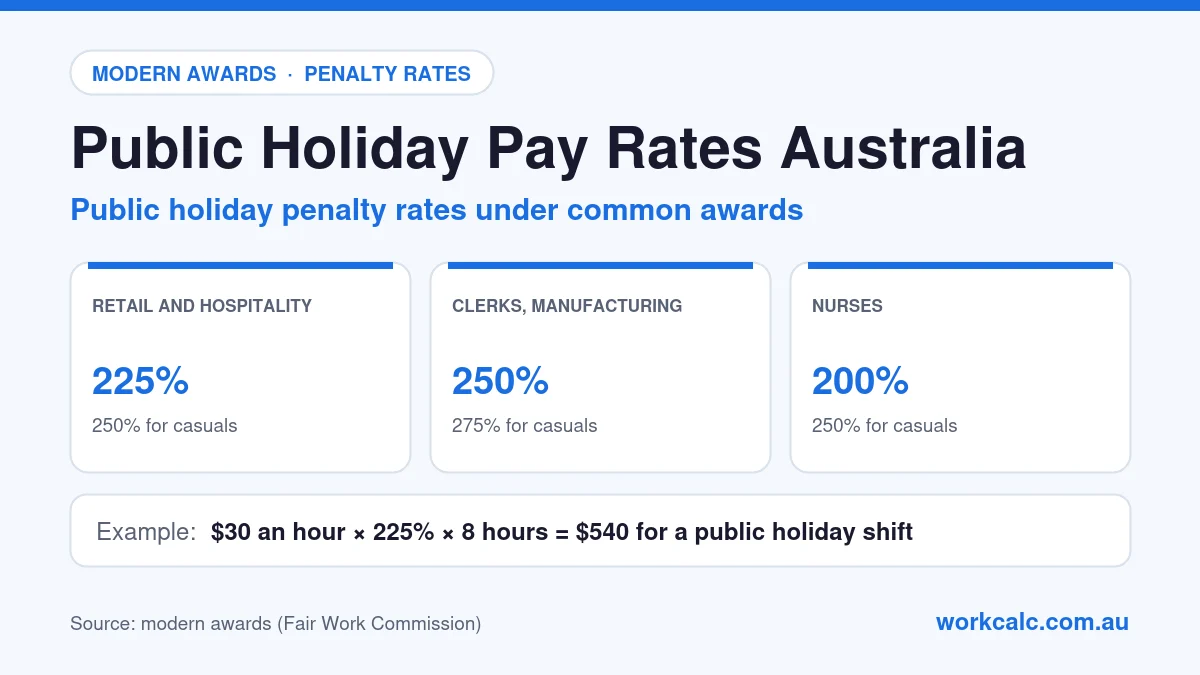
Most awards set the public holiday penalty rate at 225% or 250% of the ordinary base rate.
penalty% (from award)
Calculate the hourly rate
Multiply your base hourly rate by the penalty percentage.
base × penalty% ÷ 100
Apply to hours worked
Multiply the public holiday rate by the hours worked on the holiday.
PH rate × hours worked
How public holiday penalty rates work in Australia
Working a public holiday in Australia attracts a penalty rate — an enhanced hourly rate set by your modern award. Unlike annual leave or long service leave, public holiday penalty rates are federal and uniform across all states. The same Hospitality Industry Award rate applies whether you work in Sydney, Melbourne, Brisbane or Perth — though which days are actually public holidays varies by state.
To calculate your public holiday pay, you need three inputs: your base hourly rate (excluding casual loading), your award's penalty percentage, and the number of hours worked on the holiday. The calculator above applies the correct percentage for each major modern award automatically.
Public holiday penalty rates by modern award (2026)
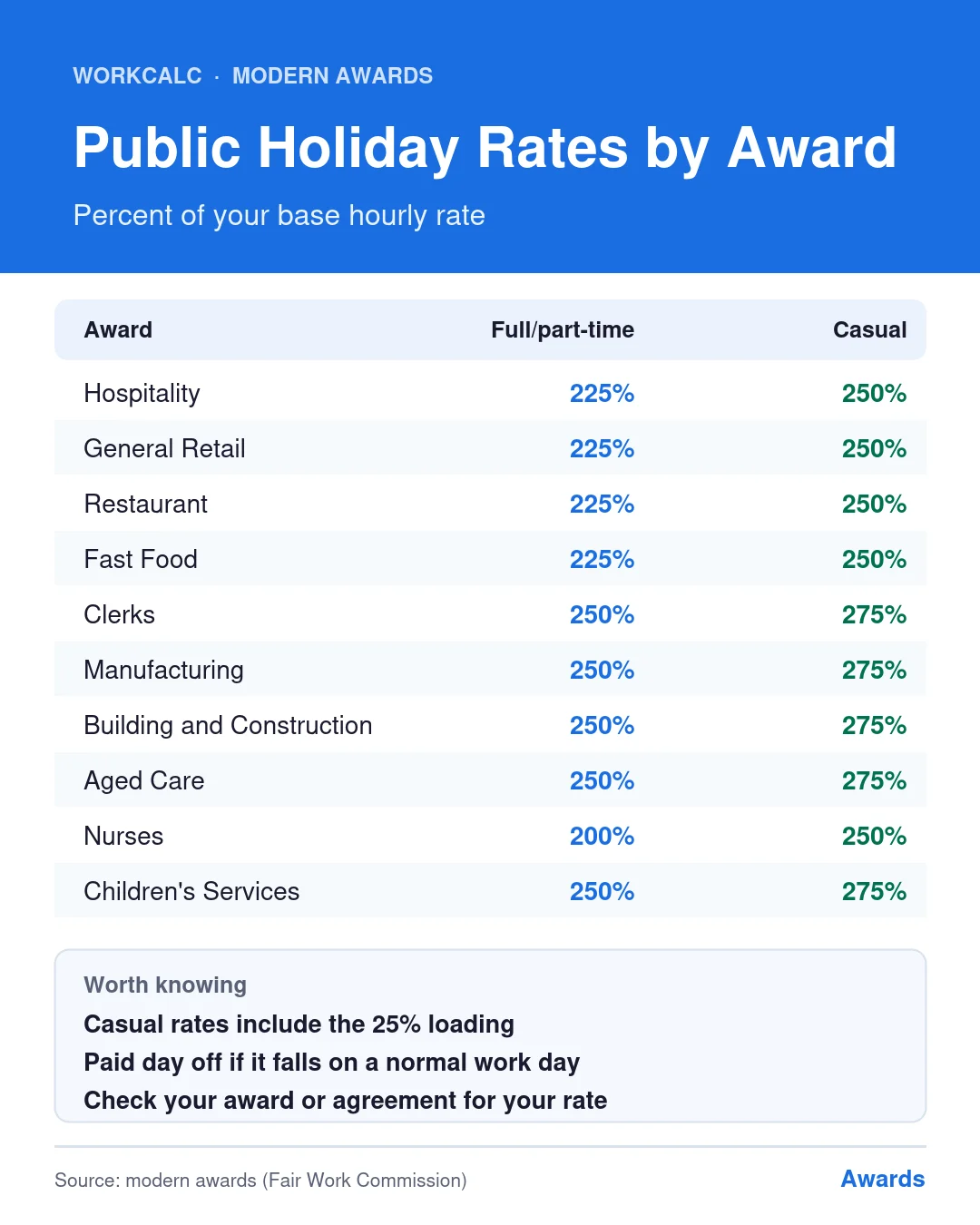
Each of Australia's 120+ modern awards sets its own public holiday penalty rate. The most common rates are shown below. For casuals, the percentage typically absorbs the 25% casual loading rather than adding it on top — so a casual at 250% is not 225% + 25%, it's a single penalty rate that already accounts for the loading.
| Modern Award | Full-time / Part-time | Casual |
|---|---|---|
| Hospitality Industry (MA000009) | 225% | 250% |
| General Retail Industry (MA000004) | 225% | 250% |
| Restaurant Industry (MA000119) | 225% | 250% |
| Fast Food Industry (MA000003) | 225% | 250% |
| Clerks — Private Sector (MA000002) | 250% | 275% |
| Manufacturing & Associated (MA000010) | 250% | 275% |
| Building & Construction (MA000020) | 250% | 275% |
| Aged Care Industry (MA000018) | 250% | 275% |
| Nurses (MA000034) | 200% | 250% |
| Children's Services (MA000120) | 250% | 275% |
| National Employment Standards (award-free) | Ordinary rate | Ordinary rate |
Rates verified against the Fair Work Ombudsman pay guides for 2025–26. Always confirm against the most current schedule for your specific award and classification level.
Public holiday pay rates in NSW, VIC, QLD, WA and SA
Public holiday penalty rates come from your modern award, so the percentage is the same in every state and territory. What changes from state to state is which days count as public holidays, and that decides whether the penalty rate applies on a given day. Here is how it works where you live.
NSW public holiday pay rates
In New South Wales, public holiday penalty rates are governed by federal modern awards — the same as every other state. NSW-specific public holidays in 2026 include New Year's Day, Australia Day (26 January), Good Friday, Easter Saturday, Easter Sunday, Easter Monday, Anzac Day (25 April), King's Birthday (8 June), Bank Holiday (3 August), Labour Day (5 October), Christmas Day, Boxing Day, and Additional Days where holidays fall on weekends. In 2026, Anzac Day falls on a Saturday, so NSW observes Monday 27 April as an additional public holiday.
Victoria public holiday pay rates
Victorian public holidays include the standard national days plus Victorian-specific dates: Labour Day (second Monday in March), Melbourne Cup Day (first Tuesday in November) which is observed across the state, AFL Grand Final Friday (the Friday before the AFL Grand Final), and Easter Sunday. Victoria does not observe a substitute Monday for Anzac Day 2026. Penalty rates under modern awards (Hospitality 225%, Retail 225%, Fast Food 225%) apply uniformly.
Queensland public holiday pay rates
Queensland public holidays include the standard national dates plus QLD-specific dates: Labour Day (first Monday in May), Royal Queensland Show Day (Brisbane only, typically Wednesday in August), and the part-day Christmas Eve public holiday (6pm to midnight, 24 December). Queensland does not observe an additional day for Anzac Day 2026 — the Saturday itself is the public holiday. Federal modern award penalty rates apply: Hospitality and Retail at 225% for full-time/part-time and 250% for casuals.
WA, SA, ACT, NT and TAS public holiday pay rates
Western Australia observes Labour Day in March, WA Day (Foundation Day) in early June, and an additional Anzac Day Monday in 2026. South Australia observes Adelaide Cup Day (March) and Proclamation Day (28 December). The ACT observes Canberra Day (March), Reconciliation Day (May/June), and Family and Community Day (September). The Northern Territory observes May Day (first Monday in May) and Picnic Day (first Monday in August). Tasmania has regional public holidays such as the Hobart and Launceston Show Days. The same federal modern award penalty rates apply in all jurisdictions.
Days that differ between states: Easter Saturday is a public holiday in NSW, Victoria (called the Saturday before Easter Sunday), Queensland (the day after Good Friday), SA, the ACT and the NT, but not in WA or Tasmania. Christmas Eve is an evening part-day public holiday in Queensland, SA and the NT, and New Year's Eve is a part-day holiday in SA and the NT. Only the hours worked inside a part-day holiday attract the public holiday rate.
Check the exact dates for your state: NSW public holidays, Victoria public holidays, Queensland public holidays, WA public holidays, SA public holidays, Tasmania public holidays, ACT public holidays and NT public holidays.
Casual vs permanent public holiday rates
One of the most common payroll errors involves casual public holiday pay. Casual employees in Australia receive a 25% casual loading on their ordinary hourly rate to compensate for the absence of paid leave entitlements. On a public holiday, however, the casual loading is typically absorbed into the casual penalty rate rather than added on top.
Example under the Hospitality Award (MA000009): a casual with a base rate of $28.00/hour earns:
- Ordinary casual rate: $28.00 × 125% = $35.00/hour (base + 25% loading)
- Public holiday casual rate: $28.00 × 250% = $70.00/hour (single rate, casual loading absorbed)
- NOT: $35.00 × 225% = $78.75/hour (this would double-count the loading)
For a casual working 8 hours on a public holiday under the Hospitality Award, the correct calculation is $28.00 × 250% × 8 = $560.00 gross. The same casual working an ordinary day shift would earn $28.00 × 125% × 8 = $280.00. The public holiday shift earns exactly $280.00 more — that's the value of the penalty rate.
Do casuals get paid for a public holiday they don't work?
No. Casual employees are paid only for the hours they actually work, so a public holiday they are not rostered on is unpaid. The 25% casual loading is paid instead of paid leave and paid public holidays. If a casual does work on the public holiday, they get their award's casual public holiday rate, usually 250% or 275% of the base rate. Full-time and part-time employees are different: they are paid their ordinary hours for a public holiday that falls on a day they would normally work.
Do part-time employees get paid for a public holiday they don't work?
Yes, if the public holiday falls on a day they would ordinarily work. Under the National Employment Standards, a full-time or part-time employee who is absent on a public holiday is paid their base rate for the ordinary hours they would have worked that day. If the holiday falls on a day they don't normally work, there is no extra payment. Casual employees are only paid for public holidays they actually work.
Example: a part-time employee works Monday to Wednesday, 7.6 hours a day, on a base rate of $30.00 an hour.
- Monday public holiday, not worked: 7.6 × $30.00 = $228.00 ordinary pay for the day off
- Monday public holiday, worked at 225%: 7.6 × $30.00 × 225% = $513.00
- Thursday public holiday (not a usual work day): no public holiday payment
Enter your own hours and award in the calculator above to see your figure.
National public holidays in Australia
Australia has seven public holidays observed across all states and territories:
- New Year's Day — 1 January
- Australia Day — 26 January (or following Monday if weekend)
- Good Friday — Friday before Easter Sunday
- Easter Monday — Monday after Easter Sunday
- Anzac Day — 25 April
- Christmas Day — 25 December
- Boxing Day — 26 December
King's Birthday is also observed nationally but on different Mondays in each state. Most states also include Easter Saturday and Easter Sunday as public holidays under their respective acts. When a public holiday falls on a weekend, most states (NSW, VIC, QLD, WA, SA, ACT, NT, TAS) gazette a substitute Monday — though the rules vary, particularly for Anzac Day.
Working over Christmas? Our guide to Christmas public holiday pay lists the 2026 Christmas and New Year public holidays in each state, including the extra Monday when Boxing Day falls on a Saturday.
When you work but don't get paid penalty rates
Penalty rates under a modern award generally apply only to employees covered by that award or an enterprise agreement. Some categories of workers do not automatically receive public holiday penalty rates:
- Award-free salaried employees — Typically those earning above the high-income threshold (currently $175,000+). They receive their ordinary salary unless their contract specifies otherwise.
- Independent contractors — Not covered by modern awards; their rates are set by contract.
- Employees on annualised salaries — Some awards allow annualised arrangements that include or exclude public holiday penalties, with strict reconciliation requirements.
- Salaried managers — Where the contract genuinely off-sets penalty rates, no separate public holiday rate applies.
If you don't ordinarily work on the day the public holiday falls, you generally aren't entitled to either pay or penalty rates for that day — though full-time and part-time employees who would normally work that day are entitled to their ordinary base pay even when they don't work.
Common public holiday pay mistakes
- Double-counting casual loading. The 25% casual loading is absorbed into the casual public holiday rate in most awards. Don't add it on top.
- Paying weekend rates on Easter Saturday. Under the General Retail Award, Easter Saturday is a public holiday — 225% (not the 125% Saturday rate).
- Using the wrong rate for substitute days. When the substitute Monday is gazetted, that Monday attracts the public holiday penalty rate, not the standard Monday rate. The actual weekend day may also still attract public holiday rates in some awards.
- Not paying part-timers who would have worked. A part-time employee whose ordinary roster includes the public holiday day is entitled to ordinary pay for that day even if they don't work.
- Applying ordinary overtime rates instead of public holiday rates. Public holiday work doesn't usually count as overtime — the penalty rate replaces, not stacks with, overtime in most awards.
- Forgetting state-specific holidays. Multi-state employers must use the local holiday calendar for each location, not a national one.
Who this public holiday rate calculator is for
This tool produces a clean, payroll-style estimate of public holiday pay suitable for:
- Casual and part-time employees wanting to confirm what they should be paid for a public holiday shift before the pay run.
- HR and payroll teams running a quick check against payroll system output or processing a one-off public holiday shift.
- Small business owners rostering staff for Christmas, Easter or Anzac Day and forecasting the cost.
- Bookkeepers reconciling penalty payments against modern award rates as part of an audit or compliance check.
- Managers negotiating shift coverage on public holidays and explaining the pay rate to staff.
This calculator applies modern award penalty rates verified against the Fair Work Ombudsman 2025–26 pay guides. Specific awards, enterprise agreements or individual contracts may set different rates — always confirm against the instrument that applies to your role. State public holiday lists are sourced from each state government's official gazette.
Public holiday rate FAQs
Plain-English answers covering penalty rates, casual loading, NSW/VIC/QLD differences and the rules that catch most people out.
How do you calculate public holiday rates in Australia?
Multiply your ordinary hourly rate × penalty rate percentage × hours worked. Most modern awards set the public holiday penalty rate at 225% or 250% for full-time and part-time employees. For casuals, the rate typically ranges from 250% to 275% — the casual loading is usually absorbed into the casual public holiday percentage rather than added on top.
What is the standard public holiday penalty rate in Australia?
For employees covered by a modern award, the standard public holiday penalty rate is 225% to 250% of the ordinary base rate for full-time and part-time employees, and 250% to 275% for casuals. Award-free employees required to work on a public holiday are entitled to their ordinary rate, with additional penalty rates depending on contract or agreement.
What are the public holiday rates under the Hospitality Award?
Under the Hospitality Industry (General) Award (MA000009), full-time and part-time employees who work on a public holiday are paid at 225% of the minimum hourly rate. Casual employees are paid at 250% — this percentage already includes the 25% casual loading. So a casual on a $28/hour base rate would earn $28 × 250% = $70/hour for working a public holiday.
What are the public holiday rates under the Retail Award?
Under the General Retail Industry Award (MA000004), full-time and part-time employees on a public holiday are paid at 225% of the minimum hourly rate. Casuals are paid at 250% (absorbing the 25% casual loading). Easter Saturday is treated as a public holiday under this award and attracts the same 225%/250% rate — not the standard 125%/150% Saturday rate.
How is the public holiday rate calculated for casuals?
In most modern awards, the public holiday penalty rate for casuals is a single percentage that already absorbs the 25% casual loading. For example, under the Hospitality Award, a casual on $28/hour base earns $28 × 250% = $70/hour — NOT $28 × 125% (casual + loading) × 225% = $78.75. Double-counting the loading is one of the most common payroll errors in Australian small business.
Do public holiday rates apply in NSW the same as Victoria?
Yes — penalty rates are set by federal modern awards and apply uniformly across all Australian states. The difference between NSW, Victoria, Queensland and other states is which days are gazetted as public holidays. Victoria has AFL Grand Final Eve and Melbourne Cup Day. NSW has Labour Day in October and Bank Holiday in August. QLD has Royal Queensland Show Day. But the penalty percentages on each holiday are identical across states.
What are the public holiday penalty rates in Queensland?
In Queensland, public holiday rates follow the federal modern award structure: 225% for FT/PT and 250% for casuals in hospitality and retail, and up to 275% for casuals in awards like fast food, manufacturing and aged care. Queensland-specific public holidays include Labour Day (1st Monday in May), Royal Queensland Show Day in Brisbane (August), and the Christmas Eve part-day public holiday (6pm–midnight, 24 December).
Can an employee refuse to work on a public holiday?
Under section 114 of the Fair Work Act, an employee can refuse a request to work on a public holiday if the refusal is reasonable. Reasonableness considers personal circumstances, family responsibilities, operational needs of the employer, the type of work, notice given, and the penalty rate entitlement. Employers must make the request reasonable before treating refusal as misconduct or a basis for termination.
Do part-time employees get public holiday pay if they don't work?
Yes. If the public holiday falls on a day a part-time employee would ordinarily work, they are paid their ordinary base rate for those hours even though they don't work. If they do work, the award penalty rate applies (usually 225% or 250%). If it falls on a day they wouldn't have worked, no payment is required. See the part-time worked example.
What happens when a public holiday falls on a weekend?
When a public holiday falls on a Saturday or Sunday, most states observe a substitute public holiday on the following Monday — and that substitute Monday attracts the public holiday penalty rate. In 2026, Anzac Day (25 April) falls on a Saturday, and NSW, ACT and WA all observe an additional day on Monday 27 April. Victoria, QLD, SA, TAS and NT do not, so the Saturday is the only public holiday in those states.
Is Easter Saturday paid at public holiday rates?
Yes, in the states and territories where Easter Saturday is a public holiday: NSW, Victoria (the Saturday before Easter Sunday), Queensland (the day after Good Friday), SA, the ACT and the NT. Your award's public holiday penalty rate applies to hours worked that day. Easter Saturday is not a public holiday in WA or Tasmania, so your award's normal Saturday rate applies there instead.
Do casual employees get paid for public holidays they don't work?
No. Casuals are paid only for hours actually worked, so a public holiday they are not rostered on is unpaid. The 25% casual loading is paid instead of paid leave and public holiday pay. If a casual works the public holiday, they get the award's casual public holiday rate, usually 250% or 275% of the base rate.