
Cashing Out Annual Leave: The Tax Consequences Australian Employees Miss
Cashing out annual leave is allowed under Fair Work — but only if you meet specific conditions. Most employees also don't realise the tax and super treatment is completely different from a termination payout.
Cashing out annual leave sounds straightforward — you swap unused leave for money instead of time off. But the Fair Work Act has strict conditions that limit when it's allowed, and the tax treatment catches many employees off guard: a cash-out during employment is taxed as ordinary income, with super on top. That's a materially different outcome from what happens when the same leave is paid out at termination.
- Not automatic — you can only cash out if your award, enterprise agreement, or (for award-free employees) a written agreement expressly allows it
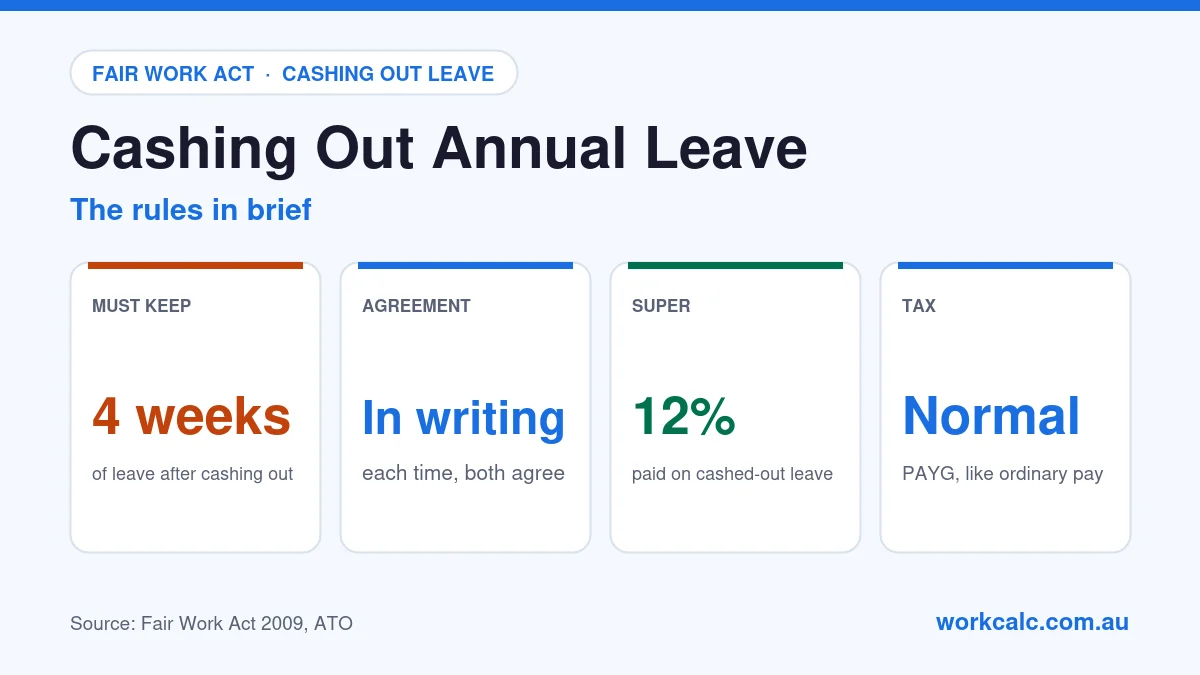
- 4-week minimum — you must retain at least 4 weeks of annual leave after the cash-out, no exceptions
- Both must agree — you cannot be forced into a cash-out; it must be genuinely voluntary and in writing each time
- Taxed as ordinary income — cash-out during employment uses Schedule 1 PAYG, not the Schedule 7 averaging concession
- Super IS owed — unlike a termination payout, a cash-out attracts the Superannuation Guarantee (currently 12%)
- No tax saving vs taking leave — the annual income tax outcome is the same; only the timing differs
What does "cashing out" annual leave actually mean?
Cashing out annual leave means converting part of your accrued leave balance to cash while you remain employed, instead of using the leave as time off. The leave hours are removed from your balance and replaced with a payment equal to what you would have earned if you had taken that leave.
This is different from a termination payout — where unused leave is paid out because employment has ended. A cash-out happens during employment, by choice, under a formal written agreement. The same dollar amount attracts different tax treatment depending on which of these two situations applies.
The Fair Work rules — what has to be in place before you can cash out
Under sections 93–94 of the Fair Work Act 2009, cashing out annual leave is only lawful when all of the following conditions are met. There is no discretion here — missing any one of them makes the arrangement invalid.
Cash-out eligibility checklist (Fair Work Act s.93–94)
-
✓
Your award or EA must allow it — a modern award or enterprise agreement must expressly permit cash-outs for your role. If you are award-free, the Fair Work Act itself allows it but only with a genuine written agreement.
-
✓
Written agreement every time — each individual cash-out requires a separate written agreement signed by both you and your employer. A blanket "cash out available on request" clause in your contract is not sufficient on its own.
-
✓
At least 4 weeks remaining after cash-out — after the transaction, your accrued annual leave balance must be at least 4 weeks. You cannot cash down to zero or below this threshold.
-
✓
Payment at ordinary rate — the cash-out must be paid at your ordinary rate of pay for the hours being cashed, plus any leave loading if applicable under your award.
-
✕
Cannot be compelled — your employer cannot require, pressure or incentivise you to cash out leave. The Fair Work Act expressly prohibits using a cash-out arrangement to avoid employment obligations.
-
!
Some awards restrict further — many modern awards cap how much leave can be cashed per 12 months (e.g. no more than 2 weeks per year), or impose additional procedural requirements. Always check your specific award.
To check your current leave balance before requesting a cash-out, use the Annual Leave Calculator — you need to confirm you'll have at least 4 weeks remaining after the transaction.
How cashed-out annual leave is taxed
This is where most employees have a misconception. A cash-out during employment is classified as ordinary earnings under the ATO's rules. Your employer withholds tax using the standard Schedule 1 PAYG tables — the same method used for your regular wages.
That means the cash-out amount is added to your regular pay for that pay period, the combined amount is annualised, and the marginal tax rate for that annualised income is applied. If you happen to cash out a large amount in a single fortnight, you may be withheld at a high rate for that period — though your actual annual tax liability is reconciled at year-end when you lodge your return.
What does NOT apply to a cash-out
- Schedule 7 (the averaging method) — this only applies to unused leave on termination, not cash-outs during employment.
- The Lump Sum A label — cash-outs appear as ordinary salary on your income statement, not as Lump Sum A. Lump Sum A is only used for some termination payouts, such as genuine redundancy.
- The pre-1993 concessional rate — the flat 32% concessional rate for pre-August 1993 leave on redundancy does not apply to cash-outs at all.
Super is payable on cash-outs — unlike termination payouts
This is the most financially significant difference most employees don't know. When annual leave is cashed out during employment, the payment is included in Ordinary Time Earnings (OTE), and your employer must pay Superannuation Guarantee contributions on it at the current rate (12%, effective 1 July 2025).
When the same leave is paid out on termination, it is explicitly excluded from OTE under the ATO's SGAA provisions, and super is not owed.
For a $5,000 cash-out, this means your employer is also contributing $600 to your super fund that they wouldn't have if you'd waited until termination. That's real money — and it changes the net comparison between cashing out now versus leaving the leave to accrue until you resign. You can check exactly what should be paid on your ordinary earnings with the Superannuation Calculator.
Cash-out vs taking leave vs waiting for termination — which is better?
The honest answer: from a pure income-tax perspective, it usually doesn't matter. Your annual income tax liability is the same whether you take annual leave as time off, cash it out mid-employment, or receive it as a termination payout — because in all three cases, the income ends up in your assessable income for the year.
The differences are in timing, super, and the withholding concession:
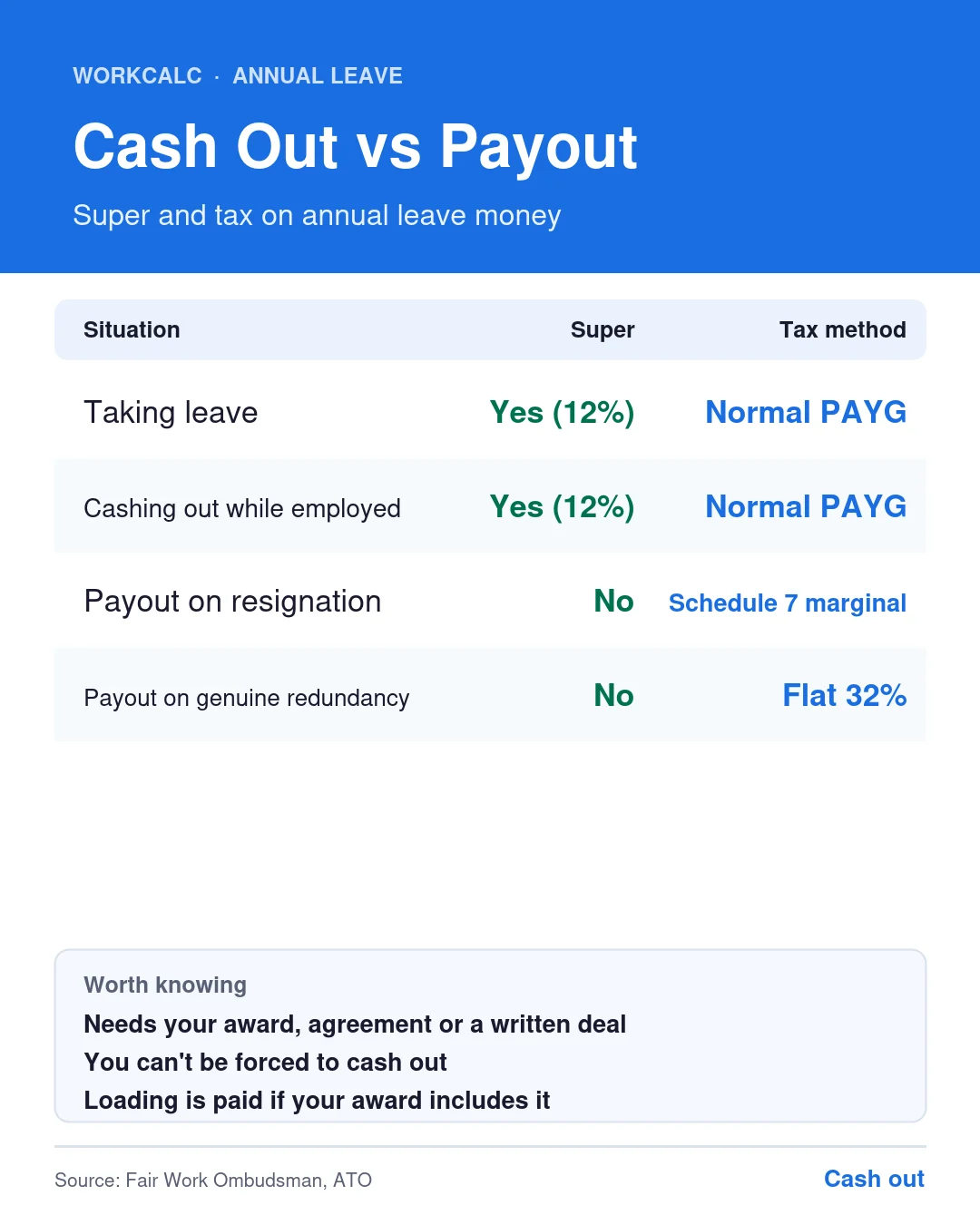
| Scenario | Tax method | Super owed | Loading payable |
|---|---|---|---|
| Take leave during employment | Schedule 1 (ordinary) | Yes (12%) | Yes (if award applies) |
| Cash out during employment | Schedule 1 (ordinary) | Yes (12%) | Yes (if award applies) |
| Payout on resignation | Schedule 7 (averaging) | No | Usually yes (check award) |
| Payout on redundancy | Schedule 7 (averaging) | No | Usually yes (check award) |
The written agreement — what it must contain
Every cash-out requires a separate written agreement. A general clause in your employment contract that says leave "may be cashed" is not enough on its own — each transaction needs its own document. The Fair Work Act specifies that the written agreement must include:
-
1
The amount of leave being cashed out
In hours or days — must be clearly quantified so there is no ambiguity about what is being removed from your balance.
-
2
The amount to be paid
The dollar figure, calculated at your ordinary rate of pay plus any applicable leave loading under your award.
-
3
The date the payment will be made
A specific payment date or pay period must be identified.
-
4
Signatures of both parties
The agreement must be signed by you and your employer. If you are under 18, a parent or guardian must also sign.
Can your employer force you to cash out leave?
No. The Fair Work Act is explicit: an employer cannot require or pressure an employee to enter into a cash-out arrangement. Any agreement made under duress — or where the employee was unaware of the consequences — is potentially unenforceable and may constitute a breach of the Act.
If your employer is applying pressure, directing that you must cash out leave, or treating cash-outs as a condition of employment, contact the Fair Work Ombudsman. This is a separate issue from an employer directing excessive leave to be taken (which is allowed under some modern awards for very large balances) — cash-out cannot be directed, only taking leave can be.
What counts as "excessive leave" — and how cash-outs fit in
Some modern awards and enterprise agreements allow employers to direct employees to take annual leave if they have an "excessive" leave balance — typically defined as more than 8 weeks of accrued leave, or 10 weeks for shift workers. This is a direction to take leave, not a direction to cash out.
If you have a large balance and want to reduce it without taking time off, a cash-out by mutual agreement is one option — provided your award allows it and you retain the 4-week minimum. Alternatively, check how your balance is tracking against the excessive leave threshold for your award to understand your position.
Related calculator Check your annual leave balance — confirm you'll keep 4 weeks after any cash-out → Related guide How Is Tax Calculated on Annual Leave Payouts? — Schedule 7, Lump Sum A, and redundancy rates → Related calculator Estimate tax on a termination payout — Annual Leave Payout Tax Calculator → Related calculator Calculate your 17.5% leave loading — Annual Leave Loading Calculator → Also check Long service leave — different cash-out rules apply per state under state legislation →Disclaimer: This article reflects the Fair Work Act 2009 and ATO rules. Individual awards and enterprise agreements may impose additional conditions on cash-outs. This is educational content, not legal or tax advice. For advice on your specific situation, consult the Fair Work Ombudsman or a registered tax agent.
Frequently asked questions: cashing out annual leave
Plain-English answers on Fair Work rules, the 4-week minimum balance, tax treatment and super implications.
Can you cash out annual leave in Australia?
Yes, but only if your modern award or enterprise agreement expressly allows it, or — for award-free employees — if you and your employer reach a genuine written agreement. You must also retain at least 4 weeks of annual leave after the cash-out, and the agreement cannot be made under pressure or duress. Without these conditions being met, a cash-out is not valid under the Fair Work Act.
How much annual leave can you cash out?
You can cash out any amount above the 4-week minimum balance that must remain in your account after the transaction. There is no upper cap in the Fair Work Act, but many modern awards limit cash-outs to a set number of weeks per 12-month period (such as a maximum of 2 weeks per year). Check your specific award for any such limit.
How is cashed-out annual leave taxed?
It is taxed as ordinary employment income using the standard Schedule 1 PAYG withholding tables — the same method as your regular wages. There is no Schedule 7 averaging concession, no Lump Sum A classification, and no flat-rate concession. The cash-out is simply added to your pay for that period and taxed accordingly. Over-withholding in a single period is corrected when you lodge your annual tax return.
Is superannuation paid on cashed-out annual leave?
Yes. A cash-out during employment is Ordinary Time Earnings, so the Superannuation Guarantee (currently 12%) applies. This is the opposite of a termination payout, where annual leave is excluded from OTE and super is not owed. If you have an employer who offers a cash-out, they must also pay super on top of the payment.
Does cashing out annual leave save tax?
No. The annual income tax result is identical to taking the leave — both are ordinary income assessed at your marginal rate for the year. A large cash-out in a single fortnight may result in high withholding for that period, but this is corrected at year-end tax time. The difference between cash-out and termination payout is real, however — the termination payout uses Schedule 7 averaging, which typically produces a lower effective withholding rate.
What is the difference between cashing out annual leave and a termination payout?
A cash-out during employment is taxed as ordinary income under Schedule 1, and super is owed. A termination payout when you leave a job is taxed under ATO Schedule 7 using the marginal averaging method (producing a lower effective rate in most cases), and super is not owed. The gross amount is the same — ordinary rate × hours — but the net outcome differs because of these tax and super differences.
Does my employer have to agree to cash out my annual leave?
Yes. A cash-out requires genuine mutual agreement — you cannot be compelled to cash out, and you cannot compel your employer to agree either. Some awards also require the employer to provide information about the arrangement in writing. If your employer is pressuring you to cash out, contact the Fair Work Ombudsman on 13 13 94.
What must a written cash-out agreement include?
The Fair Work Act requires each written agreement to specify: the amount of leave being cashed out (in hours or days), the amount to be paid (in dollars), and the date the payment will be made. Both parties must sign it. If the employee is under 18, a parent or guardian must also sign. Keep a copy — employers are required to retain records for 7 years.