
Redundancy Pay Calculator Australia
Calculate your NES redundancy entitlement in seconds — enter your years of service and weekly pay. Then switch to the Tax tab to see what's tax-free and your net payout.
under NES
2026–27
to qualify
exemption
Redundancy Entitlement Calculator
NES minimums under Fair Work Act 2009 — private sector Australia
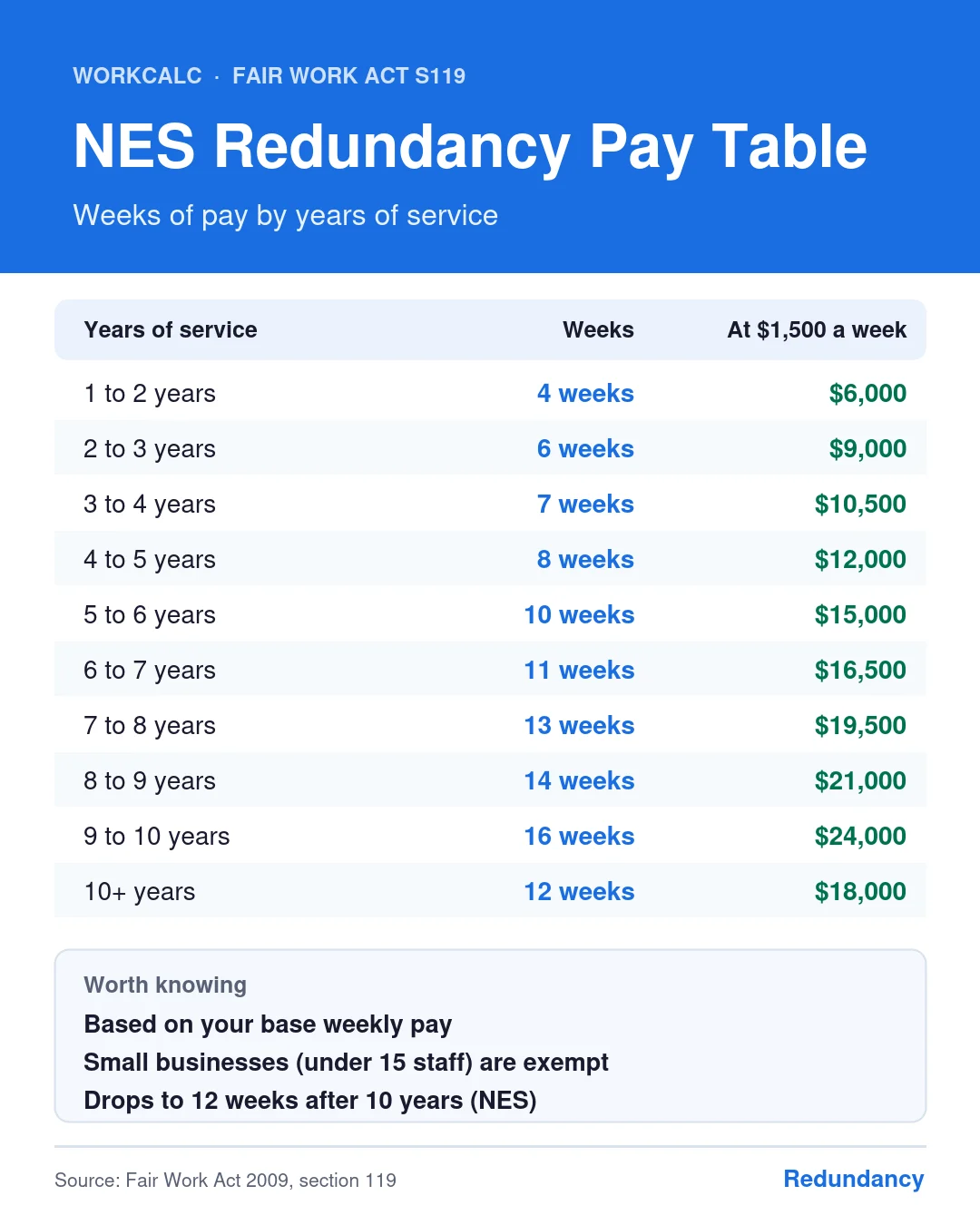
NES redundancy pay table (Fair Work Act s119)
| Years of service | Weeks redundancy pay | At $1,500/wk |
|---|---|---|
| 1 – 2 years | 4 weeks | $6,000.00 |
| 2 – 3 years | 6 weeks | $9,000.00 |
| 3 – 4 years | 7 weeks | $10,500.00 |
| 4 – 5 years | 8 weeks | $12,000.00 |
| 5 – 6 years | 10 weeks | $15,000.00 |
| 6 – 7 years | 11 weeks | $16,500.00 |
| 7 – 8 years | 13 weeks | $19,500.00 |
| 8 – 9 years | 14 weeks | $21,000.00 |
| 9 – 10 years | 16 weeks | $24,000.00 |
| 10+ years ↓ drops here | 12 weeks | $18,000.00 |
Tax on Redundancy Calculator
ATO genuine redundancy rules · 2026–27 tax-free limits · ETP withholding
Tax-free amounts use 2026–27 ATO genuine redundancy limits: $13,598 base + $6,801 per completed year of service. ETP withholding is 32% if you are under preservation age (60), or 17% at or above it (both including Medicare levy), for amounts up to the ETP cap ($270,000 in 2026–27). These are estimates only — actual tax depends on total income for the year. Full tax guide →
Redundancy Calculator by State — NSW, VIC, QLD, WA
Redundancy pay under the NES is federal law — identical in every state. The calculator above applies to all Australian states. Here's what that means in practice for each state's major search queries.
NSW
NSW employees use the same NES redundancy table as every other state. Enter your years of service and weekly pay in the calculator above for your exact NSW redundancy payout.
VIC
Victorian employees are covered by the federal NES. The redundancy calculation is identical to NSW, QLD and WA. Use the calculator above — state selection makes no difference to the NES result.
QLD
Queensland private sector employees are covered by the federal NES — same entitlements as every other state. Queensland state government employees may be covered by separate instruments; check your specific award or agreement.
WA
Most WA private sector employees are covered by the federal NES and use the same redundancy table. A small subset remain under WA state industrial law — if unsure, check with the WA Industrial Relations Commission.
How NES redundancy pay works
What you get on top of redundancy pay, who misses out, the 10-year drop in the NES table, and what makes a redundancy genuine.
What redundancy pays you get
On top of redundancy pay (NES weeks × weekly rate), you are also entitled to:
- All unused annual leave — paid at your ordinary rate, taxed using Schedule 7
- Payment in lieu of notice — if your employer doesn't require you to work out your notice period
- Long service leave — if you've reached the qualifying period in your state
- Superannuation on ordinary earnings up to the date of termination
These are in addition to redundancy pay — use the annual leave calculator and long service leave calculator to add these up.
The 10-year NES drop — don't miss this
The NES table has a counter-intuitive rule: the redundancy payment drops after 10 years of service. At 9–10 years you receive 16 weeks — the maximum. At 10+ years, only 12 weeks.
This is intentional under the Fair Work Act — the rationale is that long-tenured employees have stronger redeployment prospects. However, your enterprise agreement or employment contract may override this with more generous terms. Always check your specific agreement.
If you are approaching 10 years of service, the timing of a redundancy can significantly affect your entitlement — see full explanation with worked examples.
Who is NOT entitled to redundancy pay
- Casual employees — no guaranteed ongoing employment, so no redundancy entitlement under the NES
- Less than 12 months service — minimum 1 year continuous employment required
- Small business employees — employers with fewer than 15 staff are exempt from NES redundancy (though your award may still require it)
- Fixed-term contract employees — where the role ends at the agreed date
- Serious misconduct dismissal — dismissal for serious misconduct forfeits redundancy entitlement
Genuine redundancy vs other termination
A genuine redundancy means the job itself is no longer needed — not just that the person is being let go. For a redundancy to be genuine under the Fair Work Act, three conditions must all be met:
- The employer no longer requires the job to be done by anyone
- The employer has complied with any consultation obligations in the relevant award or agreement
- It was not reasonably practicable to redeploy the employee within the business or an associated entity
Only genuine redundancies attract the ATO tax-free threshold. See full guide to genuine redundancy rules.
Redundancy Calculator — Frequently Asked Questions
Plain-English answers on Australian redundancy pay, NES entitlements, tax treatment and who qualifies.
How is redundancy pay calculated in Australia?
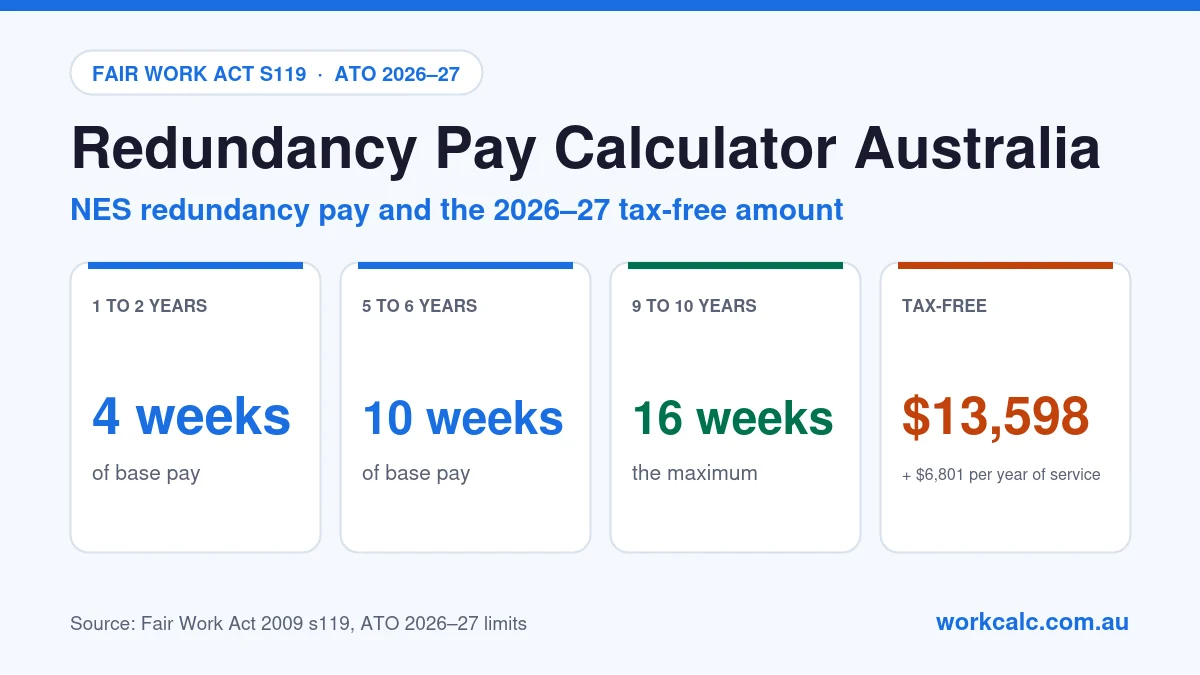
Using the NES table: years of continuous service maps to a number of weeks pay. At 1–2 years: 4 weeks. At 5–6 years: 10 weeks. At 9–10 years: 16 weeks (maximum). Pay = NES weeks × ordinary weekly base rate (no overtime or bonuses). Use the calculator above for your exact figure.
Why does redundancy pay drop after 10 years under the NES?
It's a quirk of the Fair Work Act NES table. At 9–10 years you get 16 weeks — the maximum. At 10+ years, only 12 weeks. The rationale is that very long-tenured employees have stronger prospects of redeployment. Your enterprise agreement or contract may provide more — always check it before accepting any offer.
Is redundancy the same in NSW, VIC, QLD and WA?
Yes. Redundancy pay under the NES is federal law — identical in every state and territory for private sector employees. NSW, VIC, QLD, WA, SA, TAS, ACT and NT all use the same Fair Work table. State does not change the entitlement amount.
Is any part of redundancy pay tax-free?
Yes — for genuine redundancies. The 2026–27 tax-free limit is $13,598 + $6,801 per completed year of service. The amount above this is taxed as an Employment Termination Payment at a concessional rate of 32% if you are under preservation age (60), or 17% at or above it (both including Medicare levy), up to the ETP cap. Voluntary resignations do not attract the tax-free threshold. Use the Tax tab above or see our full tax on redundancy guide.
Are small business employees entitled to redundancy pay?
Generally no. Employers with fewer than 15 employees are exempt from the NES redundancy provisions. However, if a modern award or enterprise agreement covering the employee includes redundancy pay, those provisions still apply regardless of employer size. Always check your specific award.
Do casual employees get redundancy pay?
No. Casual employees are excluded from the NES redundancy entitlement because they don't have guaranteed ongoing employment. Only permanent employees (full-time and part-time) who have completed at least 12 months of continuous service qualify for NES redundancy pay.
Does redundancy pay include annual leave and long service leave?
No — redundancy pay is the NES weeks-based payment only. On top of it, you separately receive: all unused annual leave paid out at your ordinary rate, payment in lieu of notice if applicable, and long service leave if you've reached the qualifying period. Use the annual leave calculator and long service leave calculator to add those up.
Is redundancy calculated on base salary or total package?
Base rate only. Redundancy weeks are multiplied by the ordinary weekly pay — the base hourly rate × ordinary hours (usually 38/week). Overtime, penalty rates, bonuses, allowances and superannuation contributions are excluded from the calculation.
What is the difference between redundancy and resignation financially?
The difference is significant. Redundancy gives you: NES weeks × weekly pay (tax-free up to the ATO limit) + unused annual leave + notice pay + long service leave if eligible. Resignation gives you: unused annual leave + notice pay (if you work it) — no redundancy payment, no tax-free threshold. See our full comparison guide: Redundancy vs Resignation — The Financial Difference.
When must redundancy pay be paid?
Redundancy pay must be paid on or before the employee's last day of employment — it forms part of the final pay. If an employer fails to pay redundancy when owed, the employee can make a complaint to the Fair Work Ombudsman (call 13 13 94) or lodge an underpayment claim through the Fair Work Commission. Unpaid redundancy can attract penalties against the employer.
Is severance pay the same as redundancy pay in Australia?
Yes — "severance pay" is the term commonly used in the US and UK, but in Australia the correct legal term is redundancy pay, and it's governed by the NES table under the Fair Work Act 2009. If you're searching for a severance pay calculator, the calculator above uses the same NES weeks-based formula that applies to Australian redundancy pay.
What is voluntary redundancy, and is it paid the same way?
Voluntary redundancy is where an employer offers redundancy to employees and lets them choose whether to accept it, rather than selecting who is made redundant. If the underlying redundancy is genuine (the role is genuinely no longer needed), a voluntary redundancy is calculated and taxed exactly the same as any other genuine redundancy — using the NES table above and the same ATO tax-free threshold. Some employers offer enhanced voluntary redundancy packages above the NES minimum, which is calculated the same way but with a higher weeks figure.
What other termination payments am I owed alongside redundancy?
Redundancy is one part of a broader termination payment. On top of NES redundancy pay, you're also owed: unused annual leave, payment in lieu of notice (if not worked; your NES notice periods set the minimum weeks), any accrued long service leave, and outstanding wages up to your last day. For the complete termination payments picture in one total, use the Final Pay Calculator.
What if my employer says they can't afford to pay my redundancy?
They can't reduce it unilaterally. Under section 120 of the Fair Work Act, an employer must formally apply to the Fair Work Commission to have redundancy pay reduced — either because they've found the employee other acceptable employment, or because they genuinely can't afford the full amount. The FWC assesses the application and can reduce the payment (sometimes to nil) or refuse it entirely. Until the FWC actually orders a reduction, the full NES amount is still owed. If payment simply doesn't arrive on time, that's a separate issue — contact the Fair Work Ombudsman.
What happens to my redundancy pay if my employer goes into liquidation?
The Commonwealth Fair Entitlements Guarantee (FEG) is a government safety net for employees left unpaid when an employer enters liquidation or bankruptcy. It can cover up to 13 weeks of unpaid wages, unused annual leave, unused long service leave, up to 5 weeks of payment in lieu of notice, and redundancy pay at up to 4 weeks per full year of service, following your NES entitlement scale. Payments are capped by the FEG Maximum Weekly Wage ($3,032 for the 2026–27 period) — above that, the excess must be pursued through the insolvent estate. FEG does not cover unpaid superannuation; that's handled separately through the ATO. Apply via the Department of Employment and Workplace Relations.
Can I challenge my redundancy as unfair dismissal?
Yes, if you believe the redundancy wasn't genuine — for example, your role wasn't actually eliminated, you weren't consulted as required, or you could reasonably have been redeployed. You generally have 21 days from your termination date to lodge an unfair dismissal application with the Fair Work Commission. One eligibility factor: if you're not covered by an award or enterprise agreement and you earn above the high income threshold — $190,100 for dismissals from 1 July 2026 — you're generally excluded from unfair dismissal protections, though you may still have other legal options such as a general protections claim.
Estimates only — not legal or tax advice. This calculator applies the NES Fair Work table and 2026–27 ATO genuine redundancy tax limits. Individual entitlements may be affected by enterprise agreements, modern awards, employment contracts or specific circumstances. For advice on your specific situation, contact the Fair Work Ombudsman (13 13 94) or a qualified workplace relations professional. Tax estimates should be verified with a registered tax agent.