
Tax on Redundancy Pay Australia: What's Tax-Free, What's Not and How to Calculate It
The ATO tax-free threshold for genuine redundancy, how the ETP rate works, and what happens to your leave payout and notice pay — with worked examples for 2026–27.
The key distinction: genuine redundancy vs everything else
Tax treatment of redundancy pay depends entirely on whether the ATO classifies your termination as a genuine redundancy. If it qualifies, a substantial portion of your payment is completely tax-free. If it doesn't — for example, because you resigned, were dismissed for misconduct, or your role was filled by someone else shortly after — the tax-free component disappears and the entire payment is taxed as an Employment Termination Payment from the first dollar.
This distinction can mean tens of thousands of dollars in tax on a large payment. Getting clarity on whether your redundancy is genuine before you leave is worth the effort.
The 2026–27 tax-free limits in full
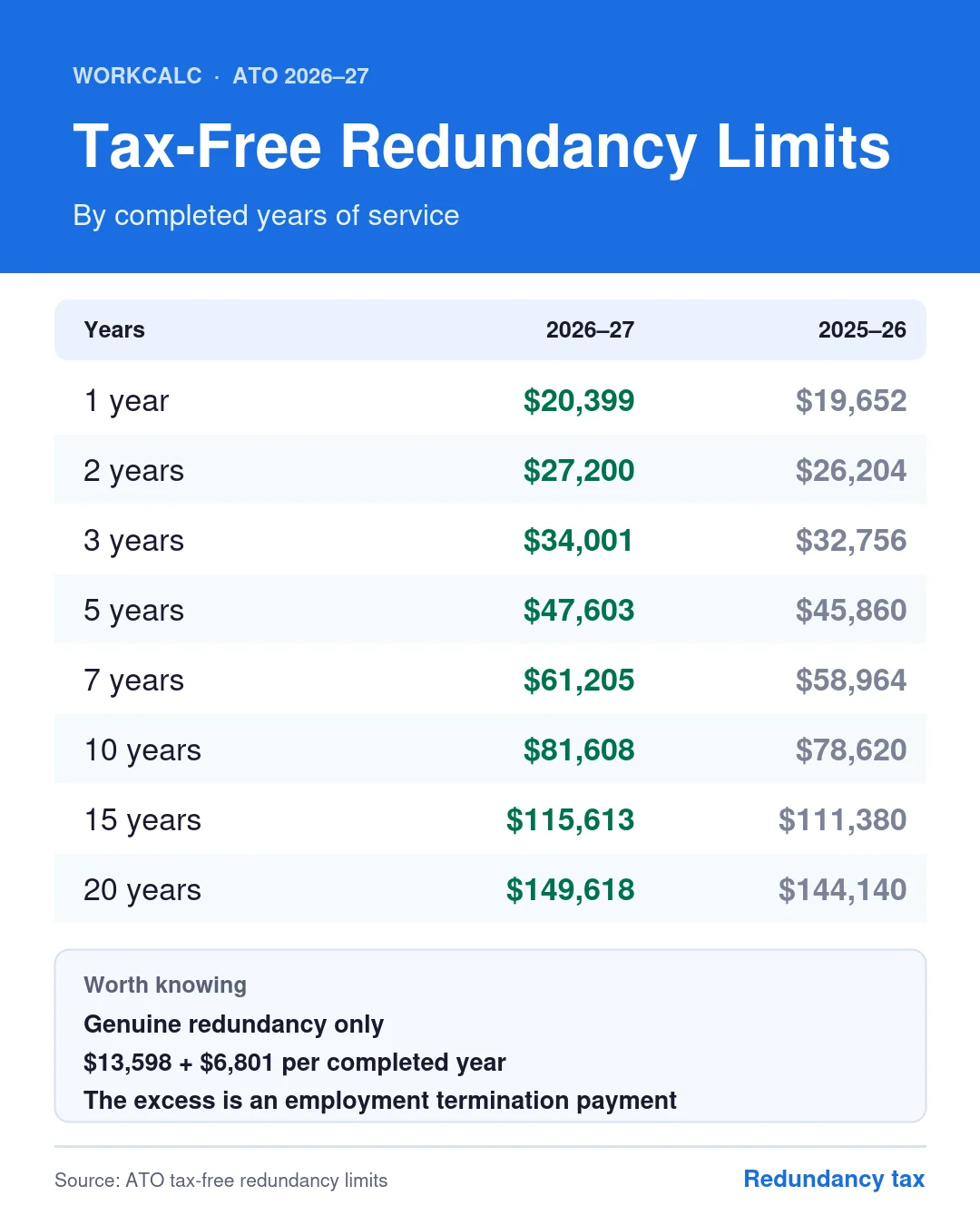
The ATO publishes indexed limits each financial year. For payments received between 1 July 2026 and 30 June 2027, the limits are:
| Completed years of service | Tax-free limit (2026–27) | 2025–26 (previous year) |
|---|---|---|
| 1 year | $20,399 | $19,652 |
| 2 years | $27,200 | $26,204 |
| 3 years | $34,001 | $32,756 |
| 5 years | $47,603 | $45,860 |
| 7 years | $61,205 | $58,964 |
| 10 years | $81,608 | $78,620 |
| 15 years | $115,613 | $111,380 |
| 20 years | $149,618 | $144,140 |
Only completed full years count. If you have worked 7 years and 11 months, only 7 years are used. Partial years do not contribute to the tax-free component.
These figures apply solely to the NES redundancy payment itself. Your unused annual leave payout, payment in lieu of notice, and long service leave are all separate — they have their own tax rules, discussed below.
What happens to the amount above the tax-free threshold
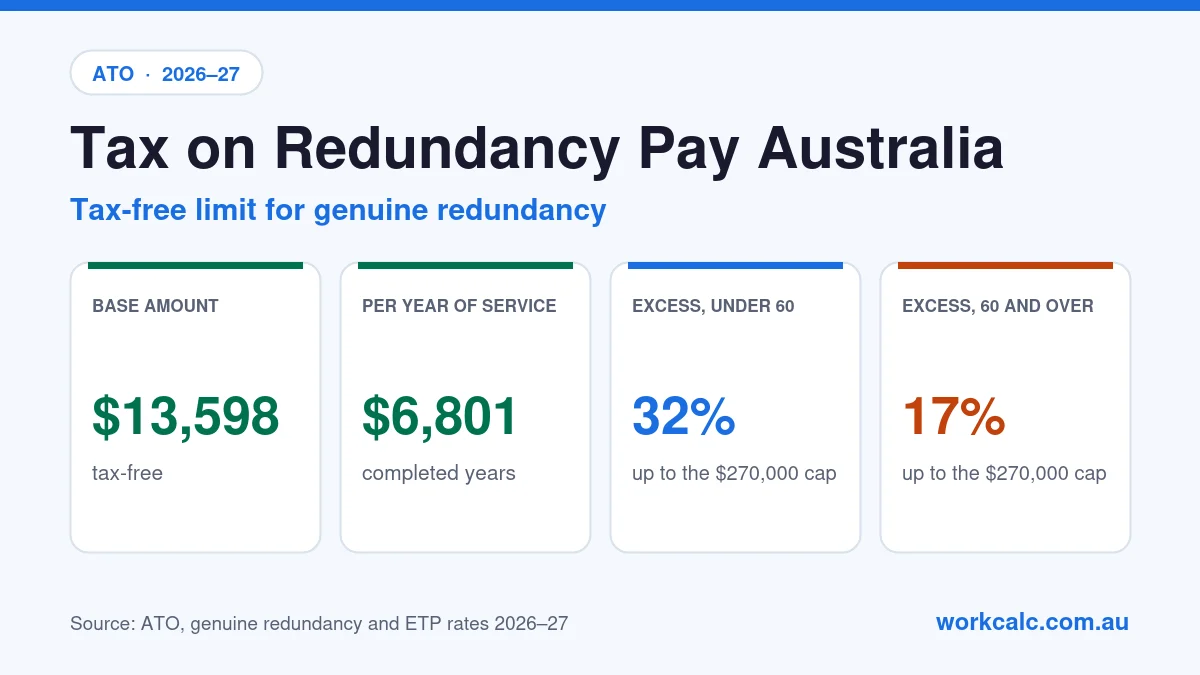
The portion of a genuine redundancy payment that exceeds the tax-free limit is classified as an Employment Termination Payment (ETP). It is not taxed at your marginal rate — it receives its own concessional flat withholding rates:
| Your situation | ETP amount | Withholding rate |
|---|---|---|
| Below preservation age (most employees under 60) | Up to $270,000 ETP cap | 32% |
| Below preservation age | Above $270,000 ETP cap | 47% (top marginal) |
| At or above preservation age (60+ for most) | Up to $270,000 ETP cap | 17% |
| At or above preservation age | Above $270,000 ETP cap | 47% (top marginal) |
For most working-age Australians born after 30 June 1964, the preservation age is 60. The 32% ETP rate (including Medicare levy) compares favourably to the top marginal rate of 47%, which is what the same money would attract if it were simply added to your regular income for the year.
Calculate your redundancy and tax estimate
NES entitlement weeks, tax-free threshold and estimated net payout — in one tool.
Worked example — 5 years service, $80,000 salary
Alex — 5 completed years, $80,000 salary ($1,538.46/week), age 42, genuine redundancy
Alex's entire 10-week NES redundancy payment falls below the tax-free limit, so no tax is withheld at all. This is common for employees with moderate service periods — the tax-free threshold is generous.
Worked example — 12 years service, $110,000 salary
Morgan — 12 completed years, $110,000 salary ($2,115.38/week), age 51, genuine redundancy
Worked example — large payout exceeding the tax-free threshold
Sam — 8 completed years, $200,000 salary ($3,846.15/week), age 48, genuine redundancy, employer paid 3× NES
How the other components of final pay are taxed
The redundancy payment and its tax-free threshold cover only the NES redundancy component. Every other part of your final pay is taxed separately under different rules:
| Component | Tax treatment | ATO classification |
|---|---|---|
| NES redundancy pay | Tax-free up to $13,598 + $6,801/yr (2026–27). Excess taxed as ETP at 32%/17%. | Genuine redundancy |
| Unused annual leave | Taxed under ATO Schedule 7 using marginal rate averaging — not part of the tax-free redundancy threshold. | Lump Sum A |
| Payment in lieu of notice | Taxed as ordinary income at your marginal rate — the same as wages. Not part of the tax-free redundancy amount. | Ordinary income |
| Unused long service leave | Taxed under ATO Schedule 7. Pre-16 Aug 1978 accrual gets a 5% tax offset; post-1978 at marginal rates via averaging. | Lump Sum B / A |
For the complete Schedule 7 mechanics behind that annual leave figure — including how marginal rate averaging actually works — see Tax on Annual Leave Payouts.
Related tool Annual Leave Payout Tax Calculator — Schedule 7 withholding on your leave balance →What makes a redundancy "genuine" under the ATO
The tax-free threshold only applies if the ATO classifies your termination as a genuine redundancy under section 83-175 of the Income Tax Assessment Act 1997. Three conditions must all be met:
- The job no longer exists. The employer genuinely no longer requires anyone to do that job — not simply replacing the person with someone else or restructuring the same role under a new title.
- Consultation obligations were followed. If a modern award or enterprise agreement requires the employer to consult about the redundancy, that process was genuinely carried out.
- Redeployment was not reasonably practicable. The employer genuinely could not redeploy the employee to another suitable role within the same employer or an associated entity.
If the ATO determines the redundancy is not genuine — for example because the role was advertised and filled shortly after, or the real reason was performance — the entire payment loses the tax-free status and is taxed as a standard ETP from the first dollar.
Does redundancy pay affect my tax return?
The tax-free component is genuinely free of tax — it is not included in your assessable income and does not need to be declared on your return. The taxable ETP component is included in your assessable income and must be declared. Your employer reports this through Single Touch Payroll and it appears on your income statement, which pre-populates your myTax return.
The employer's PAYG withholding on the ETP is a credit against your tax liability for the year. If total withholding from all sources exceeds your tax liability, you will receive a refund. If your total income for the year (including the ETP) pushes you above a HELP repayment threshold or Medicare Levy Surcharge tier, a top-up amount may be owed when you lodge.
Redundancy pay and superannuation
Superannuation Guarantee (12% SG rate, effective 1 July 2025) is not payable on redundancy payments — genuine redundancy pay, payment in lieu of notice, and unused leave payouts are all excluded from Ordinary Time Earnings under super law. Super is only payable on earnings actually worked, up to the date of termination. You can check what should have been paid on those worked earnings with the Superannuation Calculator.
Related guide Redundancy vs Resignation — The Financial Difference Every Australian Employee Should Know →All figures in this article use the ATO's published 2026–27 genuine redundancy tax-free limits ($13,598 base + $6,801 per completed year of service) and the 2026–27 ETP cap of $270,000, sourced directly from the ATO. These are indexed annually — for comparison, the 2025–26 limits were $13,100 base + $6,552 per completed year of service, with an ETP cap of $260,000.
Frequently asked questions
The most common questions about tax on redundancy pay in Australia.
How much of my redundancy pay is tax-free?
For 2026–27: $13,598 plus $6,801 for each completed year of continuous service. With 5 completed years, your tax-free limit is $13,598 + $34,005 = $47,603. Any genuine redundancy payment up to that limit is completely tax-free — no PAYG withheld and not included in your assessable income.
What is the tax rate on redundancy above the threshold?
The excess is taxed as an ETP at 32% if you are below preservation age (60 for most people), or 17% if you are at or above it — up to the $270,000 ETP cap (2026–27). Anything above the cap is taxed at 47%. Use the Redundancy Pay Calculator to model your specific numbers.
Is redundancy pay tax-free if I resign?
No. The tax-free threshold only applies to genuine redundancy payments where your job no longer exists. A voluntary resignation is taxed at normal marginal rates — no tax-free component applies. See the comparison in Redundancy vs Resignation.
Is annual leave payout taxed differently to redundancy pay?
Yes. Annual leave paid out on termination is taxed under ATO Schedule 7 (not as part of the redundancy tax-free amount) and reported as Lump Sum A. Use the Annual Leave Payout Tax Calculator to estimate the withholding on that component separately.
Does redundancy pay affect my tax return?
The tax-free component is not assessable income — it genuinely does not appear on your tax return. The taxable ETP component is assessable income and pre-populates in myTax from your income statement. Employer PAYG withholding is credited against your final liability when you lodge.
What is a genuine redundancy under ATO rules?
Under s83-175 ITAA 1997: the employer no longer requires the job to be done by anyone; consultation obligations (if any) were followed; and redeployment within the organisation was not reasonably practicable. All three conditions must be met. See How Is Redundancy Calculated for the full genuine redundancy test.
Is super paid on redundancy payments?
No. Superannuation Guarantee is not payable on genuine redundancy pay, payment in lieu of notice, or unused leave payouts — these are excluded from Ordinary Time Earnings under super law. Super is only payable on earnings actually worked up to the termination date.