
How Is Redundancy Calculated in Australia? The NES Table, Genuine Redundancy Rules and Step-by-Step Worked Examples
Everything you need to know about how redundancy pay is worked out under Australian law — the NES week table, what counts as base pay, the 10-year quirk, and what makes a redundancy genuine.
The formula: weeks × base weekly pay
Redundancy pay in Australia has a deceptively simple formula. The Fair Work Act 2009 sets out a table in Schedule 4 — called the NES redundancy table — that assigns a number of weeks pay to each band of continuous service. You look up how many years you have worked, find the corresponding weeks figure, and multiply it by your base weekly pay.
Step-by-step calculation
e.g. started 15 March 2019, redundant 15 June 2026 = 7 completed years7 completed years → 13 weeks$90,000 ÷ 52 = $1,730.77 per week13 × $1,730.77 = $22,500.00The NES redundancy pay table
This is the exact table from Schedule 4 of the Fair Work Act 2009. It applies to all private sector employees in Australia regardless of state.
| Period of continuous service | Redundancy pay (weeks) | Note |
|---|---|---|
| 1 year to less than 2 years | 4 | |
| 2 years to less than 3 years | 6 | |
| 3 years to less than 4 years | 7 | |
| 4 years to less than 5 years | 8 | |
| 5 years to less than 6 years | 10 | |
| 6 years to less than 7 years | 11 | |
| 7 years to less than 8 years | 13 | |
| 8 years to less than 9 years | 14 | |
| 9 years to less than 10 years | 16 | Peak entitlement |
| 10 years or more | 12 | ⚠ Drops to 12 weeks |
The table only applies once you have completed at least one full year of continuous service. Employees with less than 12 months of continuous service receive no NES redundancy pay.
The 10-year drop — why the entitlement goes down
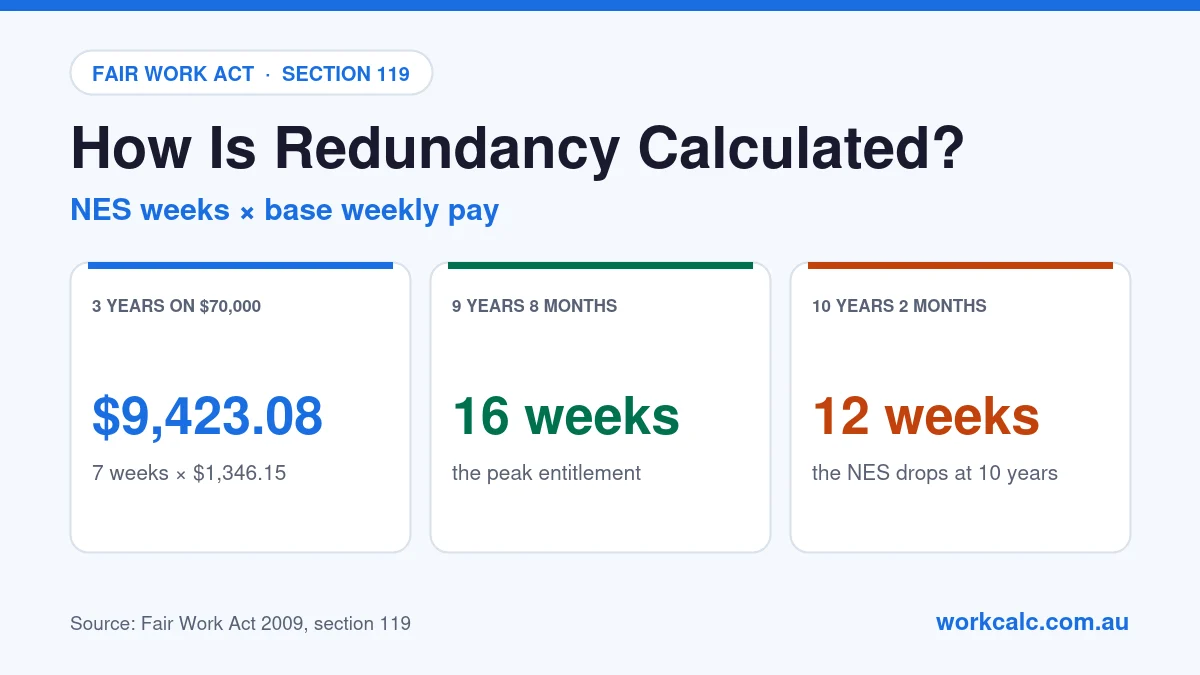
The most counterintuitive feature of the NES table is that an employee with 9 years and 11 months of service receives 16 weeks of redundancy pay, while an employee who crosses the 10-year mark receives only 12 weeks. This is not a mistake or a rounding error — it is a deliberate provision in the Fair Work Act.
The legislative rationale is that employees with 10 or more years of service are more likely to have long service leave entitlements available — in most states, the qualifying period is 7 or 10 years — and are assumed to have had more opportunity for redeployment within a large organisation. Enterprise agreements and employment contracts can always provide more generous entitlements than the NES minimum, and many do for long-serving employees.
What counts as base weekly pay
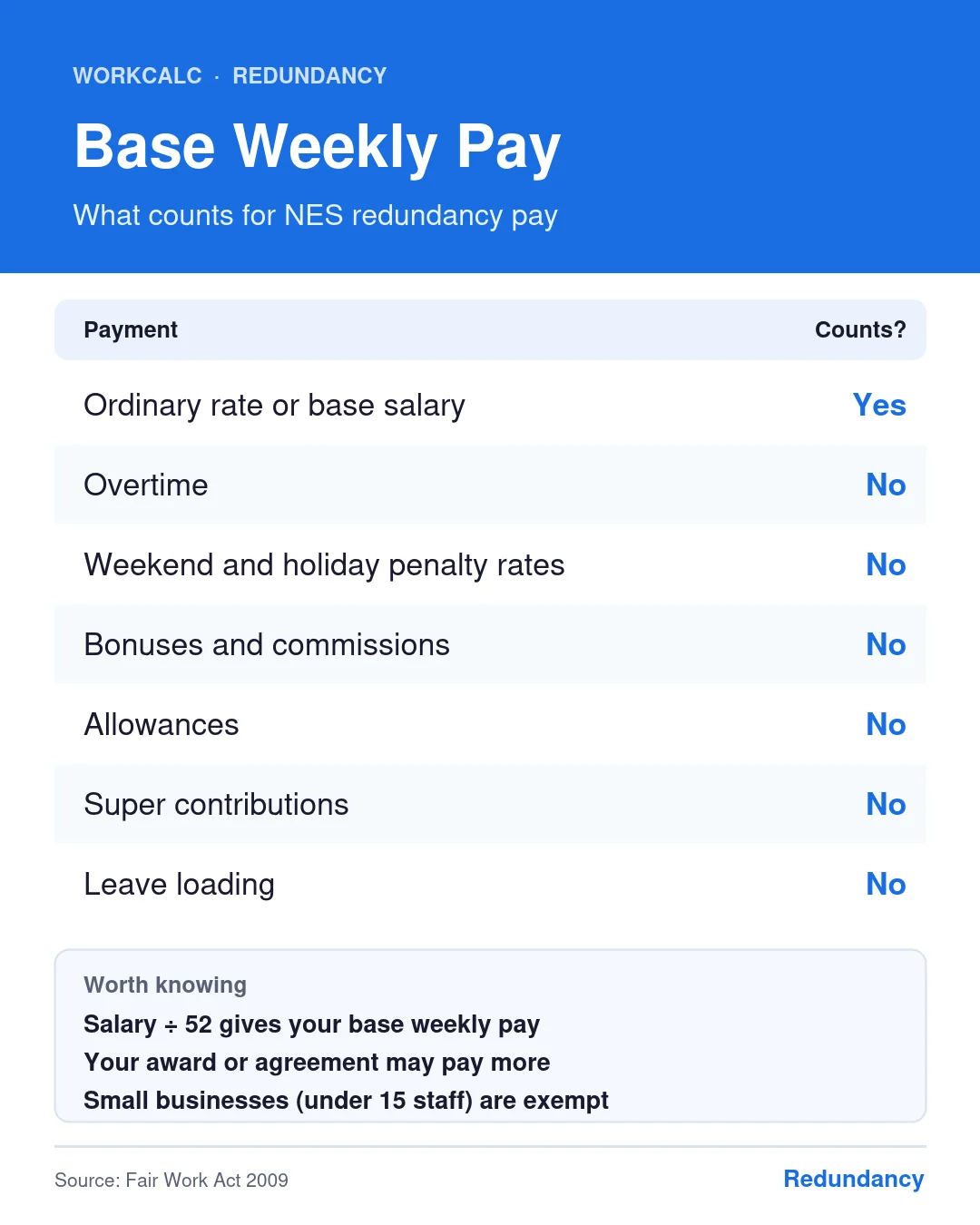
Redundancy pay is calculated on the base rate of pay for ordinary hours. This is narrower than total earnings or gross pay, and the distinction matters:
| Payment type | Included in base weekly pay? |
|---|---|
| Ordinary hourly rate or base salary | Included |
| Overtime payments | Excluded |
| Penalty rates for working weekends or public holidays | Excluded |
| Performance bonuses or commissions | Excluded |
| Allowances (meal, tool, travel) | Excluded |
| Superannuation contributions | Excluded |
| Leave loading | Excluded |
For a salaried employee, the weekly base rate is simply annual salary ÷ 52, regardless of what they actually earn in a given week. For an hourly employee, it is ordinary hourly rate × contracted ordinary hours per week (typically 38).
Related guide How Is Overtime Calculated in Australia? — the full formula for the payments excluded here →Calculate your exact redundancy entitlement
Enter your years of service and weekly pay — get the NES weeks, gross payout, and tax-free estimate in seconds.
Worked example — 3 completed years, $70,000 salary
Riley — 3 years 4 months continuous service, $70,000/yr salary, genuine redundancy
Worked example — 9 years 8 months vs 10 years 2 months (the 10-year boundary)
Two employees, same $95,000 salary, same employer — different termination dates
This is why the timing of a redundancy near the 10-year mark is worth paying close attention to.
What else is included in your final payout (beyond redundancy pay)
Redundancy pay covers only the NES weeks entitlement. Your complete final pay also includes separate amounts for each of these:
- All unused annual leave — paid at your ordinary rate, taxed under ATO Schedule 7. This is completely separate from the redundancy tax-free threshold.
- Payment in lieu of notice — if your employer does not require you to work your notice period, they must pay it out. This is taxed as ordinary income.
- Outstanding wages — any pay for hours already worked but not yet paid.
- Long service leave — if you have reached your state's qualifying period (commonly 7 or 10 years).
What qualifies as a genuine redundancy
NES redundancy pay only applies to genuine redundancies. Under the Fair Work Act, a dismissal is a genuine redundancy when all three of the following apply:
- The job no longer exists. The employer genuinely no longer requires anyone to perform that role. Simply replacing the employee with someone else — or restructuring the same function under a different job title — is not a genuine redundancy.
- Consultation obligations were met. If a modern award or enterprise agreement requires the employer to consult with the employee about the redundancy, that process was genuinely carried out before the decision was finalised.
- Redeployment was not reasonably practicable. The employer genuinely could not place the employee in another suitable role within the same business or an associated entity. If a suitable vacancy existed and the employer simply chose not to offer it, the redundancy may not be genuine.
A redundancy that does not satisfy all three conditions can be challenged as an unfair dismissal at the Fair Work Commission, provided the employee has completed the minimum employment period (6 months, or 12 months for a small business employer).
Who is exempt from NES redundancy pay
Not all employees are covered. The main exclusions under the Fair Work Act are:
- Small business employers (fewer than 15 employees at the time of redundancy) are exempt from the NES redundancy pay provisions. However, if the employee's modern award or enterprise agreement requires redundancy pay, those obligations still apply.
- Employees with less than 12 months continuous service receive no NES redundancy pay regardless of employer size.
- Casual employees are not entitled to redundancy pay under the NES. Only permanent (full-time and part-time) employees are covered.
- Some apprentices and trainees may be excluded depending on the terms of their training contract.
- Employees on fixed-term contracts where the contract has expired according to its terms are not entitled to redundancy pay in respect of the contract's end.
Can an employer pay less than the NES amount?
Only in very limited circumstances. The NES sets the legal minimum, and an employer cannot simply offer less. Two exceptions exist:
- Redeployment was available but declined. If the employer offered the employee a suitable alternative role and the employee refused it, the Fair Work Commission may reduce or eliminate the redundancy pay obligation on application by the employer.
- Genuine financial hardship. An employer experiencing genuine financial difficulty can apply to the Fair Work Commission to reduce the redundancy pay obligation. The Commission will assess whether the business can genuinely afford to pay and may reduce — but not necessarily eliminate — the entitlement.
Neither exception is automatic. The employer must make a formal application to the Fair Work Commission and establish the relevant ground. An employer who simply refuses to pay the NES amount without a Commission order is in breach of the Act.
Related guide Tax on Redundancy Pay Australia — ATO tax-free threshold, ETP rates and worked examples →Redundancy vs resignation — the financial difference
The reason redundancy pay matters so much is the gap it creates compared to resigning. An employee who resigns receives only unused annual leave and notice pay (if not worked). An employee made redundant receives all of that plus the NES redundancy weeks payment, often with significant tax concessions on top of it.
Next guide Redundancy vs Resignation — The Financial Difference Every Australian Employee Should Know Before They Decide →NES redundancy table sourced from Schedule 4 of the Fair Work Act 2009. This article covers the national minimum entitlement. Modern awards and enterprise agreements may provide more generous entitlements — always check the instrument that covers your role.
Frequently asked questions
The most common questions about how redundancy is calculated in Australia.
How is redundancy pay calculated in Australia?
Redundancy pay = NES weeks (from the Fair Work Act table) × base weekly pay (annual salary ÷ 52, excluding overtime and bonuses). The table ranges from 4 weeks at 1–2 years of service up to 16 weeks at 9–10 years, then drops to 12 weeks at 10 or more years. Use the Redundancy Pay Calculator to get your exact figure.
What is the NES redundancy pay table?
The Fair Work Act Schedule 4 table: 1–2 years = 4 weeks; 2–3 years = 6 weeks; 3–4 years = 7 weeks; 4–5 years = 8 weeks; 5–6 years = 10 weeks; 6–7 years = 11 weeks; 7–8 years = 13 weeks; 8–9 years = 14 weeks; 9–10 years = 16 weeks (peak); 10+ years = 12 weeks (drops). See the full table above.
Why does redundancy pay drop at 10 years of service?
It is a specific provision in Schedule 4 of the Fair Work Act 2009. The entitlement drops from 16 weeks (at 9–10 years) to 12 weeks (at 10+) because the legislature assumed long-serving employees have greater access to long service leave and redeployment. It is not a mistake. Enterprise agreements can override it with more generous amounts.
What counts as a genuine redundancy in Australia?
Three conditions must all be met: (1) the employer no longer requires the job to be done by anyone — the position is abolished, not just the person replaced; (2) any award or agreement consultation obligations were followed; and (3) redeployment within the organisation was not reasonably practicable. If any condition fails, the redundancy may not be genuine and can be challenged as unfair dismissal.
Is redundancy pay calculated on gross or base salary?
Base salary only. Overtime, bonuses, commissions, penalty rates, allowances, leave loading and super contributions are all excluded. For a salaried employee, the weekly base rate is annual salary ÷ 52.
Do small businesses have to pay redundancy?
Generally no — employers with fewer than 15 employees at the time of the redundancy are exempt from the NES redundancy pay provisions. However, if a modern award or enterprise agreement covering the employee requires redundancy pay, those obligations still apply regardless of business size.
How much of redundancy pay is tax-free?
For 2026–27: $13,598 base plus $6,801 for each completed year of continuous service. The amount above that is taxed as an ETP at 32% (below preservation age) or 17% (at or above preservation age), up to the $270,000 ETP cap (2026–27). See the full breakdown in Tax on Redundancy Pay Australia.