
Permanent Part-Time vs Casual: The Crucial Difference in Annual Leave Entitlements
If you're working part-time hours in Australia, your leave entitlement depends entirely on one thing: how your employer has classified you. Casual employees get a loading. Permanent employees get leave. Here's what each actually means in dollars and weeks.
Under Australian law, there is no such thing as part-time annual leave — there is only permanent annual leave and casual loading. The hours you work each week don't determine your entitlement. Your employment classification does. Casual employees working 30 hours a week get zero accrued leave. Permanent part-timers on 10 hours a week accrue 4 weeks of leave every year. The gap between these two situations is significant — and many employees don't realise which category they're actually in.
The core difference at a glance
- Casual employees: 25% loading on every hour worked, paid now — no leave balance, no accrual, no payout on exit
- Permanent part-time: Same 0.07692 accrual factor as full-time — 4 weeks per year, balance builds up, paid out on termination (see how part-time annual leave works)
- Classification is what matters — not your hours, not how long you've worked there, not what you've been told informally
- Misclassification is common — employees working regular, predictable hours for months may have a claim to permanent status even if called "casual"
- Conversion rights exist — after 12 months of regular casual work, you can formally request conversion to permanent
The two systems side by side
The National Employment Standards create two entirely separate leave frameworks depending on your employment type. They don't overlap — you're in one or the other.
What the 25% casual loading actually covers
The 25% casual loading is not arbitrary — it is designed to compensate for the absence of specific NES entitlements that permanent employees receive. But it is a blunt instrument. The loading is the same 25% regardless of how regularly you work, how predictable your hours are, or how long you've been engaged.
In practice, the 25% is intended to cover:
- Annual leave — 4 weeks per year is approximately 7.69% of ordinary earnings (4 ÷ 52)
- Personal/carer's leave — 10 days per year is approximately 3.84% (10 ÷ 260 working days)
- The absence of guaranteed hours — the risk premium for having no certainty about future work
- The absence of notice — casual employees can be let go at the end of any shift without notice pay
Notice that annual leave alone accounts for roughly 7.69 percentage points of that 25%. The rest covers the other missing entitlements and the instability premium. This is why — for employees working regular, predictable hours — the 25% loading often ends up being worth less than the full suite of NES entitlements they're forgoing.
Casual loading vs leave accrual calculator
LiveEnter your base hourly rate and hours per week to see what you receive as a casual vs what you'd accrue as permanent part-time.
vs permanent base rate
at your base rate
How to tell which category you're actually in
Your employment type is determined by the substance of your arrangement — not what your employer calls it, not what your contract says on page one, and not what's been done informally for the last year. Courts and tribunals look at a cluster of factors to decide whether employment is genuinely casual or genuinely permanent:
| Factor | Points to Casual | Points to Permanent |
|---|---|---|
| Hours pattern | Varies significantly week to week | Regular, predictable, same each week |
| How shifts are offered | Offered and accepted each time | Rostered in advance, expected to attend |
| Duration of engagement | Short-term or genuinely uncertain | Ongoing for months or years |
| Rate of pay | Includes identified 25% loading | Base rate only, no loading |
| Leave taken | No leave, declines shifts instead | Takes paid leave, balance tracked |
| Contract wording | Expressly states "casual" | States "permanent" or "ongoing" |
The key question the Fair Work Commission applies is whether there was a firm advance commitment to continuing, indefinite work. If your employer schedules you every week on the same days without any offer-and-acceptance ritual, that looks much more like permanent employment — regardless of what your contract says.
Related guide Casual vs permanent employment — the full picture beyond just leave entitlements →The casual conversion pathway
Since March 2021, the Fair Work Act has included formal casual conversion rights. If you've been working as a casual for 12 months or more with a regular pattern of hours, you may be eligible to request — or in some cases, be offered — conversion to permanent employment.
Under the employee choice pathway (in place since 26 August 2024), once you have worked as a casual for at least 6 months, or 12 months with a small business employer, you can tell your employer in writing that you want to become permanent part-time or full-time if you believe you no longer meet the definition of a casual employee.
Send a written request to your employer. They must respond within 21 days. They can only refuse on specific, genuine operational grounds — not simply to avoid leave obligations.
From your conversion date, you are a permanent part-time employee. Annual leave accrues at 0.07692 hours per ordinary hour from this date. The 25% casual loading ends. Your hours worked as casual do not count toward your leave balance.
After a full quarter on your new permanent arrangement, check that your payslip shows the correct accrual: hours/week × 0.07692 per week. Any discrepancy should be flagged to payroll immediately.
Are you permanent part-time? Calculate your exact leave entitlement.
Enter your hours, start date and hourly rate. The calculator applies the NES 0.07692 accrual factor to your actual working pattern and shows your current balance, accrual per pay period, and payout value if you leave.
Use the part-time calculator if you are permanent part-timeThe financial comparison over a full year
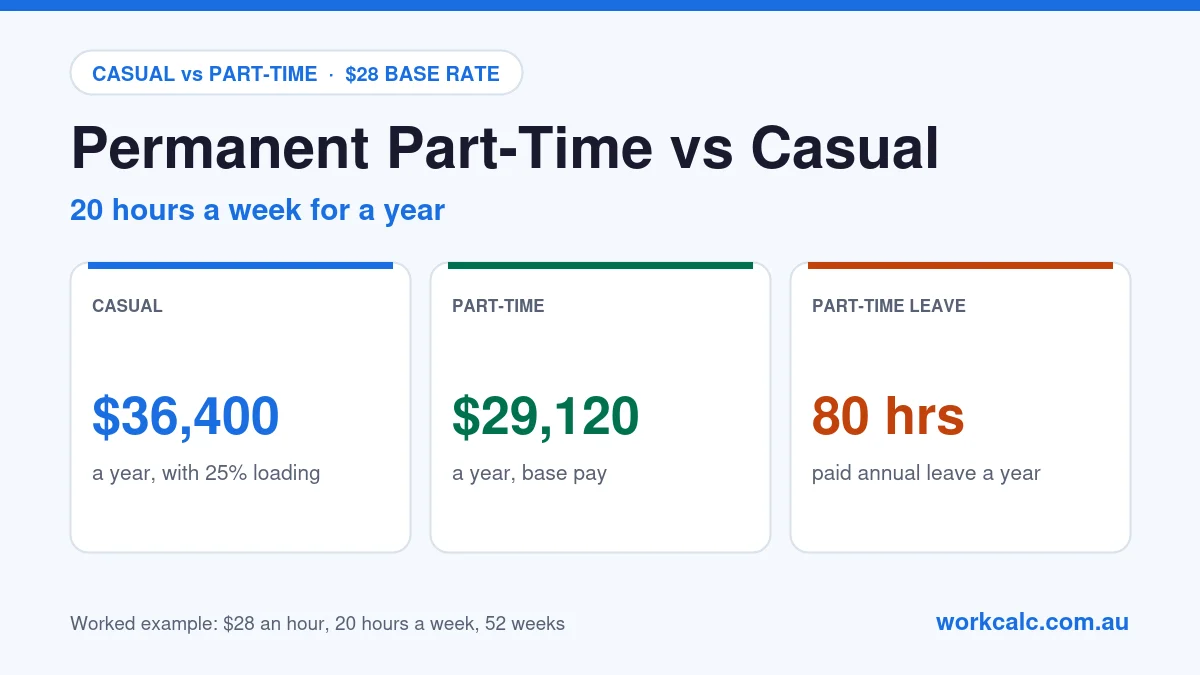
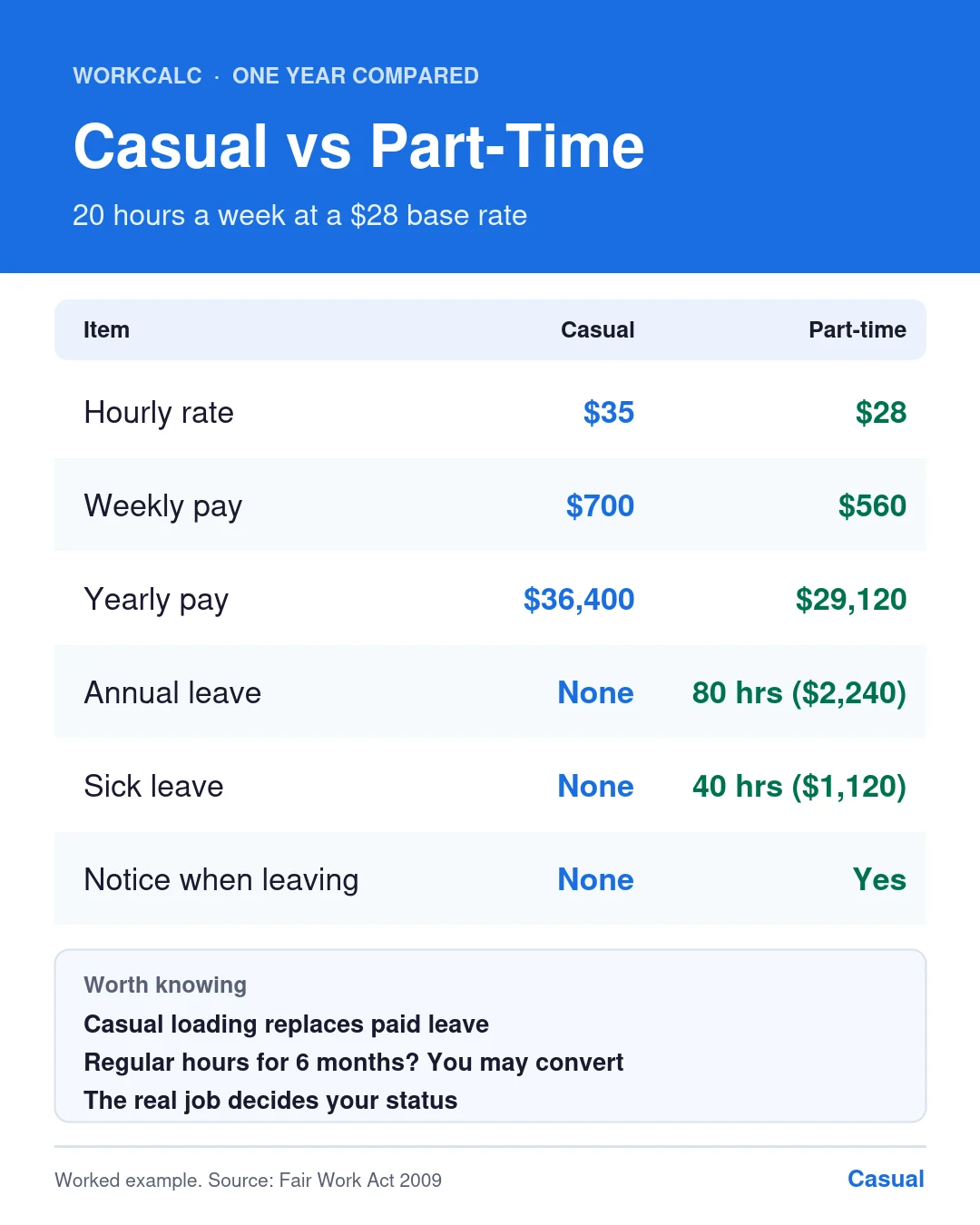
To make this concrete, consider two employees doing identical work at the same workplace — same hours, same base rate, different classification:
| Item | Casual Employee | Permanent Part-Time |
|---|---|---|
| Base rate | $28/hr | $28/hr |
| Casual loading (25%) | $7/hr extra = $35/hr | None |
| Hours/week | 20 hrs | 20 hrs |
| Weekly gross pay | $700 | $560 |
| Annual gross (52 wks) | $36,400 | $29,120 |
| Annual leave accrued | None | 80 hrs = $2,240 |
| Sick leave (10 days) | None | $1,120 |
| Notice on exit (e.g. 2 wks) | None | $1,120 |
| Total value over year | $36,400 | ~$33,600+ |
At this rate and hours, the casual earns more gross cash annually — the 25% loading is worth roughly $7,280 per year in extra pay. But the permanent employee accrues benefits worth $4,480 (leave + sick leave) that are not paid until used or paid out. And crucially, if the permanent employee stays for 7–10 years, they accumulate long service leave entitlements the casual never receives.
The loading is genuinely worthwhile for genuinely casual work — irregular hours, short-term engagements, seasonal work. For regular ongoing part-time work, the permanent entitlements often deliver greater total value over a career.
Related calculator Leaving a permanent part-time role? Calculate your exact payout including tax →I work part-time hours — do I get annual leave?
It depends entirely on your employment type, not your hours. Working part-time hours does not automatically give you annual leave. You must be classified as a permanent (ongoing) employee to accrue leave under the NES.
If you're classified as casual — even if you work the same days every week, for years — you are not legally entitled to accrued annual leave. What you receive instead is the 25% casual loading built into your hourly rate. That loading is intended to compensate for the leave you don't get, but it is paid upfront in every pay packet, not held as a balance.
If you believe your working arrangement is actually permanent in substance — regular hours, no genuine uncertainty, rostered in advance — you may have grounds to challenge your casual classification. The Fair Work Ombudsman has a free inquiry service →
What to check on your payslip right now
Your payslip tells you which system you're in. Look for these two things:
- A leave accrual line showing hours earned this period and a running balance — this means you are permanent and accruing leave correctly.
- A "casual loading" or "casual allowance" line showing a separate amount added to your base pay — this means you are casual and receiving the 25% loading instead of leave.
If your payslip shows neither — no leave accrual and no visible casual loading — it's worth asking payroll to clarify how your leave entitlement is being handled. Some payroll systems roll the loading into a single "casual hourly rate" without breaking it out. Either way, you deserve to know which system you're in.
If you have a leave balance showing on your payslip and want to know exactly how it's calculated, or what it's worth if you left tomorrow, the part-time annual leave calculator handles both.
Primary calculator Use the part-time calculator if you are permanent part-time — check your balance and payout value →Disclaimer: This article explains the National Employment Standards as set out in the Fair Work Act 2009 and reflects general principles of casual vs permanent employment classification. The indicators for genuine casual vs permanent employment are assessed on a case-by-case basis by courts and the Fair Work Commission — this article does not constitute legal advice. For binding advice on your specific situation, consult the Fair Work Ombudsman or a qualified workplace relations professional. WorkCalc Australia is independent and not affiliated with Fair Work or the ATO.
Frequently asked questions: casual vs permanent part-time leave
Plain-English answers on entitlements, the 25% loading, misclassification, and how to convert to permanent.
Do casual employees get annual leave in Australia?
No. Casual employees do not accrue paid annual leave under the NES. Instead they receive a 25% casual loading on their base hourly rate as compensation. This loading is paid in every pay period — there is no leave balance, no accrual, and no payout of leave when employment ends.
What is the difference between casual and permanent part-time annual leave?
Permanent part-time employees accrue 4 weeks of paid annual leave per year at 0.07692 hours per ordinary hour worked. The balance builds up and can be taken as paid time off or paid out on termination. Casual employees receive a 25% loading instead — paid now, in every hour, with no leave balance to draw from.
How much is the 25% casual loading worth in dollar terms?
On a $30/hour base rate, the 25% loading adds $7.50 per hour. Over a 20-hour week that's $150 extra per week. Over a full year it's $7,800 in extra pay. A permanent employee at the same rate accrues 80 hours of annual leave worth $2,400 — but also receives 10 days sick leave, notice entitlements, and redundancy rights that casuals don't get.
Can a casual employee convert to permanent part-time?
Yes. After 12 months of regular, systematic casual work with a reasonable expectation of continuing, you can formally request conversion to permanent employment. Employers can only refuse on specific operational grounds. After conversion, leave accrual starts from the conversion date — not your original casual start date. The 25% loading ends on conversion.
What happens if I was casual but should have been permanent?
If a court finds you were misclassified, your employer may owe back-pay for all unprovided leave entitlements from your actual start date. The 25% loading already paid may offset some of this liability, but courts have not always allowed the offset — particularly where the loading was not clearly identified in the contract. This is one of the most litigated areas in Australian employment law.
Does the 25% loading cover all leave entitlements?
The loading is intended to compensate for annual leave, personal leave, and the absence of guaranteed hours. It does not cover long service leave in most cases, and does not provide notice pay or redundancy entitlements. A permanent employee with 10+ years of tenure may be entitled to several weeks of long service leave that a casual will never receive.
If I'm casual, can I take unpaid annual leave?
There is no "casual annual leave" — paid or unpaid — under the NES. A casual employee can decline shifts or stop accepting work, but this is not annual leave in any legal sense. No special rules apply. If you need extended time off as a casual, you can simply not accept shifts during that period, but you have no entitlement to a job on return.
Are there industries where casual employees get paid leave?
Some enterprise agreements grant casual employees leave entitlements beyond the NES minimums — these are voluntary additions negotiated between employers and unions. If your enterprise agreement includes paid leave for casuals, that agreement governs your entitlement and overrides the NES minimum. Always check your specific agreement.