
Annual Leave Loading Explained: Who Gets 17.5%, Who Doesn't, and Why
Leave loading is one of the most misunderstood lines on an Australian payslip. Some employees get it, some don't, and almost nobody knows why. Here's the complete explanation, with worked examples.
When you take annual leave in Australia, most modern awards require your employer to pay more than just your ordinary rate. They pay your ordinary rate plus a 17.5% leave loading. It shows up on your payslip as a separate line — or sometimes bundled into your leave pay without explanation. Understanding whether you're entitled to it, and how it's calculated, can be worth hundreds of dollars every time you take a holiday.
Key facts about leave loading
- Not universal — only applies if your modern award or enterprise agreement includes it
- Standard rate is 17.5% — applied to your ordinary base rate for hours of leave taken
- Historical reason: compensates for missing overtime and shift penalties while on leave
- On termination: paid out on your unused leave if you get loading when you take leave
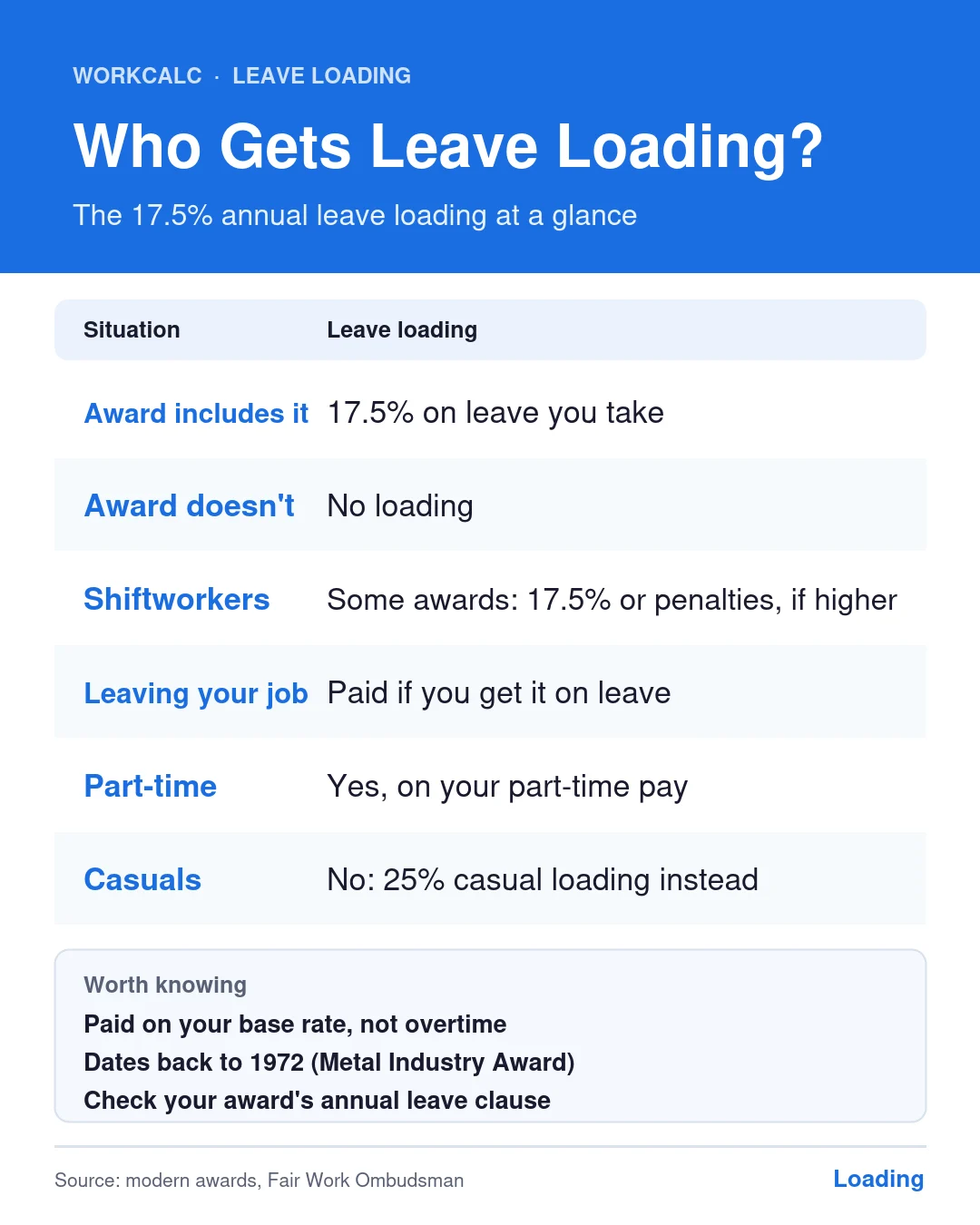
- Shift workers: some awards pay the higher of 17.5% or actual shift penalties missed
- Casual employees: do not get leave loading — they receive 25% casual loading instead
Where the 17.5% came from
Leave loading dates back to 1972, when a 17.5% loading was added to the Metal Industry Award, and it spread to most awards during the 1970s. The rationale: employees on annual leave miss out on overtime, shift penalties, and other above-base earnings they would have received if working. A flat 17.5% addition was set as an approximation of the average value of those missed payments across the workforce.
That 17.5% figure has never been updated. It has stayed at 17.5% since the 1970s and remains in most modern awards today, even though work patterns have changed significantly. For some employees — particularly shift workers with high penalty rates — 17.5% significantly understates what they actually forgo. That's why some awards now use the comparison method instead.
Working out your leave loading
Leave loading is 17.5% of your ordinary pay for the leave you take. Ordinary pay means your base rate for your ordinary hours, not overtime, penalty rates or allowances. For one week of leave on 38 hours at $30 an hour, ordinary pay is $1,140.00, the loading is $199.50, and your total leave pay is $1,339.50.
Calculator Leave Loading Calculator — work out 17.5% loading for any rate, hours or weeks of leave, including your final payout →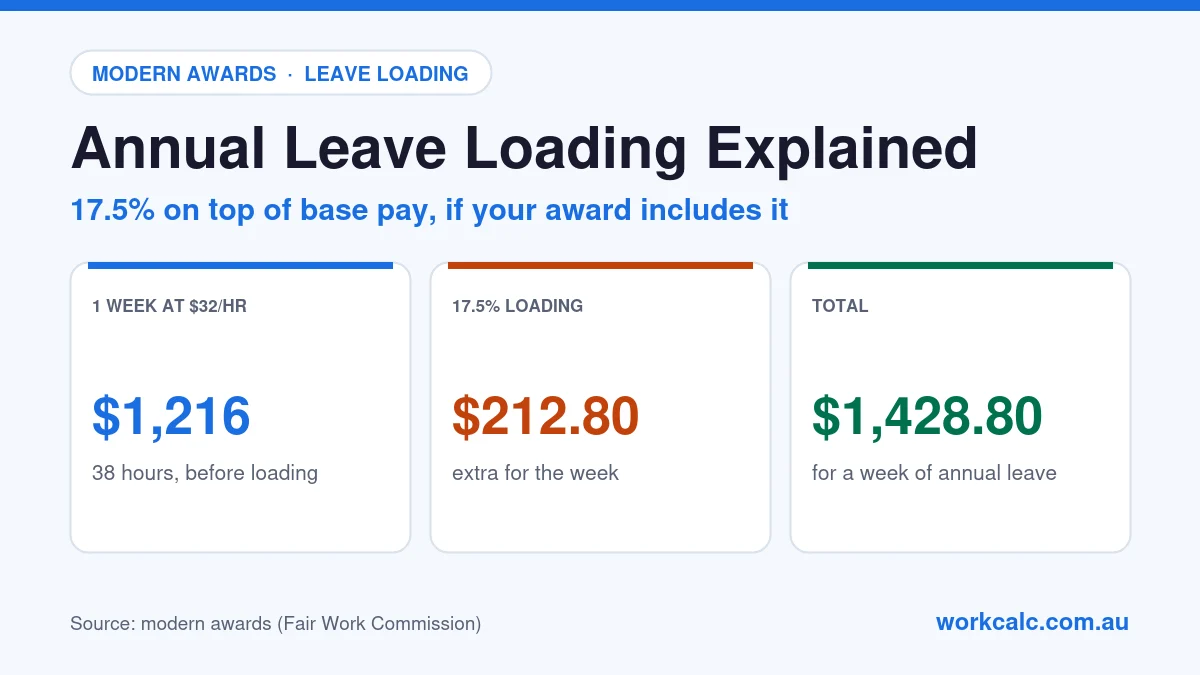
Who gets leave loading and who doesn't
The entitlement comes entirely from your modern award or enterprise agreement — not from the NES itself. The NES guarantees 4 weeks of annual leave but says nothing about loading. That means your award is the source you need to check.
- Employees covered by most modern awards (retail, hospitality, manufacturing, clerical, trades)
- Employees under enterprise agreements that retained leave loading provisions
- Employees whose contracts explicitly include 17.5% loading
- Shift workers under awards using the comparison method
- Award-free employees (those earning above the high income threshold)
- Employees under enterprise agreements that traded loading for higher base rates
- Some professional services roles under specific awards that absorbed loading
- Casual employees (receive 25% casual loading instead — not leave loading — see permanent part-time vs casual)
How to check your specific award
Go to the Fair Work Ombudsman's award summary list, find your award, and search for "annual leave loading" in the annual leave section. You're looking for a clause that says something like: "an employee is entitled to an annual leave loading of 17.5% of their ordinary rate of pay for the period of leave."
If that clause exists, you're entitled to loading. If it says loading is only payable when the shift comparison exceeds 17.5%, that's the comparison method. If the clause doesn't appear or says loading is not payable, check whether your rate has been set above award to absorb it.
The shift worker comparison method
Some awards — including several manufacturing and production awards — use a comparison method rather than a flat 17.5%. Under this method, the employer calculates two figures for the leave period:
- Option A: ordinary rate plus 17.5% loading
- Option B: the shift penalties and loadings the employee would have received if they had worked their normal roster instead of taking leave
The employee receives whichever is higher. For employees working predominantly night shifts or weekend rosters, Option B is often significantly larger than 17.5%. For employees on standard day shifts, Option A usually wins.
| Scenario | Ordinary pay (1 wk) | 17.5% loading | Shift penalties missed | Employee receives |
|---|---|---|---|---|
| Day shift worker at $32/hr, 38 hrs | $1,216 | $212.80 | $0 | $1,428.80 |
| Night shift worker at $32/hr, 38 hrs, with 25% night penalty | $1,216 | $212.80 | $304 (25% of $1,216) | $1,520.00 |
| Weekend worker at $32/hr, penalties worth 35% | $1,216 | $212.80 | $425.60 (35%) | $1,641.60 |
The night shift worker and weekend worker both receive more than the flat 17.5% method would give them — because their actual missed earnings exceed the loading.
Leave loading on termination
When employment ends, your employer must pay out your unused annual leave at the amount you would have received if you had taken it. So if you get leave loading when you take leave, the loading must be included in your final pay too. The Fair Work Ombudsman says this applies even if an award, enterprise agreement or employment contract says otherwise.
That means the 17.5% loading is added to your leave payout whether you resign, are dismissed or are made redundant, as long as loading applies when you take leave. If you don't get loading when you take leave, for example because your award or agreement doesn't include it, there is none to pay out. Missing loading is one of the most common mistakes in final pay.
Leave loading and part-time employees
Leave loading applies to part-time permanent employees on exactly the same basis as full-timers — if your award includes it, you receive it. The only difference is the absolute dollar amount, because it's calculated on your actual leave hours, which are fewer.
A part-timer on 20 hours per week taking one week of leave at $30/hour receives: ordinary pay of $600 plus loading of $105 (17.5%) = $705 total. A full-timer on 38 hours at the same rate receives $1,140 plus $199.50 = $1,339.50. Same entitlement, proportional dollar value. For the full picture, see how annual leave works for part-time employees.
My salary "includes all entitlements" — does that mean loading too?
Maybe — but the burden of proof is on your employer, not you. A broad contractual clause saying your salary "includes leave loading" or "all award entitlements" is generally not sufficient on its own. For loading to be legitimately absorbed into a higher salary, your contract should specify the exact amount being absorbed and your total remuneration must genuinely leave you no worse off than the award.
The Fair Work Commission has repeatedly found that vague "set-off" clauses do not satisfy this requirement. If your employer claims your salary absorbs leave loading but can't show you the specific calculation, that's worth querying — particularly if you're at or near the award minimum rate.
If you believe you're owed unpaid leave loading, you can lodge an underpayment inquiry with the Fair Work Ombudsman. There is a six-year limitation period on most wage claims. Check your entitlement with Fair Work →
Disclaimer: Leave loading entitlements are determined by your specific modern award or enterprise agreement — not by the NES directly. This article reflects general principles applicable to most awards. Always verify your entitlement against your actual award on the Fair Work Ombudsman website. WorkCalc Australia is independent and not affiliated with Fair Work or the ATO.
Frequently asked questions: annual leave loading
Plain-English answers on the 17.5% rate, award coverage, the comparison method, termination payouts, and salary absorption.
What is annual leave loading in Australia?
Annual leave loading is an additional payment of 17.5% on top of your ordinary rate, paid when you take annual leave. It compensates for missing overtime and shift penalties while on leave. It only applies if your modern award or enterprise agreement includes it — it is not a universal NES entitlement.
How is annual leave loading calculated?
Loading = ordinary hours of leave × ordinary rate × 0.175. For one week at $30/hr on 38 hours: ordinary pay = $1,140, loading = $199.50, total = $1,339.50. Some awards use the higher of this or the shift penalties the employee would have earned — check your specific award.
Who is entitled to annual leave loading in Australia?
Employees covered by a modern award or enterprise agreement that includes leave loading. Most awards in retail, hospitality, manufacturing, administration, and trades include 17.5%. Award-free employees, those under agreements that traded loading for higher base pay, and casual employees generally do not receive it.
Is annual leave loading paid on termination?
Yes, if you get leave loading when you take leave. When employment ends, unused annual leave must be paid at the amount you would have received if you had taken it, so the loading must be included in your payout. The Fair Work Ombudsman says this applies even if an award, agreement or contract says otherwise.
What is the shift worker comparison method for leave loading?
Some awards require employers to pay the higher of 17.5% loading or the shift penalties the employee would have received if they had worked. If your typical roster attracts penalties worth more than 17.5% of your ordinary rate, you receive the higher amount. Not all awards use this — check yours specifically.
Do casual employees get annual leave loading?
No. Casual employees receive a 25% casual loading instead of leave entitlements. They do not accrue annual leave and therefore do not receive leave loading. The 25% is a separate concept covering absence of leave, sick leave, and job security — not the same as leave loading.
Is annual leave loading taxed?
Yes. Loading paid when you take leave is taxed as ordinary income at your marginal rate. Loading paid out with unused leave when you leave a job is taxed with that payout under ATO Schedule 7. For a resignation or dismissal, leave accrued since 18 August 1993 is included in your gross pay and taxed at marginal rates using an averaging method. It is only shown as Lump Sum A, with 32% withheld, if you leave because of genuine redundancy, invalidity or an early retirement scheme, or for leave accrued before 18 August 1993.
Can an employer absorb leave loading into a higher salary?
Yes, but the contract must clearly identify the specific amount absorbed and the total must leave the employee no worse off than the award. Vague clauses saying salary "includes all entitlements" are generally insufficient. The Fair Work Commission has consistently found such clauses do not satisfy award obligations unless precise and verifiable.