
Starting a New Job Mid-Year? How to Calculate Your Annual Leave Entitlement
You don't need to wait until your work anniversary to know how much leave you've got. Annual leave accrues from day one — here's exactly how to calculate your pro rata balance at any point in the year.
Starting a new job in March, July, or October doesn't mean you wait until January to start earning leave. Under the National Employment Standards, annual leave accrues progressively from your very first ordinary hour of work. By the time you've been there three months, you already have leave in the bank — even if you can't access it yet. Here's the formula and the worked examples to prove it.
New starter quick facts
- Accrual starts day one — no waiting period, no probation delay on accrual
- The formula: ordinary hours worked × 0.07692 = hours accrued
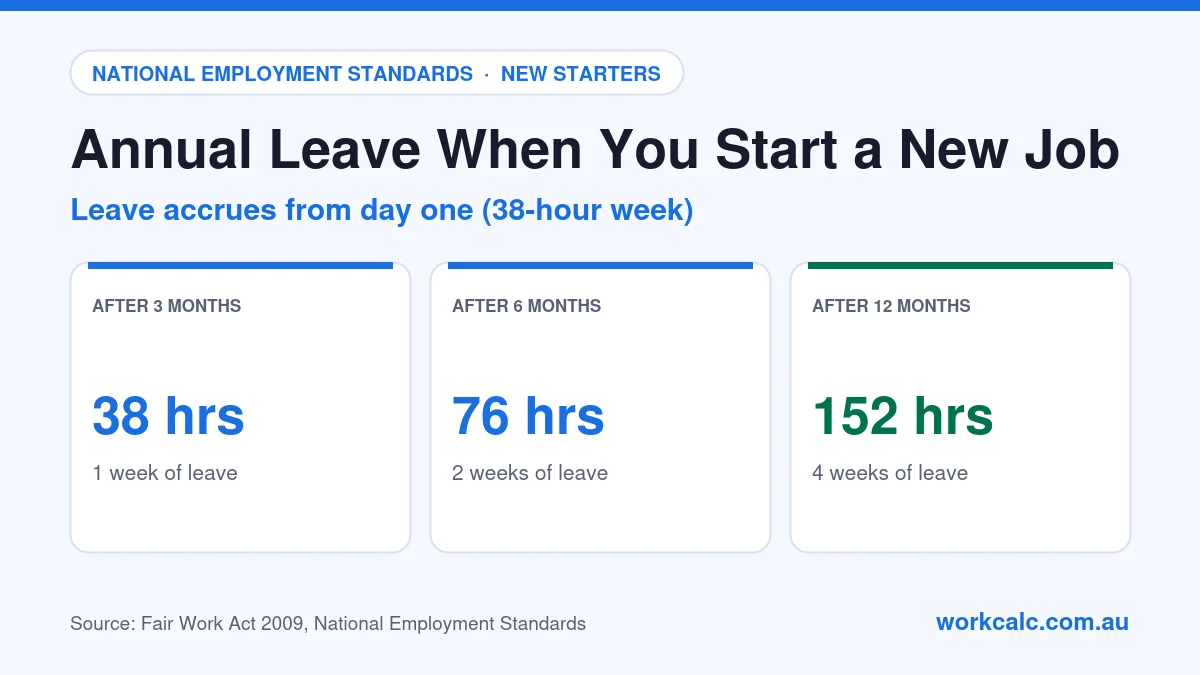
- After 3 months (13 weeks): a 38-hr employee has ~38 hours = 1 week of leave
- After 6 months (26 weeks): ~76 hours = 2 weeks of leave
- Payout if you leave early: every accrued hour must be paid out — mandatory
- Taking leave early: your employer can approve or decline — but cannot cancel your accrual
Why "mid-year start" doesn't mean "half entitlement"
A common misconception: starting in July means you only get half the annual leave of someone who started in January. This is wrong. The NES doesn't set leave annually from a calendar date — it accrues continuously, hour by hour, from your start date.
Think of it like a tap that never turns off. Every ordinary hour you work, 0.07692 hours of leave drips into your balance. The formula is the same whether you've been there 2 weeks or 2 years — and it's the same formula we covered in detail in How Annual Leave Accrues in Australia: The Exact Maths Behind Your Payslip.
This formula applies to permanent (full-time and part-time) employees. If you're casual, accrual works differently — see Casual vs Permanent Employment for how leave entitlements compare.
Calculate your leave balance right now
Enter your start date details below to see exactly how much leave you've accrued so far — in hours, days, and weeks.
Pro rata leave calculator
LiveEnter your start date and ordinary hours to see your current leave balance.
Worked examples: three common start-date scenarios
Let's walk through three realistic scenarios for a full-time employee on 38 ordinary hours per week.
| Started | Weeks worked | Hours accrued | Days accrued | Weeks of leave |
|---|---|---|---|---|
| 3 months ago | 13 wks | 38.0 hrs | 5 days | 1.0 wk |
| 6 months ago | 26 wks | 76.0 hrs | 10 days | 2.0 wks |
| 12 months ago | 52 wks | 152.0 hrs | 20 days | 4.0 wks |
Every figure above comes from the same formula: weeks worked × 38 × 0.07692. The ratio always holds — half a year of work gives half a year of leave entitlement.
When can you actually take the leave you've accrued?
Accruing leave and being allowed to take it are two different things. The NES gives your employer the right to approve or decline leave requests on reasonable business grounds. Many employers also have internal policies around:
- Minimum service before taking leave — commonly 3 months or completion of probation. This is generally permitted as long as it doesn't permanently block access.
- Minimum notice required — typically 2–4 weeks for planned leave, set by your enterprise agreement or workplace policy.
- Blackout periods — some industries (retail, hospitality) restrict leave during peak periods. These must be set out in your award or enterprise agreement to be enforceable.
- Maximum balance caps — some employers have policies directing employees to take leave when their balance exceeds a certain threshold (commonly 8 weeks).
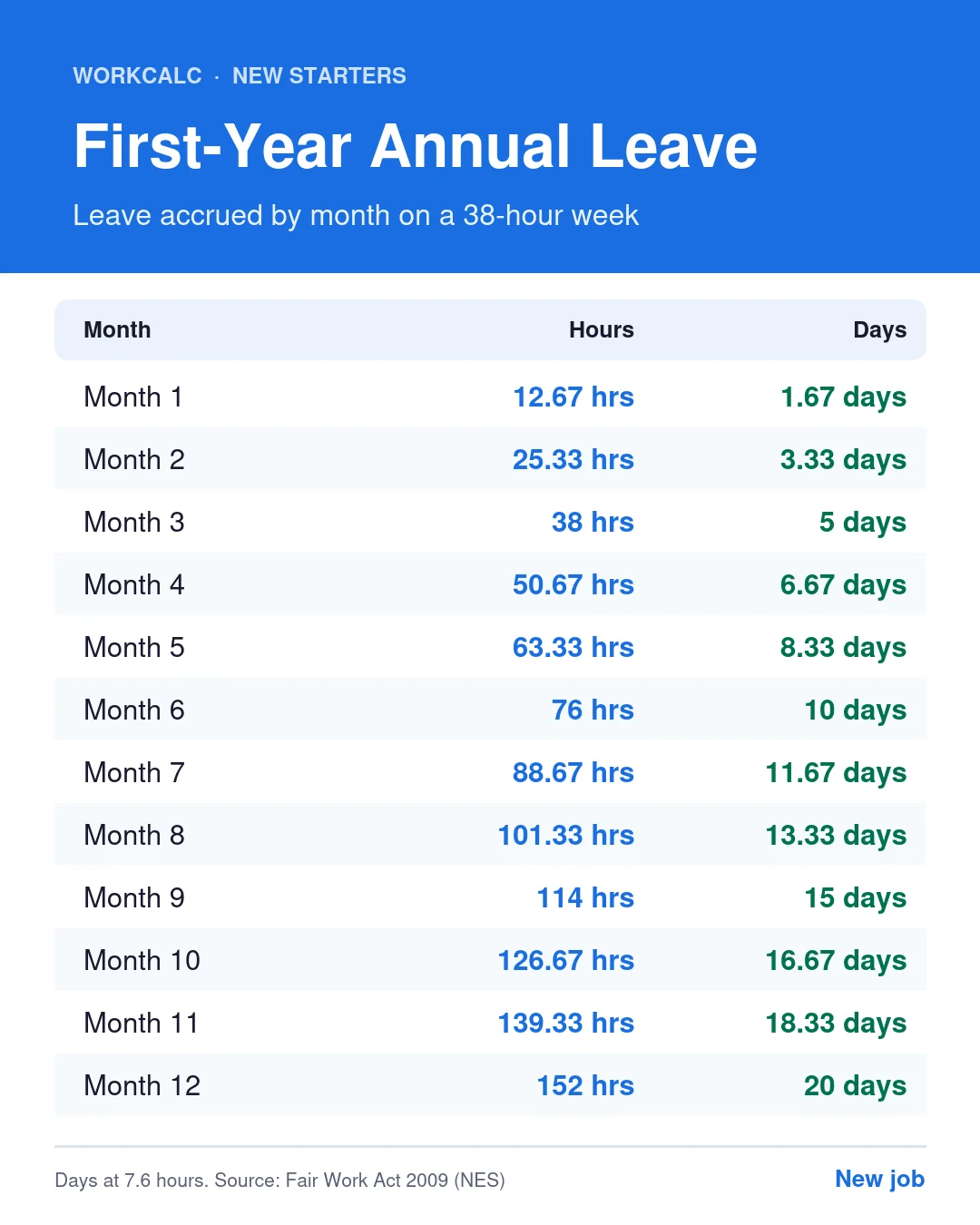
How your first year of leave accrual looks month by month
For a standard full-time employee on 38 ordinary hours per week, here's how the balance builds across the first 12 months:
About 1.5 days of leave in the bank. Unlikely you can take it yet — most employers require at least 3 months service before approving leave — but it's there and it's yours.
One week of leave. Probation typically ends around here. This is usually when you can first request leave under most employer policies.
Two weeks of leave — enough for a proper break. If you haven't taken any yet, your balance is building toward a useful buffer. Many employees plan their first leave around this point.
Three weeks of leave. If you resign at this point, your final payout includes all 114 hours at your ordinary rate — plus loading if your award requires it.
Full year entitlement reached. The NES 4-week guarantee is now fully in your balance. Accrual continues into year two at the same rate.
What if you leave before the year is up?
This is where new starters often get a pleasant surprise. Under section 90 of the Fair Work Act, every single accrued hour must be paid out when employment ends — regardless of how long you've been there. There is no minimum service period for the payout entitlement.
So if you start in January, work until April, and then resign — your employer must pay out your 3 months of accrued leave at your ordinary rate, plus leave loading if your award includes it. Read the full guide on whether annual leave is paid out when you resign.
Can I take leave during my probation period?
Your leave accrues during probation — that part is non-negotiable under the NES. Whether you can take it during probation is a separate question, and the answer depends on your employer's policy and your modern award.
Most employers have a policy requiring minimum service (commonly 3 months, or completion of probation) before approving leave. This is generally permissible as long as it doesn't permanently deny access to leave you've earned. Some awards also set minimum service periods before leave can be taken.
What your employer cannot do: cancel the accrual, make you forfeit leave you've earned, or tell you that probation period hours "don't count" for leave purposes. If your payslip shows zero leave accruing during probation, that's a payroll error that should be corrected. Calculate what your balance should be →
Part-time new starters: the same formula, proportional result
If you've started a new part-time role, the formula is identical — just applied to your ordinary hours. A 3-day-a-week employee working 24 ordinary hours per week accrues 24 × 0.07692 = 1.846 hours of leave per week. After 6 months (26 weeks) that's 48 hours — exactly 2 weeks of their 3-day schedule.
The entitlement is always proportional to your working pattern. For a deeper look at how this works across all part-time arrangements, see our guide to annual leave for part-time employees.
Related calculator Part-time new starter? Calculate your exact pro rata entitlement with the part-time tool → Related calculator Leaving before the year is up? Estimate tax on your pro rata payout → Plan ahead Also check long service leave — your clock starts ticking from day one too →Disclaimer: This article reflects the National Employment Standards under the Fair Work Act 2009. Individual modern awards and enterprise agreements may include additional conditions around when leave can be taken. For binding advice specific to your situation, consult the Fair Work Ombudsman or a qualified workplace relations professional. WorkCalc Australia is independent and not affiliated with Fair Work or the ATO.
Frequently asked questions: annual leave for new starters
Plain-English answers on pro rata accrual, probation, taking leave early, and what happens if you leave before the year ends.
How is annual leave calculated when you start a new job mid-year?
Annual leave accrues from your first day at 0.07692 hours per ordinary hour worked. If you start mid-year, your balance is simply the weeks worked × your ordinary hours × 0.07692. There is no annual reset date — accrual is continuous from your start date.
When does annual leave start accruing in Australia?
From your very first ordinary hour as a permanent employee. There is no waiting period or probationary period that delays accrual under the NES. Some employers restrict when you can take leave during probation — but the accrual itself begins immediately.
How many days of leave will I have after 6 months?
A full-time employee on 38 hours per week will have approximately 76 hours — 10 working days or 2 weeks — after 26 weeks. The exact calculation is 38 × 0.07692 × 26 = 76.0 hours. Part-time employees accrue proportionally based on their ordinary hours.
Can you take annual leave during your probation period?
Leave accrues during probation but your employer may have a policy requiring minimum service before approving leave — this is generally permitted under the Fair Work Act. What they cannot do is stop the accrual or make you forfeit earned leave. Check your contract and award for the specific terms.
Does annual leave accrue on public holidays?
Yes. Paid public holidays on days you would ordinarily work count as ordinary hours for accrual purposes. Public holidays on your non-working days have no effect on your balance either way.
What happens to your leave if you leave a new job before 12 months?
Every accrued hour must be paid out at your ordinary rate — mandatory under section 90 of the Fair Work Act. There is no minimum service period to receive the payout. Even a few weeks of accrual must be paid. Leave loading may also apply depending on your modern award.
What is pro rata annual leave in Australia?
Pro rata means your entitlement is proportional to time worked rather than a full year. Since leave accrues continuously under the NES, any employee who hasn't completed 12 months automatically has a pro rata balance. The formula — hours worked × 0.07692 — produces the exact pro rata figure at any point.
Does annual leave accrue during the probation period?
Yes — unconditionally. Probation affects unfair dismissal rights and other protections but has no effect on annual leave accrual under the NES. If your payslip shows zero leave accruing during probation, raise it with payroll — it's a configuration error.