
Is Annual Leave Paid Out When You Resign in Australia?
Yes. When you resign, your employer must pay out every hour of unused annual leave. Here's how the payout is calculated, how it's taxed, whether super is owed, and what else you're owed on your last day.
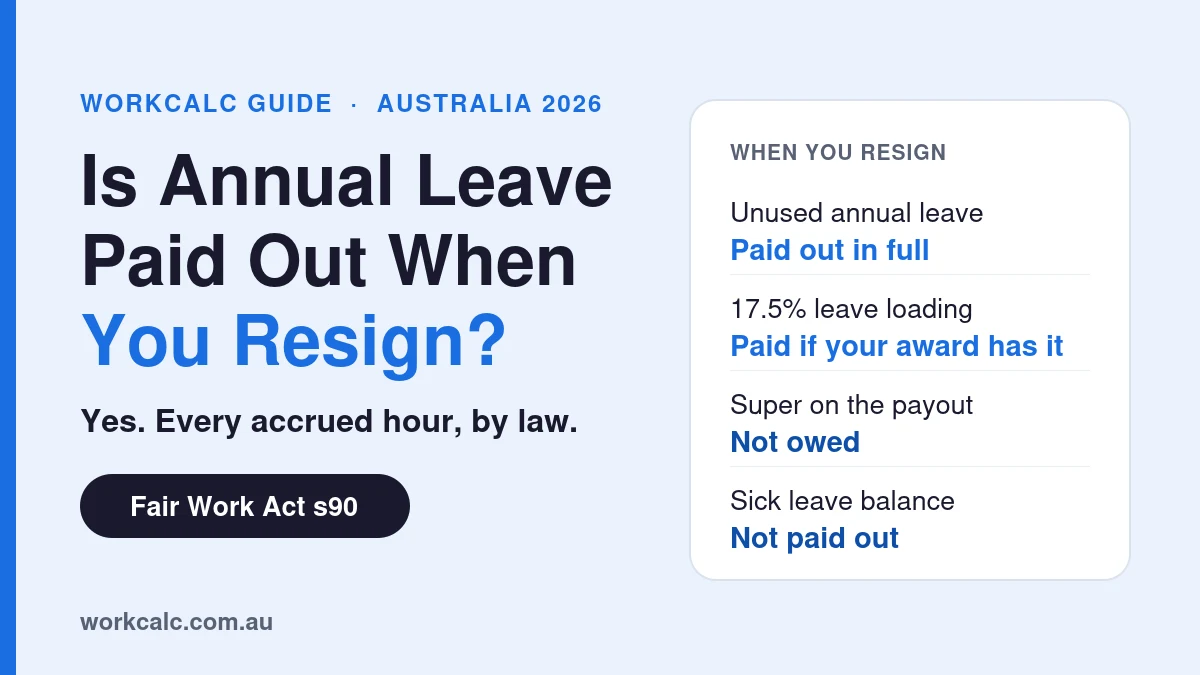
Resigning from a job triggers one guaranteed financial event: your employer must pay out every hour of accrued but untaken annual leave. This is not discretionary. Section 90 of the Fair Work Act 2009 makes it mandatory, and it applies whether you resign, are dismissed, or are made redundant. The question most employees have is not whether they'll receive it — it's how much it will be, and how much tax they'll lose.
What you need to know
- Payout is mandatory — every accrued hour must be paid at your ordinary rate under s.90 Fair Work Act
- Leave loading (17.5%) is usually also payable — check your modern award
- Tax uses ATO Schedule 7 — the marginal-rate method if you resign, or a flat 32% on a genuine redundancy
- Super is generally not owed — leave payouts on termination are excluded from OTE
- Your employer cannot withhold it — not for notice disputes, unreturned equipment, or any other reason
- Final pay timing — most awards require it within 7 days of your last day (at least monthly if your award is silent)
The payout formula — step by step
Calculating your annual leave payout is straightforward once you know your accrued balance. The formula has three components: your hours, your rate, and whether loading applies.
Your accrued hours come from your payslip leave balance. Your ordinary hourly rate is your base rate — not including overtime penalties, allowances, or bonuses. The 1.175 multiplier applies when your modern award requires leave loading to be paid on termination. Most awards do — but some don't. Check yours at the Fair Work Ombudsman website if you're unsure.
To understand exactly how your leave balance was built up before resignation — and to verify your hours are correct — see How Annual Leave Accrues in Australia: The Exact Maths Behind Your Payslip.
Resignation payout estimator
LiveEnter your leave balance, rate, and whether loading applies to see your estimated gross payout.
Gross before PAYG withholding. Tax on the leave component uses the ATO Schedule 7 marginal rate method. Use the full tax calculator for the net figure.
Estimate tax on your payoutHow your payout is taxed
Annual leave paid out on resignation is not taxed as ordinary income — it uses a special ATO method called the Schedule 7 marginal-rate averaging method.
The withholding calculation works like this: the ATO treats the leave payout as if it were spread across a notional period, calculates the marginal tax that applies, then withholds accordingly. In practice this often means less withholding than if the payment were taxed as a single lump sum — because averaging reduces the rate applied to the highest portion.
Resignation vs redundancy — the tax difference
| Why your job ends | Leave accrued before 18 Aug 1993 | Leave accrued on or after 18 Aug 1993 |
|---|---|---|
| Resignation, dismissal or retirement | 32% withheld | Marginal-rate method (Schedule 7), or 32% if the payout is under $300 |
| Genuine redundancy, invalidity or early retirement scheme | 32% withheld | 32% withheld |
In practice, almost all leave paid out today was accrued after August 1993. So if you resign, tax is withheld using the marginal-rate method: the ATO spreads the payout across a year of pay periods, works out the extra tax for one period and multiplies it back up. If you're made genuinely redundant, a flat 32% is withheld from the whole leave payout instead. Either way, your final tax is settled when you lodge your tax return.
Does your employer owe super on your leave payout?
This surprises many employees: no, super is generally not owed on your annual leave payout when employment ends.
Super Guarantee contributions are calculated on Ordinary Time Earnings (OTE). The ATO's definition of OTE excludes leave payments made on termination. So your employer's 12% super obligation does not apply to the leave payout component of your final pay.
The notice period interaction
Notice period and annual leave payout are two separate things — but they interact in important ways when you resign.
Working your notice vs being paid in lieu
If you work your full notice period, your leave balance continues accruing during that time (because you're still employed and being paid ordinary earnings). By the time your last day arrives, your leave balance will be slightly higher than when you handed in your notice. If you haven't handed it in yet, the resignation letter template works out your last day for you.
If your employer pays you in lieu of notice — ending employment immediately and paying out the notice period — your leave accrual stops on your last day of actual employment. The notice pay is separate from the leave payout. Use the notice period calculator to check how much notice applies, and the final pay calculator to add your wages, notice pay and leave payout into one total.
Can your employer force you to take leave during notice?
Only in limited cases. If you're covered by an award or registered agreement, your employer can only direct you to take annual leave if the award or agreement allows it and the direction is reasonable, for example where you have an excessive leave balance (generally more than 8 weeks, or 10 weeks for shiftworkers). If you're award and agreement free, your employer can require you to take leave if the requirement is reasonable. If you do not want to use your leave during notice, state this in writing early in the process. Any leave taken during notice reduces the payout balance — so it's worth understanding which outcome you'd prefer.
Can my employer withhold my leave payout?
No. This is one of the most clearly stated obligations in Australian employment law. Under section 90 of the Fair Work Act, every accrued hour of annual leave must be paid on termination. There are no exceptions.
Your employer cannot withhold your leave payout because: you didn't give enough notice, you didn't return equipment, there's a dispute about your performance, you owe money to the employer (debts must be recovered separately through proper legal channels), or any other operational reason.
If your employer withholds your leave payout, lodge a complaint with the Fair Work Ombudsman immediately. The Ombudsman can compel payment and apply penalties against the employer. You can also pursue the amount through the Fair Work Commission or small claims court depending on the amount. Lodge a complaint with Fair Work →
What gets paid out when you resign (and what doesn't)
When you resign, only some entitlements are paid out. Here's the quick answer for each one.
| Entitlement | Paid out when you resign? |
|---|---|
| Unused annual leave | Yes, every hour, at your ordinary rate (Fair Work Act s90) |
| Annual leave loading | Yes, if your award or agreement pays loading on termination |
| Sick and carer's leave | No, it isn't paid out when employment ends |
| Long service leave | Depends on your state or territory and years of service |
| Notice pay | Only if your employer pays you instead of letting you work your notice |
| Redundancy pay | No, it only applies when your role is made redundant |
| Super on the leave payout | No, unused leave paid on termination isn't ordinary time earnings |
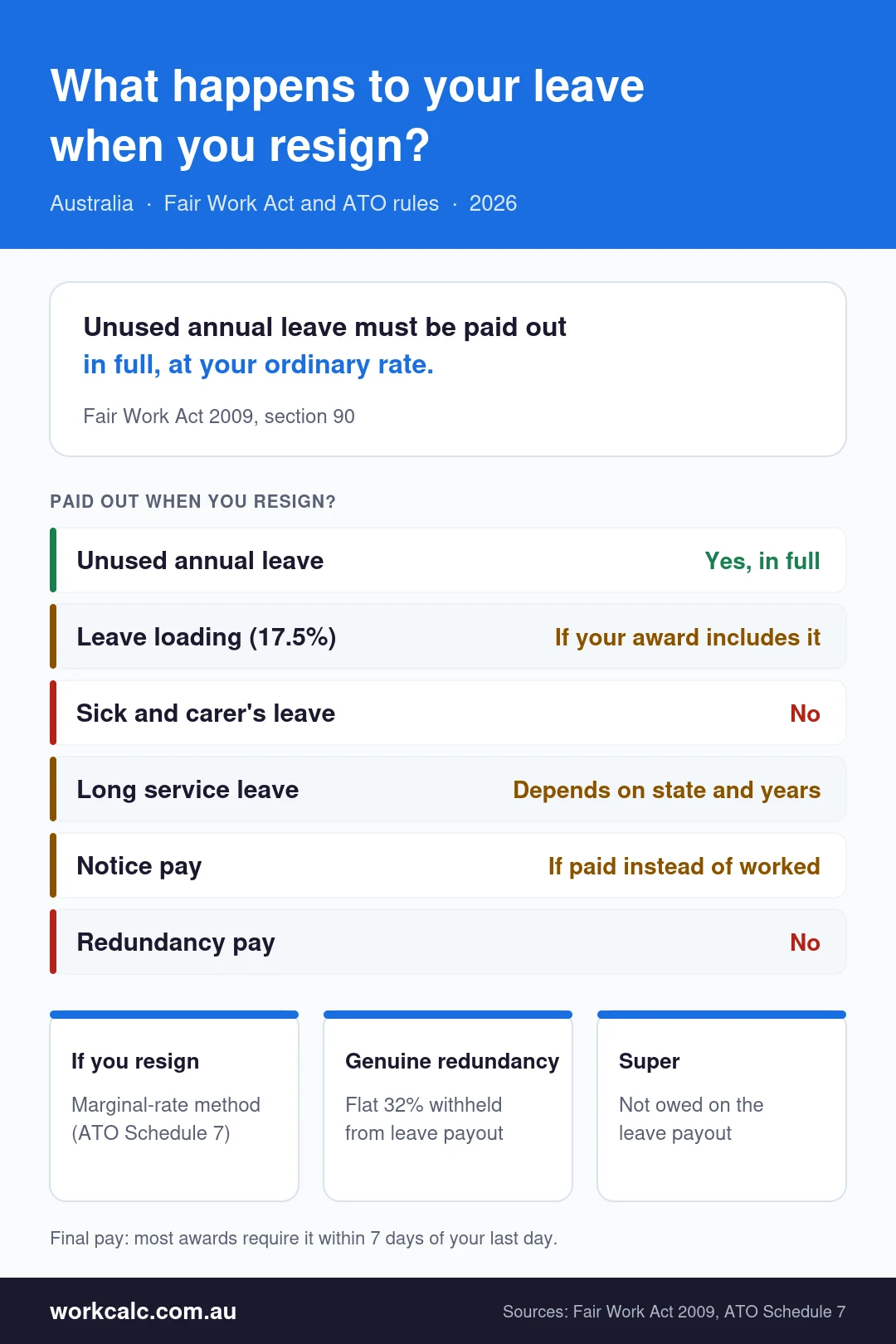
Most modern awards require your final pay, including the leave payout, within 7 days of your last day. If your award or agreement doesn't set a timeframe, you must still be paid at least monthly. To check a long service leave payout, use the long service leave calculator.
Your resignation leave checklist
Before your last day, work through these steps to make sure your payout is correct.
Your accrued hours should be on your most recent payslip. If it looks wrong, compare against the formula: hours worked × 0.07692 per hour. Any unexplained gap should be queried with payroll before you leave.
Your payout uses your ordinary rate — not your average including overtime or penalties. If you're salaried, divide your annual salary by 52 then by your ordinary weekly hours to get the hourly rate.
If you get 17.5% loading when you take annual leave, it must also be paid on your leave balance when you leave, even if your award or contract says otherwise. Check the annual leave clause of your award on the Fair Work Ombudsman website to see whether loading applies to you.
Use the estimator above or the full payout calculator to get the gross figure. Keep this number so you can compare it to what actually appears in your final pay.
Most modern awards require your final pay within 7 days of your last day (at least monthly if your award or agreement is silent). Verify the leave payout matches your calculation. If it doesn't, contact payroll immediately — errors are easier to fix before the payroll period closes.
If you've been with your employer for several years, you may also be entitled to a long service leave payout on resignation depending on your state and tenure. Rules vary — some states allow pro rata payouts after 7 years.
Disclaimer: This article reflects the Fair Work Act 2009 and ATO withholding rules as at June 2026. Tax treatment of termination payments depends on individual circumstances — consult a registered tax agent for advice specific to your situation. For workplace entitlement disputes, contact the Fair Work Ombudsman. WorkCalc Australia is independent and not affiliated with Fair Work or the ATO.
Frequently asked questions: annual leave payout on resignation
Plain-English answers on payout calculation, tax, super, notice periods, and your rights under the Fair Work Act.
Do you get paid out annual leave when you resign in Australia?
Yes — every accrued hour must be paid out at your ordinary rate under section 90 of the Fair Work Act 2009. This is mandatory regardless of how employment ends: resignation, dismissal, or redundancy. Your employer cannot withhold it for any reason.
How is annual leave payout calculated on resignation?
Payout = accrued hours × ordinary hourly rate. If your modern award includes leave loading on termination (most do), multiply by 1.175. Your ordinary rate is your base pay — not including overtime, allowances, or bonuses. Tax is then withheld under ATO Schedule 7 before payment.
How is annual leave payout taxed in Australia?
If you resign, tax is withheld from the payout using the ATO's Schedule 7 marginal-rate method, which spreads the payout across a year of pay periods to work out the extra tax (or a flat 32% if the payout is under $300). If you're made genuinely redundant, a flat 32% is withheld from the whole leave payout. Leave accrued before 18 August 1993 is taxed at 32%. Your actual tax is settled when you lodge your tax return.
Does your employer have to pay super on annual leave payout?
Generally no. Superannuation Guarantee contributions are not required on annual leave payouts made on termination because these payments are excluded from Ordinary Time Earnings (OTE) under ATO rules. However, super is owed on annual leave taken during employment — that's different from a termination payout.
Can your employer make you take leave during your notice period?
Only in limited cases. If an award or registered agreement covers you, your employer can direct you to take annual leave only if the award or agreement allows it and the direction is reasonable, such as when you have more than 8 weeks of leave (10 weeks for shiftworkers). If you'd rather have the leave paid out, say so in writing early.
When does your employer have to pay final pay after resignation?
Most modern awards require final pay within 7 days of your last day. If your award or agreement doesn't set a timeframe, the Fair Work Act requires you to be paid at least monthly. If your final pay is late, you can contact the Fair Work Ombudsman.
Does leave loading get paid out when you resign?
Usually yes. Most modern awards require 17.5% leave loading to be paid on the leave balance at termination. Some awards exclude it or have specific conditions. Check your award's annual leave section on the Fair Work Ombudsman website under "termination of employment."
What happens to annual leave if you are made redundant?
The same payout rule applies: every accrued hour is paid at your ordinary rate, plus loading if your award includes it on termination. The tax is different, though: a flat 32% is withheld from the leave payout on a genuine redundancy, compared with the marginal-rate method when you resign. You may also be owed redundancy pay; see the redundancy pay calculator.
Is sick leave paid out when you resign?
No. Under the National Employment Standards, unused sick and carer's leave isn't paid out when your employment ends. Only your unused annual leave is paid out, plus long service leave if you qualify under your state's rules.
Can I resign while I am on annual leave?
Yes. You can resign while you're on leave, but you still need to give any required notice. Your notice period can run at the same time as your paid leave, and any annual leave you haven't taken by your last day is paid out.
Is long service leave paid out when you resign?
It depends on your state or territory and your years of service. In Victoria and Western Australia, pro-rata long service leave is paid out on resignation after 7 years. In NSW and Queensland, resigning before 10 years generally only qualifies for a payout in specific circumstances, such as illness. Use the long service leave calculator to check your state's rule.