
Long Service Leave Victoria: How Much Are You Entitled To and When?
Victoria's Long Service Leave Act 2018 gives Victorian employees one of the most accessible LSL regimes in Australia — payable after just 7 years, on resignation, and with continuous accrual from day one. Here's everything you need to know.
Work out your entitlement with the VIC long service leave calculator: weeks accrued, pro-rata eligibility and what it is worth.
Victoria updated its long service leave framework in 2018 with one of the most employee-friendly LSL Acts in Australia. Once you pass 7 years of continuous employment, unused leave must be paid out when you leave for any reason, including resignation.
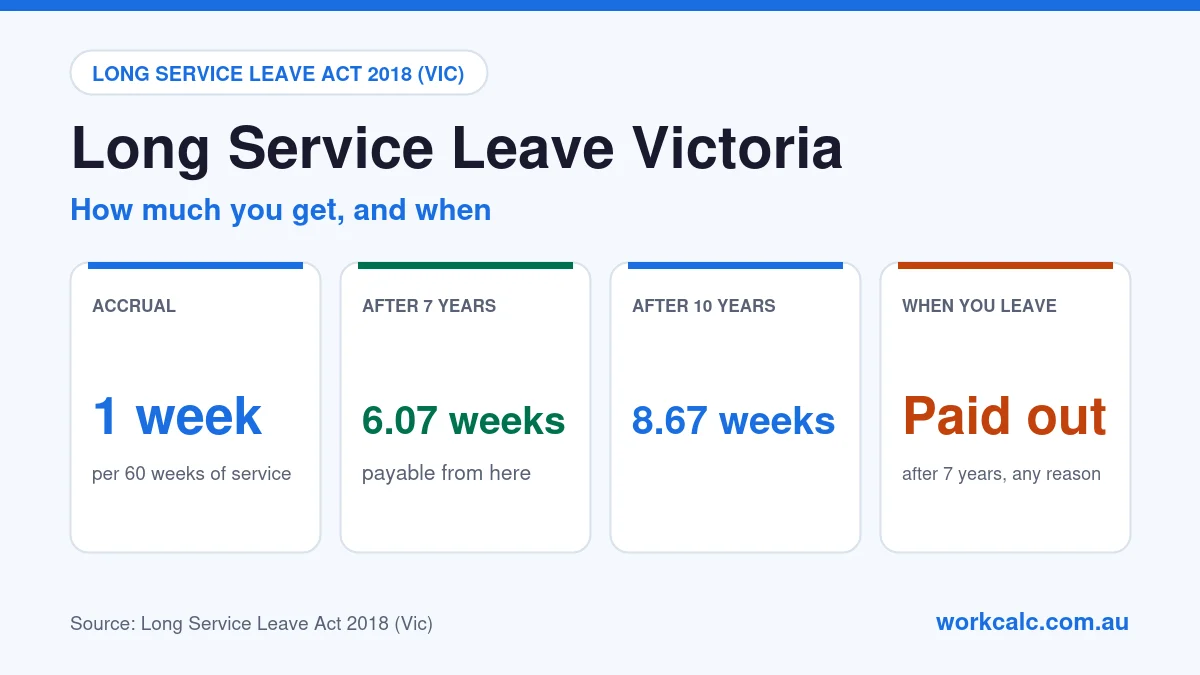
- Accrual rate: 1 week for every 60 weeks of continuous service (≈ 0.8667 weeks per year)
- Payable after: 7 years of continuous employment with the same employer
- At 7 years: approximately 6.07 weeks of LSL accrued
- At 10 years: approximately 8.67 weeks of LSL accrued
- Paid out when you leave: Yes — after 7 years, for any reason (including resignation and dismissal)
- Casual employees: Included — where service is regular and systematic
- Legislation: Long Service Leave Act 2018 (Vic)
- Governing body: Wage Inspectorate Victoria
How long service leave is calculated in Victoria
The Victorian LSL Act 2018 uses a continuous accrual model rather than a threshold-and-lump-sum approach. Leave accrues from the first day of employment at the rate of 1 week for every 60 weeks of continuous service — which equals approximately 0.8667 weeks per year.
Victoria LSL accrual at key milestones
*Paid out when employment ends for any reason once you reach 7 years.
Accrual across the employment timeline
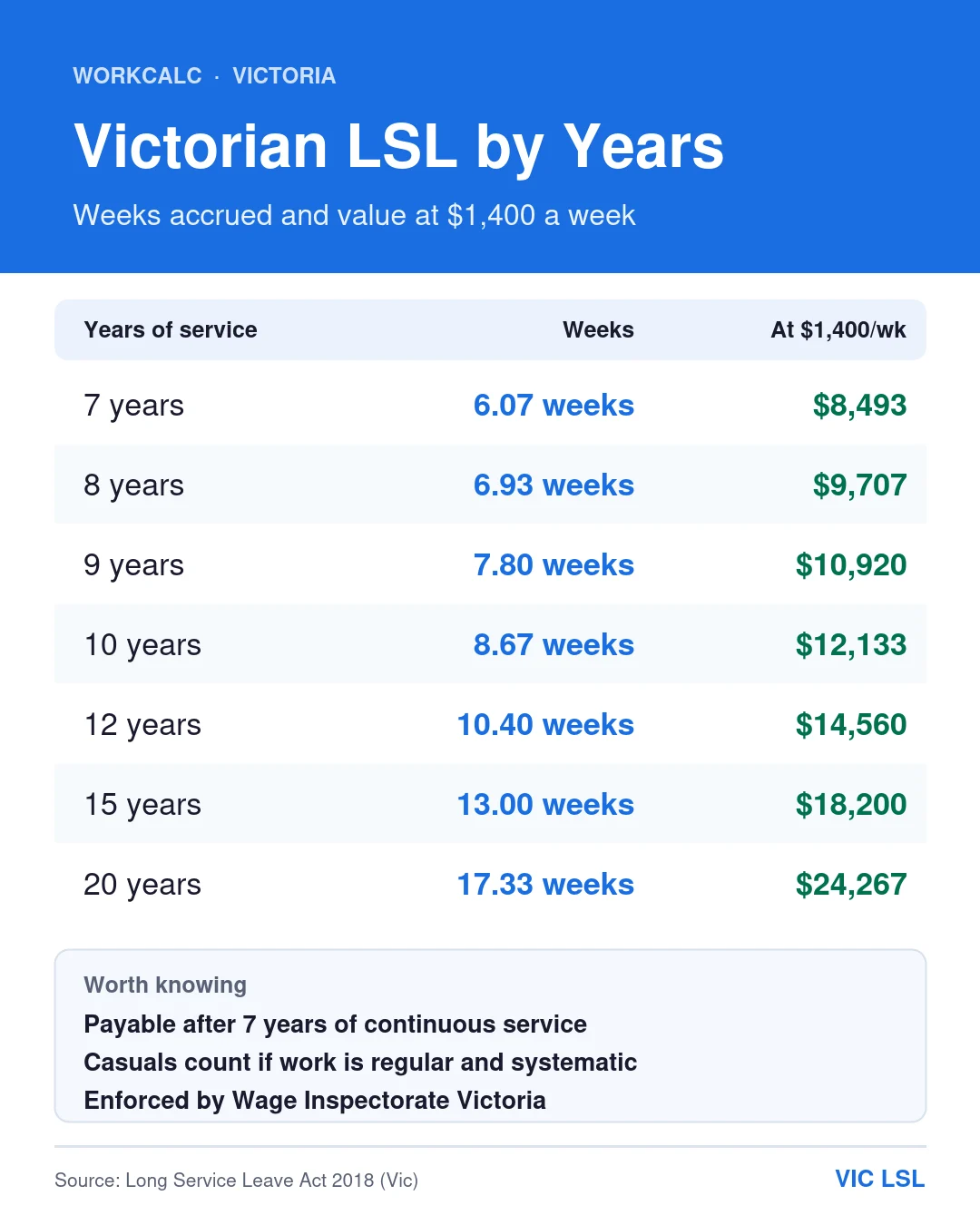
| Years of service | Weeks accrued | Hours (at 38 hrs/wk) | Payout at $1,400/wk |
|---|---|---|---|
| 5 years | 4.33 weeks | 164.6 hrs | $6,065 |
| 7 years (threshold) | 6.07 weeks | 230.5 hrs | $8,493 |
| 8 years | 6.93 weeks | 263.5 hrs | $9,707 |
| 9 years | 7.80 weeks | 296.4 hrs | $10,920 |
| 10 years | 8.67 weeks | 329.3 hrs | $12,133 |
| 12 years | 10.40 weeks | 395.2 hrs | $14,560 |
| 15 years | 13.00 weeks | 494.0 hrs | $18,200 |
| 20 years | 17.33 weeks | 658.7 hrs | $24,267 |
Victorian LSL calculator
LiveEnter your start date (or years of service), ordinary weekly pay and reason for leaving to see your Victorian LSL entitlement instantly.
Worked examples — how to calculate Victorian LSL
Example 1 Resignation after 8 years, $1,600/week
Example 2 Taking LSL at 12 years (still employed), $1,200/week
Example 3 Part-timer, 25 hrs/wk, $28/hr, 9 years
Pro-rata long service leave in Victoria — the 2018 Act changes
Under the Victorian Long Service Leave Act 2018, you can take leave after 7 years of continuous employment, and if your employment ends after 7 years for any reason, your employer must pay out any unused leave on your final day. Before 7 years, nothing is payable, whatever the reason you leave.
Victoria is one of the more generous states for people who resign. WA and SA also pay pro-rata on resignation after 7 years, while NSW, Queensland, Tasmania and the NT don't pay pro-rata on an ordinary resignation before 10 years.
Victoria vs other states — how does it compare?
What counts as continuous service in Victoria?
Under the 2018 Act, "continuous employment" is defined broadly to protect workers from technical breaks that shouldn't reset the LSL clock. The following do not break continuity:
- Paid leave — annual leave, personal/carer's leave and community service leave all count toward the 7-year period.
- Parental leave — paid parental leave counts toward accrual. Unpaid parental leave does not break continuity but the period is excluded from the accrual calculation.
- Reasonable and customary temporary absence — short gaps between periods of employment with the same employer may not break continuity, depending on the circumstances and industry.
- Transfer of business — if your employer sells or transfers the business to a new owner and you transfer with it, your continuity carries across under the 2018 Act.
- Change in employment type — moving from casual to part-time to full-time with the same employer does not break continuity. The Act specifically protects workers who transition between employment types.
The following generally do break continuous service:
- A period of genuine unemployment between separate engagements with the same employer (if not covered by a customary gap).
- Resignation and re-employment — the new period of employment starts a fresh LSL clock, unless the gap qualifies as customary in the industry.
Casual employees and LSL in Victoria
One of the significant improvements in the 2018 Act is its explicit inclusion of casual employees. A casual worker is entitled to long service leave in Victoria if their engagement with the same employer has been regular and systematic — meaning a consistent pattern of work, even if hours vary week to week.
For casual employees, the ordinary rate of pay for LSL purposes is determined by averaging their earnings over the 12 months before taking leave (or over their entire employment period if less than 12 months). This prevents employers from paying LSL at a temporarily reduced casual rate.
Victoria's portable long service leave schemes
A substantial portion of Victoria's workforce is covered by portable LSL schemes that operate independently of the main Long Service Leave Act 2018. If you work in one of these industries, your LSL entitlement is held by an industry fund — not your current employer — and carries across when you change jobs.
CoINVEST
Covers workers in Victoria's building and construction industry. LSL accrues with CoINVEST regardless of employer. Check your balance at coinvest.com.au.
Community Services Scheme
Covers eligible community services workers in Victoria. Operates as a portable scheme with entitlements registered centrally, not held by individual employers.
Cleaning Industry LSL
Covers contract cleaning workers in Victoria. Service with different cleaning contractors accumulates toward a single portable LSL entitlement.
If you work in one of these industries, do not assume your LSL is with your current employer. Check directly with the relevant scheme administrator before leaving a job — your portable entitlement may be more substantial than you expect.
Taking long service leave in Victoria — the rules
Once you've reached the 7-year threshold, the 2018 Act gives you the right to take your LSL. Here's how it works in practice:
- How to request it: You must give your employer reasonable notice. The Act doesn't specify an exact notice period — it's based on what's reasonable given the employer's operational needs and your circumstances.
- How it can be taken: As a single continuous block, or in shorter periods by agreement with your employer. The Act removed the old 12-week minimum continuous period that existed under the 1992 Act.
- Double time at half pay: You can take leave at half pay for twice the duration, or at double pay for half the duration, if you and your employer agree in writing.
- Employer can defer: An employer can postpone LSL if taking it at the requested time would cause unreasonable disruption. But the employer cannot indefinitely refuse it — they must agree to an alternative date.
- Payout in lieu: An employer can pay out an employee's LSL entitlement in cash instead of leave, but only by genuine agreement — it cannot be forced on an employee.
This article reflects the Victorian Long Service Leave Act 2018. For disputes or binding advice, contact the Wage Inspectorate Victoria or a qualified workplace relations professional. WorkCalc Australia is independent and not affiliated with the Victorian Government or Wage Inspectorate.
Victorian long service leave — frequently asked questions
Plain-English answers on Victoria's LSL Act 2018, pro-rata rules, casual entitlements and portable schemes.
How much long service leave do you get in Victoria?
Under the Victorian Long Service Leave Act 2018, employees accrue 1 week of LSL for every 60 weeks of continuous service — approximately 0.8667 weeks per year. The entitlement is payable after 7 years. At 7 years you have approximately 6.07 weeks; at 10 years approximately 8.67 weeks. Use the calculator above to get your exact figure based on your years of service and weekly pay.
When can you take long service leave in Victoria?
After 7 years of continuous service with the same employer. You give your employer reasonable notice, and leave can be taken as a single block or in shorter periods by agreement. The 2018 Act removed the minimum 12-week continuous block requirement that existed under the old 1992 Act.
How is long service leave calculated in Victoria?
Years of service × 0.8667 (1 week per 60 weeks) × ordinary weekly pay. Example: 8 years × 0.8667 × $1,400/week = $9,706.67 gross. Ordinary weekly pay excludes overtime. For varying hours, the Act uses an averaging method based on the 12 months before taking leave.
Can you get pro-rata long service leave in Victoria?
Yes. Once you reach 7 years of continuous employment, unused leave is paid out when employment ends for any reason, including resignation. Before 7 years, nothing is payable.
What is the minimum period of long service leave in Victoria?
The 2018 Act does not prescribe a statutory minimum period — the old 12-week minimum was removed. Leave must be taken as agreed between you and your employer. It can be taken all at once or in separate periods by mutual agreement. You give reasonable notice; the employer can defer if there's genuine operational disruption but must agree to an alternative date.
Are casual employees entitled to long service leave in Victoria?
Yes. The 2018 Act explicitly includes casual employees where employment has been regular and systematic. The ordinary rate for a casual is calculated by averaging earnings over the 12 months before taking leave (or the full employment period if shorter). A change from casual to permanent does not break continuity of service.
What portable long service leave schemes operate in Victoria?
Three main portable schemes operate in Victoria: CoINVEST for the building and construction industry, the Community Services Industry scheme for community services workers, and the Cleaning Industry LSL scheme for contract cleaning workers. If you work in these industries, your entitlement is held by the industry fund and carries across employers — check coinvest.com.au or the Wage Inspectorate Victoria for other schemes.
Is long service leave in Victoria paid at ordinary rates?
Yes. The 2018 Act requires LSL to be paid at the ordinary rate of pay the employee would have received during the leave period, based on their ordinary hours. Overtime, discretionary bonuses and shift penalties that vary based on actual hours worked are generally excluded. For employees with varying hours, the Act uses a 12-month averaging method.