
Final Pay Calculator Australia
Tick the entitlements that apply to your situation — wages, leave payout, notice, redundancy and long service leave — and see your estimated final pay total instantly.
Final pay components
Tick each entitlement that applies to your situation.
Include any overtime or penalty rates already worked but not yet paid, at the rate that applied — not your ordinary rate, if different.
Want the full breakdown including tax-free thresholds? Use the dedicated Redundancy Pay Calculator.
Don't know your LSL balance or whether you qualify? Check the Long Service Leave Calculator for your state's exact threshold.
Final Pay Summary
LiveTax estimate is simplified: wages and worked notice at a flat marginal rate, leave payout and notice-in-lieu under ATO Schedule 7 averaging, redundancy with the 2026–27 tax-free threshold applied where ticked. Verify with the PAYG Withholding Calculator or a registered tax agent.
What has to be in your final pay
Final pay isn't one number — it's a combination of entitlements that depends on how your employment ended.
Always included
Outstanding wages for hours worked, plus every accrued hour of unused annual leave — regardless of why employment ended.
wages + leave payout
Conditional
Notice pay if not worked, redundancy pay if genuine redundancy, long service leave if you've reached your state's threshold.
notice + redundancy + LSL
Never included
Superannuation on leave payouts, unused sick/carer's leave, and discretionary bonuses unless contractually guaranteed.
super on leave · sick leave
How final pay is calculated in Australia
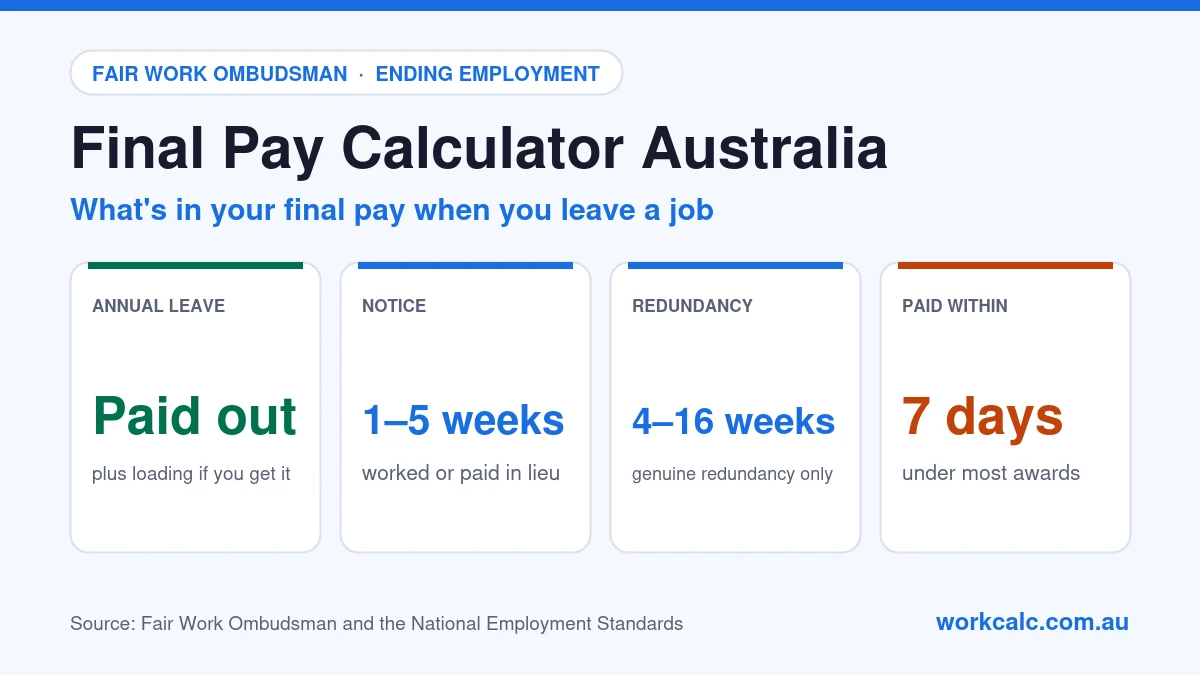
Final pay is the total amount owed to an employee on their last day of employment. It is built from several entitlements added together: outstanding wages for hours already worked, any unused annual leave paid at the ordinary rate, payment in lieu of notice if the employer ends employment without the employee working out their notice period (the NES notice periods set the minimum number of weeks), redundancy pay if the termination is a genuine redundancy, and unused long service leave if the employee has reached the qualifying period in their state.
Not every component applies to every termination. Someone resigning with notice typically receives only wages and leave payout (see what gets paid out when you resign). Someone made redundant typically receives all five — wages, leave payout, notice pay, redundancy pay, and long service leave if eligible. Tick the components above that apply to your situation to build your own total.
Resignation vs redundancy: what changes in final pay
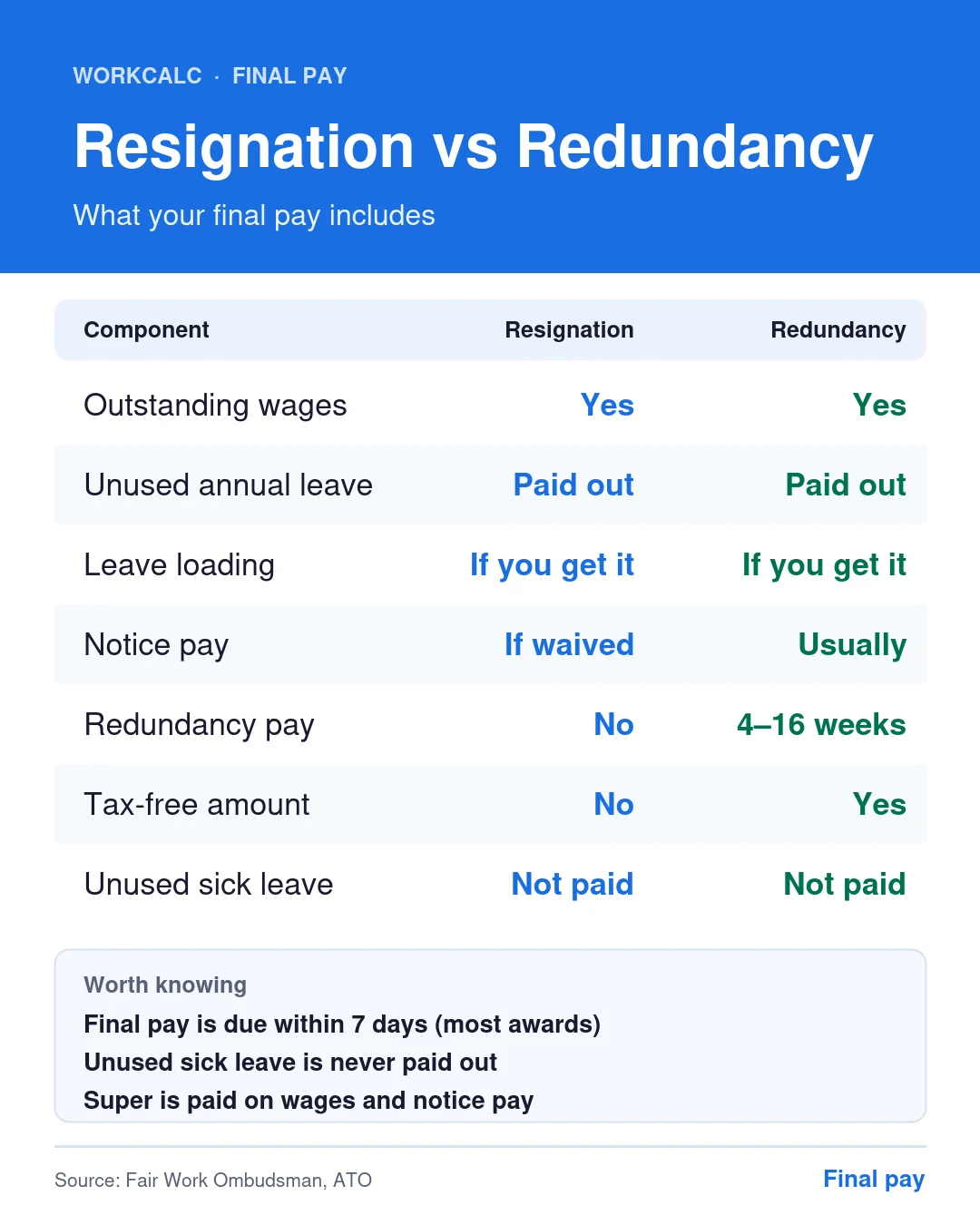
The same five components apply either way, but the totals look very different depending on how employment ends.
| Component | Resignation | Genuine redundancy |
|---|---|---|
| Outstanding wages | Always included | Always included |
| Unused annual leave | Paid out | Paid out, often more favourable tax |
| Notice pay | Only if employer waives it | Common — usually paid in lieu |
| Redundancy pay | Not applicable | 4–16 weeks under NES |
| Tax-free threshold | None | Applies to redundancy component |
| Long service leave | Pro-rata in some states only | Usually paid regardless of years |
Read the full comparison with worked dollar examples in Redundancy vs Resignation: The Financial Difference Every Australian Employee Should Know.
When final pay must be paid
There is no single legislated deadline under the Fair Work Act, but the Fair Work Ombudsman's general guidance is that final pay should be paid within 7 days of employment ending. Many modern awards and enterprise agreements set their own specific timeframe — check the one covering your role on the Fair Work Ombudsman website. If final pay is significantly delayed beyond what your award requires, you can lodge a complaint with the Fair Work Ombudsman on 13 13 94.
What's never included in final pay
- Superannuation on leave payouts. Super is only payable on ordinary earnings actually worked, including any notice period worked — not on unused annual leave, unused LSL, or redundancy pay.
- Unused sick or carer's leave. Personal/carer's leave is not paid out on termination under the NES, unlike annual leave.
- Discretionary bonuses. These aren't owed unless your contract or company policy specifically guarantees payment on termination.
This calculator combines simplified versions of each entitlement for an indicative total. For the precise breakdown of any individual component, use the dedicated Annual Leave Calculator, Redundancy Pay Calculator or Long Service Leave Calculator.
Frequently asked questions
Plain-English answers covering every component of final pay in Australia.
How do I calculate my final pay in Australia?
Add together: outstanding wages for hours worked, unused annual leave at your ordinary rate, payment in lieu of notice if applicable, redundancy pay if it's a genuine redundancy, and unused long service leave if you qualify. That's your gross final pay. Subtract PAYG tax withheld at the appropriate rate for each component for your net amount. Use the calculator above to build your own figure.
What must be included in final pay?
Always: outstanding wages and unused annual leave. Conditionally: notice pay (if not worked), redundancy pay (if genuine redundancy), and long service leave (if you've reached your state's qualifying period). Superannuation is payable on ordinary earnings actually worked, but not on leave payouts or redundancy.
When must final pay be paid?
There's no single legislated deadline under the Fair Work Act, but the Fair Work Ombudsman's general guidance is within 7 days of employment ending. Many awards set their own specific timeframe — check the one covering your role. Significant delays can be reported to the Fair Work Ombudsman on 13 13 94.
Is final pay taxed differently to normal pay?
Yes, in parts. Wages and worked notice are taxed as normal income. Unused leave uses ATO Schedule 7 — marginal rates for resignation, more favourable for genuine redundancy. Genuine redundancy payments have a tax-free component (2026–27: $13,598 + $6,801 per completed year) with the remainder taxed as an ETP — 32% below preservation age, 17% at or above it — up to the cap. See the tax on redundancy guide for the full breakdown.
Does final pay include superannuation?
Super (12% from 1 July 2025) is payable on ordinary earnings up to your last day worked, including any notice period actually worked. It is NOT payable on unused annual leave, unused long service leave, or redundancy payments — these aren't classified as ordinary time earnings under superannuation law.
Can my employer withhold my final pay?
Generally no. Employers can't withhold final pay as a penalty for resigning without notice, unreturned property, or disciplinary reasons — except in very limited circumstances permitted by a specific award, agreement, or your genuine written consent for a lawful deduction. Unlawful withholding can be reported to the Fair Work Ombudsman.
What is the difference between final pay on resignation vs redundancy?
On resignation, final pay includes outstanding wages, unused annual leave, and unused long service leave if eligible — but no redundancy pay, and notice pay only if you don't work your notice. On genuine redundancy, final pay additionally includes NES redundancy pay (4 to 16 weeks based on service) and the unused leave components receive more favourable tax treatment, with part of the redundancy payment itself tax-free up to the ATO threshold.