
How Much Super Should My Employer Pay?
The SG rate, what counts as Ordinary Time Earnings, who's eligible, and what to do if your super doesn't add up.
The short answer: 12% of your Ordinary Time Earnings
Since 1 July 2025, every Australian employer must pay 12% of an employee's Ordinary Time Earnings (OTE) into their nominated super fund. This is the final step of a long phase-up that started at 9% in 2013 — 12% is now the permanent rate, with no further legislated increases scheduled. Super is paid in addition to salary, not taken out of it.
The calculation itself is simple once you know your OTE: multiply by 0.12. Almost all the confusion in this space comes from figuring out exactly what counts as OTE — which is not the same thing as your total gross pay.
What is Ordinary Time Earnings (OTE)?
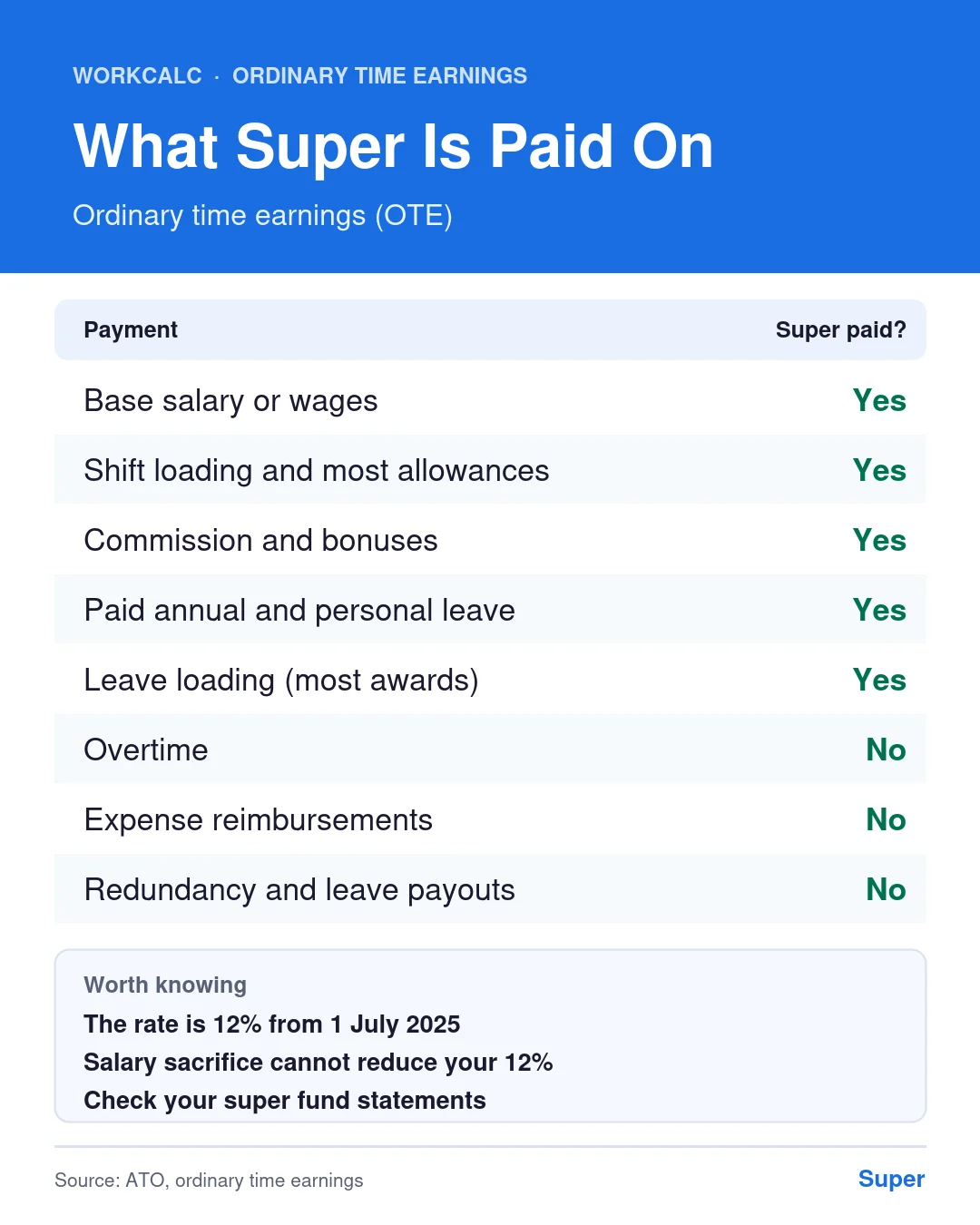
OTE is the specific measure superannuation guarantee is calculated on. It is not the same as your total gross pay for a period — the gap between the two is almost always overtime.
| Payment type | Included in OTE? |
|---|---|
| Base salary or ordinary hourly wages | Included |
| Shift loading and most allowances | Included |
| Commission and performance bonuses | Included |
| Paid annual and personal leave | Included |
| Leave loading (in most awards) | Included |
| Overtime payments | Excluded |
| Expense reimbursements | Excluded |
| Redundancy pay and unused leave paid on termination | Excluded |
This is why two employees on the same base salary can end up with different super contributions in a given period — the one working more overtime has a higher gross pay, but their super is still calculated on the smaller OTE figure, not the inflated total.
Worked example
Sarah — $72,000 base salary, $4,000 overtime this year
Notice the super is calculated on $72,000, not $76,000 — a common point of confusion when checking your own contributions against your payslip.
Related guide How Is Overtime Calculated in Australia? — the full tiered formula behind that overtime figure →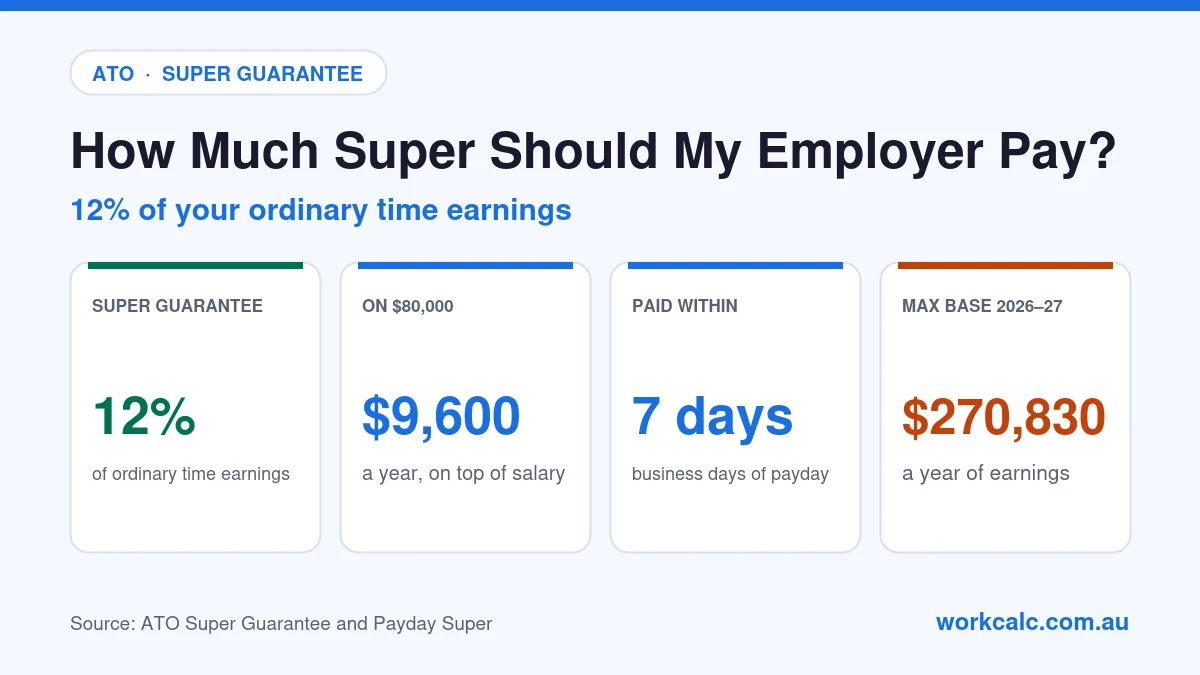
Who is entitled to superannuation
Since 1 July 2022, the old $450-per-month earnings threshold was abolished. Every employee earning any amount of OTE is now entitled to super, including casuals. The remaining eligibility rules are based on age:
- 18 or over: entitled to super on any OTE, regardless of hours worked.
- Under 18: only entitled if working more than 30 hours in a week.
- Contractors paid mainly for their labour: may still be entitled to super even when engaged under a "contractor" label — the law looks at the substance of the working arrangement, not just the title on the contract.
Check your exact super entitlement
Enter your OTE and pay frequency, or split a package-inclusive salary into base pay and super.
"Total package inclusive of super" vs "base salary + super"
Job ads describe salary in two different ways, and mixing them up is an easy way to misjudge an offer:
- Base salary + super: super is paid on top of the stated figure. A $90,000 base salary plus 12% super means the role actually costs the employer $100,800, and your take-home base stays at $90,000.
- Total package inclusive of super: the advertised number already contains the super component. A $100,000 package divides into $89,285.71 base salary and $10,714.29 super — not $100,000 base plus extra super on top.
If a job ad doesn't specify which one it means, it's worth asking before you accept — the difference between the two framings on the same advertised number is over $10,000 in real base pay.
What happens if your employer underpays your super
If an employer fails to pay the correct super on time, they become liable for the Superannuation Guarantee Charge (SGC). This isn't the same as simply paying the shortfall late — the SGC includes the unpaid super amount, an interest component, and an administration fee, and unlike normal super contributions, none of it is tax-deductible for the employer. It's designed to be a genuine deterrent, not just a late fee.
From 1 July 2026, "payday super" rules require employers to pay super at the same time as wages, rather than the previous quarterly minimum. This should make underpayment far easier to spot — a missing or short super payment will show up the same pay cycle it happens, rather than being buried for months in a quarterly lump sum.
How to check you're being paid correctly
- Find your Ordinary Time Earnings for a recent pay period on your payslip — not your total gross pay if you've worked overtime.
- Multiply that OTE by 12% to get the super you should have received for that period.
- Compare that figure against the actual contribution shown on your super fund's member statement or app for the same period.
- If there's a consistent shortfall across multiple pay cycles, raise it with your employer first — it may be a payroll error rather than deliberate underpayment.
- If it isn't resolved, you can lodge an enquiry directly with the Australian Taxation Office, who can investigate and pursue the Superannuation Guarantee Charge on your behalf if a shortfall is confirmed.
This guide covers the standard Superannuation Guarantee rules under the Superannuation Guarantee (Administration) Act 1992. Specific awards, enterprise agreements or individual contracts may provide super above the 12% statutory minimum — always check the instrument that applies to your role.
Frequently asked questions
Quick answers on super rates, OTE and what to do if something looks wrong.
How much super should my employer pay?
12% of your Ordinary Time Earnings, effective 1 July 2025. This applies to full-time, part-time and casual employees aged 18+, and to under-18s working more than 30 hours per week. Super is paid in addition to your salary, not deducted from it.
How is superannuation calculated in Australia?
Super = Ordinary Time Earnings × 12%. OTE includes base salary, most allowances, commissions, bonuses and paid leave — but excludes overtime. For example: $75,000 OTE × 0.12 = $9,000 per year.
What is the superannuation calculation formula?
Super Guarantee = Ordinary Time Earnings × SG rate. The current SG rate is 12% (effective 1 July 2025). Use the Superannuation Calculator to apply this to your own pay instantly.
What is Ordinary Time Earnings and why does it matter for super?
OTE is the specific earnings measure super is calculated on — not the same as gross pay. It includes base salary, allowances, commissions, bonuses and paid leave, but excludes overtime. Someone working a lot of overtime can have higher gross pay than OTE, and their super is still based on the smaller OTE figure.
Is overtime included in superannuation calculations?
Generally no — overtime is specifically excluded from OTE, so employers don't have to pay the 12% SG on overtime hours. Some awards or agreements treat certain extended hours as ordinary hours instead of overtime, in which case super would apply — check your specific award if you're unsure.
What should I do if I think my employer is underpaying my super?
Compare your payslip's OTE against your super fund's contribution statement over a few pay cycles. Raise any consistent shortfall with your employer first. If unresolved, lodge an enquiry with the ATO, who can investigate and pursue the Superannuation Guarantee Charge if a shortfall is confirmed.