
Pro-Rata Annual Leave Calculator
Calculate the exact annual leave you have accrued for any period of service — full-time or part-time, including the payout owed on resignation or termination.
Your details
How pro-rata annual leave is calculated
The National Employment Standards accrual formula, expressed transparently in three steps.
Time worked as a fraction of a year
Divide the number of calendar days between your start and end date by 365 to get the fraction of a year you have worked.
days worked ÷ 365
Multiply by the full-year entitlement
Multiply that fraction by 4 weeks (the NES full-year entitlement), then by your ordinary hours per week to get hours accrued.
fraction × 4 × hours/week
Deduct leave already taken
Subtract any annual leave you have already taken during this period to get your current remaining balance.
accrued hours − hours taken
What is pro-rata annual leave?
Under the National Employment Standards (NES), all permanent employees — full-time and part-time — accrue 4 weeks of paid annual leave per year, from the very first day of employment. Because accrual is continuous, at any point during the year an employee is entitled to the fraction of 4 weeks that corresponds to the time they have actually worked. That fraction is called their pro-rata annual leave entitlement.
The term "pro-rata" simply means "in proportion to." An employee who has worked half a year is entitled to half of 4 weeks (2 weeks) of leave. An employee who has worked three months is entitled to one quarter of 4 weeks (1 week), and so on.
The pro-rata formula
The calculation the Fair Work Act uses is based on calendar days, not just working days:
Accrued hours = (calendar days worked ÷ 365) × 4 × ordinary hours per week
Worked example — full-time employee, 9 months service
Jordan — 38hr/week, started 1 Jan 2026, resigning 1 Oct 2026
Worked example — part-time employee, 6 months service
Sam — 20hr/week part-time, started 1 Jan 2026, resigning 1 Jul 2026
Full-time vs part-time: the key difference
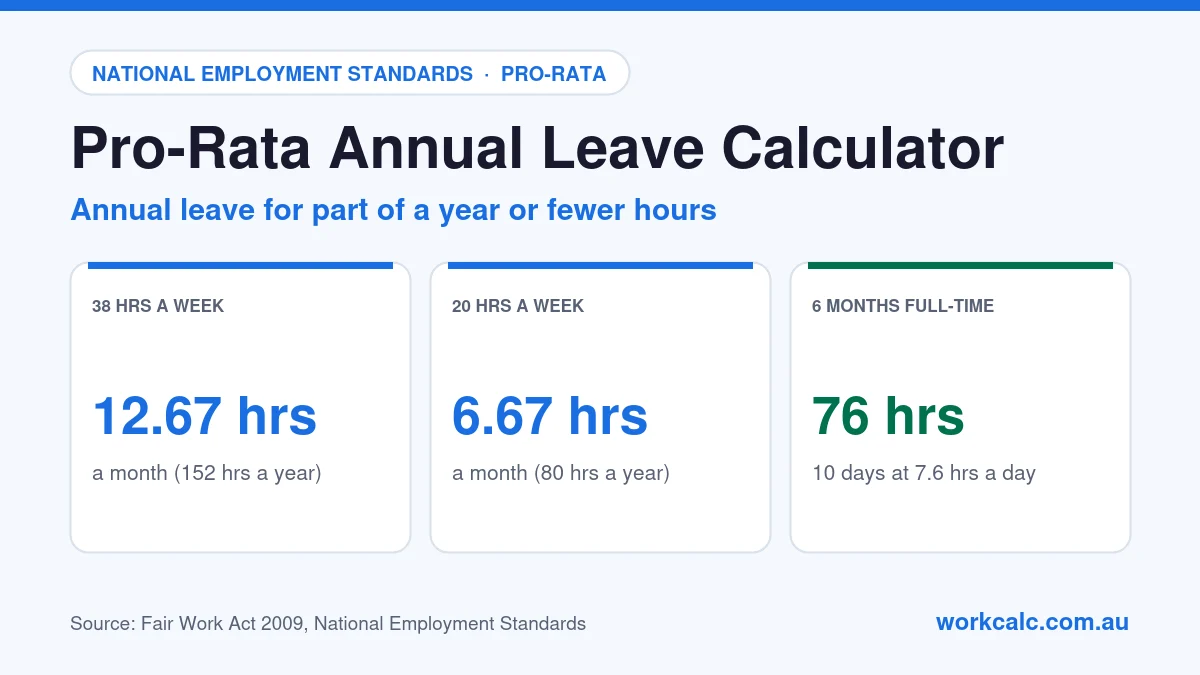
The NES entitlement is 4 weeks per year for both full-time and part-time employees, but a "week" means ordinary hours in that week. A full-time employee working 38 hours accrues 4 × 38 = 152 hours per year. A part-time employee working 20 hours accrues 4 × 20 = 80 hours per year. Both get the same number of weeks off — the hours just differ because their weeks are shorter.
| Hours per week | Annual entitlement (hours) | Pro-rata per month | Pro-rata per fortnight |
|---|---|---|---|
| 38 (standard full-time) | 152 hours | ~12.67h | ~5.85h |
| 40 | 160 hours | ~13.33h | ~6.15h |
| 32 (4-day week) | 128 hours | ~10.67h | ~4.92h |
| 25 (part-time) | 100 hours | ~8.33h | ~3.85h |
| 20 (part-time) | 80 hours | ~6.67h | ~3.08h |
| 15 (part-time) | 60 hours | ~5.00h | ~2.31h |
When is pro-rata leave paid out?
Under section 90 of the Fair Work Act 2009, all unused accrued annual leave must be paid out on termination — this includes any pro-rata amount for a partial year. This entitlement applies regardless of:
- Whether the employee resigned, was made redundant, or was dismissed
- How long the employee has worked (even just a few weeks earns some leave)
- Whether they gave proper notice
The payout is calculated at the employee's base rate of pay, or their ordinary rate if higher (e.g. shift workers who ordinarily receive a shift loading). Leave loading of 17.5% may also apply if required by the relevant modern award or enterprise agreement — check your award.
Tax on the payout is withheld under ATO Schedule 7, which applies marginal rate averaging rather than taxing the lump sum at your highest marginal rate. Use the Annual Leave Payout Tax Calculator to estimate the after-tax amount.
Converting annual leave hours to days
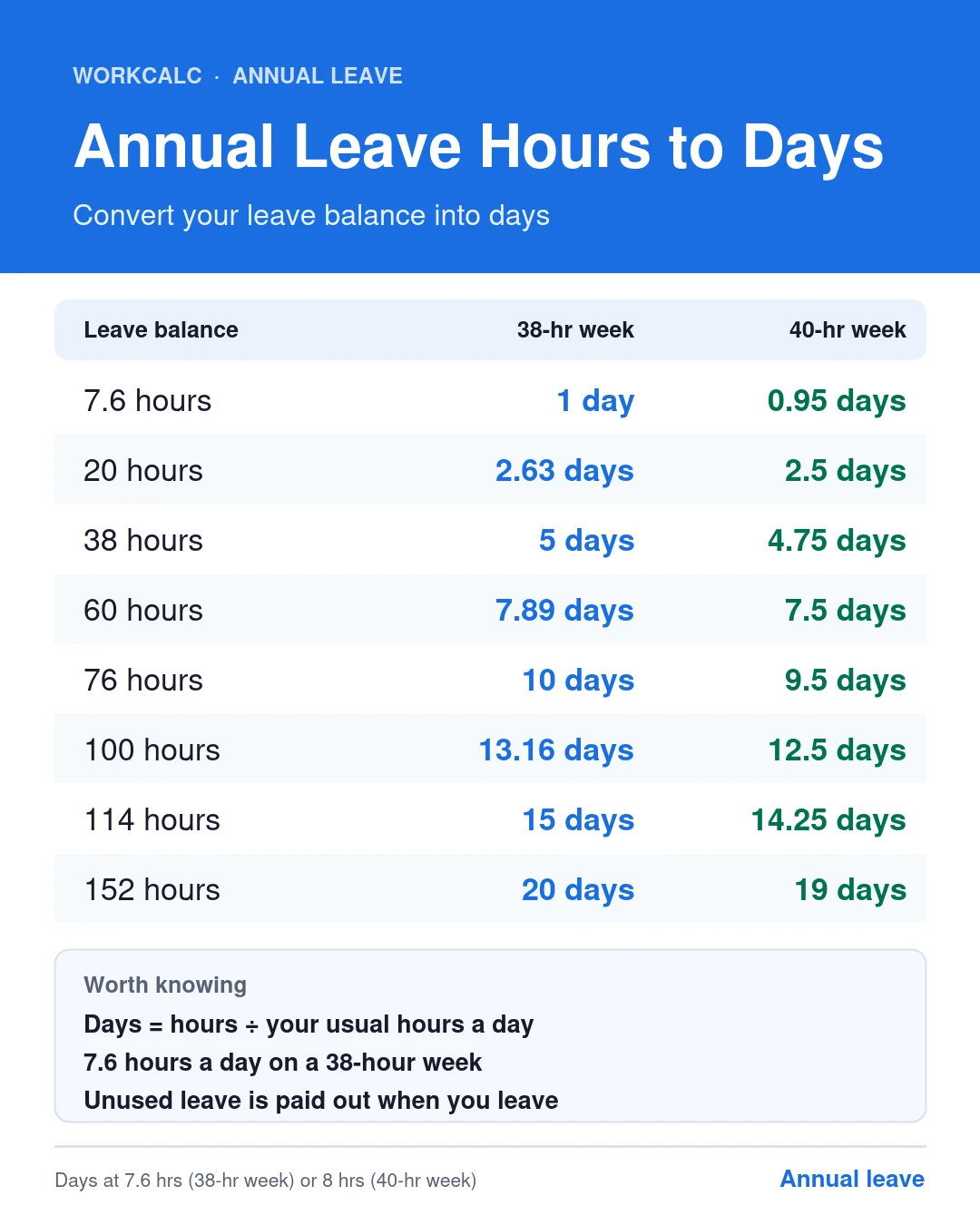
Payslips and leave balances are usually shown in hours, but many people want to know what that means in actual days off. The conversion depends on your ordinary hours per week, since a "day" is your weekly hours divided by 5:
| Balance | 38hr/week (7.6h/day) | 40hr/week (8h/day) | 20hr/week part-time (4h/day) |
|---|---|---|---|
| 60 hours | 7.89 days | 7.5 days | 15 days |
| 76 hours | 10 days | 9.5 days | 19 days |
| 100 hours | 13.16 days | 12.5 days | 25 days |
| 152 hours | 20 days (full entitlement) | 19 days | 38 days |
Formula: days = hours ÷ (ordinary hours per week ÷ 5). The calculator above shows both hours and days automatically for your exact figures.
Does pro-rata leave calculation differ by state?
No. Annual leave accrual is set nationally by the National Employment Standards under the Fair Work Act 2009, and applies the same way in NSW, VIC, QLD, SA, WA, TAS, ACT and the NT. There's no separate "QLD annual leave calculator" or state-specific formula — the 4-weeks-per-year accrual and pro-rata calculation shown on this page apply nationally to any national system employee, regardless of location.
Does pro-rata leave apply to casual employees?
No. Casual employees do not accrue annual leave under the NES. Instead, the casual loading (typically 25%) is paid on each hour worked in lieu of leave entitlements including annual leave, personal/carer's leave, and notice. Only permanent (full-time or part-time) employees accrue annual leave.
Frequently asked questions
Common questions about pro-rata annual leave accrual and payout in Australia.
How is pro-rata annual leave calculated in Australia?
Divide the number of calendar days worked by 365 to get the fraction of a year worked, then multiply by 4 (weeks per year entitlement) and by your ordinary hours per week. For example, 6 months on a 38-hour week: (182 ÷ 365) × 4 × 38 = 75.6 hours accrued.
Do you get pro-rata annual leave when you resign?
Yes. Under section 90 of the Fair Work Act 2009, all unused accrued annual leave — including any pro-rata portion for a partial year — must be paid out when employment ends for any reason, including resignation.
How do I calculate pro-rata leave for a part-time employee?
Exactly the same formula as full-time: (days worked ÷ 365) × 4 × ordinary hours per week. A part-time employee on 20 hours per week for 6 months accrues (182 ÷ 365) × 4 × 20 = 39.8 hours — which is 2 weeks at their part-time hours, proportionally the same as a full-time employee.
Is pro-rata annual leave paid out on termination?
Yes — all of it. Under the Fair Work Act, every hour of accrued annual leave (including any pro-rata partial-year amount) must be paid out when employment ends, regardless of why. Leave loading of 17.5% may also apply depending on your award or agreement.
Do casual employees get pro-rata annual leave?
No. Casual employees receive a casual loading (typically 25%) in lieu of leave entitlements. Only permanent full-time and part-time employees accrue annual leave under the NES.
How much is the annual leave payout taxed?
Tax on unused leave payout is withheld under ATO Schedule 7, which uses a marginal rate averaging method — generally producing a lower withholding rate than if the lump sum were taxed at your top marginal rate. Use the Annual Leave Payout Tax Calculator for an estimate.
How many days is 60 hours of annual leave?
It depends on your ordinary hours per week. On a standard 38-hour week (7.6 hours/day), 60 hours equals 7.89 days. On a 40-hour week (8 hours/day), it's 7.5 days. Formula: days = hours ÷ (ordinary hours per week ÷ 5). See the full conversion table above for other common balances.
Does pro-rata leave calculation differ by state (NSW, QLD, VIC)?
No. Annual leave accrual is set nationally under the National Employment Standards and applies the same way across every Australian state and territory. There's no separate state-based formula — the calculation on this page applies uniformly to national system employees regardless of location.
What if my employer refuses to pay out my pro-rata leave?
Refusing to pay out accrued annual leave on termination is a breach of the National Employment Standards under the Fair Work Act 2009. You can lodge a complaint with the Fair Work Ombudsman on 13 13 94, who can investigate and pursue recovery on your behalf.