
Redundancy vs Resignation: The Financial Difference Every Australian Employee Should Know Before They Decide
The gap between being made redundant and choosing to resign can be worth tens of thousands of dollars. Here is exactly what changes — in entitlements, in tax, and in net cash — with real numbers.
The short version: redundancy pays far more
When most people think about the difference between redundancy and resignation, they think about the redundancy payment itself. That is correct — but it understates the gap. The real difference is in three places at once: what you receive, how it is taxed, and what you give up by choosing to resign instead of waiting.
An employee who resigns receives only their unused annual leave payout (and notice pay if the employer waives the notice period). An employee who is genuinely made redundant receives all of that plus the NES redundancy payment — which on six years of service at an $85,000 salary is over $22,000 more in net cash, even after tax.
Side-by-side comparison
Every entitlement, for the same employee, under each scenario:
| Resignation | Genuine redundancy | |
|---|---|---|
| Outstanding wages | Paid — always | Paid — always |
| Unused annual leave | Paid out in full | Paid out in full |
| Notice pay | Only if employer waives it | Usually paid in lieu |
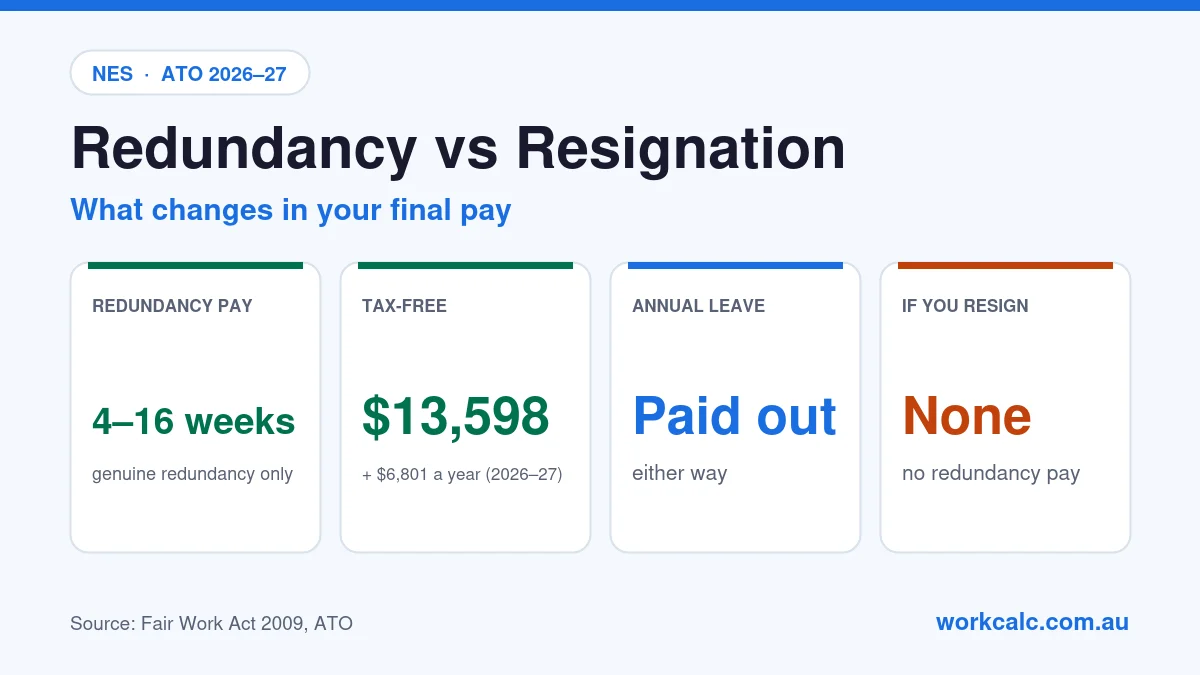
| NES redundancy pay | Not applicable | 4–16 weeks base pay |
| Tax-free threshold | None | $13,598 + $6,801/yr (2026–27) |
| ETP tax rate on excess | N/A — no redundancy payment | 32% (concessional) vs 47% marginal |
| Long service leave | Pro-rata in some states only | Usually payable regardless of years |
| Superannuation on payout | Not on leave payouts | Not on any payout component |
| Unfair dismissal rights | Not applicable | If redundancy is not genuine, can be challenged |
Worked example — $85,000 salary, 6 years service
Alex has worked for the same employer for 6 years and 3 months on an $85,000 salary. The employer is restructuring. Alex is considering whether to resign now or wait for the redundancy. Here is the financial outcome of each decision:
Resignation scenario
Genuine redundancy scenario
Alex's entire 11-week NES redundancy payment falls below the $54,404 tax-free threshold — so the full $17,980 is received tax-free. The only tax paid is on the leave payout and notice-in-lieu, both of which would have been received in either scenario. The $22,427 net difference is effectively the cost of resigning.
Calculate your own redundancy entitlement
Enter your years of service and weekly pay to see your NES weeks, tax-free limit and net payout estimate.
How the tax treatment differs
The tax gap between redundancy and resignation is one of the most underappreciated aspects of this decision. It is not just about what you receive — it is about how much of it you keep.
On resignation
- Unused annual leave is taxed under ATO Schedule 7 — a marginal rate averaging method that is slightly more favourable than being taxed at your top rate, but still substantial.
- Notice pay (if the employer waives it rather than requiring you to work it) is taxed as ordinary income at your full marginal rate.
- No tax-free amount applies to any component.
On genuine redundancy
- The NES redundancy payment is tax-free up to the ATO threshold of $13,598 + $6,801 per completed year of service (2026–27). For most employees with moderate service, the entire redundancy payment falls within the tax-free limit.
- Any redundancy above the threshold is taxed as an Employment Termination Payment at 32% — still concessional compared to the 47% top marginal rate.
- Unused annual leave is taxed the same way as resignation — under Schedule 7.
- Notice pay is also taxed as ordinary income either way.
The notice period — what changes
Notice pay is another component where the two outcomes can diverge. Under the NES, minimum notice periods are:
- Less than 1 year service: 1 week
- 1–3 years: 2 weeks
- 3–5 years: 3 weeks
- 5 or more years: 4 weeks (plus an extra week if you are 45 or older with at least 2 years of service)
On resignation, you are typically required to work your notice period. If you do not, the employer can refuse to pay it — and in some circumstances may be able to withhold pay for the unworked notice. If your employer waives your notice period (tells you to leave immediately), they must pay you in lieu.
On redundancy, most employers pay notice in lieu rather than requiring the employee to work it — particularly where the redundancy is immediate. This means notice pay commonly lands in your final payout as a lump sum on top of the redundancy payment.
Related guide Payment in Lieu of Notice — how it's calculated, taxed, and when your employer can choose to pay it out →Long service leave — the hidden difference
Long service leave treatment is where redundancy also has an edge for longer-serving employees. On resignation, most states only pay out pro-rata LSL if you have reached a minimum qualifying service threshold — in Victoria, for example, pro-rata LSL on resignation requires 7 years of service. On redundancy or dismissal, pro-rata LSL is typically payable from a lower threshold, or in some states from any service period, depending on the applicable state legislation.
Related guide Pro Rata Long Service Leave — full state-by-state thresholds, including where redundancy and resignation are treated differently →For an employee with 6–9 years of service being made redundant, this can add another $5,000–$15,000 to the payout that resignation would not have triggered.
Voluntary redundancy — is it as good as being selected?
When an employer offers voluntary redundancy — asking employees to put their hand up — accepting and being selected is treated as a genuine redundancy for both NES entitlement and ATO tax purposes. You receive the same redundancy payment, the same tax-free threshold, and the same leave and notice entitlements as an employee who was selected involuntarily.
The critical distinction is between voluntary redundancy (employer-initiated offer, employee nominates, employer accepts) and resignation (employee decides to leave without any redundancy offer on the table). Do not confuse the two — a resignation is a resignation regardless of the employer's restructuring plans, and it forfeits all redundancy entitlements.
When resigning might still make sense
The financial case for waiting out a redundancy is strong, but it is not the only consideration. Resigning may make sense if:
Wait for redundancy when...
- Redundancy is confirmed or highly likely
- The timeline is short (weeks, not months)
- Your entitlement is significant (long service, high salary)
- You have not yet secured a new role
- The tax-free amount would meaningfully reduce your tax bill
Resigning may make sense when...
- A new role starts immediately and delay would cost it
- Redundancy is uncertain or very far away
- Your entitlement is small (short service, low salary)
- The working environment has become untenable
- You have confirmed the redundancy payment in writing
If the decision is not straightforward, speaking with the Fair Work Ombudsman (13 13 94) or an employment lawyer before making a move is worth the time — the cost of getting it wrong is typically much higher than the cost of a single consultation.
Related guide How Is Redundancy Calculated in Australia? — NES table, genuine redundancy rules and worked examples →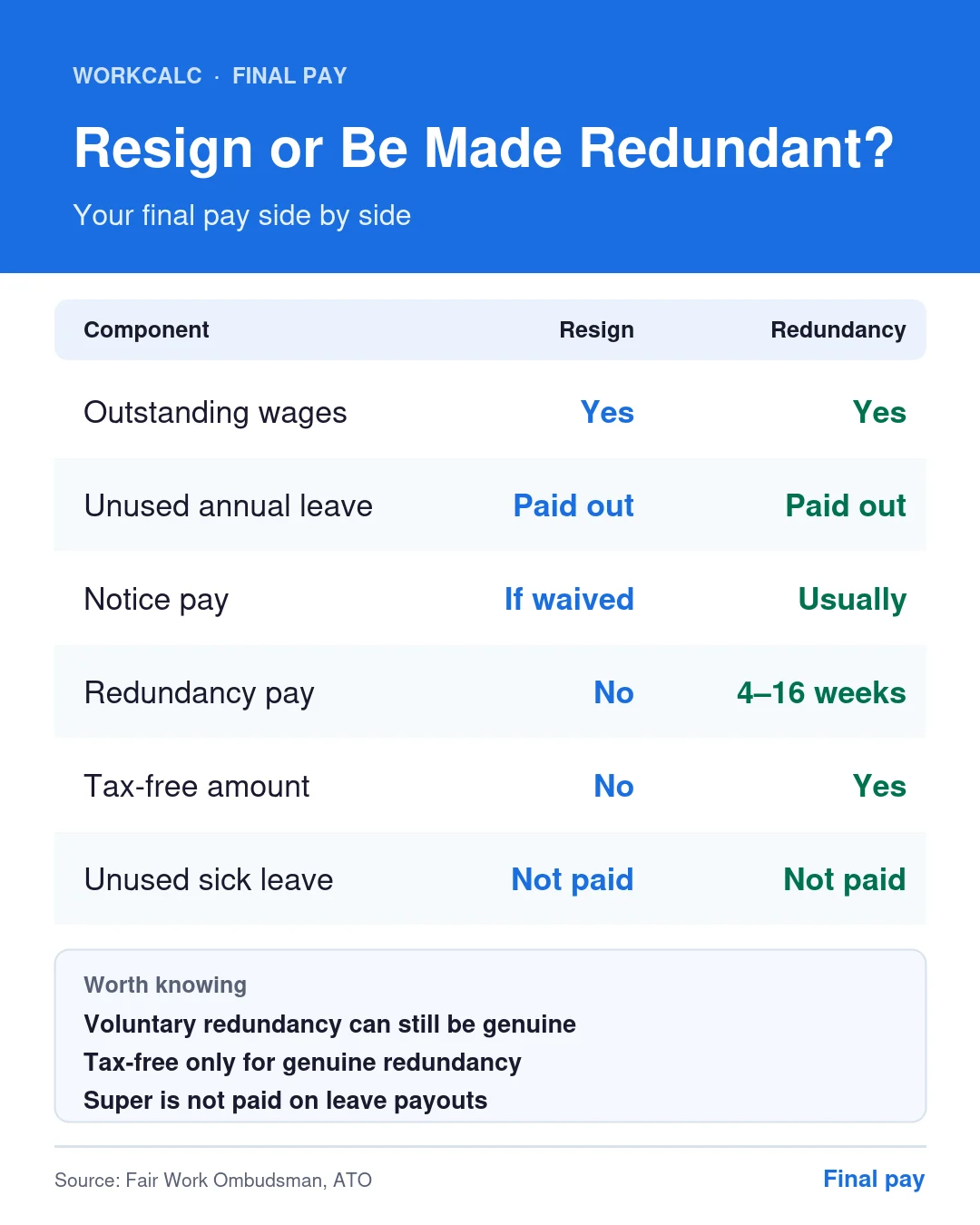
Your complete final pay — both scenarios
Whether you resign or are made redundant, your final pay includes several components that run in parallel. Use the Final Pay Calculator to model the complete picture — including wages, leave payout, notice, redundancy, and long service leave — for your specific situation.
Related tool Final Pay Calculator — wages, leave payout, notice, redundancy and LSL in one total →All dollar figures in this article are based on an $85,000 annual salary with 6 completed years of service. ATO 2026–27 genuine redundancy tax-free limits ($13,598 + $6,801 per completed year) sourced directly from the ATO. NES redundancy and notice week entitlements sourced from Schedule 4 and section 117 of the Fair Work Act 2009. Individual outcomes depend on modern award, enterprise agreement, state long service leave legislation, and specific circumstances.
Frequently asked questions
Common questions about the financial difference between redundancy and resignation in Australia.
What is the financial difference between redundancy and resignation?
On redundancy you receive NES redundancy pay (4–16 weeks), plus unused leave, notice pay, and the ATO tax-free threshold. On resignation you receive only unused leave (and notice if the employer waives it) — no redundancy payment, no tax-free amount. The gap commonly ranges from $10,000 to $50,000+ depending on salary and years of service. Use the Redundancy Pay Calculator to estimate your specific numbers.
Should I resign or wait to be made redundant?
Financially, waiting for redundancy is almost always better. You receive the NES redundancy payment, the tax-free threshold, and often notice paid in lieu as a lump sum. The main reason to resign instead is if a new role requires an immediate start and the redundancy is uncertain or distant. Never resign while redundancy is actively on offer without first confirming the financial difference in writing with your employer or taking independent advice.
Can I resign and still get redundancy pay?
Generally no. NES redundancy pay only applies when the employer terminates the employment because the job no longer exists. A voluntary resignation forfeits the redundancy payment. The only exception is a formal voluntary redundancy arrangement confirmed in writing by the employer before you leave.
Is redundancy pay taxed differently to resignation pay?
Yes, significantly. On genuine redundancy the NES payment has a tax-free component ($13,598 + $6,801 per completed year, 2026–27). Amounts above are taxed as an ETP at 32% — concessional vs the 47% top marginal rate. On resignation there is no tax-free component. See the full breakdown in Tax on Redundancy Pay Australia.
What is a voluntary redundancy and is it as good as a compulsory one?
Yes — a voluntary redundancy accepted by the employer qualifies as a genuine redundancy for both NES and ATO purposes. You receive the same payment, the same tax-free threshold, and the same entitlements as a compulsory redundancy. The key is that the employer must formally accept your nomination — putting your hand up alone does not guarantee selection.
What happens to annual leave if I resign vs made redundant?
Unused annual leave is paid out in full in both cases under section 90 of the Fair Work Act — this entitlement is identical whether you resign or are made redundant. The difference is in tax treatment and what else you receive alongside it.