
What Casual Employees Get in Australia: Public Holidays, Leave and Pay
Casuals aren't paid for public holidays they don't work and don't get paid annual leave. Here's what you get instead, what you're paid when you work a public holiday, and how to become permanent.
Being a casual means trading paid leave for a higher hourly rate. That trade covers more than most people think, from public holidays to sick days, and it changes what you're owed when you work on a public holiday.
Casual entitlements at a glance
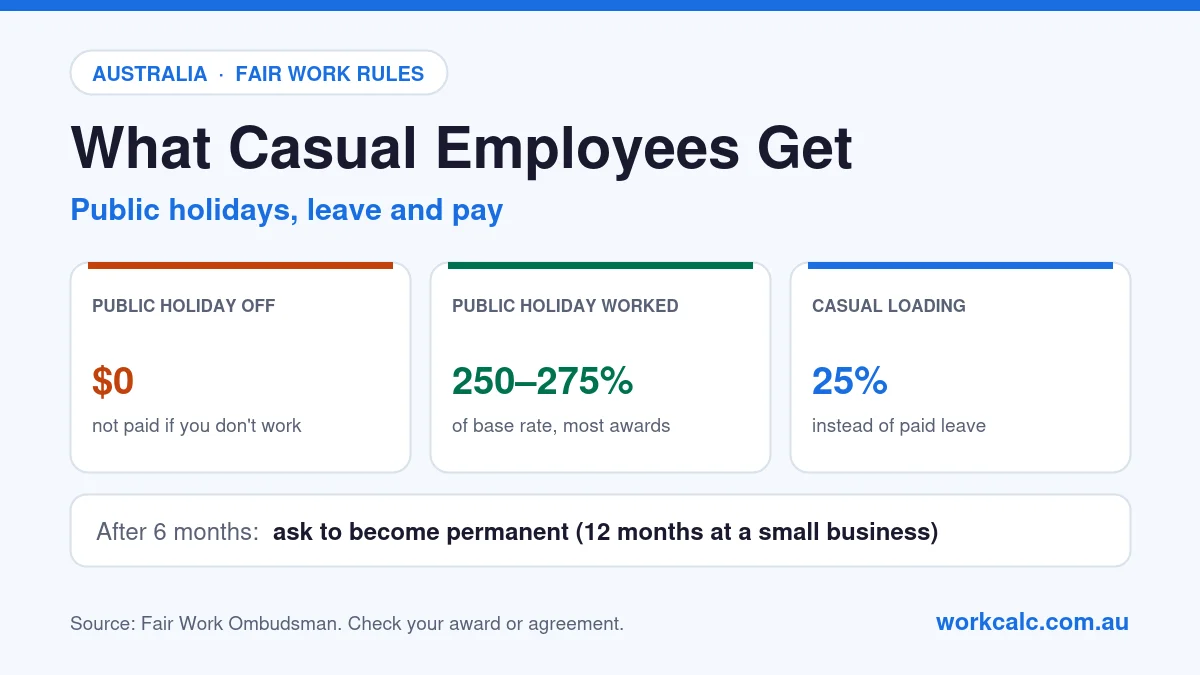
- Public holiday you don't work: no pay, even if you'd normally work that day.
- Public holiday you do work: your award's casual public holiday rate, usually 250% to 275% of the base rate.
- Annual leave and sick leave: none paid. You get a casual loading, usually 25%, instead.
- Leave you do get: 2 days unpaid carer's leave and 2 days unpaid compassionate leave each time you need it, 10 days paid family and domestic violence leave a year, and unpaid community service leave.
- Also: 12% super, and long service leave in some states and territories.
- Becoming permanent: after 6 months (12 months at a small business) you can give your employer written notice to change to permanent.
Do casuals get paid for public holidays?
Only if they work. Under the National Employment Standards, full-time and part-time employees are paid their base rate for a public holiday that falls on a day they'd normally work. Casual employees are specifically left out of that rule, so a public holiday you don't work is simply an unpaid day.
That stays true even if you've worked the same shifts every week for years. A regular pattern of work doesn't make you permanent and doesn't give you paid public holidays.
Example: Mia is a casual barista who works every Monday. Easter Monday is a public holiday and the café is closed, so Mia isn't paid for the day. Her part-time colleague, who is also rostered on Mondays, gets paid for the hours she would have worked.
What casuals earn when they work a public holiday
If you do work, your award or agreement sets your rate. Most awards have a separate casual public holiday rate that already includes the casual loading, so it isn't added again on top.
| Award | Full-time and part-time | Casual |
|---|---|---|
| General Retail, Hospitality, Restaurant, Fast Food | 225% | 250% |
| Clerks, Manufacturing, Building and Construction, Aged Care | 250% | 275% |
| Nurses | 200% | 250% |
Percentages of the award's base (minimum) hourly rate. See every award, and work out your own pay, with the public holiday pay calculator.
Worked example: say your base rate is $26.44 an hour, the national minimum wage from 1 July 2026, and you work a 6-hour shift.
| Shift | Hourly rate | 6-hour shift |
|---|---|---|
| Normal weekday (base + 25% loading) | $33.05 | $198.30 |
| Public holiday at 250% | $66.10 | $396.60 |
| Public holiday at 275% | $72.71 | $436.26 |
Some awards also set a minimum number of paid hours for a public holiday shift, so check yours if you're asked to work a short shift.
Can a casual refuse to work on a public holiday?
Yes, on the same terms as everyone else. Every employee, including casuals, has the right to be away from work on a public holiday. Your employer can ask you to work, but the request must be reasonable, and you can refuse if it isn't or if you have reasonable grounds.
Whether a request is reasonable depends on things like the type of business, your role, your personal and family circumstances, whether you're casual or permanent, whether you could expect to be asked, the pay on offer and how much notice you got. Casuals can also often turn down a shift that's offered, because there's no firm commitment to ongoing work.
Do casuals get annual leave?
No. Casual employees don't get paid annual leave, paid sick and carer's leave, leave loading, notice of termination or redundancy pay, however regularly they work. The casual loading, usually 25% of the base rate, is paid instead.
Because there's no leave balance, there's nothing to pay out when a casual job ends. If you want to compare a year as a casual with a year as a permanent part-timer, see permanent part-time vs casual annual leave.
What casual employees do get
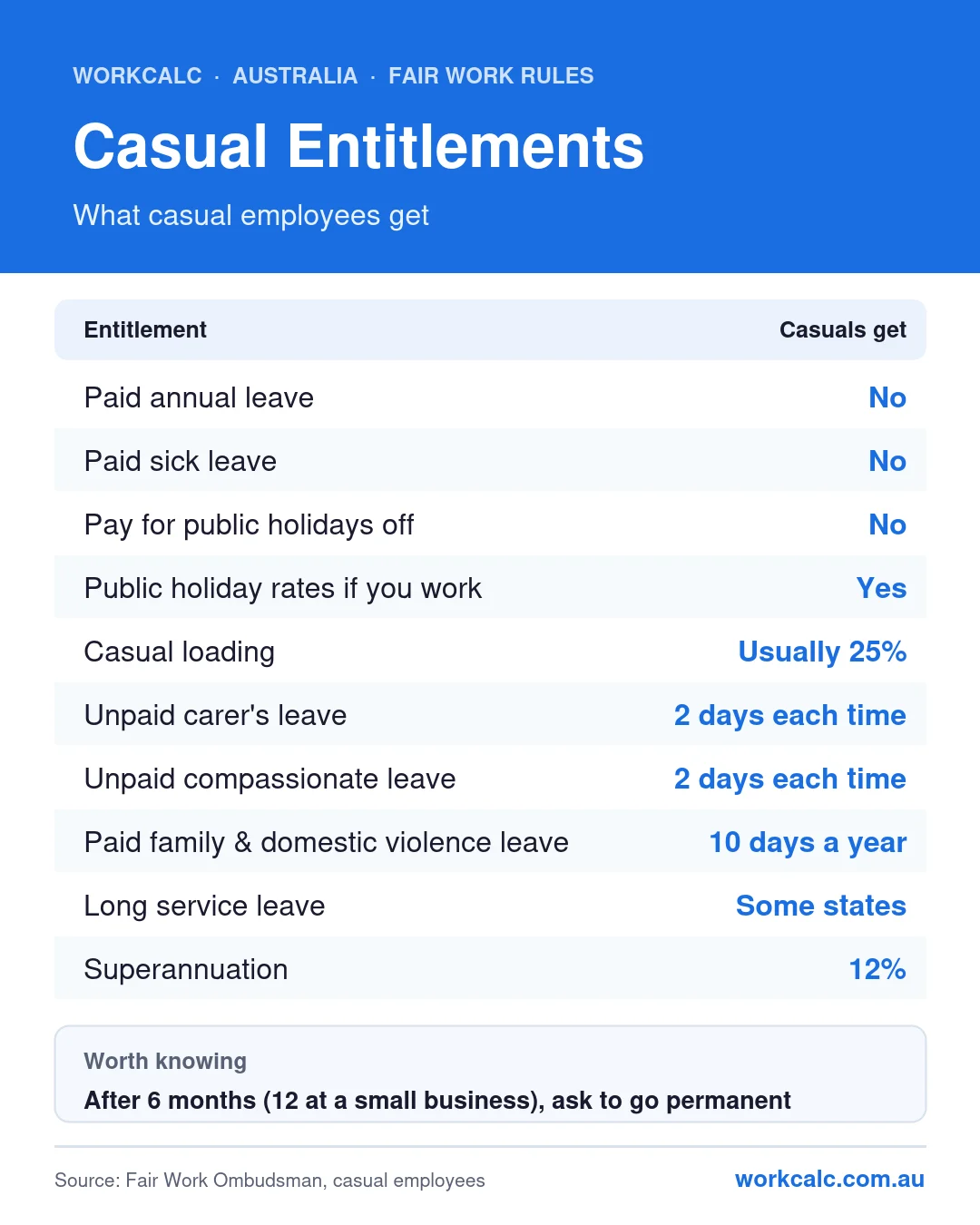
| Entitlement | Casuals get |
|---|---|
| Casual loading | Usually 25% on top of the base rate |
| Carer's leave | 2 days unpaid each time it's needed |
| Compassionate leave | 2 days unpaid each time it's needed |
| Family and domestic violence leave | 10 days paid a year |
| Community service leave (such as jury duty) | Unpaid |
| Unpaid parental leave and flexible work requests | After 12 months of regular, systematic work, if you expect it to continue |
| Long service leave | In some states and territories |
| Superannuation | 12% of ordinary time earnings |
| Paid annual leave, sick leave and public holidays off | No |
Long service leave rules for casuals depend on your state. Check yours with the long service leave calculator.
How to become permanent and get paid leave
Since 26 August 2024, casuals have had an "employee choice" pathway to permanent work. You can give your employer written notice that you want to change to full-time or part-time if:
- you've worked for them for at least 6 months, or 12 months if it's a small business, and
- you believe you no longer meet the definition of a casual employee, for example because there's now a firm advance commitment to ongoing work.
Your employer must reply in writing within 21 days, and can only refuse for certain reasons. Once the change takes effect, you build up paid annual leave and sick leave, and you're paid for public holidays that fall on your normal work days. Your employer can also offer to make you permanent at any time if you both agree.
For the full comparison, including what happens if your employer refuses, see casual vs permanent employment.
Check you're paid correctly
- Your payslip should show a casual rate or casual loading for every hour you work.
- Public holiday hours should be paid at the casual public holiday rate, not the normal casual rate.
- Your employer should pay 12% super on your ordinary earnings.
- Your casual rate should be at least the minimum for your award. For award-free casuals, that's $33.05 an hour from 1 July 2026. Check it with the minimum wage calculator.
Not sure whether a date is a public holiday where you work? Use the public holiday checker. If you're working over Christmas, read working on Christmas Day.
Next readPublic holiday pay calculator: casual and permanent rates by awardSources: Fair Work Ombudsman pages on casual employees, becoming a permanent employee, not working on public holidays and public holiday penalty rates; Fair Work Act 2009 (sections 15A, 66A to 66K, 114 and 116); public holiday clauses of the General Retail Industry, Hospitality, Restaurant, Fast Food, Clerks, Manufacturing, Building and Construction, Aged Care and Nurses awards. Checked October 2026. This guide is general information, not legal advice.
Casual employee FAQs
Quick answers about public holidays, leave and pay for casuals.
Do casuals get paid for public holidays they don't work?
No. Under the National Employment Standards, full-time and part-time employees are paid for a public holiday that falls on a day they normally work, but casual employees are left out of that rule. A public holiday a casual doesn't work is unpaid, even if they work that day every week.
What is the public holiday rate for casual employees?
It depends on your award. Under the General Retail, Hospitality, Restaurant and Fast Food awards, casuals get 250% of the base rate on a public holiday. Under the Clerks, Manufacturing, Building and Construction and Aged Care awards it's 275%, and under the Nurses award 250%.
Is the casual loading added on top of the public holiday rate?
Not under most awards. The casual public holiday rate already includes the casual loading. For example, the Retail award pays casuals 250% of the base rate on a public holiday, compared with 225% for permanent staff. Adding another 25% on top would count the loading twice.
Do casual employees get annual leave?
No. Casuals don't get paid annual leave or leave loading, however regularly they work. They're paid a casual loading, usually 25% of the base rate, instead. Because there's no leave balance, nothing is paid out when a casual job ends.
Do casuals get paid sick leave?
No. Casuals don't get paid sick or carer's leave. They can take 2 days of unpaid carer's leave and 2 days of unpaid compassionate leave each time it's needed, and 10 days of paid family and domestic violence leave a year.
Can a casual refuse to work on a public holiday?
Yes. Every employee, including casuals, can be away from work on a public holiday. An employer can ask you to work, but you can refuse if the request isn't reasonable or you have reasonable grounds, such as family responsibilities.
Do casuals get long service leave?
In some states and territories, yes, if you've worked long enough for the same employer. The rules for casuals are set by each state's long service leave law, so check the rules where you work.
How can a casual become permanent?
Under the employee choice pathway, a casual who has worked for at least 6 months (12 months for a small business) and believes they no longer meet the casual definition can give written notice asking to become full-time or part-time. The employer must reply in writing within 21 days and can only refuse for certain reasons.