
Salary Sacrifice Calculator Australia
See exactly how much tax you save, what lands in your super after contributions tax, and your net financial advantage — for the 2026–27 and 2025–26 financial years.
Your details
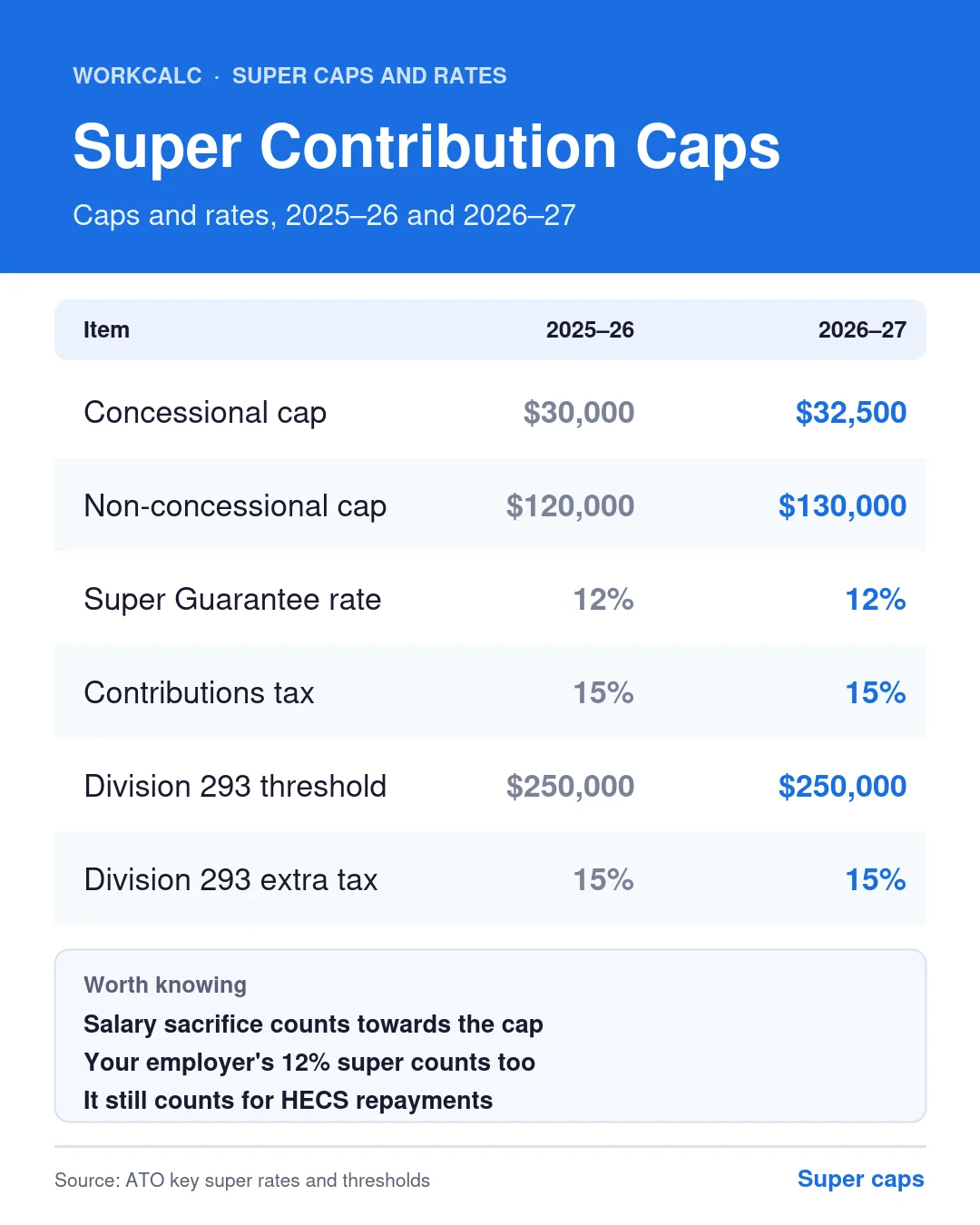
Concessional contribution caps and rates
ATO-confirmed figures for 2025–26 and 2026–27.
| Item | 2025–26 | 2026–27 |
|---|---|---|
| Concessional contributions cap | $30,000 | $32,500 |
| Non-concessional contributions cap | $120,000 | $130,000 |
| Superannuation Guarantee rate | 12% | 12% |
| Contributions tax (standard) | 15% | 15% |
| Division 293 threshold | $250,000 | $250,000 |
| Division 293 additional tax | 15% | 15% |
| Second tax bracket rate | 16% | 15% |
How salary sacrifice to super works
Salary sacrifice is an agreement with your employer to redirect part of your before-tax salary into your superannuation fund instead of receiving it as take-home pay. Because the sacrificed amount never appears in your assessable income, it avoids your marginal income tax rate — which can be up to 47% including the Medicare levy — and instead attracts only the concessional 15% contributions tax inside your super fund.
This creates a genuine tax saving: the difference between your marginal rate and 15% stays working for you inside super, rather than going to the ATO as income tax.
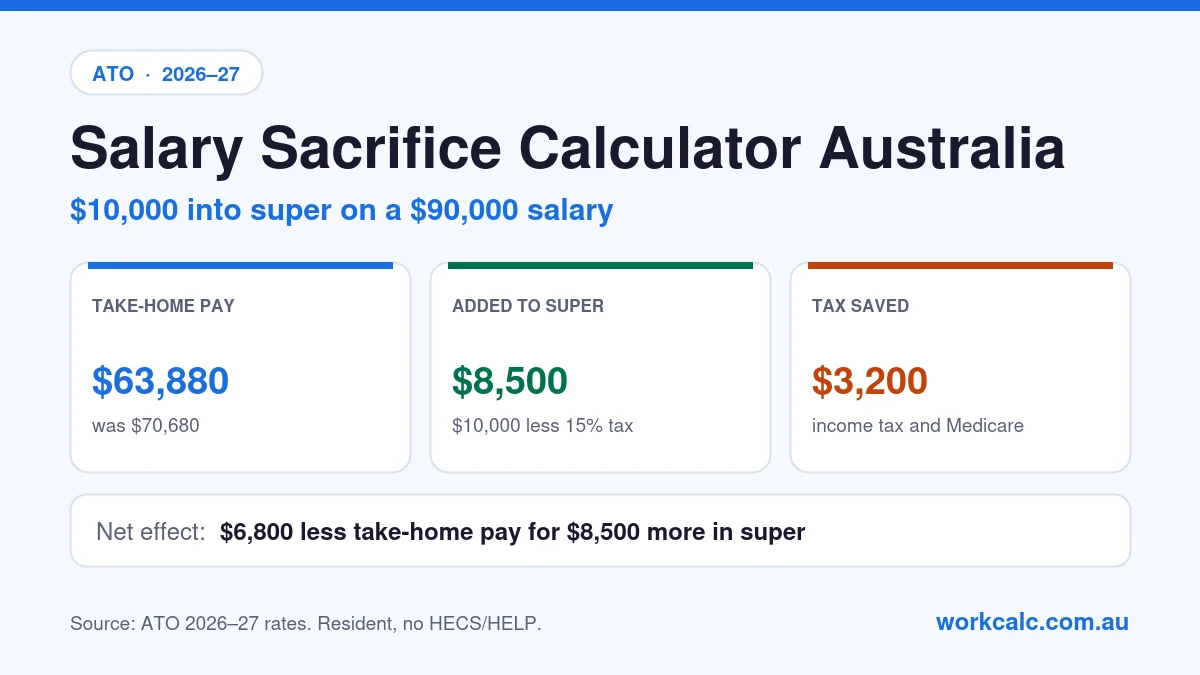
Worked example — $90,000 salary, $10,000 sacrifice
| Item | Without sacrifice | With $10,000 sacrifice |
|---|---|---|
| Taxable salary | $90,000 | $80,000 |
| Income tax + Medicare levy | $19,320 | $16,120 |
| Take-home pay | $70,680 | $63,880 |
Take-home pay drops by $6,800 — but of the $10,000 sacrificed, $8,500 lands in super after the 15% contributions tax. The net advantage is $1,700: that's the tax saving that would otherwise have been lost, now compounding inside your super fund instead.
The concessional contributions cap
All concessional (before-tax) contributions to your super count towards a single annual cap — $32,500 for 2026–27 (up from $30,000 in 2025–26). This cap includes three things combined:
- Your employer's compulsory Superannuation Guarantee (12% of your ordinary time earnings)
- Any salary sacrifice you elect to make
- Any personal contributions you claim as a tax deduction
If your combined concessional contributions exceed the cap, the excess is taxed at your marginal rate instead of the concessional 15% rate — removing the tax advantage entirely for that portion, and potentially creating an unexpected tax bill.
Carry-forward unused cap
If your total super balance was below $500,000 at 30 June of the previous financial year, you may be able to carry forward unused concessional cap amounts from the previous 5 years. This is particularly useful if you had a lower-income year, took parental leave, or are catching up on super after a career break.
Division 293 tax — the high income surcharge
If your income plus low-tax concessional contributions exceed $250,000 in a financial year, an additional 15% tax applies to the contributions above that threshold — Division 293 tax. This brings the total tax on the affected portion to 30% instead of the standard 15%. The $250,000 threshold has not been indexed since 2017, meaning more Australians are drawn into it each year as wages grow.
Even with Division 293 applying, salary sacrifice is usually still worthwhile — 30% tax remains well below the top marginal rate of 47%. The benefit is simply reduced compared to lower income levels. Division 293 tax is assessed separately by the ATO after you lodge your tax return, not deducted at source.
Does salary sacrifice affect my HECS or HELP debt?
This is one of the most commonly misunderstood aspects of salary sacrifice. While sacrificing reduces your taxable income, it does not reduce your HECS/HELP compulsory repayment. The ATO's repayment income calculation specifically adds back your reportable super contributions — which includes salary sacrifice amounts above your compulsory Superannuation Guarantee — before calculating how much you owe.
In practice, this means salary sacrificing $10,000 will reduce your income tax bill but will not lower your HECS repayment obligation, because that $10,000 is added straight back in for the HECS calculation. This is different to how it affects standard income tax, where the sacrifice genuinely reduces your taxable income.
Salary sacrifice for things other than super
Some employers — particularly in the not-for-profit and public health sectors — allow salary sacrifice for benefits beyond super, subject to Fringe Benefits Tax (FBT) rules:
- Novated lease (car): uses either the statutory formula method or operating cost method to calculate FBT — a genuinely different calculation to super salary sacrifice, and not covered by this calculator.
- Laptops and electronic devices: often FBT-exempt if primarily used for work.
- Not-for-profit salary packaging: eligible NFP employees can salary package up to $15,900 of everyday living expenses (rent, mortgage, groceries) FBT-free each year, plus a separate $2,650 meal entertainment cap. Public hospital employees have a similar but distinct $9,010 cap.
These arrangements have their own separate rules, caps, and calculation methods — this calculator focuses specifically on super salary sacrifice, which is the most common and most straightforward form.
When salary sacrifice is worth it — and when it isn't
Salary sacrifice provides more benefit the higher your marginal tax rate is, because the gap between your marginal rate and the 15% contributions tax rate is what creates the saving:
- Below $18,200 taxable income: no benefit — you're not paying income tax to save in the first place.
- $18,201–$45,000 (15% bracket, 2026–27): minimal benefit — your marginal rate is close to the 15% contributions tax rate.
- $45,001–$135,000 (30% bracket): solid benefit — roughly 15 percentage points saved on every dollar sacrificed.
- $135,001–$190,000 (37% bracket): strong benefit — roughly 22 percentage points saved.
- Above $190,000 (45% bracket): the largest benefit — roughly 32 percentage points saved, until Division 293 reduces it above $250,000.
Salary sacrifice also locks the money away until you reach preservation age (currently 60 for most people) — a genuine trade-off against liquidity that's worth weighing against the tax saving, particularly if you may need access to cash before retirement.
Frequently asked questions
Common questions about salary sacrifice to super in Australia.
How does salary sacrifice to super work?
You agree with your employer to redirect part of your before-tax salary into super instead of cash. The sacrificed amount is taxed at 15% inside super instead of your marginal rate (up to 47%), creating a tax saving that stays in your retirement savings.
How much can I salary sacrifice into super in 2026–27?
The concessional cap is $32,500 for 2026–27, covering your employer's SG (12%), any salary sacrifice, and personal deductible contributions combined. Exceeding the cap means the excess is taxed at your marginal rate instead of 15%. Carry-forward may allow more if your super balance is under $500,000.
Does salary sacrifice reduce my Superannuation Guarantee contribution?
No. Since 1 July 2020, employers must calculate the 12% SG on your salary before sacrifice, not the reduced amount. Your compulsory super entitlement is unaffected by how much you choose to salary sacrifice.
Does salary sacrifice affect my HECS or HELP repayments?
No, it does not reduce your HECS repayment. The ATO's repayment income calculation adds back your reportable super contributions before calculating your compulsory repayment — so salary sacrifice reduces your income tax but not your HECS obligation.
What is Division 293 tax and does it affect salary sacrifice?
An additional 15% tax on concessional contributions when your income plus contributions exceed $250,000, bringing total tax on the affected portion to 30%. Salary sacrifice usually remains worthwhile even with Division 293, since 30% is still well below the 47% top marginal rate.
Can I salary sacrifice for things other than super?
Yes — some employers allow novated leases, laptops, or (for eligible NFP/health employees) everyday living expenses. These use different FBT-based calculations to super salary sacrifice and are not covered by this calculator.
Is salary sacrifice worth it for low income earners?
Less so. Below $18,200 there's no benefit since you pay no income tax anyway. In the $18,201–$45,000 bracket (15% in 2026–27) the saving is minimal since your marginal rate is close to the 15% contributions tax. The benefit grows significantly at higher income brackets.
How does salary sacrifice affect my take-home pay?
Your take-home pay reduces by less than the full sacrifice amount, because you're no longer paying income tax on that portion of your salary. On a $90,000 salary sacrificing $10,000 in 2026–27, take-home pay drops by $6,800 — not the full $10,000 — because $3,200 of that would have gone to tax and Medicare levy anyway. Use the calculator above to see your exact take-home pay reduction alongside how much lands in super after contributions tax.