
Tax Brackets Australia 2026–27
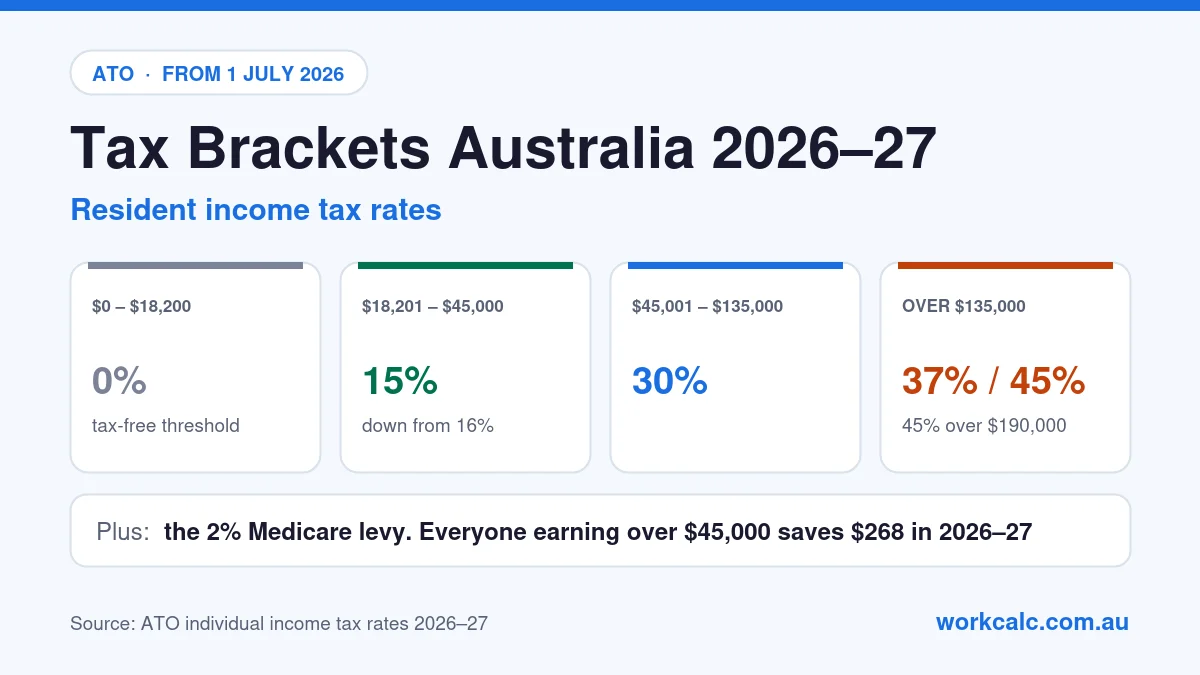
From 1 July 2026, Australian residents pay no tax on the first $18,200 they earn. After that the rates are 15%, 30%, 37% and 45%. The 15% rate replaces the old 16% rate, which saves you up to $268 this year. Use the calculator below to see your tax, marginal rate and average rate.
Tax bracket calculator
Enter your taxable income for the year to see your tax bracket, how much tax you pay in each bracket, and what you keep. For your take-home pay per week or fortnight, including super and HECS, use the pay calculator. For your HECS repayment on its own, use the HECS repayment calculator.
*The marginal rate is the tax plus Medicare levy on your next dollar of income. It includes the reduction of the low income tax offset where that applies.
Australian resident tax rates 2026–27
| Taxable income | Tax on this income | Rate |
|---|---|---|
| $0 – $18,200 | Nil | 0% |
| $18,201 – $45,000 | 15c for each $1 over $18,200 | 15% |
| $45,001 – $135,000 | $4,020 plus 30c for each $1 over $45,000 | 30% |
| $135,001 – $190,000 | $31,020 plus 37c for each $1 over $135,000 | 37% |
| $190,001 and over | $51,370 plus 45c for each $1 over $190,000 | 45% |
For the 2026–27 income year (1 July 2026 to 30 June 2027). These rates don't include the 2% Medicare levy. Source: ATO, Tax rates – Australian resident.
What changed on 1 July 2026?
The rate on income between $18,201 and $45,000 fell from 16% to 15%. The thresholds and the 30%, 37% and 45% rates didn't change. Anyone earning over $45,000 saves the full $268 a year (1% of $26,800), which is about $10.30 a fortnight. If you earn between $18,200 and $45,000, you save 1% of your income above $18,200.
Legislation passed in 2025 cuts the rate again to 14% from 1 July 2027. From 2027–28, that's a saving of up to $536 a year compared with the 2025–26 rates.
| Taxable income | Tax 2025–26 | Tax 2026–27 | You save |
|---|---|---|---|
| $30,000 | $1,188 | $1,070 | $118 |
| $45,000 | $3,963 | $3,695 | $268 |
| $60,000 | $8,688 | $8,420 | $268 |
| $100,000 | $20,788 | $20,520 | $268 |
| $200,000 | $56,138 | $55,870 | $268 |
Income tax after the low income tax offset, not including the Medicare levy.
How tax brackets work (marginal tax explained)
Australia has a marginal tax system. Each rate applies only to the part of your income that falls inside that bracket, not to your whole income. Earning a dollar more can never leave you with less money after income tax.
Worked example: $80,000 taxable income in 2026–27
- First $18,200: tax-free, so $0.
- $18,201 to $45,000: $26,800 × 15% = $4,020.
- $45,001 to $80,000: $35,000 × 30% = $10,500.
- Income tax: $4,020 + $10,500 = $14,520. No low income tax offset applies at this income.
- Medicare levy: $80,000 × 2% = $1,600.
Total tax is $16,120, which leaves $63,880. Your tax bracket is 30%, but your average tax rate is only 20.2% ($16,120 ÷ $80,000). Your marginal rate is 32%: of every extra dollar you earn, 30c goes in income tax and 2c in Medicare levy.
Myth: “A pay rise will push me into a higher bracket and I'll take home less.” Not true. Only the dollars above $135,000 are taxed at 37%. If you go from $134,000 to $136,000, the extra $2,000 is taxed at 30% and 37%, and the rest of your income is taxed exactly as before.
How much tax you pay on common incomes (2026–27)
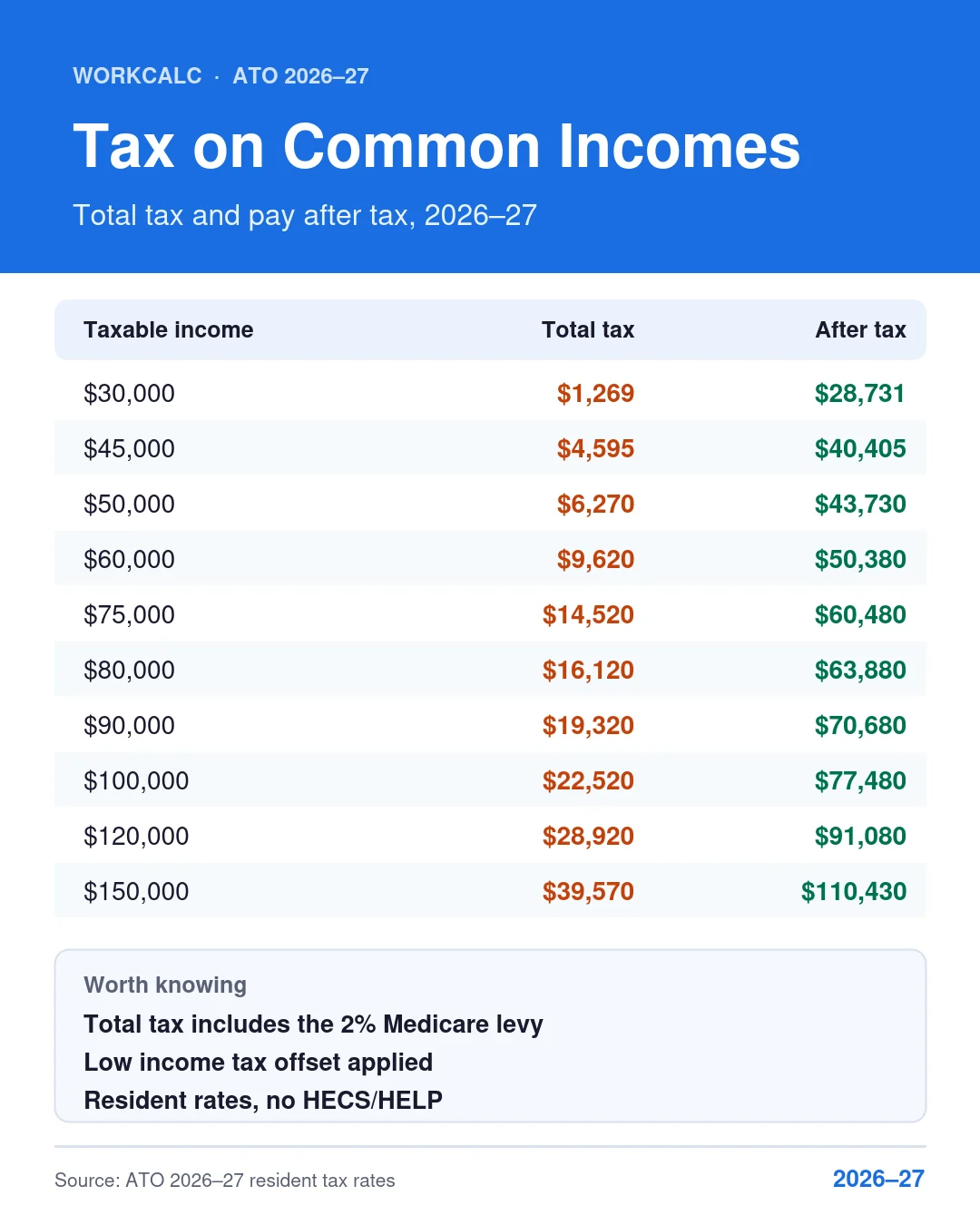
| Taxable income | Income tax* | Medicare levy | Total tax | After tax | Average rate |
|---|---|---|---|---|---|
| $18,200 | $0 | $0 | $0 | $18,200 | 0.0% |
| $30,000 | $1,070 | $199 | $1,269 | $28,731 | 4.2% |
| $45,000 | $3,695 | $900 | $4,595 | $40,405 | 10.2% |
| $50,000 | $5,270 | $1,000 | $6,270 | $43,730 | 12.5% |
| $60,000 | $8,420 | $1,200 | $9,620 | $50,380 | 16.0% |
| $75,000 | $13,020 | $1,500 | $14,520 | $60,480 | 19.4% |
| $80,000 | $14,520 | $1,600 | $16,120 | $63,880 | 20.2% |
| $90,000 | $17,520 | $1,800 | $19,320 | $70,680 | 21.5% |
| $100,000 | $20,520 | $2,000 | $22,520 | $77,480 | 22.5% |
| $120,000 | $26,520 | $2,400 | $28,920 | $91,080 | 24.1% |
| $135,000 | $31,020 | $2,700 | $33,720 | $101,280 | 25.0% |
| $150,000 | $36,570 | $3,000 | $39,570 | $110,430 | 26.4% |
| $190,000 | $51,370 | $3,800 | $55,170 | $134,830 | 29.0% |
| $200,000 | $55,870 | $4,000 | $59,870 | $140,130 | 29.9% |
| $250,000 | $78,370 | $5,000 | $83,370 | $166,630 | 33.3% |
*Income tax after the low income tax offset. Figures are for Australian residents for the full year, with no Medicare levy surcharge or HECS/HELP. For the pay per fortnight or week on any salary, use the pay calculator. To see how much tax is taken out of each pay, see the ATO tax tables for 2026–27.
Low income tax offset (LITO)
If you're a resident on a lower income, the low income tax offset reduces your tax. It's worked out automatically when you lodge your tax return. It can bring your tax down to zero but won't give you a refund beyond that.
| Taxable income | Offset |
|---|---|
| $37,500 or less | $700 |
| $37,501 – $45,000 | $700 minus 5c for each $1 over $37,500 |
| $45,001 – $66,667 | $325 minus 1.5c for each $1 over $45,000 |
| $66,668 and over | Nil |
Because of the offset, a resident with only this income pays no income tax until their taxable income passes about $22,866 in 2026–27 (up from $22,575 in 2025–26). The offset tapers away between $37,500 and $66,667, so the marginal rate in that range is slightly higher than the bracket rate.
Medicare levy and Medicare levy surcharge
The tax rates above don't include the Medicare levy. Most residents pay 2% of their taxable income on top. Low-income earners pay less or none: in 2025–26, a single person with taxable income of $28,011 or less pays no levy, and it phases in up to $35,013. The ATO usually confirms the thresholds for the new year later in the year, so our calculator uses the 2025–26 thresholds.
Higher earners without an appropriate level of private hospital cover may also pay the Medicare levy surcharge. For 2026–27, singles pay 1% on income for MLS purposes over $105,000, 1.25% over $123,000 and 1.5% over $164,000. The pay calculator includes the surcharge if you tick “no private hospital cover”.
Foreign resident and working holiday maker tax rates
Foreign residents
Foreign residents don't get the tax-free threshold or the low income tax offset, and don't pay the Medicare levy. The 1 July 2026 cut applied only to the resident 16% bracket, so foreign resident rates are unchanged.
| Taxable income | Tax on this income |
|---|---|
| $0 – $135,000 | 30c for each $1 |
| $135,001 – $190,000 | $40,500 plus 37c for each $1 over $135,000 |
| $190,001 and over | $60,850 plus 45c for each $1 over $190,000 |
Working holiday makers (visa 417 or 462)
Working holiday maker income is taxed at 15% from the first dollar up to $45,000. After that, the resident rates apply.
| Taxable income | Tax on this income |
|---|---|
| $0 – $45,000 | 15c for each $1 |
| $45,001 – $135,000 | $6,750 plus 30c for each $1 over $45,000 |
| $135,001 – $190,000 | $33,750 plus 37c for each $1 over $135,000 |
| $190,001 and over | $54,100 plus 45c for each $1 over $190,000 |
Source: ATO foreign resident and working holiday maker tax rates. The ATO had published these tables up to 2025–26 when we last checked, and the 2026–27 changes didn't affect them.
Australian tax rates by year (2018–19 to 2027–28)
| Income year | Tax-free | 2nd bracket | 3rd bracket | 4th bracket | Top rate |
|---|---|---|---|---|---|
| 2027–28 (legislated) | to $18,200 | 14% to $45,000 | 30% to $135,000 | 37% to $190,000 | 45% |
| 2026–27 | to $18,200 | 15% to $45,000 | 30% to $135,000 | 37% to $190,000 | 45% |
| 2024–25 and 2025–26 | to $18,200 | 16% to $45,000 | 30% to $135,000 | 37% to $190,000 | 45% |
| 2020–21 to 2023–24 | to $18,200 | 19% to $45,000 | 32.5% to $120,000 | 37% to $180,000 | 45% |
| 2018–19 and 2019–20 | to $18,200 | 19% to $37,000 | 32.5% to $90,000 | 37% to $180,000 | 45% |
Resident rates, not including the Medicare levy. 2024–25 was the first year of the Stage 3 tax cuts.
Tax brackets FAQs
What are the tax brackets in Australia for 2026–27?
For Australian residents: 0% up to $18,200, 15% from $18,201 to $45,000, 30% from $45,001 to $135,000, 37% from $135,001 to $190,000 and 45% above $190,000. Most people also pay the 2% Medicare levy.
What changed in the tax rates on 1 July 2026?
The rate for income between $18,201 and $45,000 fell from 16% to 15%. Everyone earning over $45,000 saves $268 a year. The rate is legislated to fall again to 14% from 1 July 2027.
How much tax do I pay on $80,000 in Australia?
In 2026–27 you pay $14,520 in income tax and a $1,600 Medicare levy, $16,120 in total. That leaves $63,880 a year, which is about $2,456.92 a fortnight.
What is my marginal tax rate on $100,000?
30%, or 32% with the Medicare levy. Total tax on $100,000 is $22,520 ($20,520 income tax plus $2,000 Medicare levy), so your average rate is 22.5%.
Will moving into a higher tax bracket reduce my take-home pay?
No. Only the part of your income above each threshold is taxed at the higher rate. A pay rise always increases your income after tax, even if it moves you into a new bracket.
What is the tax-free threshold in Australia?
$18,200 a year for residents. With the low income tax offset, a resident whose only income is taxable income doesn't pay income tax until about $22,866 in 2026–27. If you have more than one job, you normally claim the tax-free threshold from only one employer.
Do the tax brackets include the Medicare levy?
No. The Medicare levy is an extra 2% of taxable income for most residents. Singles with taxable income of $28,011 or less paid no levy in 2025–26, and it phases in up to $35,013.
What tax rate do foreign residents pay in Australia?
Foreign residents pay 30% from the first dollar up to $135,000, 37% up to $190,000 and 45% above that. They don't get the tax-free threshold and don't pay the Medicare levy. Working holiday makers pay 15% up to $45,000, then the resident rates.