
Work Date Calculator Australia — Add or Subtract Business Days
Add or subtract working days from any date, excluding Australian public holidays by state. Calculate notice periods, contract deadlines, probation end dates and payment due dates in business days — instantly.
Work date calculator — business days excluding Australian public holidays
Calculation Mode
Location & Options
Results appear instantly — public holidays for your state are excluded automatically.
- Start date
- Number of business days
- State or territory
Result
LiveBreakdown
Weekends and state public holidays excluded. Portable LSL schemes, awards and contracts may define business days differently.
How the work date calculator counts Australian business days
Every calculation skips weekends and Australian public holidays specific to your state or territory.
Identify all public holidays in range
National holidays (Anzac Day, Christmas, etc.) plus state-specific holidays are loaded for your selected state and year.
national + state holidaysStep through each day
Starting from your date, each day is checked: is it Saturday or Sunday? Is it a public holiday? If either — it is skipped and does not count as a business day.
Mon–Fri & not PH = +1Return the result date or count
In Add/Subtract mode: the calendar date after counting the required working days. In Count mode: the total number of business days between your two dates.
result date or day count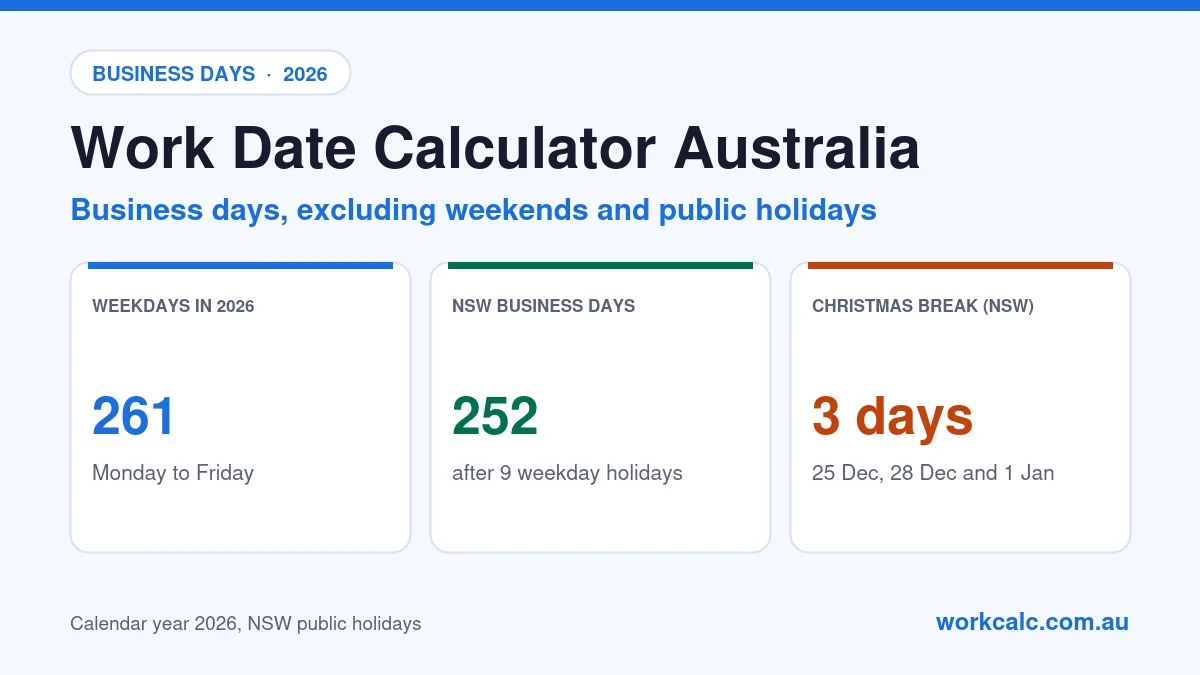
How to calculate working days in Australia (excluding public holidays)
A working day in Australia is any Monday to Friday that is not a public holiday. Calculating business days manually is straightforward for a single week, but quickly becomes error-prone across months because public holiday dates shift each year and differ significantly between states. The AFL Grand Final Friday applies only in Victoria. The Queen's Birthday falls in June in most states but in September in Queensland and on a different date in WA. Show Days are unique to individual Queensland cities.
Calculating a notice period end date in working days — Fair Work Act rules
Notice periods under the Fair Work Act 2009 are defined in weeks, not business days — but public holidays within the notice period extend the period and are not counted. If you give notice and a public holiday falls before your last day, your employment continues for one additional working day beyond the nominal end date.
| Period of continuous service | Minimum notice | If over 45 with 2+ years |
|---|---|---|
| Less than 1 year | 1 week | 2 weeks |
| 1 to 3 years | 2 weeks | 3 weeks |
| 3 to 5 years | 3 weeks | 4 weeks |
| More than 5 years | 4 weeks | 5 weeks |
To find your notice period end date: enter your last working day, select "Add business days," enter your required notice period in working days (1 week = 5 business days), and select your state. The calculator will return your correct final day, skipping any public holidays that fall within the period.
Related calculator Notice Period Calculator Australia — minimum notice by years of service under the Fair Work Act →Calculating invoice payment due dates and contract deadlines in business days
Many Australian contracts, invoices and legal documents state timeframes in business days: "payment within 14 business days," "respond within 5 business days," "settlement in 30 business days." Converting these to a calendar date requires knowing which days fall on weekends or public holidays within that period.
- Net 14 (14 business days): Not 14 calendar days — if the period spans the Easter long weekend or a public holiday, the due date is later than a simple +14 calendar day calculation would suggest.
- Legal timeframes: Court deadlines and ASIC filing periods stated in business days exclude public holidays in the relevant jurisdiction.
- Conveyancing settlement: Property settlement periods in Australia are typically quoted in business days, making the public holiday exclusion material — particularly around Christmas and Easter when multiple holidays cluster.
Australian public holidays by state — what's excluded from the business day count
The calculator excludes all of the following for each state. National public holidays apply everywhere; state-specific holidays apply in the selected state only.
| National public holiday | 2026 date | All states? |
|---|---|---|
| New Year's Day | 1 January 2026 | Yes |
| Australia Day | 26 January 2026 | Yes |
| Good Friday | 3 April 2026 | Yes |
| Easter Saturday | 4 April 2026 | Most states |
| Easter Monday | 6 April 2026 | Yes |
| Anzac Day | 25 April 2026 | Yes |
| Christmas Day | 25 December 2026 | Yes |
| Boxing Day | 26 December 2026 | Yes |
State-specific holidays include the King's Birthday (different dates in VIC, QLD, WA, SA, TAS, ACT and NT), AFL Grand Final Friday (VIC only), Melbourne Cup Day (VIC only), Adelaide Cup (SA), Eight Hours Day / Labour Day (varies), and Queensland Show Days for individual cities.
How many working days are in a year in Australia?
A standard Australian calendar year contains 260 to 262 weekdays. After deducting the 8 national public holidays plus state-specific holidays (typically 2 to 6 additional days depending on the state), most employees work between 250 and 254 business days per year. Victoria and Queensland tend to have slightly fewer working days than NSW due to additional state holidays. Use "Count days" mode and enter 1 January to 31 December to get the exact count for your state and year.
Related calculator Overtime Calculator Australia — calculate overtime pay and penalty rates including public holidays →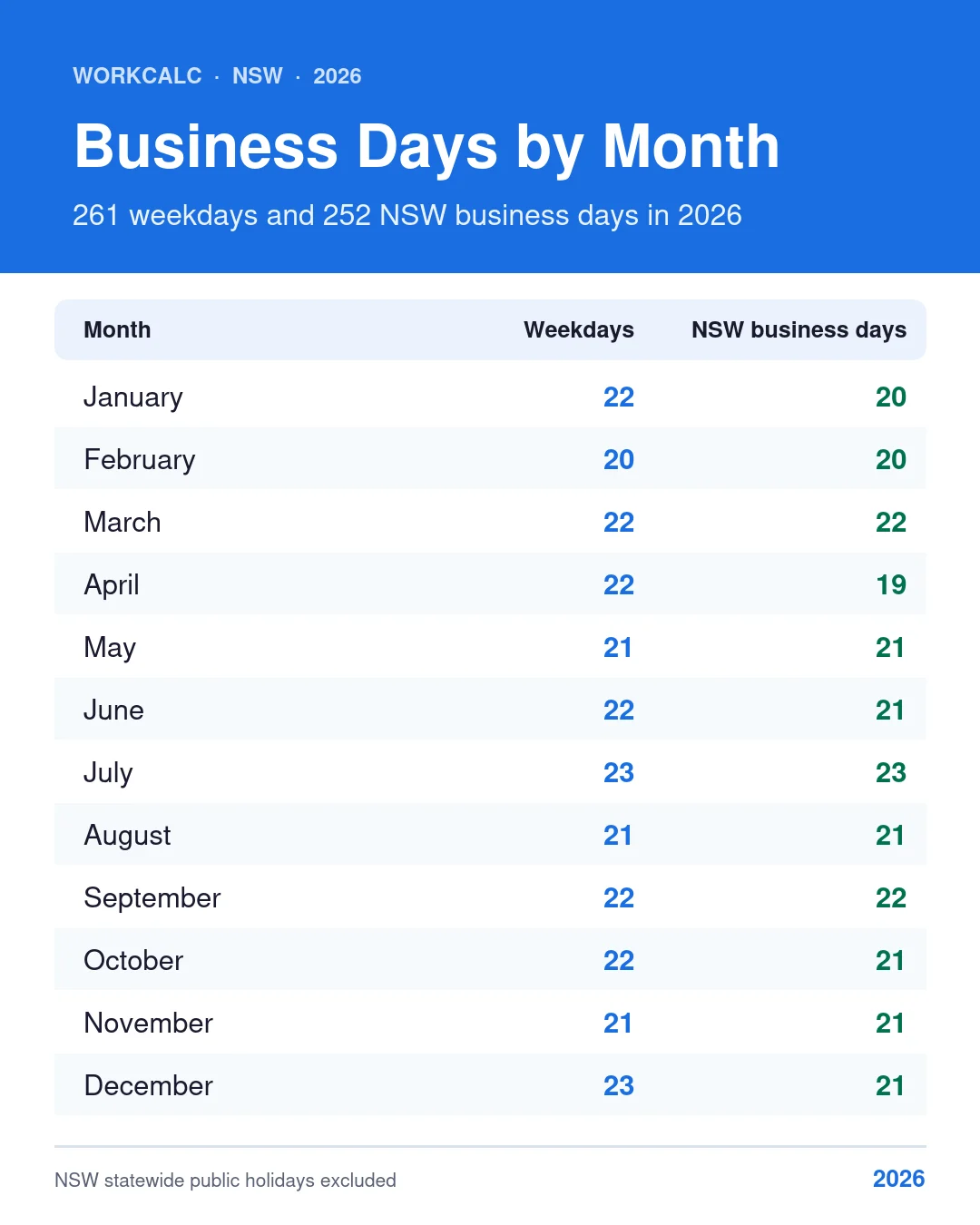
Common use cases for the Australian work date calculator
- Notice period end date: Find the exact last working day after submitting resignation, accounting for any public holidays within the notice period.
- Probation end date: Calculate when a 3-month or 6-month probation period expires in business days from an employment start date.
- Invoice payment due date: Convert "Net 14 business days" or "Net 30 business days" to a specific calendar date.
- Redundancy payment timing: Employers must pay all final entitlements by the next pay day or within 7 days of termination — check the exact date.
- Annual leave end date: If taking a block of annual leave measured in working days, find the exact return-to-work date.
- Legal filing deadlines: Court documents, ASIC filings and ATO deadlines stated in business days require public holiday exclusions for the relevant jurisdiction.
For further information on what constitutes a working day in Australian employment law, see the Fair Work Ombudsman public holidays guide. For penalty rates applying to work performed on public holidays, use the Public Holiday Rate Calculator.
Work date calculator FAQs — business days & public holidays Australia
Plain-English answers to common questions about calculating working days, notice periods and business day deadlines in Australia.
How do I calculate working days between two dates in Australia?
To calculate working days between two dates in Australia: count every calendar day from the start date to the end date, then subtract Saturdays, Sundays and any Australian public holidays that fall within that range. The count depends on your state or territory because public holidays vary — for example, the AFL Grand Final Friday applies only in Victoria. Use the Work Date Calculator above and select your state to get an accurate count that excludes all relevant public holidays.
What counts as a working day in Australia?
A working day (also called a business day) in Australia is any weekday — Monday to Friday — that is not a public holiday. Saturdays, Sundays and Australian public holidays (federal and state-specific) are not working days. Some awards and contracts define 'business day' differently, but the standard Fair Work definition excludes weekends and public holidays.
How do I calculate a notice period in working days in Australia?
To calculate a notice period in working days: enter your last working day or resignation date as the start date, enter your required notice period in business days, and select your state so the calculator can exclude the correct public holidays. The result is your final working day. Under the Fair Work Act, minimum notice periods are based on years of service — 1 week for less than 1 year, up to 4 weeks for 5+ years, plus an extra week if you are over 45 with more than 2 years of service.
Are public holidays counted as working days for notice periods?
No. Public holidays are not counted as working days for the purpose of notice periods in Australia. If a public holiday falls within your notice period, it extends the period by one additional working day. This applies to both employer and employee notice. Use the Work Date Calculator to find your correct end date — the public holiday calendar automatically adjusts for your state.
Can I use this calculator to find a payment due date in business days?
Yes. Enter the invoice or contract start date, enter the number of business days for payment (e.g. 14 business days = Net 14), select your state, and the calculator returns the actual calendar date on which payment is due — excluding weekends and public holidays. This is useful for invoices, legal deadlines, settlement periods and any contractual obligation stated in business days.
How many working days are there in a year in Australia?
A typical Australian calendar year has approximately 260 to 262 working days before public holidays are deducted. After removing the 8 national public holidays plus 2 to 6 additional state-specific holidays, most employees work between 250 and 254 business days per year, depending on their state or territory. Use the 'count working days between dates' mode and enter 1 January to 31 December to calculate exactly how many business days fall in your state and year.
Which Australian public holidays does this calculator include?
The calculator includes all national public holidays (New Year's Day, Australia Day, Good Friday, Easter Saturday, Easter Monday, Anzac Day, Christmas Day and Boxing Day) plus all state and territory-specific holidays. These include the King's Birthday (which falls on different dates in each state), AFL Grand Final Friday (VIC), Melbourne Cup Day (VIC), Show Days (QLD), Adelaide Cup (SA), Eight Hours Day (TAS) and others. The calculator is pre-loaded with accurate dates for 2025 through 2028.
How do I calculate a probation end date in Australia?
Enter your employment start date, select 'Add business days', enter your probation period in working days (e.g. a 3-month probation for a full-time employee is approximately 65 business days), and select your state. The calculator returns the date your probation ends, excluding weekends and public holidays. Under the Fair Work Act, the minimum employment period before unfair dismissal protections apply is 6 months for most employees (1 year for small business employees with fewer than 15 employees).