
Hourly Rate Calculator Australia
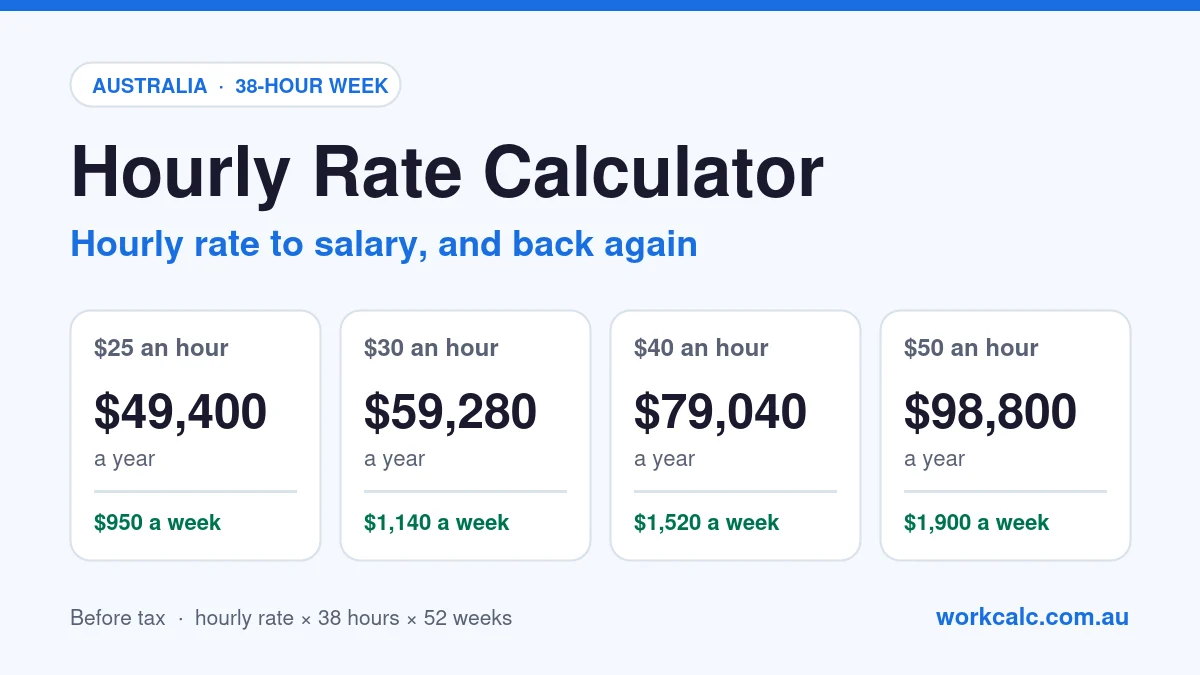
Convert an hourly rate to a weekly, fortnightly, monthly and yearly salary, or work out the hourly rate of a salary. The calculator also shows the after-tax amount for each period. On a standard 38-hour week, $30 an hour is $59,280 a year, and a $80,000 salary is $40.49 an hour.
Hourly rate calculator
Choose whether you're starting from an hourly rate or a salary, then enter your usual hours per week.
| Period | Before tax | After tax |
|---|
*The same rate plus the 25% casual loading most awards apply. Casuals don't get paid leave, so their yearly total depends on the weeks they actually work.
How to convert an hourly rate to a salary
Yearly salary = hourly rate × hours per week × 52
Hourly rate = yearly salary ÷ (hours per week × 52)
For a full-time employee on 38 hours a week, that's 1,976 paid hours a year. So:
- $30 an hour × 38 × 52 = $59,280 a year, or $1,140 a week
- $80,000 a year ÷ 1,976 = $40.49 an hour
- On a 40-hour week (2,080 hours a year), $30 an hour is $62,400 a year, and $80,000 is $38.46 an hour
Monthly pay is the yearly amount ÷ 12, not the weekly amount × 4. A year has about 4.33 weeks per month, so multiplying by 4 understates your monthly pay by roughly 8%.
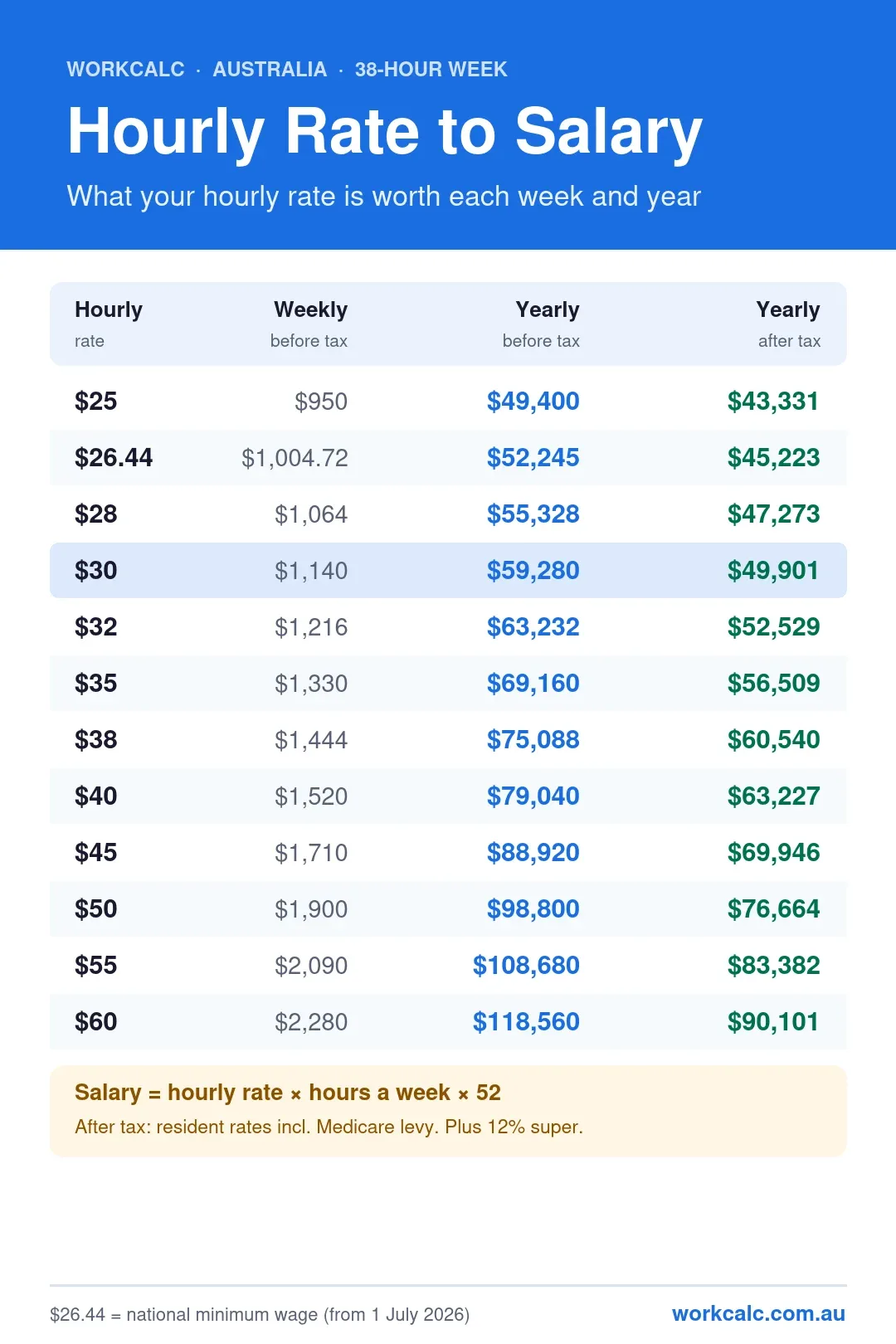
Hourly rate to salary table (38-hour week)
| Hourly rate | Weekly | Fortnightly | Monthly | Yearly | Yearly after tax |
|---|---|---|---|---|---|
| $25 | $950 | $1,900 | $4,116.67 | $49,400 | $43,331 |
| $26.44 (minimum wage) | $1,004.72 | $2,009.44 | $4,353.79 | $52,245 | $45,223 |
| $28 | $1,064 | $2,128 | $4,610.67 | $55,328 | $47,273 |
| $30 | $1,140 | $2,280 | $4,940 | $59,280 | $49,901 |
| $32 | $1,216 | $2,432 | $5,269.33 | $63,232 | $52,529 |
| $35 | $1,330 | $2,660 | $5,763.33 | $69,160 | $56,509 |
| $38 | $1,444 | $2,888 | $6,257.33 | $75,088 | $60,540 |
| $40 | $1,520 | $3,040 | $6,586.67 | $79,040 | $63,227 |
| $45 | $1,710 | $3,420 | $7,410 | $88,920 | $69,946 |
| $50 | $1,900 | $3,800 | $8,233.33 | $98,800 | $76,664 |
| $55 | $2,090 | $4,180 | $9,056.67 | $108,680 | $83,382 |
| $60 | $2,280 | $4,560 | $9,880 | $118,560 | $90,101 |
After tax uses 2026–27 resident rates, including the low income tax offset and the 2% Medicare levy, with no HECS/HELP. Super is paid on top. For your exact take-home pay with HECS, super and salary sacrifice, use the pay calculator.
Salary to hourly rate table
| Yearly salary | Hourly (38 hrs/week) | Hourly (40 hrs/week) | Yearly after tax |
|---|---|---|---|
| $50,000 | $25.30 | $24.04 | $43,730 |
| $60,000 | $30.36 | $28.85 | $50,380 |
| $65,000 | $32.89 | $31.25 | $53,705 |
| $70,000 | $35.43 | $33.65 | $57,080 |
| $75,000 | $37.96 | $36.06 | $60,480 |
| $80,000 | $40.49 | $38.46 | $63,880 |
| $90,000 | $45.55 | $43.27 | $70,680 |
| $100,000 | $50.61 | $48.08 | $77,480 |
| $110,000 | $55.67 | $52.88 | $84,280 |
| $120,000 | $60.73 | $57.69 | $91,080 |
| $150,000 | $75.91 | $72.12 | $110,430 |
Salary before tax, not including super. If your package includes super, take the super out first: package ÷ 1.12 gives your base salary.
Should you use 38 or 40 hours?
Use the hours in your award, agreement or contract. Under the National Employment Standards, a full-time employee's maximum ordinary hours are 38 a week, plus reasonable additional hours. That's why 38 is the standard figure for converting a salary in Australia. Some contracts say 40 hours with the extra 2 hours built into the salary. For those, divide by 40 to find the real hourly rate you're paid, and use the overtime calculator for hours above that.
Casual rates and the minimum wage
From 1 July 2026, the national minimum wage is $26.44 an hour, or $1,004.90 for a 38-hour week. The Fair Work Commission sets the weekly amount and rounds the hourly rate, which is why $26.44 × 38 comes to $1,004.72. Casual employees covered by the national minimum wage get a 25% casual loading on top, so their minimum is $33.05 an hour. Most modern awards pay more than the minimum wage. Check your award rate with the minimum wage calculator.
The casual loading replaces paid leave. So when you compare a casual hourly rate with a permanent salary, remember that a permanent employee is also paid for about 4 weeks of annual leave, public holidays and sick leave. A permanent employee earning $30 an hour is paid for all 52 weeks. A casual on $37.50 an hour is only paid for the hours they work.
Super is paid on top of your hourly rate
Your employer must pay 12% superannuation on your ordinary time earnings, on top of your pay. On $30 an hour for 38 hours a week, that's $136.80 a week, or $7,113.60 a year, paid into your super fund. The superannuation calculator works out your super for any pay.
Hourly rate FAQs
How do I convert an hourly rate to a yearly salary?
Multiply your hourly rate by your hours per week, then by 52. On a 38-hour week, $30 an hour × 38 × 52 = $59,280 a year.
$30 an hour is how much a year in Australia?
$59,280 a year on a 38-hour week, or $62,400 on a 40-hour week. After tax in 2026–27, $59,280 is about $49,901 a year, or $959.64 a week.
$25 an hour is how much a year?
$49,400 a year on a 38-hour week, which is $950 a week before tax. After tax in 2026–27, that's about $43,331 a year.
How do I work out my hourly rate from my salary?
Divide your yearly salary by your hours per week × 52. For a full-time 38-hour week, divide by 1,976. For example, $80,000 ÷ 1,976 = $40.49 an hour.
Is a full-time week 38 or 40 hours in Australia?
The National Employment Standards set a maximum of 38 ordinary hours a week for full-time employees, plus reasonable additional hours. Some contracts specify 40 hours, so use the hours in your own award or contract.
What is the minimum hourly rate in Australia?
$26.44 an hour from 1 July 2026, or $1,004.90 for a 38-hour week. Casual employees on the national minimum wage get a 25% loading, which makes it $33.05 an hour. Many award rates are higher.
Should I use 52 weeks if I take annual leave?
Yes, if you're a permanent employee. Your annual leave and public holidays are paid, so you're paid for all 52 weeks. Casual employees aren't paid for leave, so they should multiply by the number of weeks they actually work.
Is super included in my hourly rate?
Usually not. Your employer pays 12% super on top of your ordinary hourly pay. On $30 an hour for 38 hours a week, that's $7,113.60 a year in super.