
YTD Calculator Australia
Enter your year-to-date pay and tax withheld to project your full financial year income — and see whether you're on track for a refund or a tax bill.
Your YTD figures
What does YTD mean on a payslip?
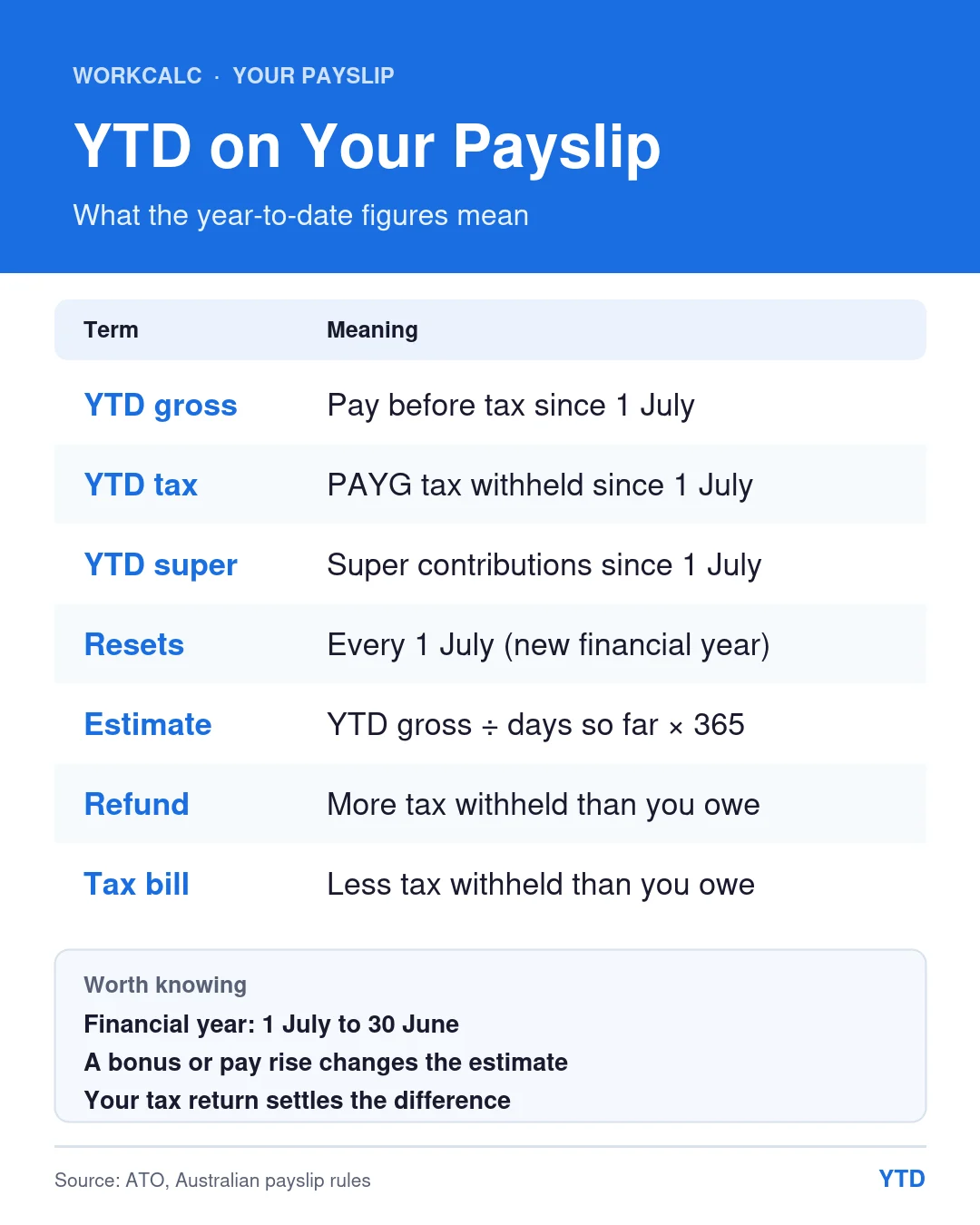
YTD stands for Year-to-Date — the cumulative total of your gross earnings, tax withheld, and superannuation contributions from the start of the current financial year (1 July) up to your most recent pay date. These figures reset to zero every 1 July when a new financial year begins.
Most Australian payslips show YTD figures alongside the "this pay period" figures, giving you a running total you can use to check your progress through the year.
How the full-year projection works
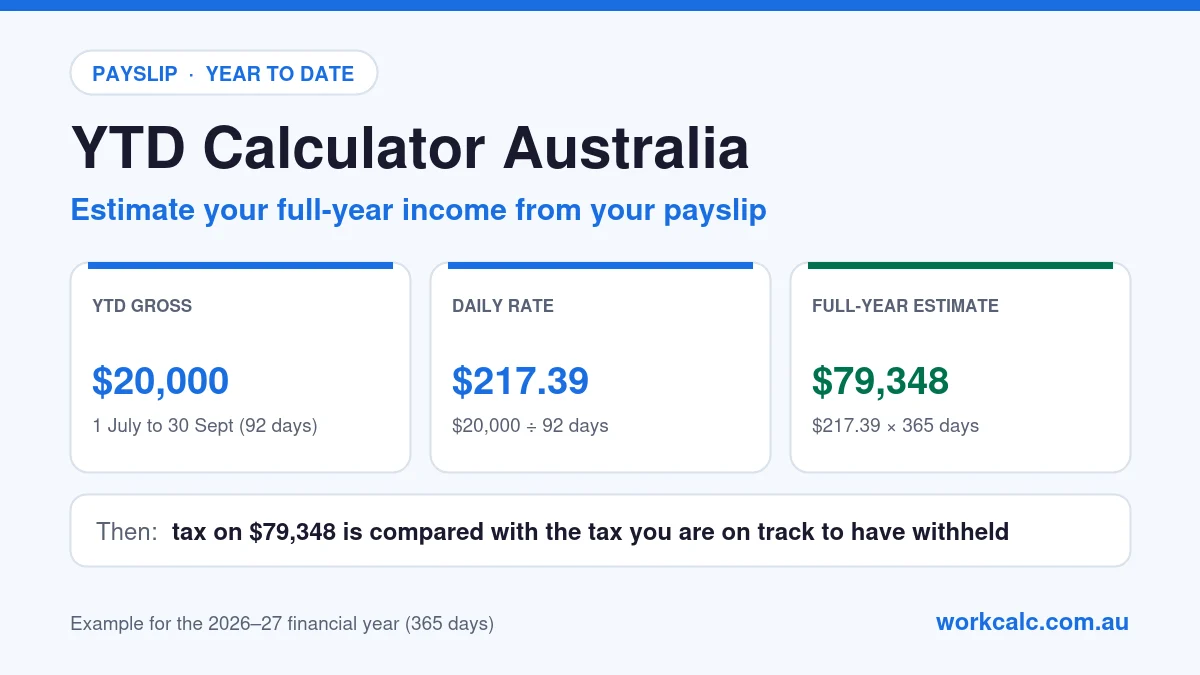
This calculator projects your total income for the financial year by assuming your pay rate stays consistent for the remaining days:
where daily rate = YTD gross ÷ days elapsed since you started earning
Working out your refund or tax bill
Once your total projected income is known, the calculator applies the correct ATO marginal tax brackets (plus the Low Income Tax Offset and Medicare levy, and HECS/HELP if applicable) to work out what your actual tax liability should be for the full year. This is then compared against your projected total withholding — what you're on track to have withheld if your current withholding rate continues.
- Projected withholding higher than correct tax: you're on track for a refund at tax time.
- Projected withholding lower than correct tax: you may owe money when you lodge your return.
Why YTD withholding doesn't always match perfectly
Your employer's payroll system calculates PAYG withholding using ATO tables that assume a consistent, regular pay pattern for the whole year. If your actual income has been irregular — overtime in some periods, a bonus, a mid-year pay rise, unpaid leave, or a period without work — your YTD withholding may not perfectly track what would eventually be correct for your true annual income. This is completely normal, and it's exactly what the annual tax return process reconciles.
Starting a job partway through the year
If you started your current job partway through the financial year, set the "Started earning this FY" date to your actual start date rather than 1 July. This ensures the daily rate calculation is based on the period you've actually been earning, rather than incorrectly assuming a full year of income when you've only worked part of it.
Frequently asked questions
Common questions about YTD figures and full-year tax projections.
What does YTD mean on a payslip?
Year-to-Date — your cumulative gross earnings, tax withheld, and super since 1 July, resetting each new financial year. Most Australian payslips display this alongside the current pay period figures.
How do I calculate my projected annual income from YTD figures?
Divide YTD gross by days elapsed since you started earning this FY, giving a daily rate. Multiply by days remaining in the year, then add to your YTD figure. This assumes your pay rate stays consistent.
How do I know if I'll get a refund or owe money at tax time?
Compare your projected total tax withheld against the correct tax liability on your projected total income (using ATO brackets, LITO, Medicare levy, and HECS/HELP if applicable). Higher projected withholding than correct tax means a refund; lower means you may owe money.
Why might my YTD tax withheld seem too low or too high?
PAYG withholding assumes a consistent regular pay pattern. Overtime, bonuses, a mid-year pay rise, or unpaid leave can all cause your actual YTD withholding to differ from what's ultimately correct — this is normal and gets reconciled at tax time.
Does superannuation appear in YTD figures?
Yes, most payslips show YTD super separately — the cumulative 12% Superannuation Guarantee paid into your fund since 1 July, calculated on your Ordinary Time Earnings.