
Overtime Calculator Australia
Calculate your overtime pay at time-and-a-half, double time, or public holiday rates — for permanent and casual employees, instantly.
Your details
Overtime rates at a glance
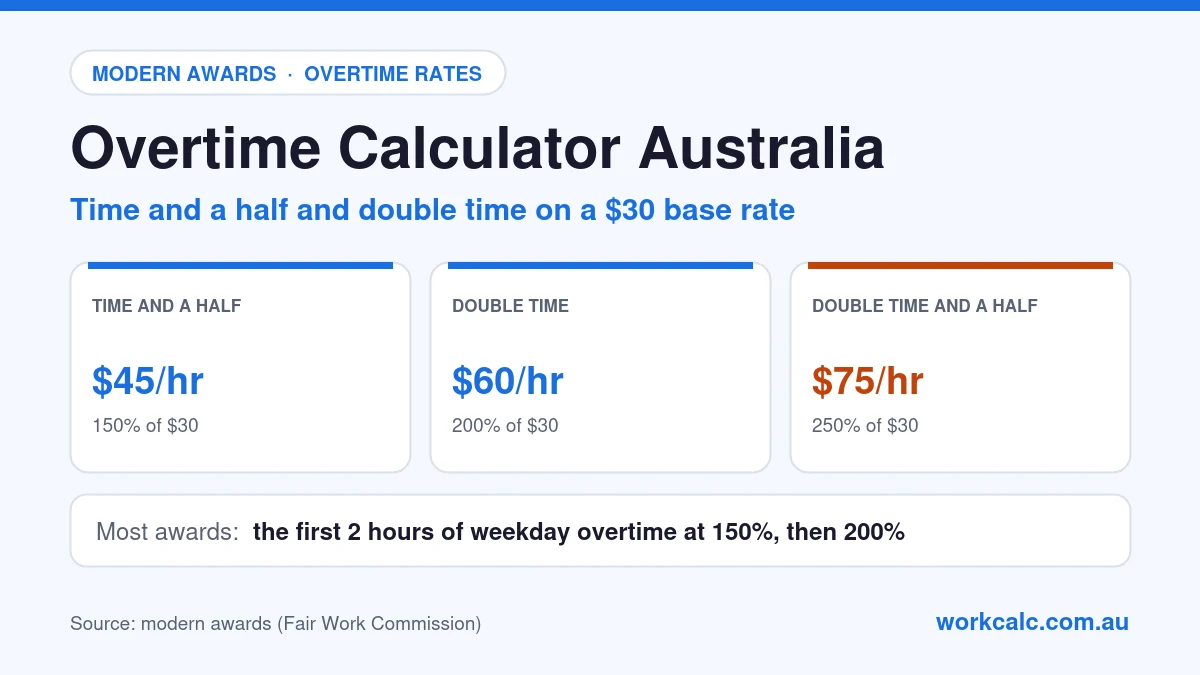
| Rate | How to work it out | On a $30/hr base |
|---|---|---|
| Time and a half (150%) | Hourly rate × 1.5 | $45.00/hr |
| Double time (200%) | Hourly rate × 2 | $60.00/hr |
| Double time and a half (250%) | Hourly rate × 2.5 | $75.00/hr |
| Weekday overtime | Most awards: first 2 hours at 150%, then 200% | |
Casual overtime is usually higher (175% then 225%). Enter your hours below for your exact overtime pay.
Standard overtime rates by award
General rates under most modern awards — always verify your specific rate via the Fair Work Ombudsman.
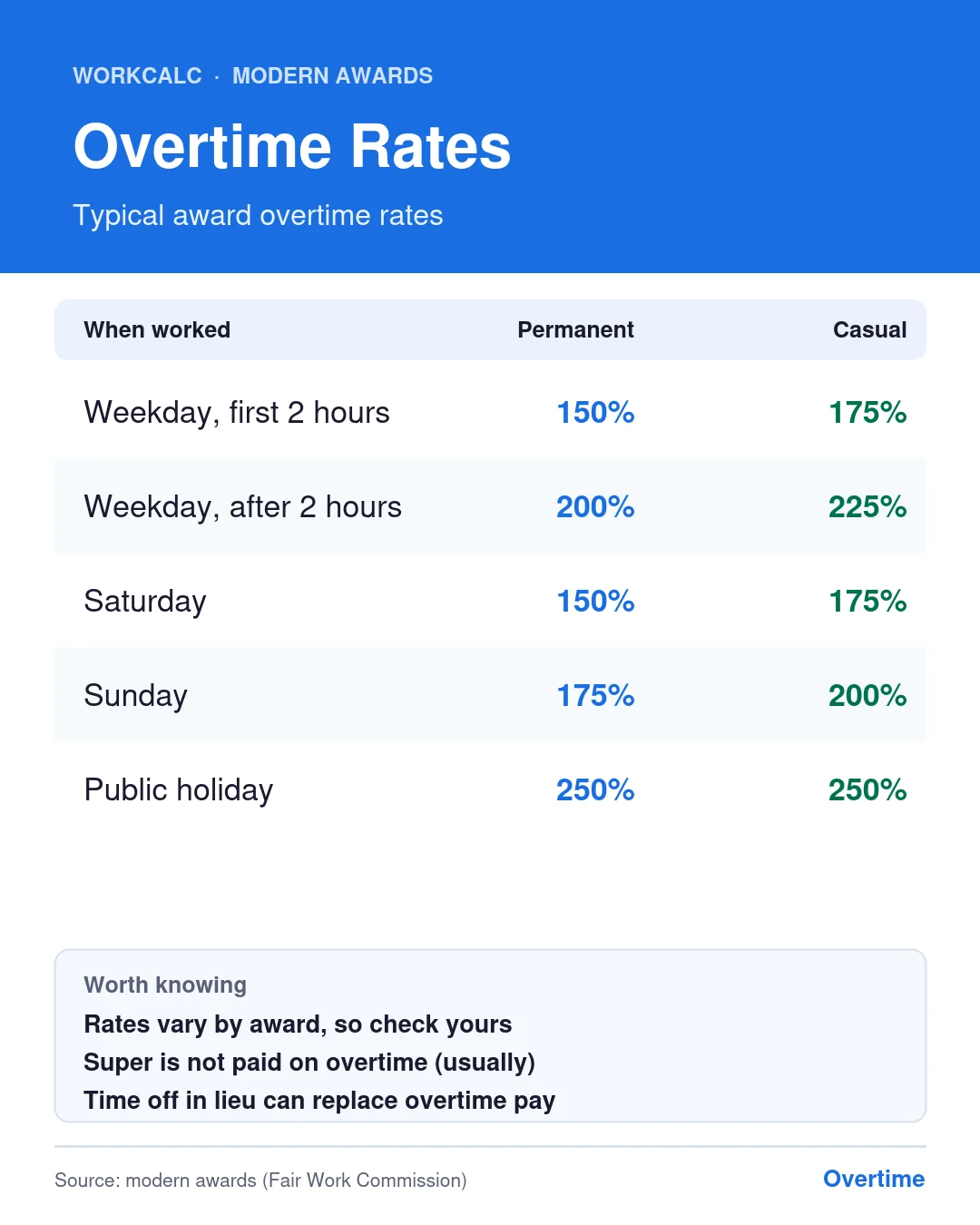
| When worked | Permanent employees | Casual employees |
|---|---|---|
| Weekday — first 2 hours | 150% time and a half | 175% time and three-quarters |
| Weekday — after 2 hours | 200% double time | 225% double time and a quarter |
| Saturday | 150% time and a half | 175% time and three-quarters |
| Sunday | 175% | 200% double time |
| Public holiday | 250% double time and a half | 250% double time and a half |
How overtime pay works in Australia
Overtime is work performed outside your ordinary hours — the hours set out in your modern award, enterprise agreement, or employment contract. For a full-time employee, ordinary hours are generally capped at 38 hours per week, or 7.6 hours per day under many awards. Once you exceed that threshold, overtime rates apply to the extra hours worked.
Overtime rates are set by your specific modern award or enterprise agreement — not the National Employment Standards directly. The NES sets the maximum ordinary hours and the right to refuse unreasonable additional hours, but the actual overtime multiplier (150%, 200%, etc.) comes from your award. For the full formula walkthrough with step-by-step worked examples, see How Is Overtime Calculated in Australia?
How to calculate time and a half and double time: worked example
Jordan is a permanent employee earning $32/hour, working 4 hours of overtime on a Tuesday under an award with a 2-hour first tier:
- First 2 hours at 150%: 2 × $32 × 1.5 = $96.00
- Remaining 2 hours at 200%: 2 × $32 × 2.0 = $128.00
- Total overtime pay: $96.00 + $128.00 = $224.00
Compare this to Jordan's ordinary rate for those same 4 hours — just $128.00. The overtime premium adds an extra $96.00 for the same hours worked.
Casual employee overtime rates
Casual employees are entitled to overtime just like permanent employees — a common misconception is that casual loading replaces overtime entitlement, but it does not. Casual overtime is typically paid at a higher multiplier than permanent overtime, because the higher rate incorporates both the overtime premium and continues to account for the casual loading on those hours.
A typical casual overtime structure is 175% for the first two hours (versus 150% for permanent) and 225% after that (versus 200% for permanent). This is not universal — some awards calculate casual overtime differently, so always check your specific award.
Weekend and public holiday overtime
Overtime worked on a Saturday, Sunday, or public holiday often follows a flat rate rather than the tiered weekday structure — there is usually no "first two hours" distinction on weekends. Common rates:
- Saturday: typically 150% flat, for all hours worked
- Sunday: typically 175–200% flat, for all hours worked
- Public holiday: typically 250% flat (double time and a half) — the highest standard overtime rate in the award system
Working a public holiday specifically also interacts with your Public Holiday Rate Calculator entitlements — some awards treat public holiday work as overtime, others treat it as a separate penalty rate category. Check your award for the exact interaction.
Can your employer force you to work overtime?
Under section 62 of the Fair Work Act 2009, an employer can only request or require an employee to work additional hours if those hours are reasonable. Factors used to assess reasonableness include:
- Any risk to your health and safety, including fatigue
- Your personal circumstances, including family and caring responsibilities
- The genuine needs of the workplace
- Whether you are being compensated fairly for the additional hours
- How much notice you were given
- The usual patterns of work in your industry or role
If a request does not meet these reasonableness factors, you can refuse to work the additional hours without breaching your employment obligations.
Time Off In Lieu (TOIL) instead of overtime pay
Some awards allow employees to take paid time off instead of receiving overtime pay — this is called Time Off In Lieu (TOIL). Critically, TOIL requires your genuine written agreement — your employer cannot unilaterally direct you to take TOIL instead of paying overtime.
TOIL is usually accrued at the overtime rate, not hour-for-hour. This means one hour of overtime worked at time and a half (150%) entitles you to 1.5 hours of time off — not just 1 hour. Most awards require TOIL to be used within a set period (commonly 6 months); if unused within that period, the employer must pay out the accrued overtime at the applicable overtime rate.
Overtime and tax
Overtime pay is taxed as ordinary income at your normal marginal rate — it is not taxed at a special overtime rate. Because overtime is added to your regular pay in the same pay period, PAYG withholding for that period may be higher than usual (since the payroll system annualises that period's higher income to estimate tax). This evens out over the full financial year when you lodge your tax return. Use the PAYG Withholding Calculator to estimate the tax impact on a pay period that includes overtime.
Frequently asked questions
Common questions about overtime pay and rates in Australia.
How is overtime calculated in Australia?
Most modern awards pay time and a half (150%) for the first two or three hours of weekday overtime, then double time (200%) after that. Casual employees typically receive 175% and 225% respectively. Weekend and public holiday overtime often uses flat rates instead of the tiered structure. The exact rates depend on your specific modern award or enterprise agreement.
What is the overtime rate for casual employees?
A common structure is 175% (time and three-quarters) for the first two hours and 225% (double time and a quarter) after that — higher than the permanent employee rate to reflect the casual loading. This varies by award, so always verify your specific rate.
How much is overtime pay on a public holiday?
Typically 250% (double time and a half) of your ordinary hourly rate, regardless of whether you are permanent or casual. This is the highest standard overtime rate under most Australian modern awards.
When does overtime start in Australia?
Generally once a full-time employee exceeds 38 ordinary hours per week, or 7.6 hours per day, depending on which trigger your award uses. Part-time employees can trigger overtime once they exceed their agreed contracted hours. Exact triggers are set by your specific award, not the NES directly.
Can my employer force me to work overtime?
Only if the additional hours are reasonable, under section 62 of the Fair Work Act 2009. Factors include health and safety risk, your personal circumstances, workplace needs, adequate compensation, notice given, and usual industry patterns. You can refuse unreasonable overtime requests.
Is overtime pay taxed differently to normal wages?
No — overtime is taxed as ordinary income at your normal marginal rate, in the pay period it's earned. It is not taxed at a special rate. Use the PAYG Withholding Calculator to estimate tax on a pay period including overtime.
Can I take time off instead of overtime pay?
Yes, this is Time Off In Lieu (TOIL) — but it requires your genuine written agreement, not employer direction. TOIL usually accrues at the overtime rate (1 hour at 150% overtime = 1.5 hours TOIL). Most awards require TOIL to be used within 6 months, after which it must be paid out at the overtime rate.
How do you calculate time and a half?
Multiply your ordinary hourly rate by 1.5. On a $30 base rate, time and a half is $45.00 an hour, so 3 hours of overtime at time and a half is 3 × $45.00 = $135.00. Double time is your rate × 2, or $60.00 an hour on a $30 base. Your award sets when each rate applies.