
How Is Overtime Calculated in Australia? The Complete Formula and Worked Examples
The exact formula behind weekday, weekend and public holiday overtime — with the tiered rate structure explained step by step and real dollar examples.
The basic overtime formula
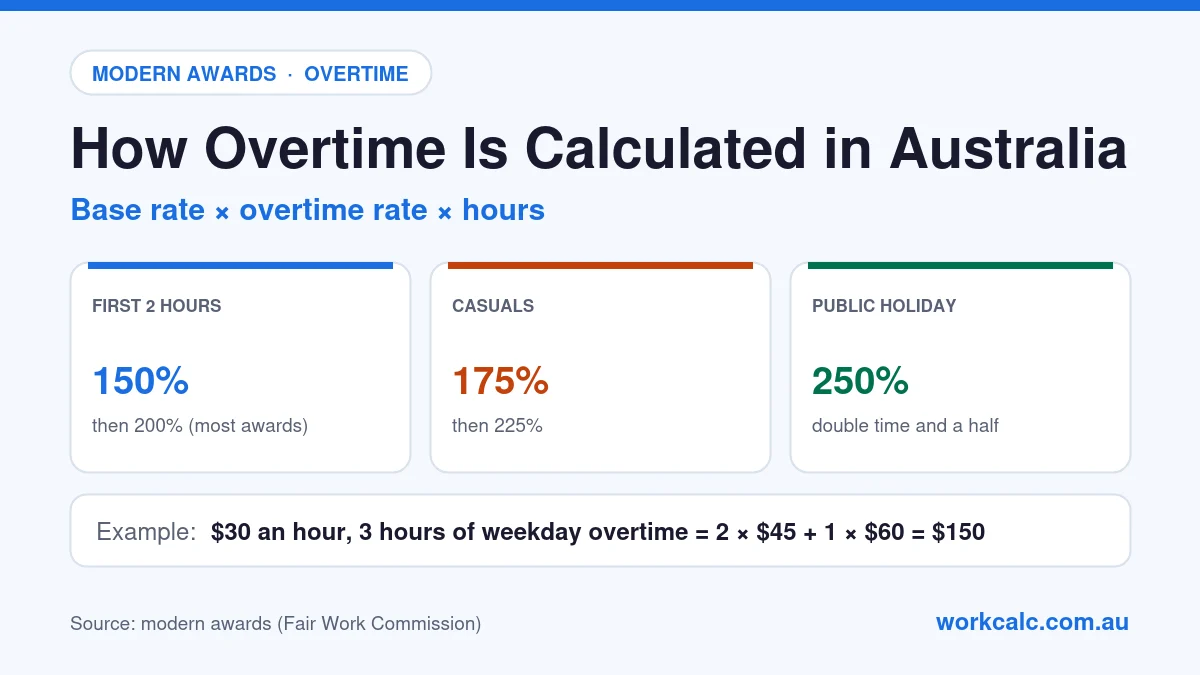
Every overtime calculation in Australia comes down to the same underlying formula, applied to whichever rate tier is relevant:
The complexity comes from working out which multiplier applies — and that depends on three things: whether you're a permanent or casual employee, what day the overtime was worked, and (for weekday overtime) how many hours you've already worked that day or week.
Step-by-step: how to calculate tiered weekday overtime
Weekday overtime under most modern awards uses a two-tier structure. Here's how to work it out:
- Find your ordinary hourly rate — your base rate, not including any allowances or existing loadings.
- Identify your first-tier threshold — usually the first 2 hours of overtime (some awards use 3 hours).
- Calculate tier 1 pay: tier 1 hours × ordinary rate × 1.5 (or 1.75 for casuals).
- Calculate tier 2 pay for any remaining hours: tier 2 hours × ordinary rate × 2.0 (or 2.25 for casuals).
- Add tier 1 and tier 2 together for your total overtime pay.
Worked example — 4 hours weekday overtime
Permanent employee, $30/hour, 4 hours overtime on a Tuesday
Compare this to what those same 4 hours would earn at the ordinary rate: just $120.00. The tiered overtime structure adds an extra $90.00 for identical hours worked.
Worked example — time and a half after 6 hours, double time after 8
Some awards, agreements and exam questions set the overtime bands by hours worked in the shift instead of hours of overtime. A common example: $18.50 an hour for the first 6 hours, time and a half after 6 hours, and double time after 8 hours. How much is earned for a 7-hour shift?
$18.50/hour, 7-hour shift, time and a half after 6 hours, double time after 8
The answer is $138.75. Only one hour falls in the time-and-a-half band, and a 7-hour shift never reaches double time. If the same person worked 9 hours, the pay would be $111.00 + (2 × $27.75) + (1 × $37.00) = $203.50.
Calculate your exact overtime pay
Enter your rate, hours and day type — get the tiered breakdown instantly.
Casual employee overtime — the higher-rate formula
The formula is identical for casual employees, but the multipliers are higher to reflect their existing 25% casual loading:
| Employment type | First 2 hours | After 2 hours |
|---|---|---|
| Permanent | 150% | 200% |
| Casual | 175% | 225% |
Worked example — casual overtime
Casual employee, $28/hour, 4 hours overtime on a Wednesday
Weekend overtime — flat rate formula
Saturday and Sunday overtime is usually simpler to calculate than weekday overtime because there's typically no tier structure — the same multiplier applies to every hour worked, regardless of how many hours:
| Day | Permanent employees | Casual employees |
|---|---|---|
| Saturday | 150% | 175% |
| Sunday | 175% | 200% |
Worked example — Saturday overtime
Permanent employee, $32/hour, 5 hours worked on a Saturday
Public holiday overtime — the highest rate
Public holiday work is calculated using the same flat-rate formula as weekends, but at the highest standard multiplier in the Australian award system — typically 250% (double time and a half), regardless of employment type:
Permanent employee, $35/hour, 6 hours worked on a public holiday
What counts as your "ordinary hourly rate"
The rate used in every overtime calculation is your ordinary base rate — not your total gross pay. This specifically excludes:
- Existing penalty rates or loadings already being paid
- Allowances (travel, tools, meal allowances)
- Bonuses or commissions
- Superannuation contributions
For a salaried employee, the ordinary hourly rate is typically found by dividing the annual salary by 52 weeks, then by standard weekly hours (commonly 38): annual salary ÷ 52 ÷ 38. For example, a $75,000 salary on a 38-hour week gives an ordinary hourly rate of $37.95.
When does overtime actually start?
Overtime is triggered once you exceed your ordinary hours — the threshold set by your award, not a fixed rule for every worker. Common triggers include:
- Weekly threshold: hours beyond 38 per week for full-time employees
- Daily threshold: hours beyond 7.6 per day under many awards, even if the weekly total hasn't been exceeded
- Part-time threshold: hours beyond your specifically agreed contracted hours, even if under 38/week
Some awards use only a weekly trigger, others use only a daily trigger, and some use both — meaning an employee could trigger overtime on a single long day even without exceeding their weekly total. Always check your specific award for the exact trigger that applies to your role.
Related tool Notice Period Calculator — NES minimum notice and pay in lieu →Overtime and tax — what changes on your payslip
Overtime is taxed as ordinary income, not at a special rate. Because it's added on top of your regular pay in the same pay period, the PAYG withholding formula annualises that period's higher income — meaning more tax gets withheld from that specific pay than usual. This is not a penalty; it evens out over the full financial year when you lodge your tax return, since your total annual income (including all overtime) determines your actual tax liability.
A common misconception is that overtime is taxed at a higher permanent rate — it isn't. The higher withholding in that one pay period is a timing effect of how PAYG withholding tables work, not a different tax rate applied specifically to overtime. For the full five-step formula behind how tax, the Medicare levy and any HECS/HELP repayment turn your gross pay into what actually lands in your account, see our guide on how take-home pay is calculated.
Related tool PAYG Withholding Calculator — estimate tax on a pay period including overtime →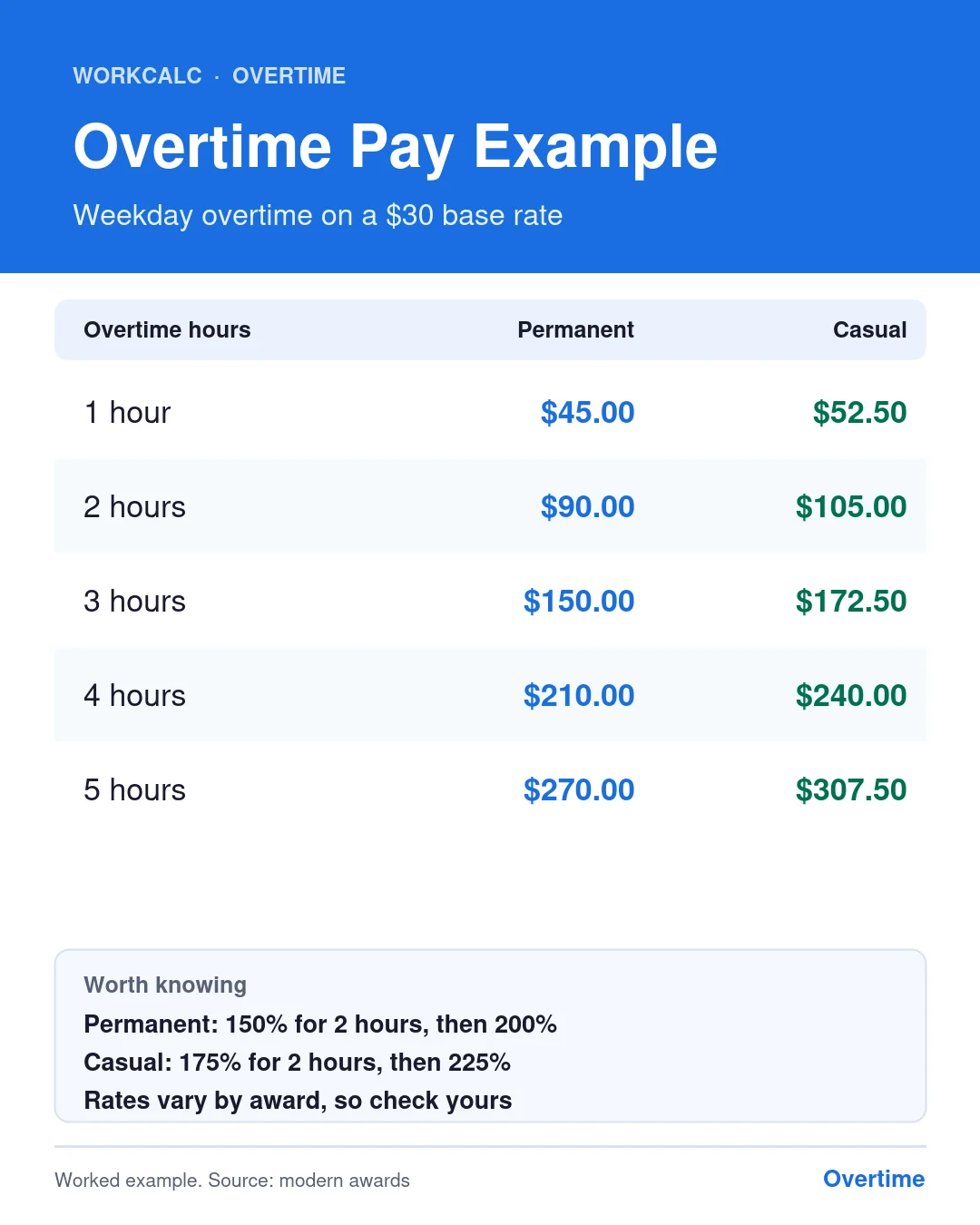
Overtime and superannuation
Whether overtime counts towards your Ordinary Time Earnings (OTE) for superannuation purposes depends on how your specific award defines OTE — this is more nuanced than the common assumption that overtime is always excluded from super. Genuine overtime — hours worked outside your ordinary rostered hours, paid at an overtime rate — is generally excluded from OTE. However, if hours that look like "overtime" are actually part of an agreed ordinary hours arrangement (common in some rostered industries), they may still count towards OTE. Check your award or the ATO's guidance on Ordinary Time Earnings if you're unsure. You can estimate your total employer super contribution with our Superannuation Calculator.
Related guide How Much Super Should My Employer Pay? — full breakdown of what counts as Ordinary Time Earnings →This guide covers general overtime formulas common under most Australian modern awards. Overtime rates are now protected under the Fair Work Amendment (Protecting Penalty and Overtime Rates) Act 2025 — the Fair Work Commission cannot reduce these rates. Your specific award may use different multipliers or thresholds; always verify with the Fair Work Ombudsman.
Frequently asked questions
Common questions about how overtime pay is calculated in Australia.
How is overtime calculated in Australia?
Most modern awards use a tiered formula for weekday overtime: time and a half (150%) for the first two hours, then double time (200%) after that. Casual employees typically get 175% and 225%. Weekends and public holidays use flat rates rather than tiers. Use the Overtime Calculator to get your exact figure instantly.
What is the formula to calculate overtime pay?
Overtime pay = hours worked × ordinary hourly rate × overtime multiplier. For tiered weekday overtime, calculate each tier separately then add them together. Example: 4 hours at $30/hour with a 2-hour first tier = (2 × $30 × 1.5) + (2 × $30 × 2.0) = $210 total.
How do I calculate overtime pay for a casual employee?
Same formula, higher multipliers — typically 175% for the first two hours and 225% after that, versus 150% and 200% for permanent employees. This reflects the existing casual loading being carried through the overtime rate.
How is overtime calculated on a public holiday?
Typically a flat 250% (double time and a half) applied to all hours worked, with no tiered structure. Example: 5 hours at $32/hour on a public holiday = 5 × $32 × 2.5 = $400.
Does overtime calculation include superannuation?
It depends on how your award defines Ordinary Time Earnings. Genuine overtime is generally excluded from OTE and therefore from super — but if the extra hours are effectively part of an agreed ordinary hours pattern, they may still count. Check your specific award or ATO guidance on OTE.
What hourly rate is used to calculate overtime?
Your ordinary base rate only — excluding allowances, bonuses, existing loadings, and super. For salaried employees, this is typically annual salary ÷ 52 weeks ÷ standard weekly hours (commonly 38).
How much is earned for 7 hours at $18.50 with time and a half after 6 hours and double time after 8?
$138.75. The first 6 hours are paid at $18.50 an hour ($111.00) and the 7th hour at time and a half, $27.75. Double time only starts after 8 hours, so it does not apply to a 7-hour shift.