
Superannuation Calculator Australia
Check how much super your employer should be paying you, or work backwards from a total package salary to find your base pay and super split.
Superannuation Guarantee Calculator
How much super your employer must pay you, on top of your salary
Package-Inclusive Salary Splitter
Find your base salary and super when a job ad says "total package inclusive of super"
Formula: base salary = package ÷ 1.12, super = base salary × 0.12. This is the standard method when an advertised salary explicitly says "package" or "inclusive of superannuation" — different from a salary stated as a base rate, where super is paid additionally on top.
How superannuation guarantee is calculated
Three transparent steps based on the Superannuation Guarantee (Administration) Act 1992.
Find your OTE
Ordinary Time Earnings — your base pay plus most allowances and bonuses, excluding overtime.
base pay + allowances
Apply the SG rate
Multiply OTE by the current Superannuation Guarantee rate of 12%, effective 1 July 2025.
OTE × 0.12
Paid in addition
This amount is paid into your super fund on top of your take-home wages, not deducted from them.
wages + super, not wages − super
How much super should I be getting in Australia?
Since 1 July 2025, employers must pay 12% of your Ordinary Time Earnings (OTE) into your nominated super fund. This was the last step of a phase-up that began in 2013–14, and 12% is now the ongoing rate, with no further increases legislated. Super is paid in addition to your salary, not deducted from it.
The calculation is straightforward once you know your OTE: multiply it by 0.12. The complexity usually comes from working out exactly what counts as OTE in the first place — see the table below.
Superannuation rate in Australia by year
The super guarantee (SG) rate is 12% from 1 July 2025, and it stays at 12% for 2026–27 and later years. The rate has gone up in steps since 2013:
| Financial year | SG rate |
|---|---|
| 2002–03 to 2012–13 | 9% |
| 2013–14 | 9.25% |
| 2014–15 to 2020–21 | 9.5% |
| 2021–22 | 10% |
| 2022–23 | 10.5% |
| 2023–24 | 11% |
| 2024–25 | 11.5% |
| 2025–26 | 12% |
| 2026–27 onwards | 12% |
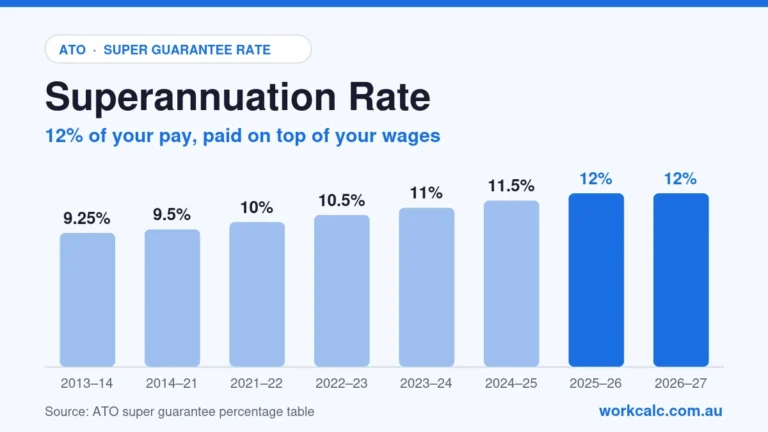
Rates are from the ATO's super guarantee percentage table. If you are checking an old payslip, use the rate for the period when the wages were paid.
What counts as Ordinary Time Earnings (OTE)
This is the single biggest source of confusion in super calculations. OTE is not the same as your total gross pay — overtime is specifically excluded, while most other payment types are included.
| Payment type | Included in OTE? |
|---|---|
| Base salary or hourly wages | ✓ Included |
| Shift loading and most allowances | ✓ Included |
| Casual loading | ✓ Included |
| Weekend and public holiday penalty rates | ✓ Included |
| Commission and performance bonuses | ✓ Included |
| Paid annual and personal leave | ✓ Included |
| Leave loading (in most cases) | ✓ Included |
| Overtime payments | ✗ Excluded |
| Reimbursement of expenses | ✗ Excluded |
| Redundancy and unused leave payouts on termination | ✗ Excluded |
This is why someone working a lot of overtime can have a much higher gross pay than their OTE — and their super is calculated on the smaller OTE figure, not their total pay. For the full breakdown with worked examples, read How Much Super Should My Employer Pay?
Is super paid on overtime?
Usually no. Super is worked out on ordinary time earnings, and overtime is not ordinary time when your award, agreement or contract sets your ordinary hours. That covers most employees, so hours you work beyond your ordinary hours at overtime rates don't attract super.
| 38 ordinary hours at $35 plus 6 hours overtime | Amount |
|---|---|
| Ordinary hours: 38 × $35 | $1,330.00 |
| Overtime: 6 × $35 × 1.5 | $315.00 |
| Gross pay for the week | $1,645.00 |
| Super: 12% × $1,330 (ordinary time only) | $159.60 |
| Not 12% × $1,645 | $197.40 |
There are exceptions:
- No set ordinary hours. If your award or agreement doesn't state your ordinary hours, or doesn't separate them from other hours, the ATO treats all the hours you work as ordinary hours, so super is paid on all of them.
- Your award or agreement requires it. Some awards, enterprise agreements and contracts require super on overtime. The 12% guarantee is only the minimum.
- Payday Super doesn't change this. From 1 July 2026 super is calculated on qualifying earnings, which are ordinary time earnings plus a few extra items such as salary-sacrificed amounts. Overtime is still left out.
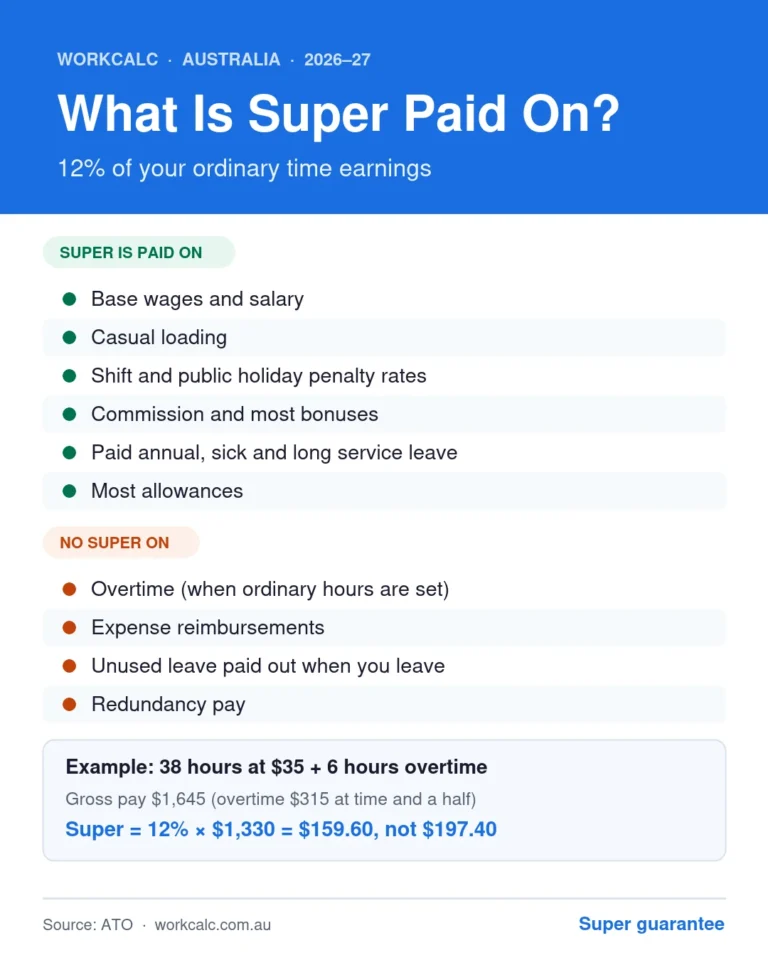
Enter your overtime in the calculator above to see it listed separately from the earnings your super is based on.
How to calculate super from a total package (salary inclusive of super)
Job advertisements describe salary in two different ways, and the difference matters a lot:
- "Base salary + super" — super is paid on top. A $90,000 base salary means you actually cost the employer $90,000 × 1.12 = $100,800, and your take-home base remains $90,000.
- "Total package inclusive of super" — the advertised figure already contains super. A $100,000 package means your actual base salary is $100,000 ÷ 1.12 = $89,285.71, with $10,714.29 in super making up the rest.
Use the "Split a package-inclusive salary" tab above to work out exactly which one you're being offered, and what your real take-home base will be.
To find the base salary in a package that is inclusive of super, divide the package by 1.12. The super is the package minus that base salary. At the 12% rate:
| Package inclusive of super | Base salary | Super (12%) |
|---|---|---|
| $60,000 | $53,571.43 | $6,428.57 |
| $70,000 | $62,500.00 | $7,500.00 |
| $80,000 | $71,428.57 | $8,571.43 |
| $90,000 | $80,357.14 | $9,642.86 |
| $100,000 | $89,285.71 | $10,714.29 |
| $120,000 | $107,142.86 | $12,857.14 |
| $150,000 | $133,928.57 | $16,071.43 |
Is there a cap on how much super I can be paid?
Yes — it's called the Maximum Contribution Base (MCB), and it matters mainly for higher earners. Once your earnings for the financial year reach the MCB, your employer isn't required to pay compulsory super on anything above it — though they can choose to if their award or enterprise agreement says so.
In practice, this only affects employees earning above roughly $270,830 in a financial year — for the vast majority of employees using this calculator, super is payable on every dollar of OTE and this cap never comes into play.
How much super does an employer pay?
An employer must pay at least 12% of each eligible employee's ordinary time earnings into their super fund, on top of their wages. For an employee on an $80,000 salary that is $9,600 a year, so the employee costs $89,600 before payroll tax or workers compensation premiums.
From 1 July 2026, under Payday Super, employers pay super with every pay run instead of quarterly. The contribution has to reach the employee's fund within 7 business days of payday, with some exceptions such as new employees. If it is late, the employer owes the super guarantee charge, which adds interest and is not tax deductible.
Employers can use the calculator above for each employee: enter their ordinary time earnings and any overtime for the pay period, and the result shows the super to pay and the total cost of that pay.
Who is entitled to superannuation
Since 1 July 2022, the $450-per-month earnings threshold was abolished — every employee earning any amount of OTE is entitled to super, including casuals. The main eligibility rules now are based on age:
- 18 or over: entitled to super on any OTE, regardless of hours worked.
- Under 18: entitled to super only if working more than 30 hours in a week.
- Contractors paid mainly for labour: may still be entitled to super even if engaged as a "contractor" — the law looks at the substance of the arrangement, not just the label.
What happens if your employer underpays your super
If your employer doesn't pay the correct super on time, they become liable for the Superannuation Guarantee Charge (SGC) — which includes the unpaid super amount, interest, and an administration fee, and unlike normal super contributions, the SGC is not tax-deductible for the employer. As of 1 July 2026, Payday Super is now in effect: employers must pay super at the same time as wages (within 7 business days of each payday) rather than quarterly, making underpayment easier to spot and harder to hide.
One technical change worth knowing: under Payday Super, the ATO now calculates SG on "qualifying earnings" rather than the older quarterly OTE-only basis — in practice, qualifying earnings is OTE plus a small number of additional payment types (such as certain salary-sacrificed amounts), so for most employees the figure this calculator produces will match what you're actually owed. High earners near the Maximum Contribution Base should check their year-to-date qualifying earnings directly with their employer or the ATO.
To check you're being paid correctly: compare your payslip's stated OTE against your super fund's contribution statements. A mismatch over several pay cycles is worth raising with your employer, and if unresolved, with the ATO.
This calculator applies the Superannuation Guarantee (Administration) Act 1992 12% rate effective 1 July 2025. Individual entitlements may vary based on specific award provisions, salary sacrifice arrangements, or enterprise agreements that exceed the statutory minimum.
Frequently asked questions
Plain-English answers covering super calculation, eligibility and what to do if you're underpaid.
How do I calculate my superannuation in Australia?
Multiply your Ordinary Time Earnings (OTE) by the current SG rate of 12% (from 1 July 2025). For example, on $80,000 OTE: $80,000 × 0.12 = $9,600 per year. OTE includes base pay, most allowances and bonuses, but excludes overtime.
How much super should my employer pay?
12% of your Ordinary Time Earnings, effective 1 July 2025. This applies whether you're full-time, part-time or casual, as long as you're 18+ or under 18 and working more than 30 hours per week. As of 1 July 2026, Payday Super is now in effect — super must be paid at the same time as wages, within 7 business days of each payday, rather than quarterly.
Is there a cap on how much super I can be paid?
Yes — the Maximum Contribution Base, $270,830 per year for 2026–27. Once your earnings reach this amount in a financial year, your employer isn't required to pay compulsory super on anything above it. This changed from a quarterly $62,500 cap in 2025–26 to a single annual cap from 1 July 2026, alongside the switch to Payday Super. It only affects higher earners — most employees never reach it.
Is superannuation calculated before or after tax?
Before income tax — SG is calculated on gross OTE. The super contribution itself is then taxed at 15% (concessional contributions tax) when it enters your fund, which is generally lower than your marginal income tax rate.
What is included in Ordinary Time Earnings for superannuation?
Base salary, most allowances, commissions, performance bonuses, and paid leave (annual and personal). Overtime is excluded, along with expense reimbursements and termination payouts like unused leave or redundancy pay. See the full table above for a complete breakdown.
How do I calculate superannuation from a total package salary?
Divide the package by 1.12 to find your base salary, then multiply that base by 0.12 for the super component. A $100,000 package: base = $100,000 ÷ 1.12 = $89,285.71, super = $89,285.71 × 0.12 = $10,714.29. Use the "Split a package-inclusive salary" tab above to do this instantly.
Do casual employees get superannuation in Australia?
Yes. Since the $450 monthly threshold was abolished on 1 July 2022, casual employees are entitled to super on the same basis as permanent employees, provided they meet the age requirements and earn OTE.
What happens if my employer doesn't pay my superannuation?
The employer becomes liable for the Superannuation Guarantee Charge (SGC) — the unpaid super plus interest and an admin fee, none of which is tax-deductible for them. Check your super fund statements against your payslips regularly, and lodge an enquiry with the ATO if you find a shortfall.
Is super paid on overtime?
Usually no. Super is paid on ordinary time earnings, and overtime worked beyond your set ordinary hours isn't included. If your award or agreement doesn't set your ordinary hours, all hours count and super is paid on them. Some awards and agreements also require super on overtime.
What is the superannuation rate in Australia?
12% of ordinary time earnings, from 1 July 2025. It stays at 12% for 2026–27 and later years. It was 11.5% in 2024–25 and 11% in 2023–24.
Is super paid on unused annual leave or redundancy pay?
No. Unused annual leave and long service leave paid out when you leave, and redundancy pay, are not ordinary time earnings, so no super guarantee is paid on them. Annual leave you take while you are employed does attract super.