
Minimum Wage Calculator Australia
Calculate the national minimum wage for any number of hours — hourly, daily, weekly, fortnightly or annual — for permanent and casual employees.
Your hours
Junior minimum wage rates — from 1 July 2026
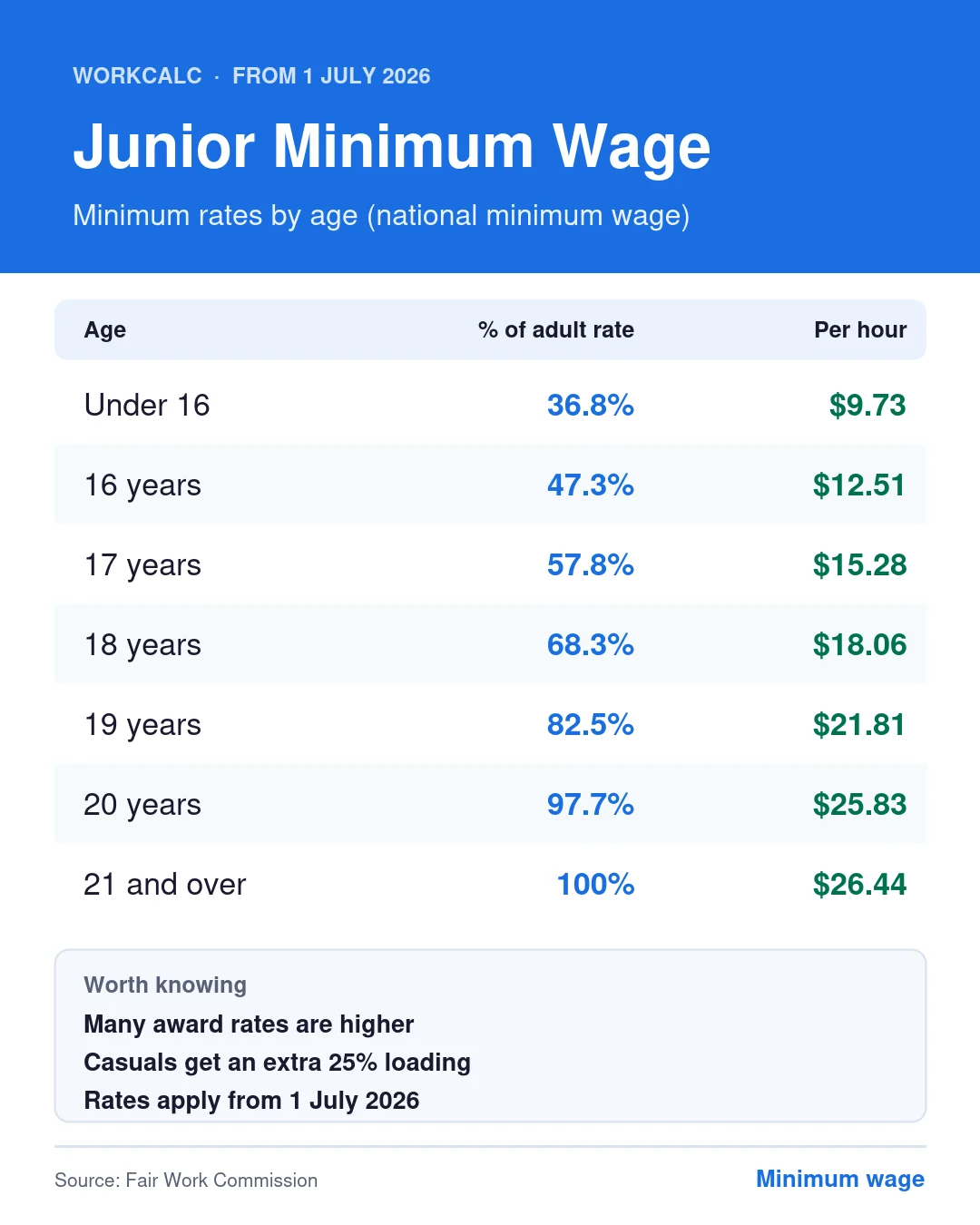
Employees under 21 can be paid a percentage of the adult minimum wage. These are national minimums only — many awards set higher junior rates.
| Age | % of adult rate | Minimum hourly rate | Minimum weekly (38h) |
|---|---|---|---|
| Under 16 | 36.8% | $9.73 | $369.80 |
| 16 years | 47.3% | $12.51 | $475.38 |
| 17 years | 57.8% | $15.28 | $580.64 |
| 18 years | 68.3% | $18.06 | $686.28 |
| 19 years | 82.5% | $21.81 | $828.78 |
| 20 years | 97.7% | $25.83 | $981.54 |
| 21 years and over | 100% | $26.44 | $1,004.90 |
What is the minimum wage in Australia in 2026?
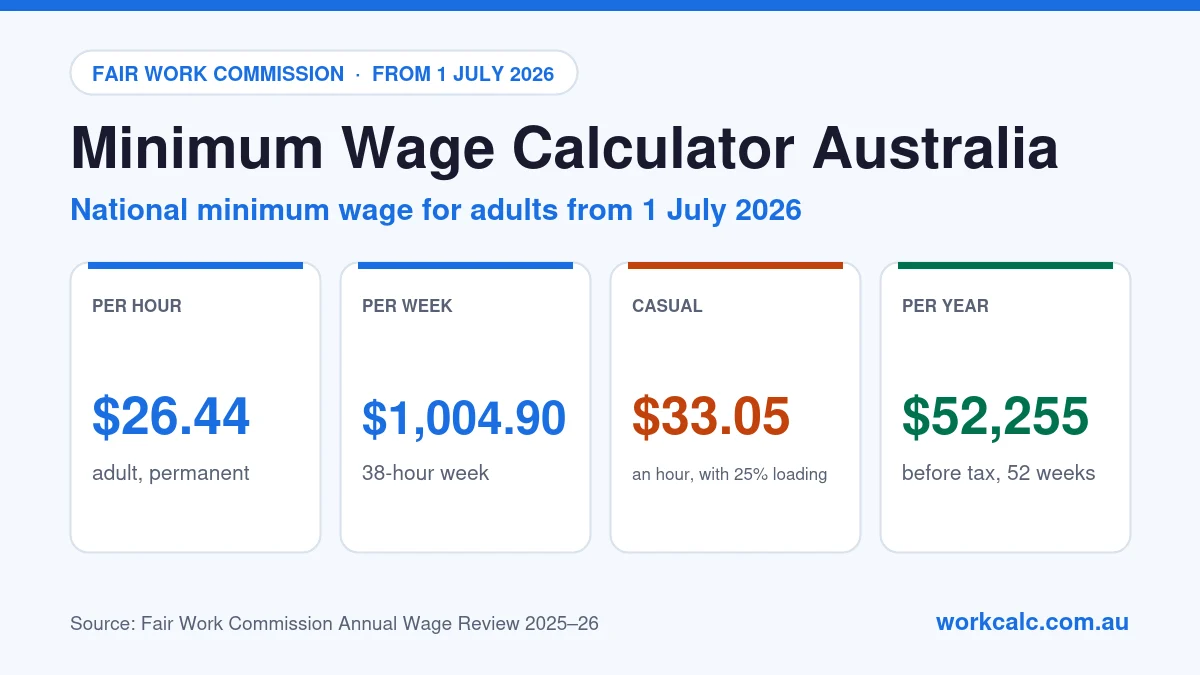
The National Minimum Wage from 1 July 2026 is $26.44 per hour or $1,004.90 per week for a standard 38-hour week. This was set by the Fair Work Commission's 2026 Annual Wage Review decision on 2 June 2026, representing a 6% increase from the 2025-26 rate of $24.95 per hour ($948.00 per week).
This is the first time the weekly national minimum wage has exceeded $1,000. The increase takes effect from the first full pay period starting on or after 1 July 2026.
When does the new rate take effect?
The 2026-27 minimum wage takes effect from the first full pay period starting on or after 1 July 2026. What this means in practice:
- If your weekly pay period starts on Wednesday, the new rates apply from Wednesday 1 July 2026
- If your weekly pay period starts on Monday, the new rates apply from Monday 6 July 2026
- If your pay period is fortnightly starting Monday, check whether your fortnightly cycle includes 1 July — the new rate applies from the first fortnightly period that starts on or after 1 July 2026
Permanent vs casual minimum wage
Casual employees receive a 25% casual loading on top of the minimum wage in lieu of entitlements such as annual leave, personal leave, notice of termination, and redundancy pay. From 1 July 2026:
- Permanent minimum: $26.44/hr · $1,004.90/wk
- Casual minimum: $33.05/hr · $1,256.13/wk ($26.44 × 1.25)
Not sure which type suits your situation? See our full breakdown of casual vs permanent employment in Australia, including leave entitlements, job security, and how to work out which pays more overall.
Common minimum wage calculations
Quick reference for the most common calculations people run on the 2026–27 National Minimum Wage of $26.44/hr:
- Casual loading: $26.44 × 1.25 = $33.05/hr
- 38-hour week: $26.44 × 38 = $1,004.72 — close to, but not exactly, the official weekly rate (see note below)
- Annual salary (38h week, 52 weeks): $1,004.90 × 52 = $52,254.80/yr
- Casual, 38-hour week: $33.05 × 38 = $1,255.90, though the FWC's published casual weekly figure of $1,256.13 is calculated as $1,004.90 × 1.25
Does the minimum wage change depending on your state?
No — the National Minimum Wage is a single national rate set by the Fair Work Commission and applies uniformly across NSW, VIC, QLD, SA, TAS, ACT and the NT. There's no separate "NSW minimum wage" or "QLD minimum wage" — if you're covered by the national system, you're covered by the same $26.44/hr floor no matter which state or city you're in.
The one exception is Western Australia, which has two employment systems. National system employees in WA follow the same national rate as everywhere else. But WA state system employees (sole traders, partnerships, and non-constitutional corporations) fall under WA's separate state industrial relations system, with rates set via WA state awards rather than the national minimum — contact Wageline on 1300 655 266 to check which applies to you.
Does the minimum wage apply to all workers?
No. The National Minimum Wage applies only to employees not covered by a modern award or enterprise agreement. In practice, the vast majority of Australian workers are covered by one of 121 modern awards that set specific minimum rates for their industry or occupation — which are always at or above the national minimum.
If you are covered by a modern award, your minimum wage is the relevant classification rate in that award, not the national minimum. Award rates are increased by the same percentage as the national minimum wage each year following the Annual Wage Review. Use the Fair Work Ombudsman's Pay and Conditions Tool to find your exact award rate. New to a job? Full minimum wage and leave entitlements apply from your very first shift — there's no such thing as a reduced probation period rate in Australia.
What is the minimum wage after tax?
The figures on this page are all gross — before income tax and Medicare levy are withheld. Take-home pay depends on your total annual earnings, tax-free threshold eligibility, and any HELP/HECS debt, so there's no single "after-tax minimum wage" figure that applies to everyone. For someone earning only the minimum wage on a 38-hour week ($52,254.80/yr), tax withheld would typically be relatively modest given Australia's tax-free threshold on the first $18,200 of income. Use the PAYG Withholding Calculator to estimate your actual take-home pay based on your specific hours and pay cycle.
Minimum wage history — recent years
- From 1 July 2026: $26.44/hr · $1,004.90/wk (+6.0%)
- From 1 July 2025: $24.95/hr · $948.00/wk (+3.5%)
- From 1 July 2024: $24.10/hr · $915.90/wk (+3.75%)
- From 1 July 2023: $23.23/hr · $882.80/wk (+8.65%)
- From 1 July 2022: $21.38/hr · $812.60/wk (+5.2%)
Frequently asked questions
Common questions about the national minimum wage in Australia.
What is the minimum wage in Australia in 2026?
From 1 July 2026: $26.44 per hour or $1,004.90 per week for a 38-hour week. The previous 2025-26 rate (to 30 June 2026) was $24.95 per hour ($948.00 per week). The 2026-27 rate represents a 6% increase, set by the Fair Work Commission's 2026 Annual Wage Review decision on 2 June 2026.
What is the minimum wage per hour in Australia?
$26.44 per hour from 1 July 2026 for a permanent employee not covered by a modern award. Casual employees receive a 25% loading on top, making the casual minimum $33.05 per hour. The previous rate was $24.95 per hour (2025-26).
When does the new minimum wage take effect?
The 2026-27 rate of $26.44/hr takes effect from the first full pay period starting on or after 1 July 2026. If your weekly pay period starts on Wednesday, the new rate applies from 1 July 2026. If it starts Monday, from 6 July 2026.
Do casual employees get a higher minimum wage?
Yes. Casual employees receive a 25% casual loading on top of the base rate in lieu of leave and other entitlements. From 1 July 2026 the casual minimum is $33.05 per hour ($26.44 × 1.25). Casual employees under a modern award receive the loading on their award rate.
Does the minimum wage apply to all Australian workers?
No — only to employees not covered by a modern award or enterprise agreement. Most Australian workers are covered by an award, which sets specific rates for their industry. Award rates are always at or above the national minimum. Use the Fair Work Ombudsman's Pay and Conditions Tool to find your award rate.
What is the minimum wage for a 16 or 17 year old?
Junior minimum rates from 1 July 2026: 16 years = $12.51/hr (47.3% of adult rate); 17 years = $15.28/hr (57.8%); 18 years = $18.06/hr (68.3%); 19 years = $21.81/hr (82.5%); 20 years = $25.83/hr (97.7%). These are national minimums only — many awards set higher junior rates. See the full junior rates table above.
Does the minimum wage differ by state or city (NSW, QLD, VIC, Melbourne, Sydney)?
No — the National Minimum Wage is a single national rate that applies uniformly across every Australian state, territory and city — NSW, VIC, QLD, SA, TAS, ACT and the NT. There's no separate "Melbourne minimum wage" or "Sydney minimum wage"; it's the same national floor everywhere. The one exception is Western Australia, which has a separate state industrial relations system for some employers (sole traders, partnerships, non-constitutional corporations) — WA state system employees should check their rate via Wageline on 1300 655 266.
What is the minimum wage after tax in Australia?
All figures on this page are gross, before tax. There's no single after-tax figure since it depends on your total annual earnings, tax-free threshold, and any HELP/HECS debt. Use the PAYG Withholding Calculator to estimate your take-home pay based on your actual hours.
What is the minimum wage per year in Australia?
$52,254.80 per year for a permanent employee working a standard 38-hour week, based on the $1,004.90 weekly rate from 1 July 2026 ($1,004.90 × 52 weeks). This is a gross annual figure before tax and superannuation.
Why doesn't $26.44 × 38 hours equal $1,004.90 exactly?
$26.44 × 38 = $1,004.72, which is 18 cents short of the official $1,004.90 weekly rate. That's because the Fair Work Commission sets the weekly rate as the primary figure, then derives the hourly rate by dividing it back down and rounding ($1,004.90 ÷ 38 = $26.4447, rounded to $26.44). For payroll, always use the officially published weekly figure rather than hourly × hours.
What if my employer is paying me less than minimum wage?
Underpayment of the minimum wage is unlawful under the Fair Work Act 2009. If you believe you are being underpaid, contact the Fair Work Ombudsman on 13 13 94 or lodge an online enquiry at fairwork.gov.au. The Ombudsman can investigate and recover unpaid wages on your behalf.