
Sick Leave Entitlements in Australia: The Complete Guide to Personal/Carer's Leave
How many sick days you're entitled to, how the 1/26 accrual formula works, when your employer can ask for a medical certificate, and what happens to your balance if you never use it.
The short answer: 10 days a year, pro-rata for part-time
Under the National Employment Standards (NES), full-time employees in Australia are entitled to 10 days of paid personal/carer's leave every year. Part-time employees receive a pro-rata entitlement based on their ordinary hours of work. Casual employees are not entitled to paid personal leave at all — they receive a casual loading instead. Personal/carer's leave is one of 11 minimum entitlements every employee must be told about — see the Fair Work Information Statement guide for the full list.
This single entitlement is commonly called "sick leave," but it officially covers two different situations: taking time off because you are unwell, and taking time off to care for an immediate family or household member who is unwell. Both draw from the exact same 10-day balance.
How the 1/26 accrual formula works
The NES doesn't hand you 10 days upfront on day one — leave accrues progressively throughout the year, starting from your very first day of employment, including any probation period. The formula is:
Personal leave accrued = Ordinary hours worked in the year ÷ 26
Worked example — full-time employee
Full-time employee, 38 ordinary hours per week, for 1 full year
Worked example — part-time employee
Part-time employee, 20 ordinary hours per week, for 1 full year
Notice both employees get the same proportional entitlement — 10 days at whatever their ordinary daily hours happen to be. The number of hours in the balance differs, but the number of working days off is the same.
Related tool Sick Day Calculator — work out your exact accrued balance →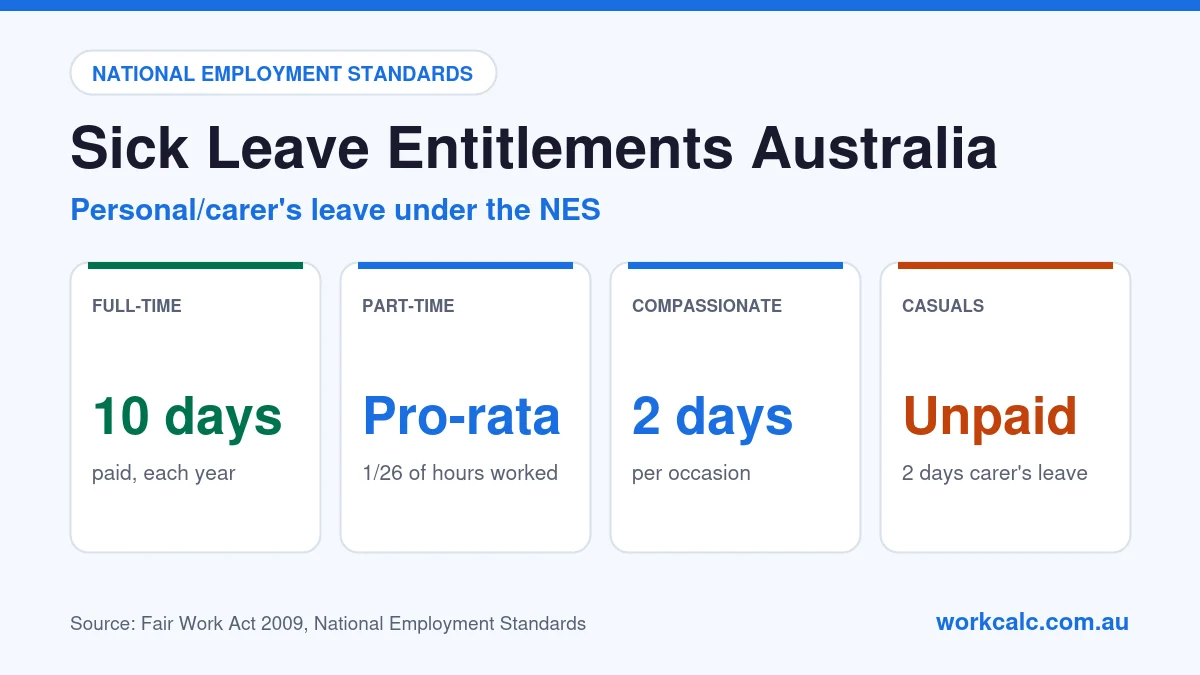
Sick leave and carer's leave are the same entitlement
A common misconception is that carer's leave is an extra entitlement on top of sick leave. It isn't — they come from the identical 10-day pool. You can use your leave for either purpose, in any combination:
- Sick leave — when you personally are unfit for work due to illness or injury, including mental health conditions such as anxiety, depression, or stress, and pregnancy-related illness.
- Carer's leave — when you need to care for or support a member of your immediate family or household who is sick, injured, or facing an unexpected emergency.
An "unexpected emergency" for carer's leave purposes isn't limited to illness — it can include things like needing to pick up a child from school unexpectedly, provided the situation is genuinely unforeseen.
Check your exact leave balance
Enter your hours and length of service to see your accrued personal leave.
Do casual employees get sick leave?
No. Casual employees are not entitled to paid personal/carer's leave under the NES — this is one of the fundamental trade-offs of casual employment, offset by the casual loading (typically 25%) paid on every hour worked instead.
Casual employees do still get some related entitlements:
- 2 days of unpaid carer's leave per occasion
- 2 days of unpaid compassionate leave per occasion
- 10 days of paid family and domestic violence leave per year — this specific entitlement applies to casuals too, unlike standard personal leave
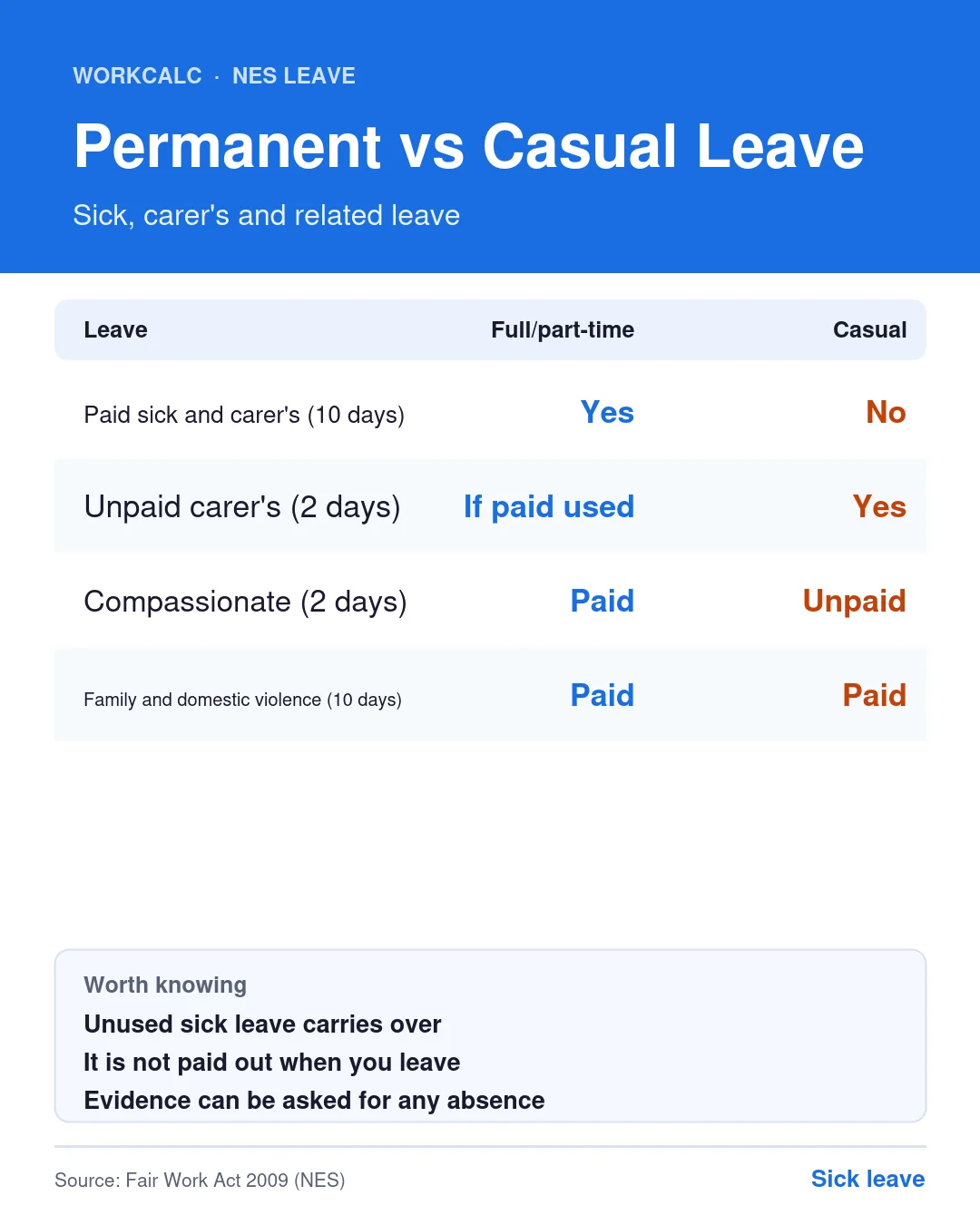
| Entitlement | Full-time / Part-time | Casual |
|---|---|---|
| Paid personal/carer's leave (10 days/yr) | Entitled | Not entitled |
| Unpaid carer's leave (2 days/occasion) | If paid leave exhausted | Entitled |
| Paid compassionate leave (2 days/occasion) | Entitled | Unpaid only |
| Family and domestic violence leave (10 days/yr) | Entitled, paid | Entitled, paid |
When can your employer ask for a medical certificate?
Your employer can request evidence that would satisfy a reasonable person that your leave was genuinely necessary — but the Fair Work Act does not set a fixed rule specifying exactly when this applies, or precisely how many days trigger the requirement. In practice:
- A medical certificate from a registered health practitioner (doctor, dentist, physiotherapist, psychologist, and others) is the most common accepted evidence.
- A statutory declaration is an equally valid alternative — useful if accessing a GP is difficult, costly, or impractical for a single day off. These can be made at a pharmacy, post office, or before a justice of the peace.
- Many workplace policies specifically require evidence only for absences of 2 or more consecutive days, or where a pattern of absences raises a genuine concern (such as recurring Monday or Friday absences) — but this is a policy choice, not a fixed legal threshold.
- A medical certificate does not need to disclose the specific nature of your illness — it only needs to confirm you were unfit for work during the relevant period.
Does unused sick leave carry over, and is it paid out?
Personal/carer's leave accumulates indefinitely if you don't use it — unlike some other leave types, there is no annual reset or expiry. An employee who rarely takes sick leave over many years of service can build up a very large balance, which acts as a genuine safety net if a serious illness occurs later.
Compassionate leave — a separate but related entitlement
Compassionate leave (sometimes called bereavement leave) is a distinct entitlement from personal/carer's leave, though the two are often confused. All employees, including casuals, are entitled to 2 days per occasion when:
- An immediate family or household member has a life-threatening illness or injury
- An immediate family or household member dies
- A pregnancy in the employee's immediate family ends in stillbirth
- The employee, or their spouse or de facto partner, has a miscarriage
For permanent employees, compassionate leave is paid at the base rate for the ordinary hours that would have been worked. For casual employees, it is unpaid.
Related guide Paid Parental Leave Australia — another core NES leave entitlement, in full →Frequently asked questions
Common questions about sick leave and personal/carer's leave in Australia.
How many sick days do you get per year in Australia?
Full-time employees get 10 days of paid personal/carer's leave per year, pro-rata for part-time. Technically calculated as 1/26 of ordinary hours worked in a year. Casual employees are not entitled to paid personal leave. Use the Sick Day Calculator for your exact accrued balance.
Do casual employees get sick leave in Australia?
No. Casuals aren't entitled to paid personal/carer's leave — they receive a casual loading instead. Casuals do get 2 days unpaid carer's leave per occasion, unpaid compassionate leave, and 10 days paid family and domestic violence leave per year.
Does unused sick leave get paid out when you leave a job?
No. Unlike annual leave, personal/carer's leave is not paid out on termination — whether you resign, are made redundant, or are dismissed. This applies under the NES minimum; some contracts or agreements may provide otherwise, but it's not a legal requirement.
Do I need a medical certificate for sick leave?
Your employer can ask for evidence that satisfies a reasonable person, such as a medical certificate — but a statutory declaration is an equally valid alternative. There's no fixed legal rule on exactly when evidence is required; many policies only ask for it after 2+ consecutive days off.
What is the difference between sick leave and carer's leave?
They're the same entitlement, not separate pools. Sick leave is for your own illness or injury; carer's leave is for caring for an immediate family or household member. You can use your 10-day balance for either purpose in any combination.
Does unused sick leave carry over to the next year?
Yes, indefinitely. Unlike some leave types, personal/carer's leave doesn't reset or expire — an employee who rarely takes sick leave can build a substantial balance over many years, providing a safety net for genuine future illness.
Can mental health conditions be used to take sick leave?
Yes. Personal leave covers any personal illness or injury, explicitly including mental health conditions like anxiety, depression, and stress. A medical certificate doesn't need to disclose the specific illness — only that you were unfit for work.