
Casual vs Permanent Employment in Australia: The Complete Comparison
The real trade-off between the 25% casual loading and paid leave entitlements, the new legal definition of "casual" since August 2024, and how to convert to permanent employment under the Employee Choice Pathway.
The core trade-off: cash now vs security later
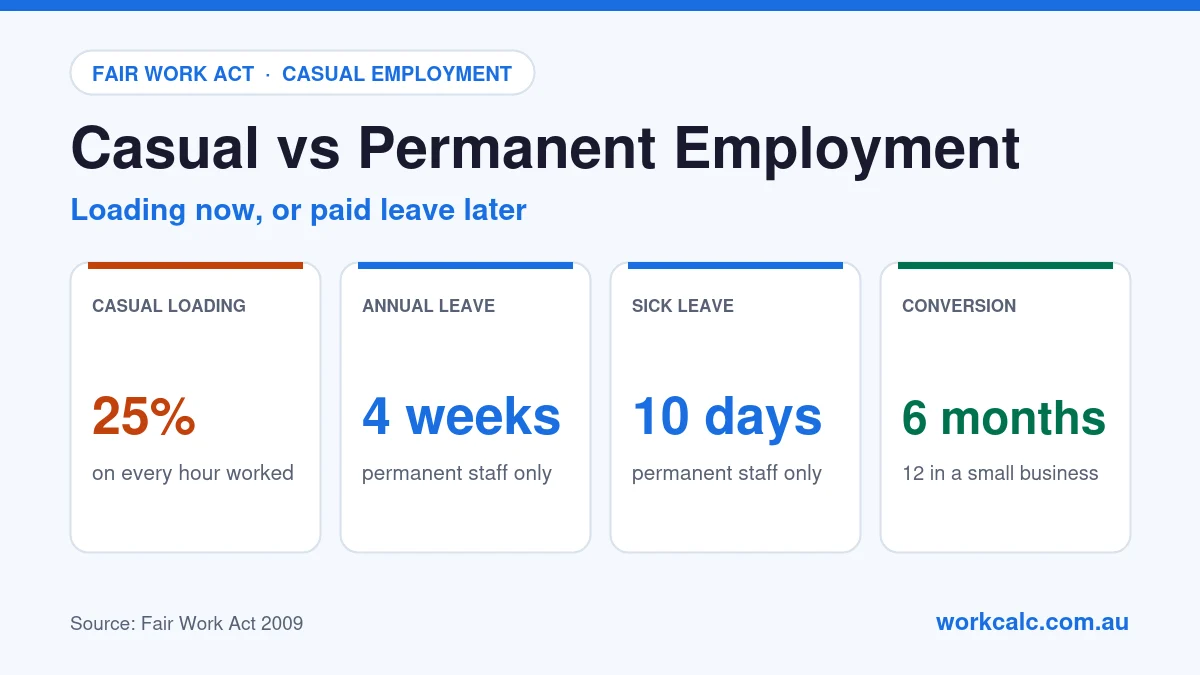
Casual and permanent employment represent two fundamentally different deals. A casual employee is paid a 25% loading on top of the base rate, in exchange for giving up guaranteed ongoing hours, paid leave, notice of termination, and redundancy pay. A permanent employee (full-time or part-time) gets all of those protections, but no loading, and is generally rostered on fixed, predictable hours. Permanent part-time staff get the same 4 weeks of paid annual leave as full-time staff, measured at their own hours (see annual leave for part-time employees). This is one of the 11 minimum entitlements every employee should know about — see the Fair Work Information Statement guide for the complete list.
Neither arrangement is objectively "better" — the right choice depends on whether you value flexibility and higher immediate pay, or security and accrued entitlements, more.
Full entitlements comparison
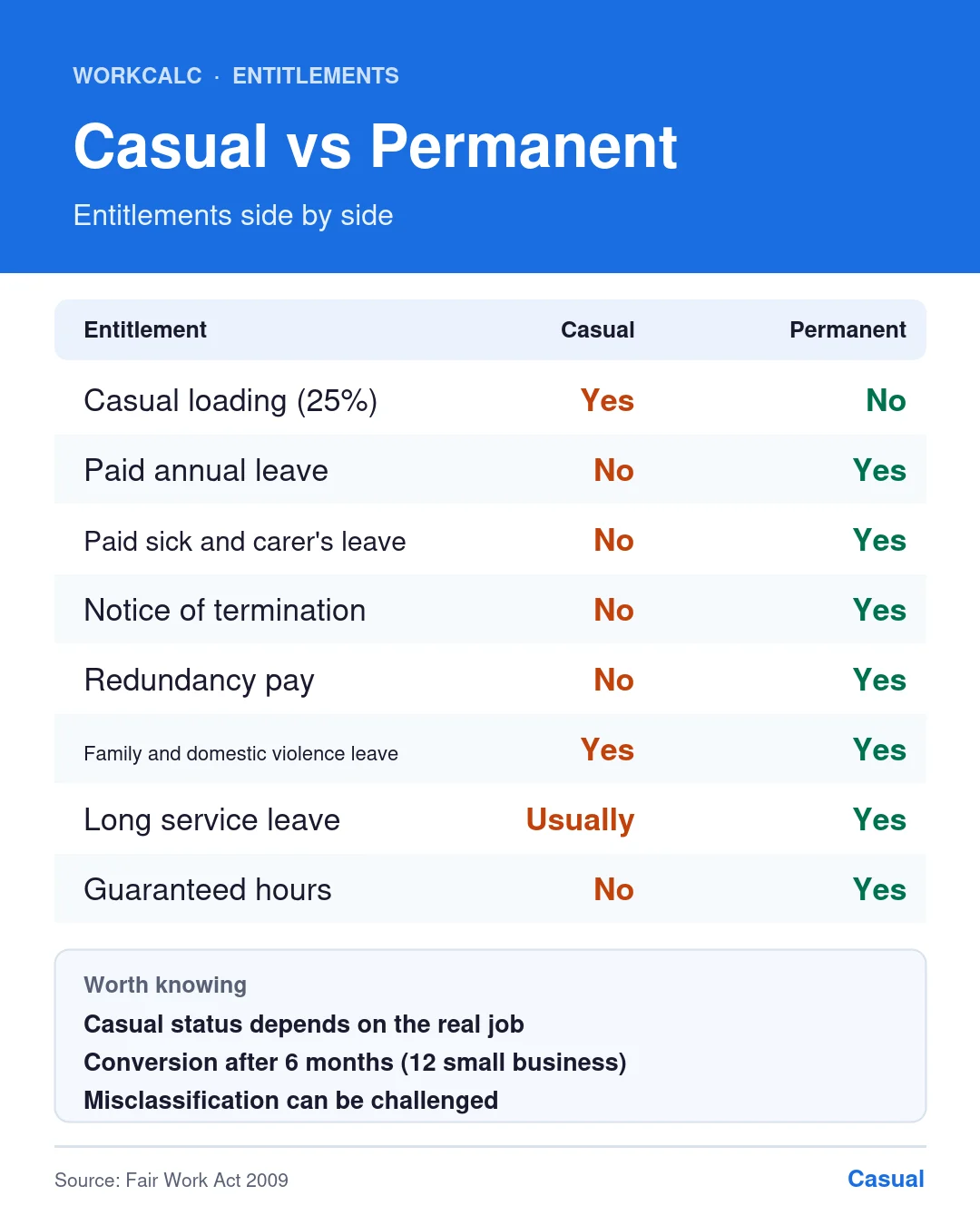
| Entitlement | Casual | Permanent (FT/PT) |
|---|---|---|
| Casual loading (typically 25%) | Yes | No |
| Paid annual leave (4 weeks/year) | No | Yes |
| Paid personal/carer's leave (10 days/year) | No | Yes |
| Notice of termination | No | Yes |
| Redundancy pay | No | Yes |
| Unpaid carer's leave (2 days/occasion) | Yes | Via paid leave first |
| Family and domestic violence leave (10 days/yr, paid) | Yes | Yes |
| Long service leave (state-based, if eligible) | Usually yes | Yes |
| Guaranteed ongoing hours | No | Yes |
Is the casual loading actually worth more than paid leave?
This is worth working through with real numbers, because the answer often surprises people. Here's a direct comparison at the same $30/hour base rate, over a full year of standard 38-hour weeks:
Casual — annual loading value
Permanent — leave entitlement value
The new legal definition of "casual" since August 2024
This is where things get genuinely more complex than most people realise — and where a lot of older information online is now out of date. Since 26 August 2024, under section 15A of the Fair Work Act 2009, a person is only a casual employee if:
- There is no firm advance commitment to continuing and indefinite work, and
- They are entitled to a casual loading or a specific casual pay rate under an award, agreement, or contract
Critically, this assessment now looks at the real substance, practical reality, and true nature of the actual working relationship — not just what the employment contract says on paper. Before this change, a worker's status was determined largely by the wording of the initial contract, following the 2021 High Court decision in WorkPac v Rossato.
Converting to permanent: the Employee Choice Pathway
The old system required employers to offer casual conversion after 12 months of regular work. That system has been replaced. Since 26 February 2025 (26 August 2025 for small business employers with 15 or fewer staff), eligible casual employees can proactively request conversion under the new Employee Choice Pathway.
Employee Choice Pathway — key dates
Who is eligible to request conversion
- Employed for at least 6 months (12 months if working for a small business employer)
- Genuinely believe they no longer meet the legal definition of a casual employee
- Not currently in an active dispute with the employer about changing to permanent employment
- No prior refusal of a similar request in the last 6 months
Note that employment before 26 August 2024 doesn't count towards this specific 6-month/12-month eligibility window — the clock effectively started from that date for the new pathway.
What happens after you give notice
- You give your employer written notice that you believe you no longer meet the casual definition and want to convert.
- Your employer must consult with you about the proposed change.
- The employer must respond in writing within 21 days, either accepting or refusing.
- If accepted, the change typically takes effect from the start of your first full pay period after the response — unless you agree on a different date.
- If refused, the employer must provide written reasons — and can only refuse if you genuinely still meet the casual definition, or there are fair and reasonable operational grounds (such as significant business impact or the change breaching an applicable award).
Check what you'd be entitled to as permanent
See your annual leave, personal leave and notice period entitlements if you convert.
What if your conversion request is disputed?
If you and your employer can't resolve a disagreement about your conversion request at the workplace level, either party can refer the dispute to the Fair Work Commission, which can attempt to resolve it through conciliation and, in some circumstances, arbitration.
Sick leave and notice — the entitlements that matter most
Two of the biggest practical gaps for casual employees are personal/carer's leave and notice of termination — both entirely absent from casual employment, regardless of how long someone has worked for the same employer.
Related guide Sick Leave Entitlements Australia — see exactly what casuals miss out on → Related tool Notice Period Calculator — an entitlement only permanent employees receive →Misclassification — a real risk for both sides
Because the legal test now looks at practical reality rather than contract wording, an employee genuinely labelled "casual" but working regular, predictable, ongoing hours may actually be entitled to permanent employee benefits retroactively if the arrangement is challenged. This creates real risk for employers — potential back-pay claims covering unpaid leave, public holiday pay, and other entitlements, even if a casual loading was paid throughout. If your rostered hours have looked essentially identical for many months with no genuine unpredictability, it's worth understanding your position under the new definition.
This guide covers the general National Employment Standards position following the Closing Loopholes reforms. Specific modern awards or enterprise agreements may provide additional or different arrangements — always check the instrument that applies to your role.
Frequently asked questions
Common questions about casual vs permanent employment in Australia.
What is the difference between casual and permanent employment?
Casual employees get a loading (typically 25%) instead of paid leave, notice, and redundancy pay, but have no guaranteed ongoing hours. Permanent employees get paid annual and personal leave, notice, and redundancy pay if eligible, but no loading, and are generally rostered on fixed hours.
What is the new legal definition of a casual employee?
Since 26 August 2024, under s15A of the Fair Work Act, a casual employee is someone with no firm advance commitment to continuing and indefinite work, entitled to a casual loading. This is assessed on the real substance and practical reality of the relationship, not just the contract wording.
How does a casual employee convert to permanent employment?
Via the Employee Choice Pathway (from 26 February 2025, or 26 August 2025 for small business). Eligible employees give written notice after 6 months (12 for small business), the employer consults and responds in writing within 21 days, and can only refuse on limited grounds.
Is the casual loading worth more than paid leave entitlements?
In raw dollar terms, often yes — the 25% loading can exceed the cash value of standard paid leave. But this excludes notice pay, redundancy pay, and the value of guaranteed income security that only permanent employment provides.
Can an employer refuse a conversion request?
Yes, but only if the employee still genuinely meets the casual definition, or there are fair and reasonable operational grounds — such as significant business impact or the change breaching an award. The employer must give written reasons within 21 days.
Do casual employees get redundancy pay or notice?
No — regardless of length of service. This is reserved for permanent (full-time and part-time) employees under the NES. See the Redundancy Pay Calculator and Notice Period Calculator for what permanent employees are entitled to.