
Paid Parental Leave Calculator Australia
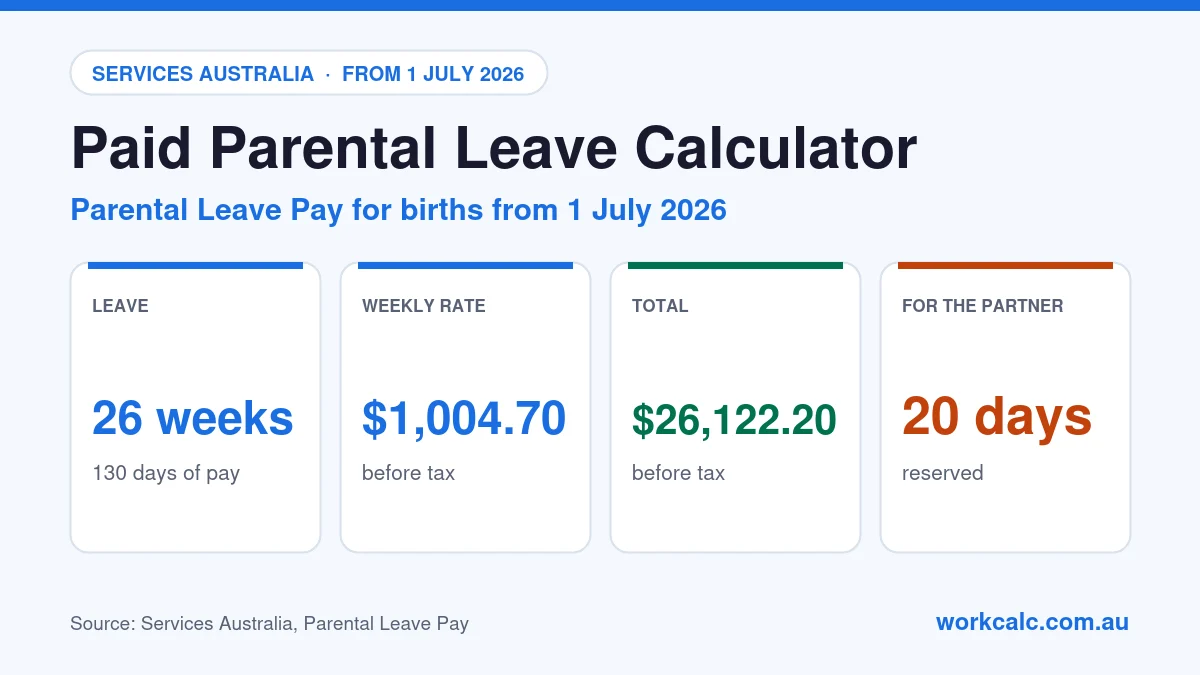
Calculate your government Parental Leave Pay entitlement — up to 130 days at $1,004.70/week, plus the 12% superannuation contribution.
Your details
Parental Leave Pay rates by financial year
Confirmed figures from Services Australia.
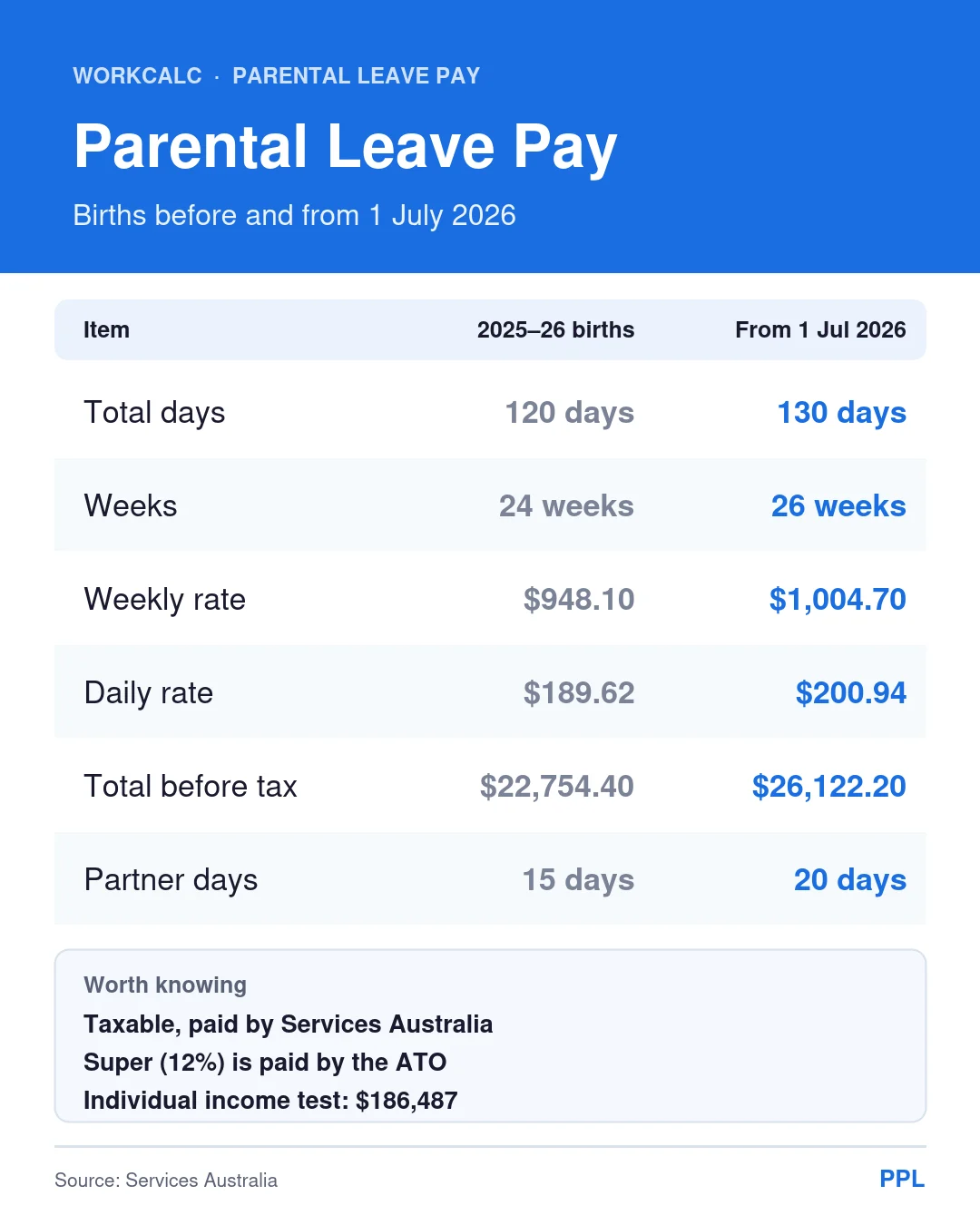
| Item | Births 1 Jul 2025 – 30 Jun 2026 | Births from 1 Jul 2026 |
|---|---|---|
| Total days | 120 days | 130 days |
| Equivalent weeks | 24 weeks | 26 weeks |
| Weekly rate (before tax) | $948.10 | $1,004.70 |
| Daily rate (before tax) | $189.62 | $200.94 |
| Total gross entitlement | $22,754.40 | $26,122.20 |
| Days reserved for partner | 15 days | 20 days |
| Superannuation (12% SG) | Yes, from ATO | Yes, from ATO |
How Parental Leave Pay works
Parental Leave Pay (PPL) is a government payment through Services Australia for eligible parents caring for a newborn or newly adopted child. For children born or adopted on or after 1 July 2026, the entitlement reaches its final stage: 130 days (26 weeks), paid at the national minimum wage rate of $1,004.70 per week before tax. For the complete story on how the scheme reached this point and how it interacts with unpaid leave, see Paid Parental Leave Australia 2026: Your Complete Guide.
This completes a staged expansion that began under the Paid Parental Leave Amendment (More Support for Working Families) Act 2023 — the scheme has increased by two weeks every year since 1 July 2024, starting from an earlier 20-week base.
How the days are split between parents
For children born from 1 July 2026, 20 days of the 130-day total are reserved specifically for a partner, on a use-it-or-lose-it basis — if the reserved parent doesn't use them, they can't be transferred to the other parent. The remaining 110 days are flexible and can be taken by either parent, or shared between them, in whatever combination the family chooses.
A single parent receives all 130 days themselves, since there's no partner to reserve days for. Both parents can take up to 20 days of leave at the same time if they choose.
Eligibility — the income and work tests
To receive Parental Leave Pay, you generally need to meet:
- Income test: individual adjusted taxable income of $186,487 or less (2025-26 financial year, used for 2026-27 births), or a combined family income of $386,525 or less if you don't meet the individual test.
- Work test: worked at least 330 hours across 10 of the 13 months before the birth or adoption — roughly one day a week on average.
- Primary carer status: you must be the child's primary carer for the period you're claiming.
- Residency requirements apply, along with standard claim timing rules.
Income is assessed using the financial year before either your claim date or your child's birth/adoption date, whichever is earlier.
"Keeping in touch" days
You generally can't work on the days you're claiming PPL for. However, Services Australia allows up to 10 "keeping in touch" days to be worked during the paid leave period without losing your entitlement for those specific days — designed to help maintain a connection with your workplace and ease the return-to-work transition.
Parental Leave Pay is separate from unpaid job-protected leave
Government PPL is a Centrelink payment — it's completely separate from the unpaid parental leave entitlement under the National Employment Standards, which guarantees up to 12 months of unpaid, job-protected leave (extendable to 24 months with employer agreement). Many families use PPL to fund part of this unpaid leave period, and some employers also offer their own paid parental leave scheme on top, which can be taken concurrently or sequentially with government PPL.
This calculator covers government Parental Leave Pay only — it does not include Family Tax Benefit, employer-paid parental leave, or other family payments, which are assessed separately.
Frequently asked questions
Common questions about Paid Parental Leave in Australia.
How much is Paid Parental Leave in Australia in 2026?
For children born or adopted from 1 July 2026, up to 130 days (26 weeks) at $1,004.70/week before tax — approximately $26,122 total. This is the final stage of the scheme's staged expansion since 2011.
Does superannuation apply to Parental Leave Pay?
Yes, since 1 July 2025. The ATO pays a 12% Superannuation Guarantee contribution on your PPL, directly into your nominated super fund after the financial year ends — no separate claim needed.
What is the income test for Parental Leave Pay?
Individual adjusted taxable income of $186,487 or less (2026-27), or family income of $386,525 or less if you don't meet the individual test, assessed on the prior financial year's income.
How many days are reserved for a partner?
20 days of the 130-day total, for births from 1 July 2026 — on a use-it-or-lose-it basis. The remaining 110 days are flexible between parents.
Can I work while receiving Parental Leave Pay?
Not on the specific days you're claiming for, but up to 10 "keeping in touch" days can be worked during the paid leave period without losing your entitlement for those days.