
Paid Parental Leave Australia 2026: Your Complete Guide to the 26-Week Scheme
Everything you need to know about government Parental Leave Pay — the full 130-day entitlement, superannuation on your payments, eligibility rules, and how it fits with unpaid leave.
The scheme has just reached its final expansion stage
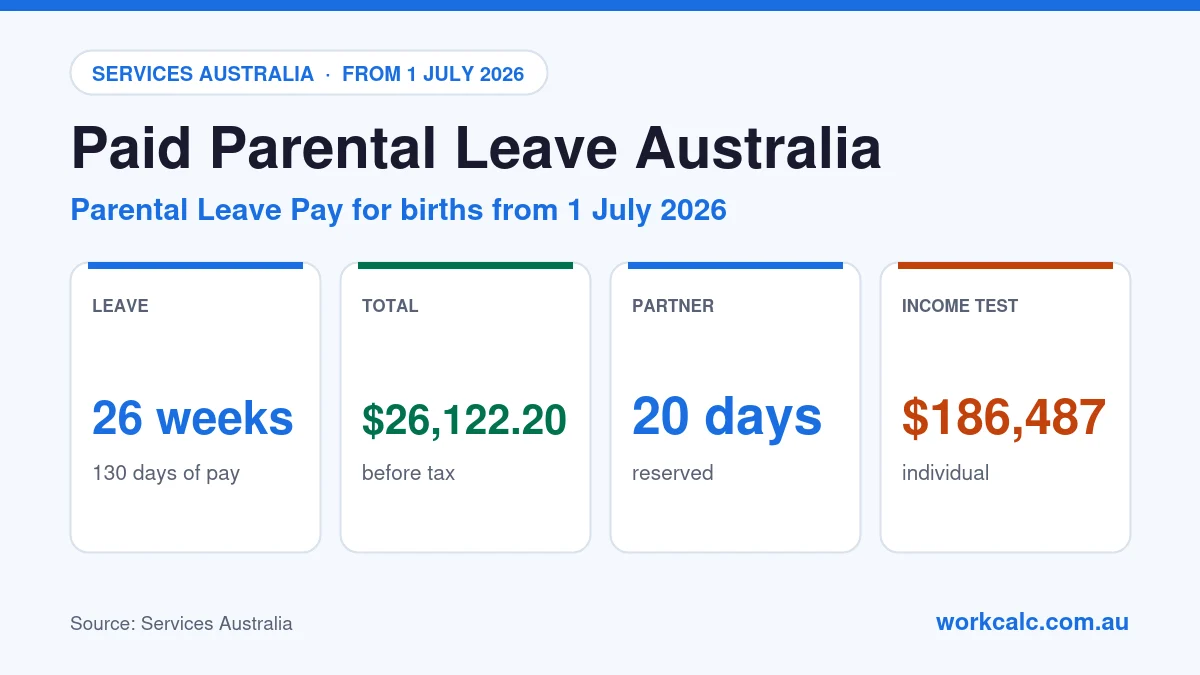
If you're expecting a child in the second half of 2026, you have access to the most generous government Parental Leave Pay entitlement in Australia's history: 130 days (26 weeks), paid at $1,004.70 per week before tax — the same rate as the national minimum wage. This is the final step of a staged expansion that's been running since 2011, when the scheme started at just 18 weeks.
How Parental Leave Pay grew to 26 weeks
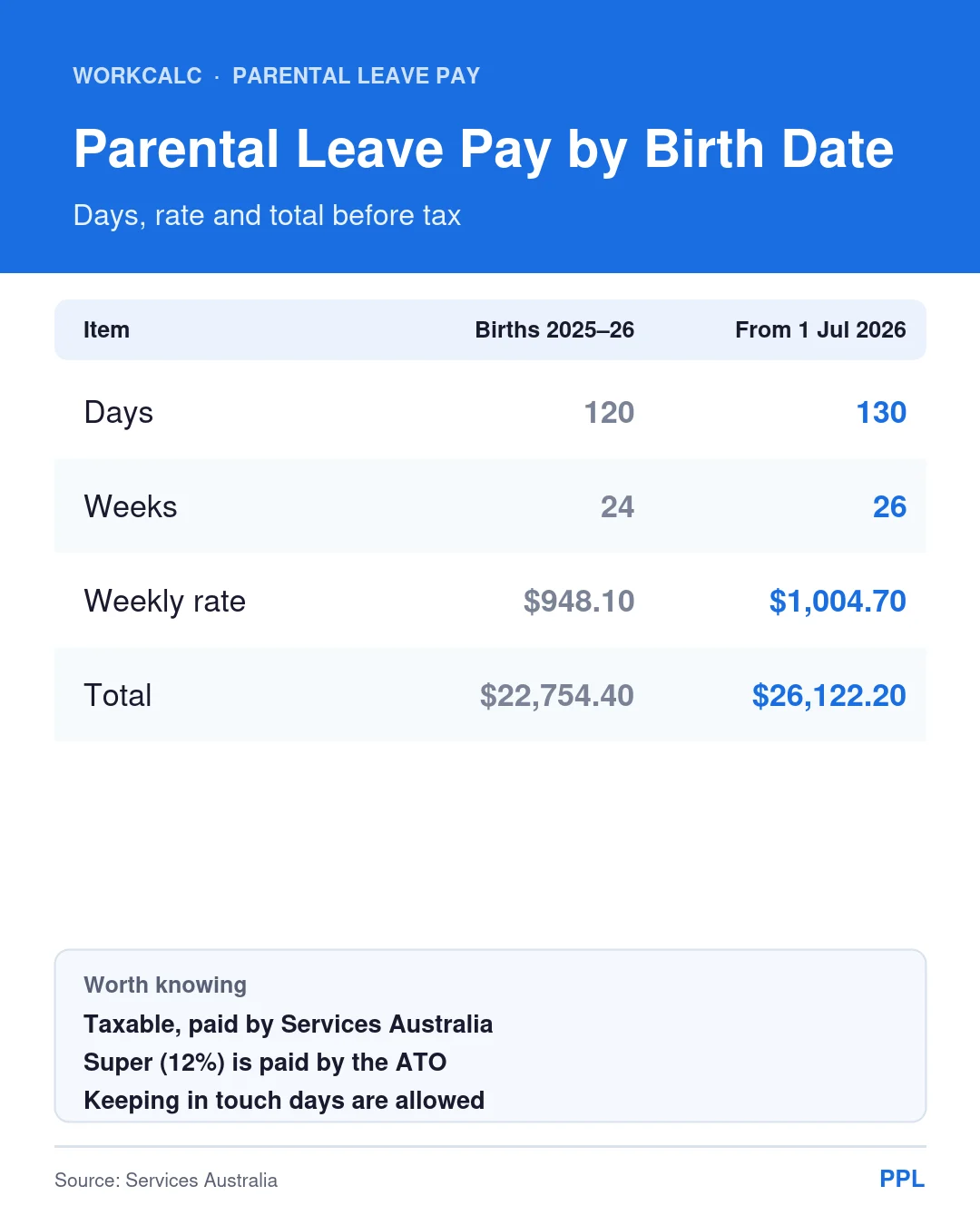
For a child born or adopted before 1 July 2026, the entitlement is 120 days (24 weeks) instead. If you lodged a claim before 1 July 2026 with a balance of 120 days, and your child is born on or after that date, Services Australia automatically tops your balance up to 130 days once you provide proof of birth — no new claim required.
Calculate your exact entitlement
See your total PPL payment and superannuation contribution.
How much you'll actually receive
The full 26-week entitlement works out to $26,122.20 before tax, based on the national minimum wage rate of $1,004.70 per week (or $200.94 per day, calculated on a 5-day week basis).
| Birth/adoption date | Days | Weekly rate | Total gross |
|---|---|---|---|
| 1 Jul 2025 – 30 Jun 2026 | 120 days | $948.10 | $22,754.40 |
| On or after 1 Jul 2026 | 130 days | $1,004.70 | $26,122.20 |
Sharing the leave between partners
For children born from 1 July 2026, 20 days of the 130-day total are reserved specifically for a partner — non-transferable on a use-it-or-lose-it basis. The remaining 110 days are flexible and can go to either parent, in whatever split the family decides.
Both parents can now take up to 20 days at the same time as each other, which is a meaningful increase from the 10-day overlap previously allowed for children born before 1 July 2025. This gives families genuine flexibility to have both parents home together during part of the leave period, not just sequentially.
Related tool Paid Parental Leave Calculator — see the day-by-day split for your family situation →Are you eligible?
Three main tests determine eligibility:
1. The income test
Your individual adjusted taxable income from the previous financial year must be $186,487 or less (2026-27 threshold). If you don't meet this, a family income test applies instead — combined income of $386,525 or less. This means a higher-earning partner can still enable the household to qualify, provided the lower-earning partner is the one claiming and the family total sits under the combined limit.
2. The work test
You need to have worked at least 330 hours across 10 of the 13 months before your child's birth or adoption — roughly averaging one day a week. This applies to employees, casuals, and self-employed people alike, provided the hours and structure meet the requirement.
3. Primary carer status
You must be the child's primary carer for the days you're claiming. Both the birth parent and their partner need to separately meet the eligibility tests if they each intend to claim a portion of the leave.
Is Parental Leave Pay taxable?
Yes — PPL is taxable income, included in your assessable income for the year you receive it. Because it's usually paid at a lower rate than most people's normal salary, and often received during a period when your overall annual income is reduced, the tax withheld during the leave period may not perfectly reflect your true annual tax position — similar to how any change in income partway through a year affects PAYG withholding.
Related tool Take-Home Pay Calculator — estimate your tax position for a single pay period including PPL → Related tool YTD Calculator — project your full-year income and refund for a year that includes PPL →PPL vs unpaid parental leave vs employer-paid leave
It's worth being clear about three genuinely different things that all get loosely called "parental leave":
- Government Parental Leave Pay (PPL) — the Centrelink payment covered in this guide, up to 130 days at minimum wage rate.
- Unpaid parental leave — a separate job-protection entitlement under the National Employment Standards, guaranteeing up to 12 months unpaid leave (extendable to 24 months with employer agreement), regardless of whether you receive PPL.
- Employer-paid parental leave — an optional benefit some employers offer on top of the government scheme, often at your normal salary rather than minimum wage, which can be taken concurrently with or in addition to government PPL depending on the employer's specific policy.
Many families structure their time off by combining all three: using employer-paid leave first (often at full salary), then government PPL, then unpaid leave to extend the total time away from work.
Keeping in touch with your workplace
You generally can't work on the specific days you're claiming PPL for — but Services Australia allows up to 10 "keeping in touch" days to be worked during the paid leave period without forfeiting your entitlement for those days. This is designed to help ease the return-to-work transition while maintaining a connection with your workplace, such as attending a planning day or training session.
Frequently asked questions
Common questions about Paid Parental Leave in Australia.
How long is Paid Parental Leave in Australia in 2026?
Up to 130 days (26 weeks) for children born or adopted from 1 July 2026 — the final stage of a staged expansion since 2011. Children born before this date receive 120 days (24 weeks).
Is Parental Leave Pay taxable income?
Yes, it's included in your assessable income for the year received. Your final tax liability depends on your total annual income, including any earnings before or after the leave period.
Can both parents take Parental Leave Pay at the same time?
Yes, up to 20 days simultaneously, for children born from 1 July 2026 — up from 10 days previously. This lets both parents be home together for part of the leave period.
What happens to unused Parental Leave Pay days?
The 20 days reserved for a partner are use-it-or-lose-it and can't transfer to the other parent. The remaining 110 flexible days can be split however the family chooses, within the relevant claim period.
Does Parental Leave Pay replace my normal salary?
Not necessarily — PPL is paid at the minimum wage rate, which may be lower than your normal salary. Some employers offer their own paid parental leave on top, often at full salary, which can be combined with government PPL depending on employer policy.