
Medical Certificates for Sick Leave: What Your Employer Can (and Can't) Ask For
Your employer can ask for evidence of sick leave — even for a single day off. Here's exactly what makes a medical certificate valid in Australia, when a statutory declaration or pharmacist certificate will do instead, and what your employer legally can't do with it.
Most people assume a medical certificate is only needed for a longer illness — but under Australian workplace law, your employer can ask for evidence of sick leave for as little as one day off. There's no minimum threshold written into the Fair Work Act. What matters is whether the request is reasonable, and whether the evidence you provide would satisfy a "reasonable person" that you genuinely needed the leave.
What you need to know
- Evidence can be requested for any absence — including a single day — under section 107 of the Fair Work Act 2009
- A valid certificate needs the practitioner's details, your name, the date issued, and the dates you're unfit for work — not your diagnosis
- Statutory declarations are a recognised alternative when you genuinely can't get a doctor's appointment
- Pharmacist Absence from Work Certificates exist but are limited to 1–2 days and aren't the same as a medical certificate
- Telehealth certificates are valid if issued after a genuine consultation with an AHPRA-registered practitioner
- Your employer can only reject a certificate in limited circumstances — missing details, backdating without explanation, or evidence of fraud
Do you need a medical certificate for sick leave?
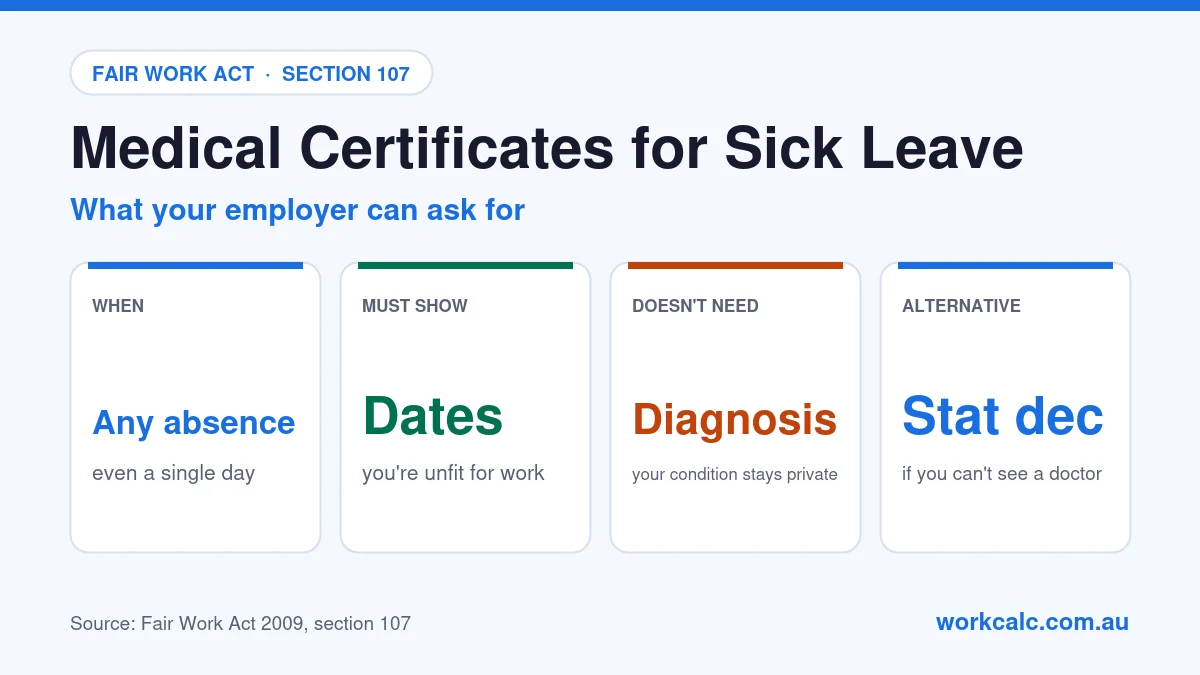
Under section 107 of the Fair Work Act 2009, an employer can ask an employee to provide evidence that would satisfy a reasonable person that the leave was genuinely needed — whether that's because of a personal illness or injury, or to care for an immediate family or household member. Critically, the Act sets no minimum number of days before this evidence can be requested. Your employer is entitled to ask for a certificate even if you were only off for a single day.
Whether they actually do ask depends on your workplace. Some employers only request evidence for absences of two days or more, or when sick days fall in a pattern — for example, always attached to a weekend or public holiday. Others apply a stricter policy and want a certificate every time. Your award, enterprise agreement, or employment contract can specify exactly when evidence is required and what form it should take, so check yours if you're unsure.
What makes a medical certificate valid
There's no single legally prescribed template for a medical certificate in Australia, but the Australian Medical Association's guidelines — and how the Fair Work Commission has interpreted "reasonable evidence" in practice — point to the same core elements. A certificate that will hold up generally includes:
- The practitioner's name and details — including their registration or provider number
- Your name as the patient
- The date the certificate was issued
- The date, or dates, you were or are unfit for work
- A statement confirming you were unfit for work due to illness, injury, or caring responsibilities
Certificates that are vague, missing key details, or backdated without any explanation are the ones most likely to be questioned. In one Fair Work Commission matter, an employer was entitled to reject a certificate that didn't specify what duties an employee could and couldn't perform, gave no reasoning for a sudden change in medical opinion, and was submitted two weeks late — the certificate simply didn't do the job of establishing genuine unfitness for work.
What if you can't get a doctor's appointment?
Getting a same-day GP appointment isn't always realistic, especially for a one- or two-day illness. Fair Work recognises that a medical certificate isn't the only acceptable form of evidence — a statutory declaration can do the job instead.
Some awards or enterprise agreements specify exactly what type of evidence is acceptable. If yours is silent on the point, a statutory declaration is generally a valid fallback.
State plainly that you were unfit for work, or needed to care for a family or household member, and on which date(s). It's a legal document — a false declaration can carry serious consequences.
If your employer's policy requires a medical certificate rather than a declaration, a pharmacist consultation or a genuine telehealth appointment are both faster routes than waiting for a GP.
Medical certificate vs statutory declaration vs pharmacist certificate
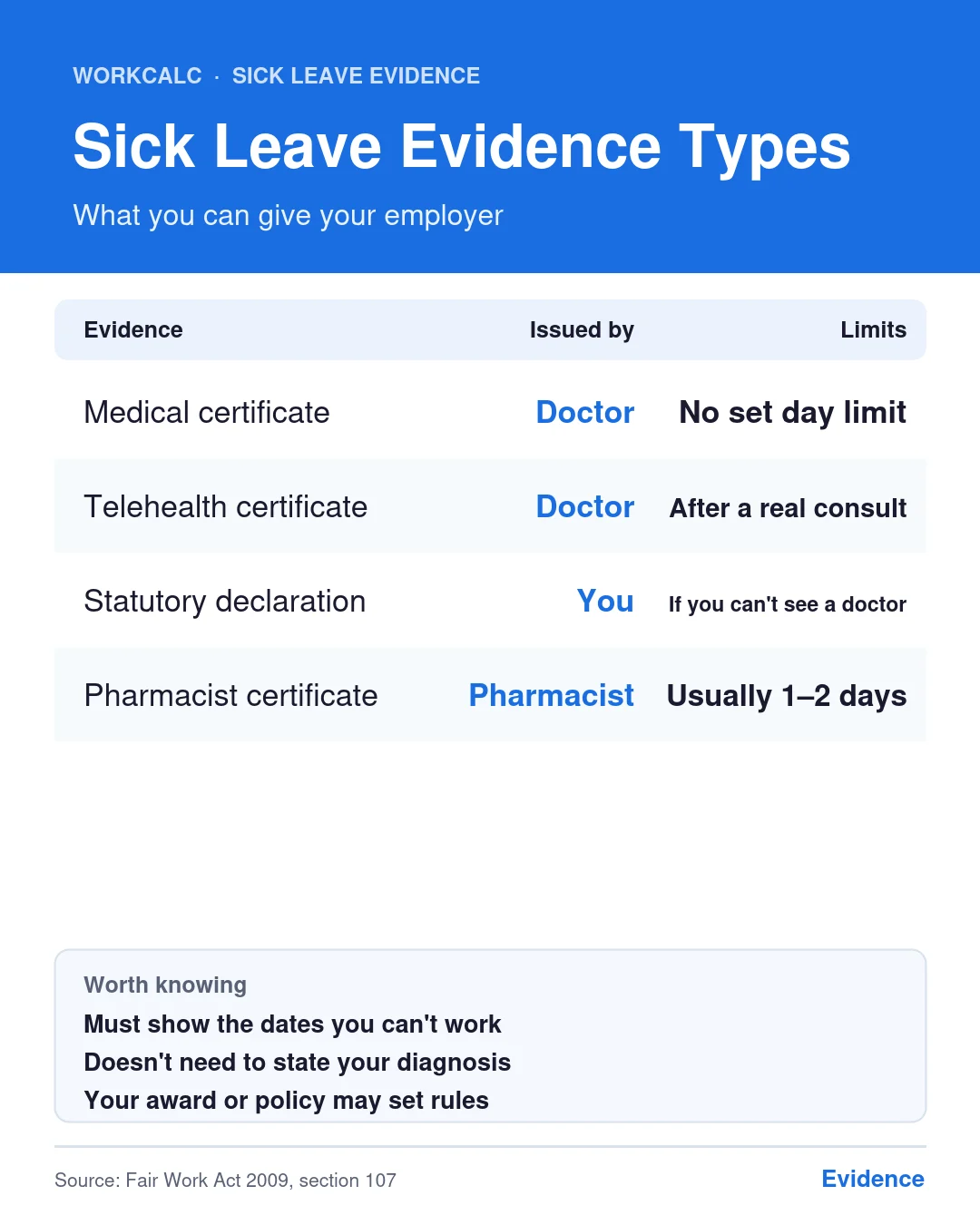
| Evidence type | Who issues it | Typical limits |
|---|---|---|
| Medical certificate | Registered doctor (in person or telehealth) | No set day limit; most formal, widely accepted |
| Statutory declaration | You, as a legal declaration | Use when a certificate genuinely isn't obtainable; must be truthful |
| Pharmacist Absence from Work Certificate | Registered pharmacist | Usually capped at 1–2 days; minor ailments only; can't be backdated |
A pharmacist-issued Absence from Work Certificate is a genuinely useful option for a short, minor illness, but it comes with real limits worth knowing before you rely on one. It generally can't be used for compassionate leave, can't certify that you're fit to return to work, and can't extend an existing medical certificate. It's also a different document to a medical certificate — always confirm with your employer that they'll accept one before assuming it's interchangeable.
Related guide New to sick leave entitlements? See how many days you accrue and how they're calculated →Are online medical certificates valid?
Yes — a certificate issued after a genuine telehealth consultation with an AHPRA-registered practitioner carries the same legal weight as one issued face to face. What matters under the Fair Work Act is who issued it and how, not whether the appointment happened by video call or in a waiting room.
Can your employer reject your medical certificate?
Generally, no — not without good reason. The starting position under the Fair Work Act is that a signed certificate from a registered medical practitioner should be accepted as reasonable evidence. Employers aren't expected to second-guess a doctor's clinical judgement, and rejecting a certificate purely because they're suspicious, without more, puts them on shaky legal ground.
That said, employers can question or reject a certificate in more limited, exceptional circumstances — for example:
- The certificate is missing key details, such as the practitioner's registration information or the dates of unfitness
- It's been backdated with no explanation for the delay
- There's evidence the certificate wasn't genuinely issued by the practitioner named on it, or was altered
- It's too vague to establish what the employee was actually unfit to do, or for how long
Fair Work Commission decisions have upheld termination in cases involving forged certificates — including one where an employee provided a certificate that turned out not to have been written by the doctor named on it at all. On the other end of the spectrum, a certificate that's genuine but simply too vague to establish the necessary facts has also been found insufficient, without any suggestion of dishonesty. The common thread in both is the same: the certificate has to actually do its job of establishing genuine unfitness for work, in enough detail to be checked if needed.
What your employer generally can't do: attend a medical appointment with you unless you specifically ask them to, or contact your doctor directly for more information without your involvement.
Can I be sacked for taking sick leave without a medical certificate?
Not automatically. If your employer validly asks for evidence and you don't provide any, the usual consequence is that the day is treated as unpaid rather than paid personal leave — not instant termination.
Dismissal risk comes from a different place: providing false or forged evidence, or a clear, repeated pattern of breaching a workplace policy after being warned. A single missing certificate, on its own, is rarely grounds for termination.
If you're ever unsure what your specific award or agreement requires, the Fair Work Ombudsman's page on notice and medical certificates sets out the underlying rules in full.
Do you have to tell your employer your diagnosis?
No. A medical certificate only needs to confirm that you were unfit for work — it doesn't need to say what your illness or injury actually was, and you're under no obligation to volunteer that information. Your employer isn't entitled to your specific diagnosis just because you've taken sick leave.
The one exception is where there's a genuine workplace health and safety issue, or where reasonable adjustments need to be made so you can do your job. Even then, sharing more detailed medical information is usually something you'd need to consent to first, rather than something your employer can simply demand.
Medical certificates and unpaid sick leave
Once you've used up your paid personal/carer's leave balance for the year, any further sick days are typically unpaid — but your employer can still ask for evidence on the same basis as paid leave. This matters most for casual employees, who don't accrue paid sick leave under the National Employment Standards at all, but may still be asked to provide evidence if their award or agreement requires it for any personal leave taken, paid or not.
Related calculator Check how many sick days you've accrued and what's left in your balance →Disclaimer: This article explains the general evidence requirements for sick and carer's leave under the National Employment Standards and Fair Work Act 2009. Specific modern awards, enterprise agreements, and employment contracts can vary the exact evidence required and when it must be provided. This is educational content, not legal or medical advice — for guidance on your specific situation, consult the Fair Work Ombudsman, your award, or a qualified workplace relations professional. WorkCalc Australia is independent and not affiliated with Fair Work, the ATO, or any medical certificate provider.
Frequently asked questions about medical certificates for sick leave
Plain-English answers on when evidence is required, what counts, and what your employer can and can't do with it.
Do you need a medical certificate for sick leave in Australia?
Yes, if your employer asks for one. Under section 107 of the Fair Work Act 2009, your employer can request evidence for any period of sick or carer's leave, including a single day off. You don't need a certificate automatically for every sick day, but if your employer asks for evidence and you don't provide it, you may not be paid for that leave.
Is a medical certificate required for one day of sick leave?
It can be. The Fair Work Act sets no minimum number of days before an employer can ask for evidence — they can request a certificate even for a single day off. Whether they actually do depends on your workplace policy, your award, and how often you've taken sick leave without notice.
What makes a medical certificate valid in Australia?
A valid certificate generally needs the practitioner's name and details, your name, the date it was issued, and the date(s) you were or are unfit for work. It does not need to state your diagnosis unless your contract, award, or enterprise agreement specifically requires it. The certificate must come from a registered health practitioner.
Can I use a statutory declaration instead of a medical certificate?
Yes. Fair Work recognises a statutory declaration as an acceptable form of evidence when you can't get a medical certificate — for example, if you couldn't get a doctor's appointment. A statutory declaration is a legal document, so it must be truthful; a false declaration can have serious legal consequences.
Can a pharmacist give me a medical certificate for work?
Many pharmacies can issue an Absence from Work Certificate, but it's not the same thing as a doctor's medical certificate. Pharmacist certificates are generally limited to minor ailments, cover a maximum of one to two days, can't be backdated, and can't be used to extend an existing medical certificate or certify fitness to return to work. Check with your employer first that they'll accept one.
Are online or telehealth medical certificates valid for sick leave?
Yes, provided the certificate is issued by an AHPRA-registered practitioner following a genuine consultation — it carries the same legal weight as an in-person certificate. Certificates issued with no consultation at all, based purely on self-reported symptoms, sit on shakier legal ground and have been given little weight in at least one Federal Circuit and Family Court decision.
Can my employer reject my medical certificate?
Only in limited circumstances. Employers are generally expected to accept a signed certificate from a registered practitioner. They can question or reject one where there's a genuine reason — for example, it's missing key details, it's been backdated without explanation, or there's evidence it's fraudulent. Fair Work Commission cases have upheld employer decisions to reject certificates that were forged or too vague to establish genuine unfitness for work.
Do I have to tell my employer my diagnosis?
No. A medical certificate only needs to confirm you were unfit for work — it doesn't need to state what your illness or injury actually was, unless you choose to share that. The exception is where there's a genuine workplace safety issue or you need adjustments to do your job, and even then your consent is usually required first.