
Probation Periods in Australia: What You're Entitled to From Day One
"Probation" doesn't actually appear anywhere in the Fair Work Act. Here's what a probation period really is, what you're legally entitled to while you're on one, and how it's different from the "minimum employment period" almost everyone confuses it with.
Nearly every new job in Australia starts with a probation period — usually three to six months where your employer is sizing you up. What surprises most people is that the Fair Work Act 2009 doesn't actually define "probation" at all. It's a contract term your employer sets, not a statutory status that switches off your rights. Full pay, leave accrual, and minimum notice all still apply. The real legal threshold that matters — the "minimum employment period" — is a completely different concept that most people mix up with probation, and getting the two confused is where most of the anxiety about this topic comes from.
What you need to know
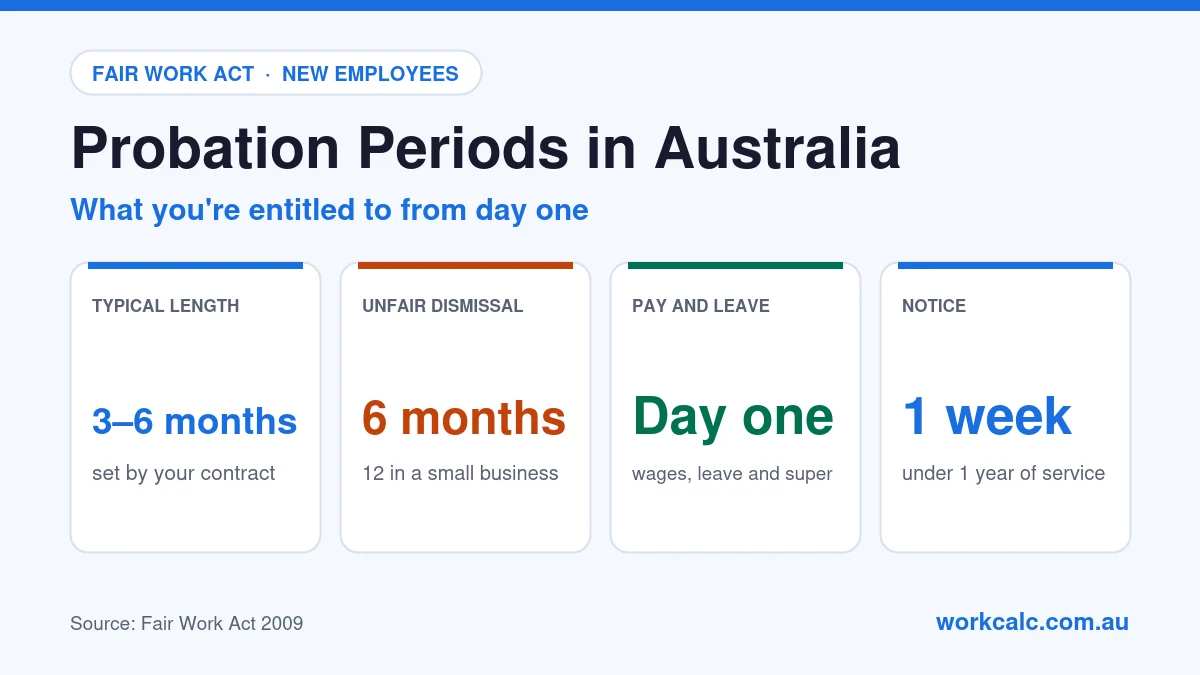
- Probation isn't in the Fair Work Act — it's a contractual arrangement, typically 3–6 months, set by your employer
- There's no such thing as unpaid probation — full wages, annual leave, personal leave, and super all accrue from day one
- Minimum notice still applies if you're let go during probation, based on your length of service
- Unfair dismissal protection depends on the "minimum employment period" — 6 months (employers with 15+ staff) or 12 months (small business) — not on your probation status
- General protections apply from day one, with no minimum service requirement — you can't be dismissed for a discriminatory reason even on your first shift
- Extending probation needs your contract or award to allow it, and doesn't change the legal minimum employment period
What a probation period actually is
A probation period is a trial phase at the start of employment — commonly three to six months — during which an employer assesses whether a new hire is suited to the role, and the employee gets a feel for whether the job and workplace are a good fit. It's a genuinely useful, widely used practice. What it isn't is a legal category with its own set of reduced rights.
The length is essentially up to your employer, set out in your employment contract or offer letter. Three months is common among larger employers; six months is common among smaller businesses. That pattern isn't a coincidence — it tends to track the "minimum employment period" explained below, even though the two are legally unrelated.
Is probation paid? What you're entitled to from day one
Yes — in full, from your very first shift. This is the single most misunderstood part of probation, and it's worth stating plainly: there is no such thing as unpaid probation under Australian law. While you're on probation, you continue to receive exactly the same entitlements under the National Employment Standards as any other employee, including:
- Your full award rate or agreed wage — not a reduced "training" or "trial" rate
- Accrual of annual leave, if you're full-time or part-time
- Accrual of personal and carer's leave
- Superannuation guarantee contributions on your ordinary earnings
- All other applicable NES entitlements, including public holidays and parental leave eligibility over time
Probation vs the minimum employment period — the distinction almost everyone gets wrong
This is where the real confusion lives. People often assume "I'm still on probation" means "I have no job security at all." What actually governs your access to unfair dismissal protection is a separate legal concept: the minimum employment period (MEP), defined in section 383 of the Fair Work Act 2009.
Until you reach the minimum employment period, you generally can't lodge an unfair dismissal claim with the Fair Work Commission. This is true whether or not your contract mentions probation at all — a business with no probation clause in its contracts still has the same MEP protection, and a business with a 12-month probation clause still can't override the legal MEP for a larger employer.
| Probation period | Minimum employment period | |
|---|---|---|
| Where it comes from | Your employment contract | Fair Work Act 2009, s.383 |
| Typical length | 3–6 months, employer's choice | Fixed: 6 months (15+ staff) or 12 months (small business) |
| Can it be changed by contract? | Yes | No |
| What it affects | Internal performance review process | Eligibility to bring an unfair dismissal claim |
| Do NES entitlements still apply? | Yes, in full | Yes, in full |
There's also a separate eligibility limit worth knowing: to bring an unfair dismissal claim, you generally need to earn below the high income threshold — $190,100 a year from 1 July 2026, indexed annually — unless you're covered by a modern award or enterprise agreement, in which case the threshold doesn't apply to you.
Related calculator Check exactly how much notice you're entitled to, based on your length of service →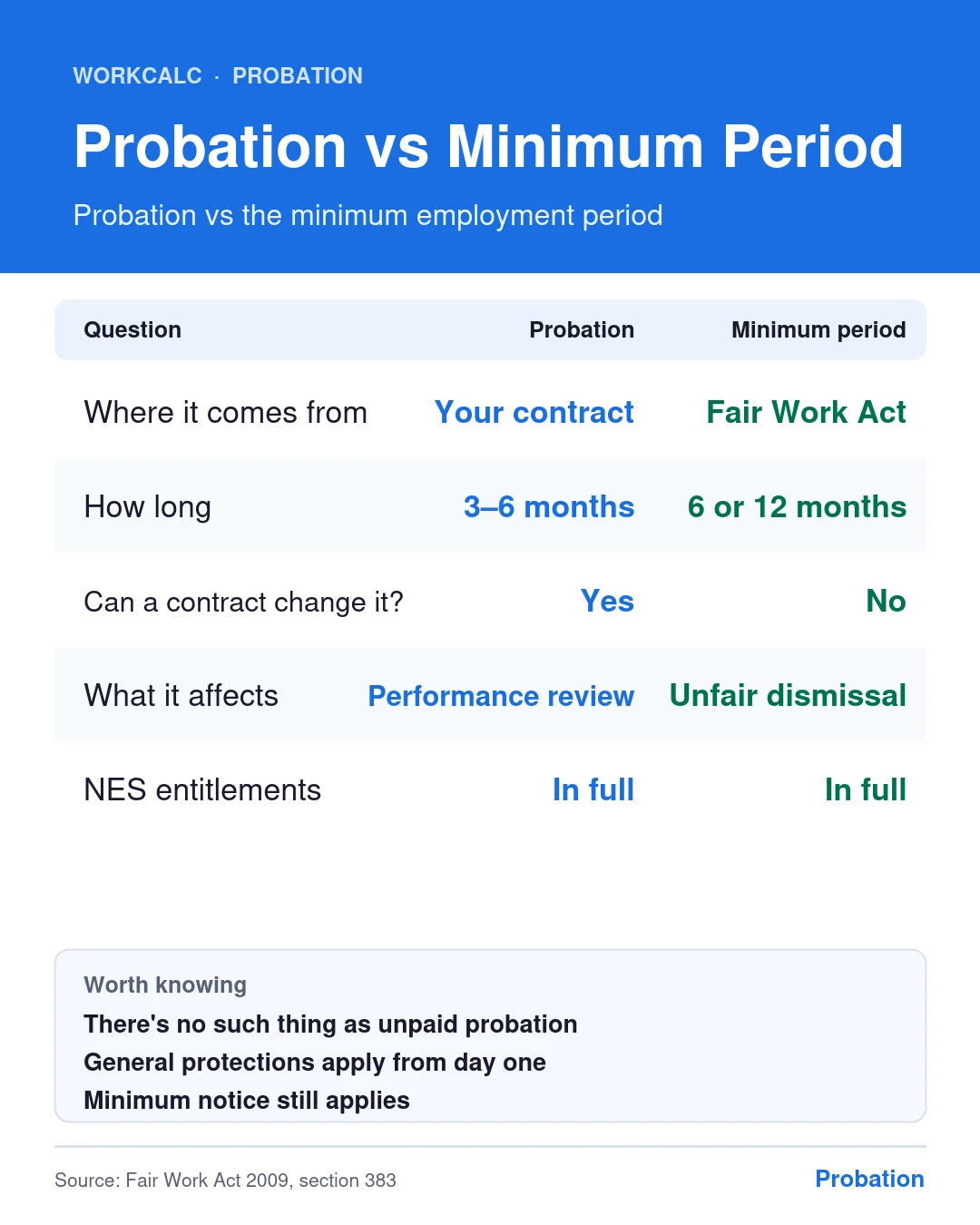
What happens if you don't pass probation?
If your employer decides during probation that the role isn't working out, you're still entitled to the same minimum protections that apply to any dismissal that falls short of the full unfair dismissal test:
The National Employment Standards set minimum notice periods based on your length of service (see the NES notice periods by years of service). Being on probation doesn't remove this — your employer must give you notice or pay you out instead.
Every hour of accrued but untaken annual leave must be paid out, exactly as it would be for any other termination.
Even without unfair dismissal rights, you can't lawfully be dismissed for a discriminatory reason or for exercising a workplace right — general protections apply regardless of your service length.
General protections apply from day one — with no minimum period at all
This is the part probation confusion tends to obscure. Unfair dismissal has a minimum employment period. General protections don't. You're protected against adverse action — dismissal, demotion, or other detriment — for reasons including your race, sex, age, disability, pregnancy, industrial activity, or for exercising a legitimate workplace right, from your very first day of employment, probation or not.
In practice, this means a dismissal that looks like a simple "didn't pass probation" decision can still be challenged if the real reason was actually discriminatory or retaliatory — the absence of unfair dismissal rights during probation doesn't create a blanket exemption from every other protection in the Fair Work Act.
Can I be sacked during probation without a reason?
In terms of unfair dismissal specifically — largely yes, because you generally haven't yet reached the minimum employment period that gives access to that claim. Your employer doesn't need to satisfy the Fair Work Commission's "harsh, unjust or unreasonable" test the way they would for a longer-serving employee.
But that's not the same as having no protection at all. You're still entitled to minimum notice (or payment in lieu), payout of accrued leave, and — critically — you cannot lawfully be dismissed for a discriminatory reason or for exercising a workplace right, no matter how early in your employment it happens.
If you think your dismissal during probation was actually about something like your pregnancy, a workplace complaint you made, or a protected characteristic, that's a general protections matter, not an unfair dismissal one — and it's worth getting advice quickly, since strict time limits apply. Fair Work's probation page is the right starting point.
Can your employer extend your probation period?
Only if your employment contract or applicable award allows it. An extension should be communicated to you in writing, ideally with clear reasons and performance feedback attached — not sprung on you verbally at the end of your original probation date.
One thing an extension doesn't do: change the legal minimum employment period. If your employer has 15 or more staff, your MEP is fixed at 6 months regardless of whether your contract says probation runs for 6, 9, or 12 months. A long probation clause can create the appearance of extended vulnerability, but the actual legal threshold for unfair dismissal access is set by the Fair Work Act, not by your contract.
Probation and casual employment
Formal probation periods are far less common — and less meaningful — for casual employees, since casual work doesn't come with the same ongoing employment relationship that probation is designed to review. If you're casual, the minimum employment period and general protections concepts above still apply in the same way, but annual leave accrual doesn't, since casuals receive a loading instead.
Disclaimer: This article explains the general rules around probation periods, the minimum employment period, and related entitlements under the Fair Work Act 2009. Specific modern awards, enterprise agreements, and employment contracts can vary some details. This is educational content, not legal advice — for guidance on your specific situation, consult the Fair Work Ombudsman, the Fair Work Commission, or a qualified workplace relations professional. WorkCalc Australia is independent and not affiliated with Fair Work or the ATO.
Frequently asked questions about probation periods in Australia
Plain-English answers on pay, notice, extensions, and how probation differs from the minimum employment period.
What is a probation period in Australia?
A probation period is a trial phase at the start of employment, typically 3 to 6 months, where an employer assesses whether a new hire is suited to the role. It's a contractual arrangement set by the employer, not a term defined or required by the Fair Work Act 2009. Full National Employment Standards entitlements still apply throughout.
Is probation paid in Australia?
Yes, in full. There is no such thing as unpaid probation under Australian law. You're entitled to your full award or agreed wage from your very first shift, and you accrue annual leave, personal/carer's leave, and superannuation exactly as you would after probation ends.
What is the minimum employment period for unfair dismissal?
Six months if your employer has 15 or more employees, or 12 months if your employer is a small business with fewer than 15 employees. This is set by section 383 of the Fair Work Act 2009 and can't be shortened or extended by your employment contract — it's a completely separate concept from your probation period, even though the two are often confused.
How much notice do I get if I'm let go during probation?
You're still entitled to minimum notice under the National Employment Standards, or payment in lieu of notice, based on your length of service. Being on probation doesn't remove this entitlement — it only affects whether you can bring an unfair dismissal claim, which is a different legal protection.
Can my employer extend my probation period?
Only if your employment contract or applicable award allows it, and the extension should be communicated to you in writing with clear reasons. Extending probation doesn't change the legal minimum employment period for unfair dismissal, which is fixed by the Fair Work Act regardless of what your contract says.
Can I be dismissed during probation without a reason?
You generally can't bring an unfair dismissal claim before reaching the minimum employment period, so a dismissal during probation doesn't need to meet the usual "harsh, unjust or unreasonable" test. However, general protections against discrimination and adverse action for exercising a workplace right apply from your very first day, with no minimum service requirement at all.
Do I accrue annual leave and sick leave during probation?
Yes. Full-time and part-time employees accrue annual leave and personal/carer's leave from their first day of employment, probation included. If your employment ends during probation, any accrued but untaken annual leave must still be paid out.
What's the difference between probation and the minimum employment period?
Probation is a contractual trial period your employer sets, commonly 3 to 6 months, used for performance review. The minimum employment period is a legal threshold — 6 or 12 months depending on employer size — that determines whether you can bring an unfair dismissal claim at all. The two often overlap in length by coincidence, but they're governed by completely different rules and one doesn't affect the other.