
ATO Tax Tables 2026–27: How Much Tax Comes Out of Your Pay
How much tax your employer takes out of your weekly, fortnightly or monthly pay from 1 July 2026. Figures are shown with and without the tax-free threshold, with the extra amount for HECS/HELP, and with your take-home pay.
Each time you're paid, your employer withholds tax using the ATO's tax tables and sends it to the ATO for you. The tables changed on 1 July 2026, when the tax rate on income between $18,201 and $45,000 fell from 16% to 15%. This guide shows the amount withheld on common weekly, fortnightly and monthly pay, and explains what changes it.
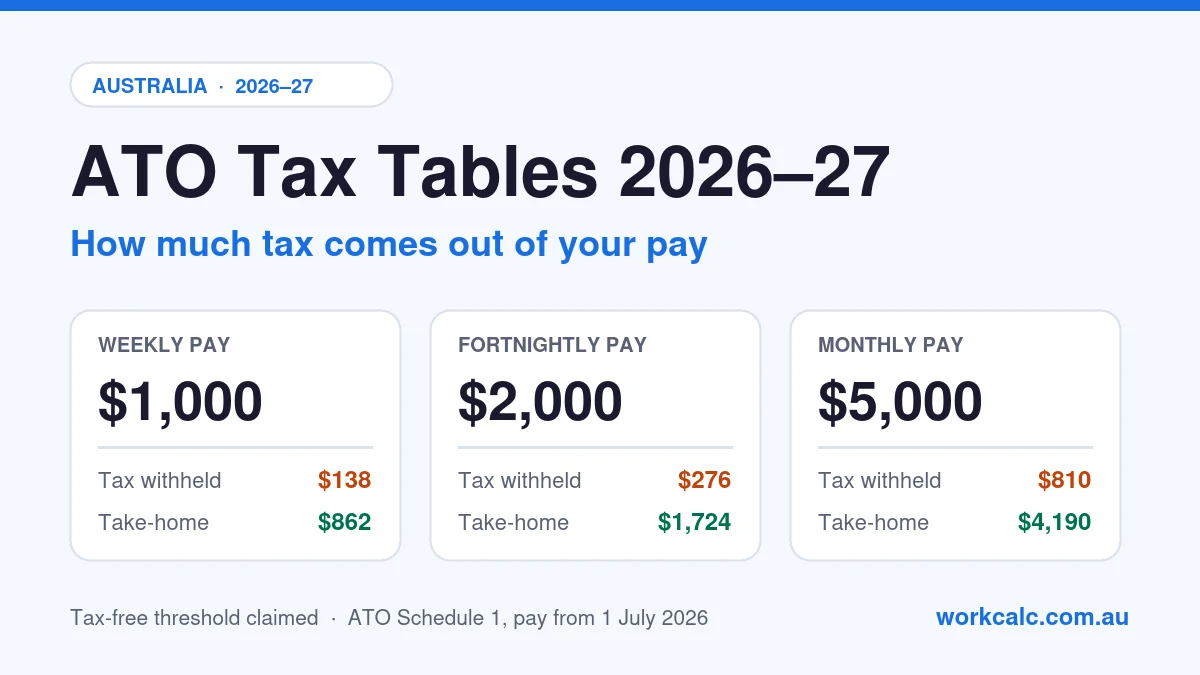
Quick answers (2026–27, tax-free threshold claimed)
- $1,000 a week: $138 tax withheld, $862 take-home
- $2,000 a fortnight: $276 tax withheld, $1,724 take-home
- $5,000 a month: $810 tax withheld, $4,190 take-home
- No tax-free threshold (for example, a second job): more is withheld. On $2,000 a fortnight it's $498.
- HECS/HELP debt: extra is withheld once you earn more than about $1,337 a week ($2,674 a fortnight). See your yearly repayment with the HECS repayment calculator.
- Medicare levy is already included in the amounts withheld
For an exact amount on any pay, including cents, use our PAYG withholding calculator. For your full take-home pay with super, use the pay calculator.
Fortnightly tax table 2026–27
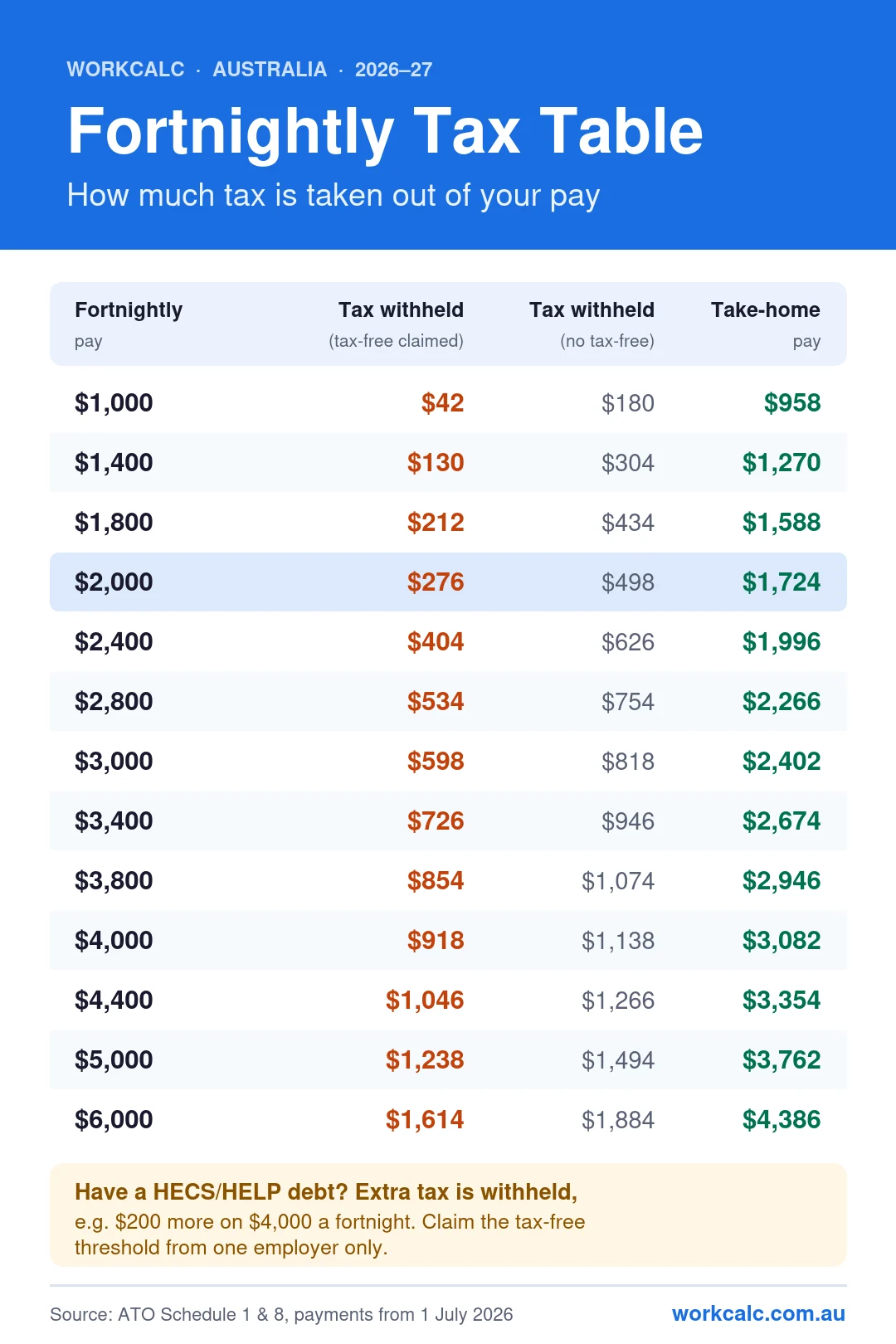
Most Australians are paid fortnightly. This table shows the tax withheld from fortnightly pay from 1 July 2026. “Take-home” is your pay after tax when you claim the tax-free threshold and have no HECS/HELP debt.
| Fortnightly pay | Tax withheld (tax-free threshold claimed) | Tax withheld (no tax-free threshold) | Extra for HECS/HELP | Take-home pay |
|---|---|---|---|---|
| $800 | $12 | $144 | $0 | $788 |
| $1,000 | $42 | $180 | $0 | $958 |
| $1,200 | $84 | $240 | $0 | $1,116 |
| $1,400 | $130 | $304 | $0 | $1,270 |
| $1,600 | $166 | $368 | $0 | $1,434 |
| $1,800 | $212 | $434 | $0 | $1,588 |
| $2,000 | $276 | $498 | $0 | $1,724 |
| $2,200 | $340 | $562 | $0 | $1,860 |
| $2,400 | $404 | $626 | $0 | $1,996 |
| $2,600 | $470 | $690 | $0 | $2,130 |
| $2,800 | $534 | $754 | $20 | $2,266 |
| $3,000 | $598 | $818 | $50 | $2,402 |
| $3,200 | $662 | $882 | $80 | $2,538 |
| $3,400 | $726 | $946 | $110 | $2,674 |
| $3,600 | $790 | $1,010 | $140 | $2,810 |
| $3,800 | $854 | $1,074 | $170 | $2,946 |
| $4,000 | $918 | $1,138 | $200 | $3,082 |
| $4,200 | $982 | $1,202 | $230 | $3,218 |
| $4,400 | $1,046 | $1,266 | $260 | $3,354 |
| $4,600 | $1,110 | $1,338 | $290 | $3,490 |
| $4,800 | $1,174 | $1,416 | $320 | $3,626 |
| $5,000 | $1,238 | $1,494 | $350 | $3,762 |
| $5,200 | $1,302 | $1,572 | $384 | $3,898 |
| $5,400 | $1,380 | $1,650 | $418 | $4,020 |
| $5,600 | $1,458 | $1,728 | $452 | $4,142 |
| $5,800 | $1,536 | $1,806 | $486 | $4,264 |
| $6,000 | $1,614 | $1,884 | $520 | $4,386 |
Weekly tax table 2026–27
Tax withheld from weekly pay from 1 July 2026. If you claim the tax-free threshold, nothing is withheld on weekly pay up to $361.
| Weekly pay | Tax withheld (tax-free threshold claimed) | Tax withheld (no tax-free threshold) | Extra for HECS/HELP | Take-home pay |
|---|---|---|---|---|
| $400 | $6 | $72 | $0 | $394 |
| $500 | $21 | $90 | $0 | $479 |
| $600 | $42 | $120 | $0 | $558 |
| $700 | $65 | $152 | $0 | $635 |
| $800 | $83 | $184 | $0 | $717 |
| $900 | $106 | $217 | $0 | $794 |
| $1,000 | $138 | $249 | $0 | $862 |
| $1,100 | $170 | $281 | $0 | $930 |
| $1,200 | $202 | $313 | $0 | $998 |
| $1,300 | $235 | $345 | $0 | $1,065 |
| $1,400 | $267 | $377 | $10 | $1,133 |
| $1,500 | $299 | $409 | $25 | $1,201 |
| $1,600 | $331 | $441 | $40 | $1,269 |
| $1,700 | $363 | $473 | $55 | $1,337 |
| $1,800 | $395 | $505 | $70 | $1,405 |
| $1,900 | $427 | $537 | $85 | $1,473 |
| $2,000 | $459 | $569 | $100 | $1,541 |
| $2,100 | $491 | $601 | $115 | $1,609 |
| $2,200 | $523 | $633 | $130 | $1,677 |
| $2,300 | $555 | $669 | $145 | $1,745 |
| $2,400 | $587 | $708 | $160 | $1,813 |
| $2,500 | $619 | $747 | $175 | $1,881 |
| $2,600 | $651 | $786 | $192 | $1,949 |
| $2,700 | $690 | $825 | $209 | $2,010 |
| $2,800 | $729 | $864 | $226 | $2,071 |
| $2,900 | $768 | $903 | $243 | $2,132 |
| $3,000 | $807 | $942 | $260 | $2,193 |
Monthly tax table 2026–27
Tax withheld from monthly pay from 1 July 2026. The ATO works out monthly withholding by converting your pay to a weekly amount, which is why the monthly figures aren't simply the weekly ones multiplied by four.
| Monthly pay | Tax withheld (tax-free threshold claimed) | Tax withheld (no tax-free threshold) | Extra for HECS/HELP | Take-home pay |
|---|---|---|---|---|
| $2,000 | $65 | $360 | $0 | $1,935 |
| $2,500 | $156 | $485 | $0 | $2,344 |
| $3,000 | $273 | $646 | $0 | $2,727 |
| $3,500 | $364 | $810 | $0 | $3,136 |
| $4,000 | $490 | $971 | $0 | $3,510 |
| $4,500 | $650 | $1,131 | $0 | $3,850 |
| $5,000 | $810 | $1,291 | $0 | $4,190 |
| $5,500 | $975 | $1,452 | $0 | $4,525 |
| $6,000 | $1,131 | $1,612 | $30 | $4,869 |
| $6,500 | $1,296 | $1,772 | $108 | $5,204 |
| $7,000 | $1,452 | $1,928 | $182 | $5,548 |
| $7,500 | $1,612 | $2,089 | $256 | $5,888 |
| $8,000 | $1,772 | $2,249 | $329 | $6,228 |
| $8,500 | $1,933 | $2,409 | $407 | $6,567 |
| $9,000 | $2,093 | $2,570 | $481 | $6,907 |
| $9,500 | $2,253 | $2,730 | $555 | $7,247 |
| $10,000 | $2,414 | $2,908 | $633 | $7,586 |
| $10,500 | $2,574 | $3,103 | $706 | $7,926 |
| $11,000 | $2,734 | $3,298 | $784 | $8,266 |
| $11,500 | $2,912 | $3,493 | $871 | $8,588 |
| $12,000 | $3,107 | $3,688 | $953 | $8,893 |
| $12,500 | $3,302 | $3,883 | $1,040 | $9,198 |
| $13,000 | $3,497 | $4,082 | $1,127 | $9,503 |
All figures are for Australian residents, from the ATO's Schedule 1 (tax) and Schedule 8 (HECS/HELP) withholding formulas for payments made on or after 1 July 2026. The HELP column assumes you claim the tax-free threshold. Pay is before tax and doesn't include super, which your employer pays on top.
How to read the ATO tax tables
To find your figure, you need three things:
- Your gross pay for the period. This is your pay before tax, including overtime and allowances, less any salary sacrifice.
- Whether you've claimed the tax-free threshold. You make this choice on the Tax file number declaration you give your employer. Claiming it means the first $18,200 of your yearly income is treated as tax-free, so much less is withheld.
- Whether you have a study or training loan such as HECS/HELP, VSL or an apprenticeship loan. If you do, extra is withheld under Schedule 8 once your pay passes the repayment threshold.
Employers use the exact formulas behind these tables, so your payslip can differ from our table by a dollar or two if your pay isn't a round number. The tables above don't cover working holiday makers, foreign residents, seniors and pensioners, or anyone who has asked for a tax offset or variation to be applied to their pay.
Why the tax withheld isn't the tax you actually owe
Withholding is an estimate. The formulas assume you earn the same amount every pay for the whole year. They include the 2% Medicare levy and spread the low income tax offset across your pays. Your real tax is only worked out when you lodge your tax return.
For example, on a steady $2,000 a fortnight ($52,000 a year), $276 × 26 = $7,176 is withheld over the year. The actual tax and Medicare levy on $52,000 in 2026–27 is $6,940, so you'd get about $236 back at tax time, before any deductions. On $4,000 a fortnight, $23,868 is withheld against $23,800 of actual tax, so the difference is much smaller.
You're likely to end up with a tax bill instead of a refund if:
- you claimed the tax-free threshold from two employers and earn more than $18,200 in total
- you have income with no tax withheld, such as interest, rent or ABN work
- you should be paying the Medicare levy surcharge, because the tables don't include it
To see which tax bracket you're in and your actual tax for the year, use the tax bracket calculator.
Extra withholding for HECS/HELP debts
If you tell your employer you have a study or training loan, they withhold an extra amount using Schedule 8. For 2026–27, repayments are marginal: nothing is withheld until your pay is above about $1,337 a week ($2,674 a fortnight), which matches the $69,528 yearly repayment threshold. After that, 15c is withheld for each dollar above the threshold, rising to 17c at higher incomes. Above $186,050 a year, 10% of your whole income is withheld.
What changed in the tax tables on 1 July 2026
- Lower rate on the second bracket. The rate on income from $18,201 to $45,000 fell from 16% to 15%. Anyone earning over $45,000 now has about $5 a week, or $10 a fortnight, less withheld than in 2025–26.
- Higher HECS/HELP thresholds. The minimum repayment income went up to $69,528, so less is withheld for many people with a study loan.
- The same brackets above $45,000. The 30%, 37% and 45% rates and their thresholds didn't change. See the 2026–27 tax brackets for the full rates.
If your pay didn't change on 1 July, but your take-home pay went up by around $10 a fortnight, your employer has correctly switched to the new tables.
How to check your payslip is right
- Find your gross pay for the period on your payslip.
- Look up the nearest row in the table above, or enter your exact pay in the PAYG withholding calculator.
- Compare it with the “tax” or “PAYG” line on your payslip. If the difference is more than a few dollars, check which tax-free threshold and HECS/HELP choices your employer has on file.
- Check the year to date totals with the YTD calculator to make sure nothing was missed earlier in the year.
Embed this infographic on your site
You're welcome to share the fortnightly tax table infographic, as long as you include the link back to this page.
Sources: ATO Schedule 1 (Statement of formulas for calculating amounts to be withheld) and Schedule 8 (study and training support loans), both for payments made on or after 1 July 2026, and the ATO's resident tax rates. The figures were calculated with the ATO formulas, which WorkCalc checks against the ATO's own worked examples. They were last checked on 19 September 2026. This is general information, not tax advice. WorkCalc Australia is independent and not affiliated with the ATO.
Tax tables FAQs
Quick answers using the 2026–27 ATO withholding formulas for Australian residents.
How much tax is taken out of $2,000 a fortnight?
$276 if you claim the tax-free threshold, leaving $1,724 take-home pay. If you don't claim the tax-free threshold, $498 is withheld. These are the 2026–27 amounts for Australian residents with no HECS/HELP debt.
How much tax is taken out of $1,000 a week?
$138 a week if you claim the tax-free threshold, so you take home $862. Without the tax-free threshold, $249 is withheld.
How much tax is taken out of $5,000 a month?
$810 a month if you claim the tax-free threshold, leaving $4,190. Without the tax-free threshold, $1,291 is withheld. If you have a HECS/HELP debt, nothing extra is withheld at this amount, because it's below the repayment threshold.
Do the ATO tax tables include the Medicare levy?
Yes. The amounts withheld under Schedule 1 include the 2% Medicare levy. They don't include the Medicare levy surcharge or HECS/HELP repayments. HECS/HELP is withheld separately under Schedule 8.
Why is more tax withheld than I actually owe?
Withholding is an estimate made each pay. On $2,000 a fortnight, $7,176 is withheld over a full year, but the actual tax and Medicare levy on $52,000 is $6,940. The difference of about $236 comes back as a refund when you lodge your tax return.
Should I claim the tax-free threshold on a second job?
Usually not. Claim it from the employer that pays you the most. You can claim it from more than one employer only if your total income for the year will be less than $18,200. Otherwise too little tax is withheld and you'll get a tax bill.
Where can I find the official ATO tax tables?
On the ATO website under tax tables. The ATO publishes weekly, fortnightly and monthly tax tables and the Schedule 1 formulas employers use. WorkCalc's PAYG withholding calculator uses the same formulas to give you the exact amount on any pay.