
Workers Compensation Calculator Australia
Work out your weekly workers compensation payments if you can't work because of a work injury. Payments are a percentage of your earnings before the injury. The percentage steps down over time, and each state and territory sets its own rates and caps.
Workers compensation calculator
Choose your state, enter your average weekly earnings before the injury, and how many weeks you've been off work. The calculator shows your weekly payment now and how it changes over the life of the claim.
How your payments change over time
| Period | Weekly payment |
|---|
Workers compensation weekly payments by state
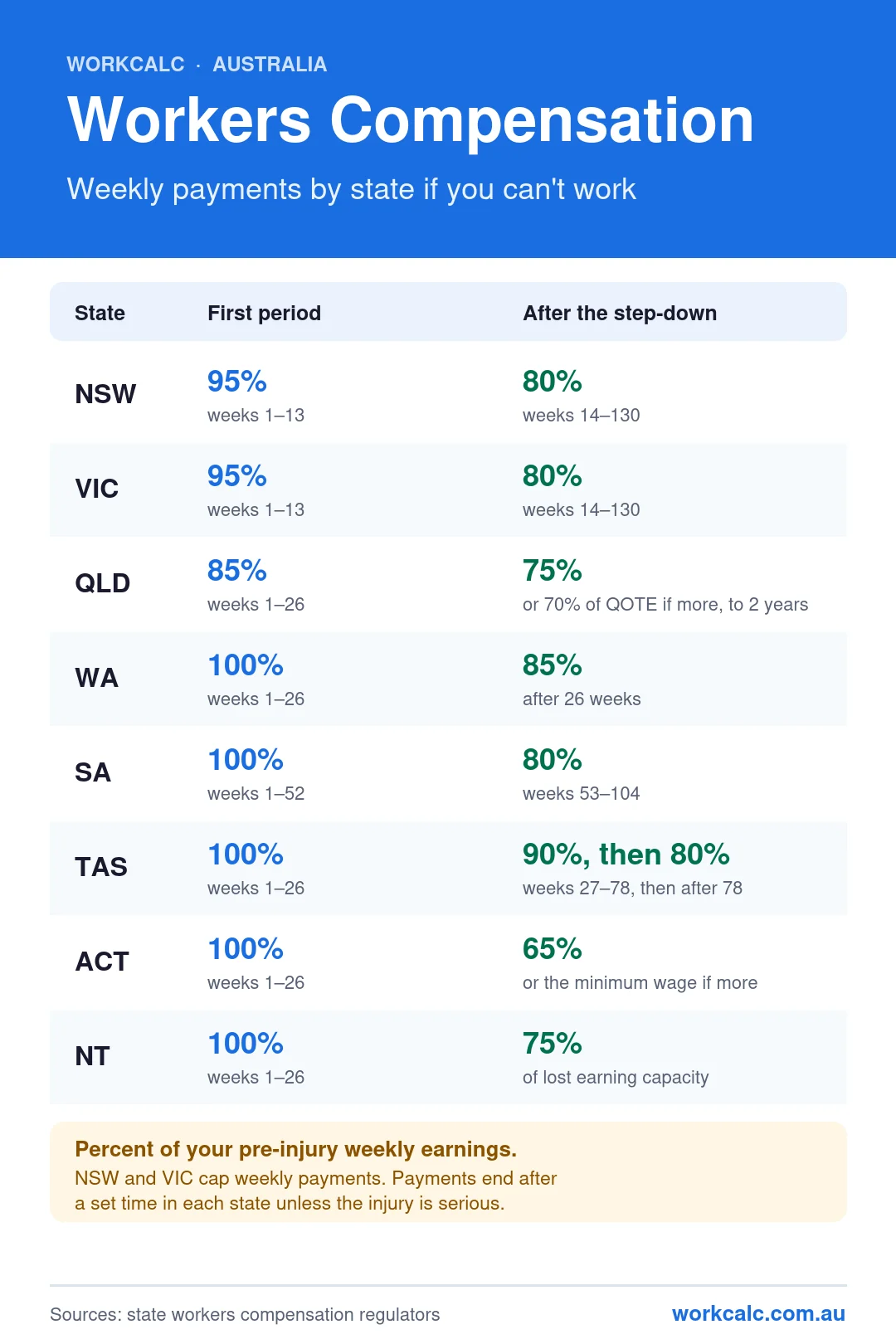
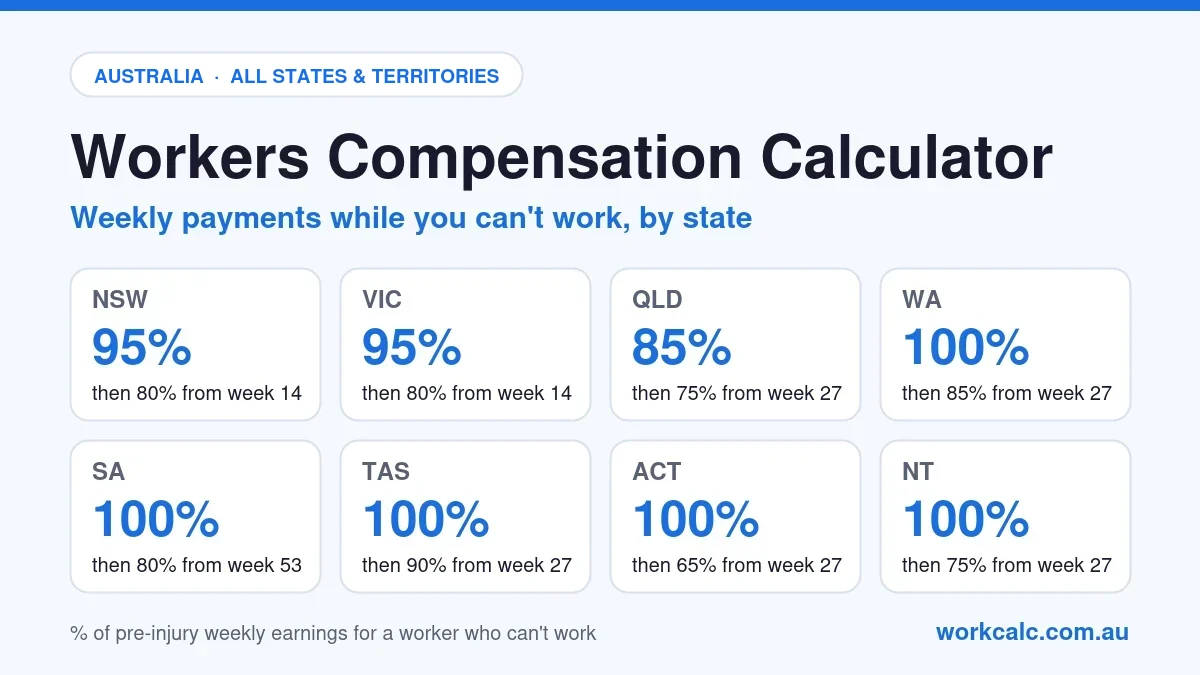
| State | First period | After the step-down |
|---|---|---|
| NSW | 95% of pre-injury earnings, weeks 1–13 | 80%, weeks 14–130 (max $2,662.10 a week) |
| VIC | 95% of pre-injury earnings, weeks 1–13 | 80%, weeks 14–130 (max $3,000 a week) |
| QLD | 85% of normal weekly earnings (or award rate if higher), weeks 1–26 | 75% of earnings or 70% of QOTE, whichever is more, to 2 years |
| WA | 100% of pre-injury earnings, weeks 1–26 | 85% after 26 weeks |
| SA | 100% of average weekly earnings, weeks 1–52 | 80%, weeks 53–104 |
| TAS | 100% of normal weekly earnings, weeks 1–26 | 90% to week 78, then 80% |
| ACT | 100% of pre-incapacity earnings, weeks 1–26 | 65% or the national minimum wage, whichever is more |
| NT | 100% of normal weekly earnings, weeks 1–26 | 75% of your lost earning capacity |
Rates for workers who can't work at all (total incapacity) under each state's main scheme. Commonwealth (Comcare) employees and some other groups have different rules.
How is workers compensation calculated?
Weekly workers compensation replaces part of the income you lose while you can't work. Every state uses the same basic steps:
- Work out your pre-injury earnings. This is usually your average gross weekly pay over the 52 weeks before the injury, or over the time you worked there if that's shorter. NSW and Victoria call it PIAWE (pre-injury average weekly earnings). Queensland, Tasmania and the NT use “normal weekly earnings”, and SA uses “average weekly earnings”.
- Apply your state's percentage. You get between 85% and 100% of those earnings at first, depending on the state.
- Apply any cap. NSW and Victoria cap weekly payments, at $2,662.10 and $3,000 a week. Other states have caps or lifetime limits of their own.
- Step down over time. After 13, 26 or 52 weeks, depending on the state, the percentage drops. Payments usually stop after a set time unless your injury is serious.
Example: in NSW, a worker earning $1,500 a week before the injury gets 95% for the first 13 weeks, which is $1,425 a week. From week 14 it's 80%, or $1,200 a week. Tax is withheld from both amounts, just like wages.
Workers compensation rules in each state
NSW workers compensation
If you can't work, you get 95% of your PIAWE for the first 13 weeks and 80% from week 14 to week 130, capped at the maximum weekly compensation amount of $2,662.10 (1 April 2026 to 31 March 2027). If you're back at work for at least 15 hours a week after week 13, you stay on the 95% rate, less what you earn. After 130 weeks, payments continue only in limited cases. After 260 weeks they generally stop, unless your whole person impairment is more than 20%. Overtime and shift allowances count in your PIAWE for the first 52 weeks only. Under reforms that began on 1 July 2026, new psychological injury claims have different rules, including a 130-week limit on weekly payments.
Victoria WorkCover
You get 95% of your PIAWE for the first 13 weeks and 80% from week 14 to week 130, up to the statutory maximum of $3,000 a week (from 1 July 2026). Overtime and shift allowances drop out of your PIAWE after 52 weeks. After 130 weeks, payments continue only if you have no capacity for work that's likely to continue indefinitely and a whole person impairment of 21% or more.
Queensland WorkCover
For the first 26 weeks, you get 85% of your normal weekly earnings. If you're covered by an award or agreement, you get the amount payable under it instead, if that's higher. If you're not covered, you get 80% of QOTE instead if that's higher, but never more than your normal weekly earnings. From 26 weeks to 2 years, you get 75% of normal weekly earnings or 70% of QOTE ($1,396.15 a week), whichever is more, but no more than your first-period rate. QOTE (Queensland ordinary time earnings) is $1,994.50 a week from 1 July 2026. From 2 to 5 years, the same rate applies only if your injury could result in a permanent impairment of more than 15%. Otherwise you get the single pension rate. Your employer pays the first week as its excess.
WA workers compensation
Under the Workers Compensation and Injury Management Act 2023, you get 100% of your pre-injury weekly earnings for the first 26 weeks, then 85%. A safety net stops the step-down taking you below your base award rate, or below the Minimum Conditions of Employment Act amount if you're not covered by an award. There's also a limit on the total income compensation you can receive over the claim.
SA return to work payments
ReturnToWorkSA pays 100% of your average weekly earnings for up to 52 weeks, then 80% for up to another 52 weeks. Income support usually ends after 104 weeks, unless you're assessed as seriously injured. If you're seriously injured, payments can continue until retirement age.
Tasmania workers compensation
You get 100% of your normal weekly earnings for the first 26 weeks, 90% from 26 to 78 weeks, and 80% after 78 weeks. If you can do some work but your employer doesn't provide suitable duties, the step-downs are 95% and 85% instead. The step-downs don't apply if you're back at work for at least half your normal hours. If your impairment is less than 15%, weekly payments can be made for up to 9 years.
ACT workers compensation
You get 100% of your average pre-incapacity weekly earnings for the first 26 weeks. After that, you get 65% of those earnings, or the statutory floor if that's more. The statutory floor is the national minimum wage, which is $1,004.90 a week from 1 July 2026. If your earnings before the injury were below the floor, you keep getting 100% of them.
NT workers compensation
You get your normal weekly earnings for the first 26 weeks, then 75% of your loss of earning capacity. For most people, weekly payments stop after 260 weeks (5 years). They can continue if your permanent impairment is 15% or more. Maximum and minimum amounts apply, linked to average weekly earnings.
Working reduced hours (partial incapacity)
If you're back at work on light duties or fewer hours, your weekly compensation tops up your pay instead of replacing it. In NSW and Victoria, for the first 13 weeks you get 95% of your PIAWE minus what you earn. From week 14 in Victoria, you get 80% of your PIAWE minus 80% of what you earn. In NSW, if you work 15 hours or more a week, you keep the 95% rate, less your earnings. Other states use similar top-up formulas. Your insurer works out the exact amount from your certificate of capacity and your payslips.
Workers compensation payouts and lump sums
Weekly payments aren't the only compensation you can get. Depending on your state, you may also be entitled to:
- A lump sum for permanent impairment, based on your whole person impairment percentage once your injury has stabilised
- A commutation or redemption, which settles future weekly payments as one payment in some states
- Common law damages if your employer's negligence caused the injury. Most states only allow this for more serious injuries.
- Medical and treatment costs, paid on top of weekly payments
Lump sums depend on a medical assessment and your state's tables, so they can't be worked out from your pay. Talk to your insurer, your state regulator or a lawyer before accepting any settlement.
Is workers compensation taxed?
Yes. Weekly workers compensation payments are taxed as income, and tax is withheld in the same way as wages. Use the PAYG withholding calculator to estimate the tax on your weekly payment, or the pay calculator for your take-home pay. Lump sums for permanent impairment are generally treated differently to weekly payments, so check with the ATO or a tax agent. Whether you keep getting super while on workers compensation depends on your state and your award. In Victoria, for example, super contributions start after 52 weeks of weekly payments if you meet the criteria.
Workers compensation FAQs
How is workers compensation calculated in Australia?
Your weekly payment is a percentage of your average weekly earnings before the injury, usually over the previous 52 weeks. You get 85% to 100% at first, depending on your state. The percentage steps down after 13, 26 or 52 weeks, and NSW and Victoria cap the weekly amount.
How much is workers compensation in NSW?
95% of your pre-injury average weekly earnings for the first 13 weeks, then 80% from week 14 to week 130. Payments are capped at the maximum weekly compensation amount of $2,662.10 from 1 April 2026 to 31 March 2027.
How much does WorkCover pay in Victoria?
95% of your pre-injury average weekly earnings for the first 13 weeks, then 80% until 130 weeks, up to a statutory maximum of $3,000 a week from 1 July 2026. After 130 weeks, payments only continue if you meet strict criteria.
Does workers compensation pay 100% of your wage?
In WA, SA, Tasmania, the ACT and the NT, you get 100% of your pre-injury earnings for the first period (26 weeks, or 52 weeks in SA). NSW and Victoria pay 95%, and Queensland pays 85% of normal weekly earnings, or your award rate if that's higher.
How long can you be on workers compensation?
It depends on the state and how serious your injury is. Weekly payments usually end after 130 weeks in NSW and Victoria, 104 weeks in SA, 5 years in Queensland and the NT, and up to 9 years in Tasmania for impairments under 15%. Workers with serious injuries can be paid for longer.
Does workers compensation include overtime?
In NSW and Victoria, regular overtime and shift allowances are included in your pre-injury earnings for the first 52 weeks of payments only. In other states, regular overtime can be included if it was part of your normal pattern of work.
Is workers compensation taxed?
Yes. Weekly workers compensation payments are taxable income, and tax is withheld the same way as from wages. Lump sums for permanent impairment are generally treated differently, so check your situation with the ATO or a tax agent.
Can I get a workers compensation lump sum payout?
Possibly. Most states pay a lump sum for permanent impairment based on a medical assessment, and some allow weekly payments to be settled as a single payment. Serious injuries caused by negligence may also allow a common law claim. These amounts can't be calculated from your pay alone.