
Work Hours Calculator
Add your start and finish times for the week, take off unpaid breaks, and get your daily and weekly hours in both hours and minutes and decimal hours. Enter your hourly rate and it works out your pay for the week too.
Weekly timesheet calculator
Leave a day blank if you didn't work it. Finish times after midnight are handled automatically.
| Day | Worked | Decimal |
|---|
Unpaid breaks are taken off. Hours over 38 in a week may attract overtime or penalty rates, depending on your award or agreement.
How to calculate work hours
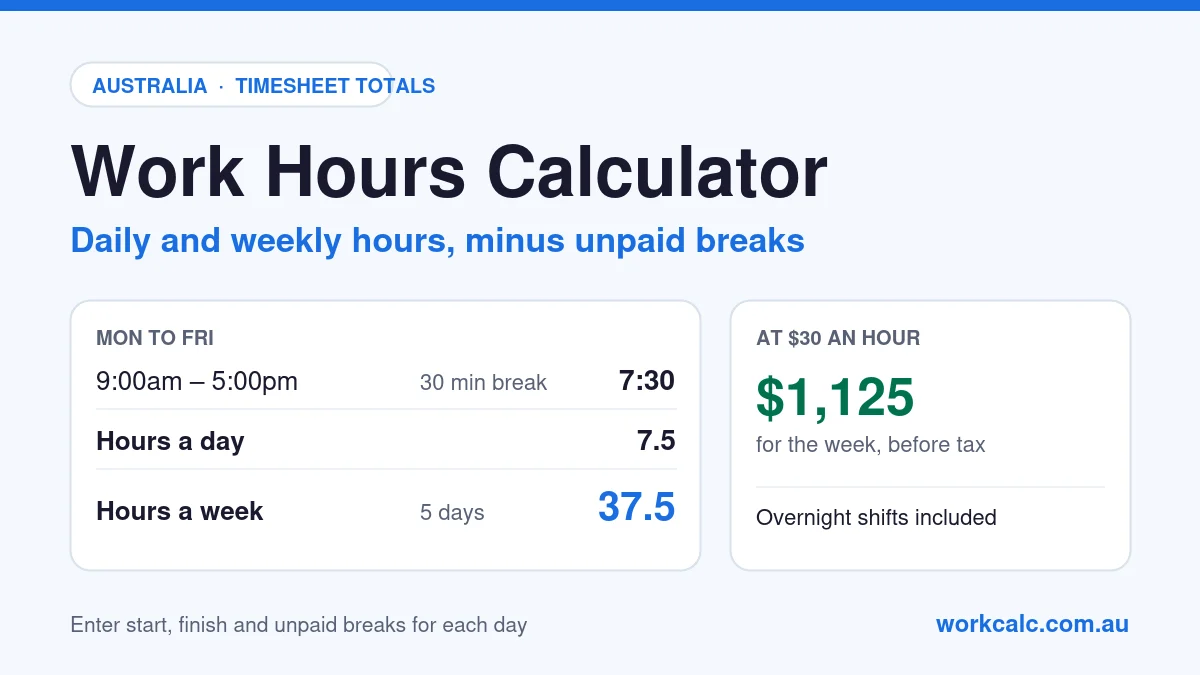
- Work out each day. Take your finish time away from your start time, then subtract any unpaid break. For example, 9:00am to 5:00pm is 8 hours, less a 30 minute meal break, so 7 hours 30 minutes.
- Convert minutes to decimals. Payroll systems use decimal hours, so divide the minutes by 60. 7 hours 30 minutes is 7.5 hours, because 30 ÷ 60 = 0.5.
- Add up the week. Five days of 7.5 hours is 37.5 hours.
- Multiply by your hourly rate. At $30 an hour, 37.5 hours is $1,125 for the week before tax.
Overnight shifts: when your finish time is earlier than your start time, the shift has run past midnight. A shift from 10:00pm to 6:00am is 8 hours. The calculator above handles this for you.
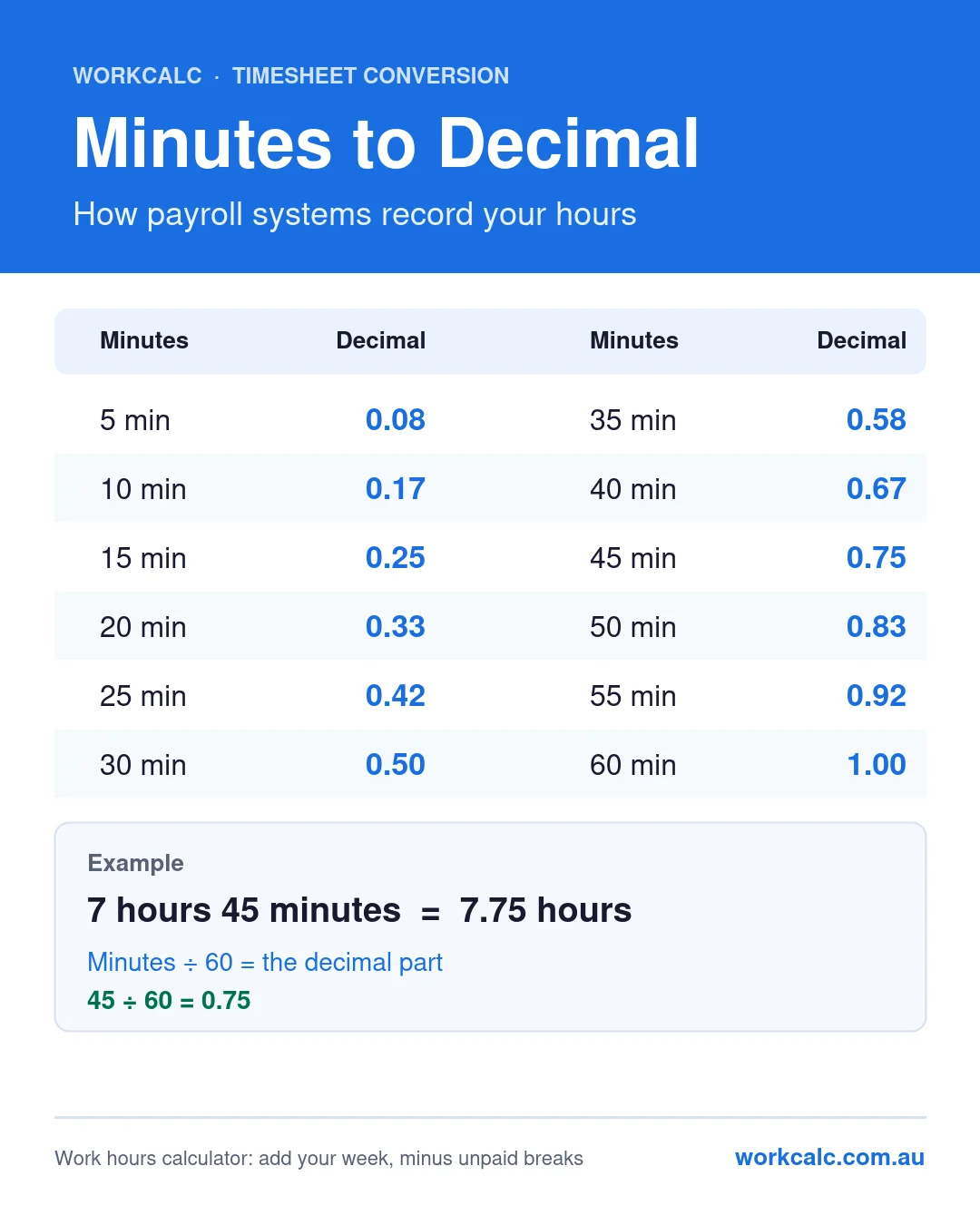
Minutes to decimal hours chart
Payroll and timesheet systems record time in decimals, not minutes. Use this chart to convert.
| Minutes | Decimal | Minutes | Decimal |
|---|---|---|---|
| 5 minutes | 0.08 | 35 minutes | 0.58 |
| 10 minutes | 0.17 | 40 minutes | 0.67 |
| 15 minutes | 0.25 | 45 minutes | 0.75 |
| 20 minutes | 0.33 | 50 minutes | 0.83 |
| 25 minutes | 0.42 | 55 minutes | 0.92 |
| 30 minutes | 0.50 | 60 minutes | 1.00 |
Rounded to two decimals. For example, 7 hours 20 minutes is 7.33 hours, and 7 hours 45 minutes is 7.75 hours.
Ordinary hours and the 38-hour week
Under the National Employment Standards, a full-time employee's maximum ordinary hours are 38 a week, plus reasonable additional hours. Part-time employees work fewer, agreed hours. Your award, enterprise agreement or contract sets when ordinary hours can be worked, and when overtime or penalty rates start.
Hours above 38 aren't automatically overtime. Some awards average ordinary hours over a roster cycle, and some employees have annualised salaries that already cover a set amount of overtime. Check your award to see which rate applies, then use the overtime calculator for time and a half and double time.
Which breaks are unpaid?
Meal breaks are usually unpaid, and shorter rest breaks (often called tea breaks or crib breaks) are usually paid. The length of each break, and when you're entitled to one, is set by your award or agreement rather than the National Employment Standards. Most awards give an unpaid meal break of at least 30 minutes after around five or six hours of work.
Only take unpaid breaks off your timesheet. If you work through a meal break because you're asked to, that time is usually paid, and some awards pay a penalty for it. Check your award on the Fair Work Ombudsman website if you're not sure.
Keeping an accurate timesheet
- Record start, finish and breaks each day, not at the end of the week. Your memory of a Monday is worse by Friday.
- Include time before and after your shift that you're required to work, such as opening up, cashing up or handovers.
- Watch rounding. Employers can round time, but rounding should be applied evenly, not always in the employer's favour. Over a year, 10 minutes a day is more than 40 hours of work.
- Keep your own copy. Employers must keep time and pay records for 7 years, but your own record is what helps if there's a dispute.
- Check your payslip against your hours each pay. Use the YTD calculator to check year-to-date totals.
Work hours FAQs
How do I calculate my hours worked in a week?
Work out each day by taking the start time from the finish time and subtracting unpaid breaks, then add the days together. Five days of 9:00am to 5:00pm with a 30 minute break is 7.5 hours a day, or 37.5 hours a week.
How do I convert minutes into decimal hours?
Divide the minutes by 60. So 15 minutes is 0.25, 30 minutes is 0.5 and 45 minutes is 0.75. That makes 7 hours 45 minutes equal to 7.75 hours.
How do I calculate hours for an overnight shift?
When the finish time is earlier than the start time, add 24 hours to the finish time before subtracting. A 10:00pm to 6:00am shift is 8 hours. The calculator on this page does it automatically.
Are meal breaks counted as hours worked?
Unpaid meal breaks aren't counted, so take them off your timesheet. Short rest breaks are usually paid and do count. Your award or agreement sets which breaks you get and whether they're paid.
How many hours is full-time work in Australia?
Full-time employees have maximum ordinary hours of 38 a week under the National Employment Standards, plus reasonable additional hours. Some contracts say 40 hours, so check your award or agreement.
Do hours over 38 a week have to be paid as overtime?
Not always. Overtime and penalty rates are set by your award, enterprise agreement or contract. Some awards average ordinary hours over a roster cycle, and some salaries are set to cover a certain amount of overtime. Check your award for the rate that applies.
Can my employer round my hours?
Rounding is common in payroll, but it should be applied evenly rather than always down. If rounding consistently reduces your pay, raise it with your employer or the Fair Work Ombudsman. Employers must keep time and pay records for 7 years.
How much is 37.5 hours a week at $30 an hour?
$1,125 a week before tax, which is $58,500 a year over 52 weeks. Use the hourly rate calculator to see the after-tax amount.