
Long Service Leave Calculator VIC
Work out your long service leave entitlement in Victoria: how many weeks you've built up, whether it's payable yet, and what it's worth. Victoria has the shortest qualifying period in the country at 7 years, and pays out for any reason after that.
Victoria long service leave calculator
Enter your service and pay to see the leave you've accrued, whether it's payable, and what it's worth.
An estimate of your entitlement under the Long Service Leave Act 2018 (Vic). Your employer or the Victoria long service leave authority can confirm your exact balance.
Long service leave in Victoria at a glance
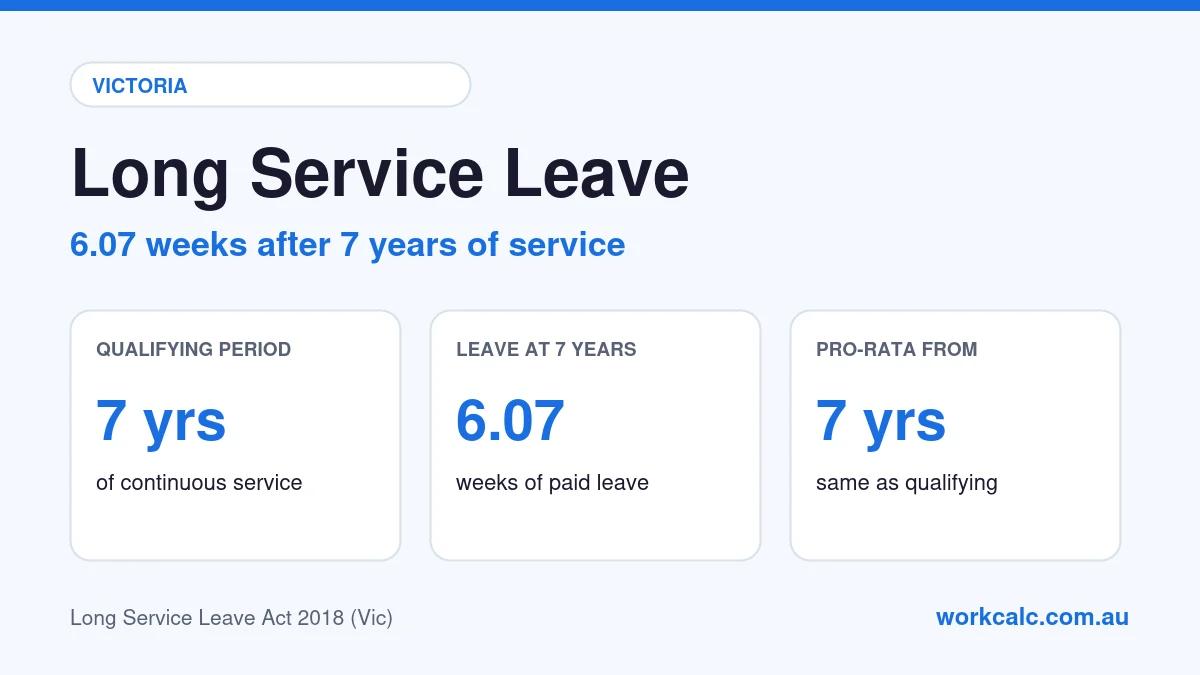
| Qualifying period | 7 years of continuous service |
| Leave at the qualifying period | 6.07 weeks |
| Accrual | 1 week for every 60 weeks of continuous service (about 0.87 weeks a year) |
| Pro-rata on termination from | 7 years (the same as the qualifying period) |
| Law | Long Service Leave Act 2018 (Vic) |
Applies to employees covered by the Victoria long service leave laws. Some industries, such as construction, coal mining and contract cleaning, have their own portable long service leave schemes with different rules.
How long service leave works in Victoria
In Victoria you accrue 1 week of long service leave for every 60 weeks of continuous employment, which is about 0.87 weeks a year. You can take the leave after 7 years, and if your employment ends after 7 years for any reason, unused leave must be paid out on your last day. Nothing is payable before 7 years.
Long service leave is about continuous service with one employer, not hours worked. Part-time employees accrue it the same way as full-time employees, and paid leave such as annual leave counts as service. Unpaid leave and some breaks in service may not count, so check the Victorian Act if you've had a long break.
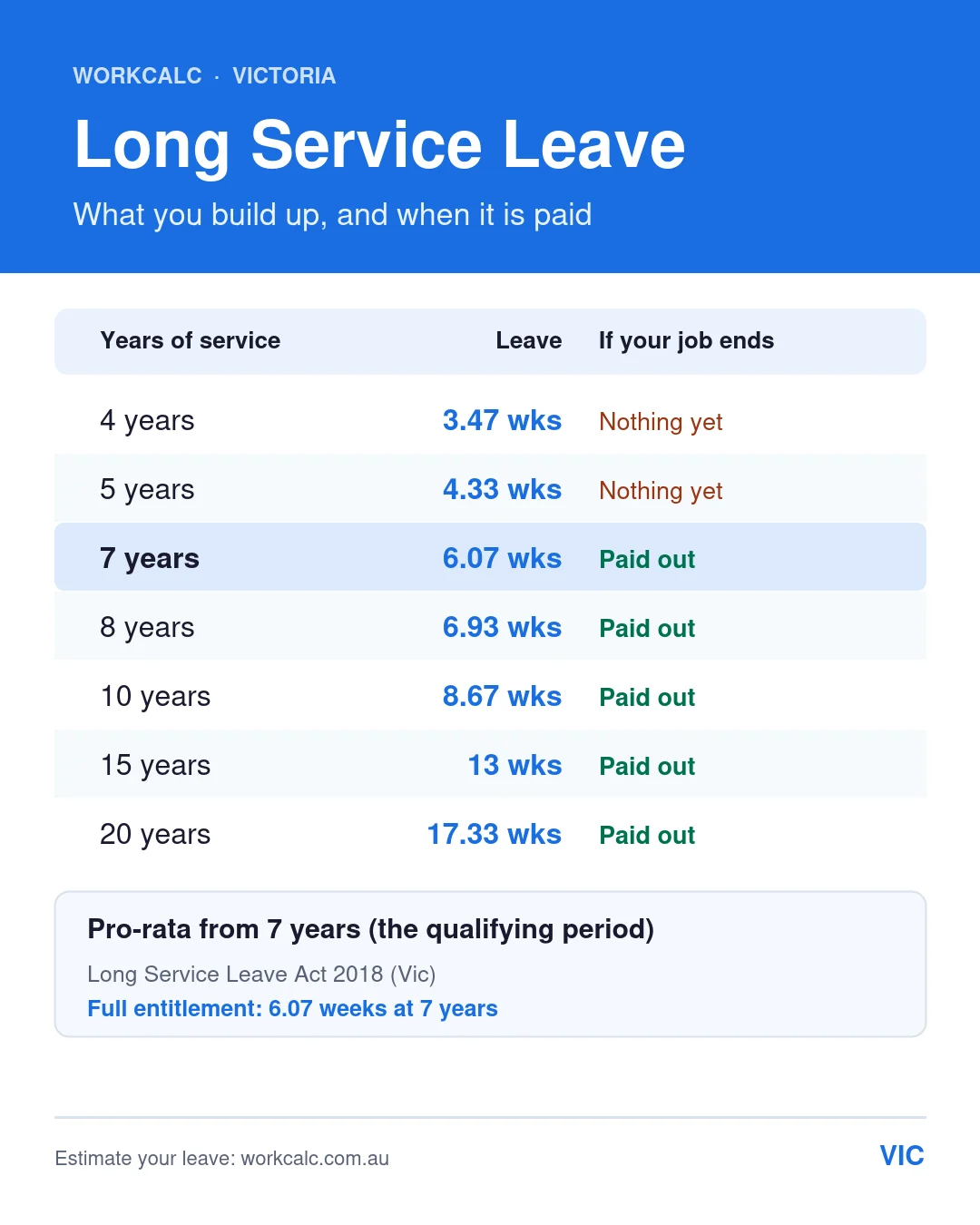
Victoria long service leave accrual table
How much leave you build up over time, and whether it's payable if your employment ends.
| Years of service | Leave accrued | If your employment ends |
|---|---|---|
| 4 years | 3.47 weeks | Nothing payable yet |
| 5 years | 4.33 weeks | Nothing payable yet |
| 7 years | 6.07 weeks | Paid out when employment ends |
| 8 years | 6.93 weeks | Paid out when employment ends |
| 10 years | 8.67 weeks | Paid out when employment ends |
| 15 years | 13 weeks | Paid out when employment ends |
| 20 years | 17.33 weeks | Paid out when employment ends |
Part years count, so your balance grows each month of service.
Pro-rata long service leave in Victoria
Pro-rata means being paid for the leave you've built up before you reach the full qualifying period. In Victoria, it can be paid from 7 years of continuous service, but only for certain reasons for leaving.
| Why your employment ends | Pro-rata paid between 7 and 7 years? |
|---|---|
| Any reason, once you reach 7 years | Yes |
| Any reason, before 7 years | No |
After 7 years, unused long service leave is paid out when your employment ends.
Taking your leave and getting paid
Once you reach 7 years you can take the leave, at a time agreed with your employer. You're paid your ordinary pay for the period, without overtime or most allowances. If your employment ends and you still have leave owing, it's paid out with your final pay.
Long service leave paid out on termination is taxed differently to your normal wages, and the tax depends on when the leave was accrued and why you left. Use the leave payout tax calculator to estimate the tax, or read our guide on tax on leave payouts.
More on Victoria long service leave
Worked examples
| Scenario | Leave | Weekly pay | Gross payout |
|---|---|---|---|
| Full entitlement at 7 years | 6.07 weeks | $1,400/wk | $8,498.00 |
| Resignation at 8 years (paid out in full) | 6.93 weeks | $1,400/wk | $9,702.00 |
| Part-time, 25 hrs at $30/hr, 7 years | 6.07 weeks | $750/wk | $4,552.50 |
| Long service, 20 years | 17.33 weeks | $2,000/wk | $34,660.00 |
Before tax, at the accrual rate in the Long Service Leave Act 2018 (Vic). In Victoria, unused leave is paid out for any reason once you pass 7 years.
How to read your payslip for your VIC LSL balance
Most Victorian payslips show a long service leave accrual section separate from annual leave. Here's what to look for and how to verify the figures match the 0.8667 formula:
Sample Victorian payslip — leave section
How to verify the LSL accrual figure: For a fortnightly pay cycle at 38 hrs/wk: ordinary hours per fortnight = 76. LSL accrual rate = 76 × (1/60) = 1.267 hrs/fortnight. If your payslip shows around 1.27 hrs per fortnight (or 2.54 hrs/month), the calculation is correct. Any significant deviation is worth querying with your employer or Wage Inspectorate Victoria.
Victorian LSL payout on resignation vs termination — is there a tax difference?
Unlike annual leave payouts — which use different ATO withholding methods depending on whether you resign or are made redundant — Victorian long service leave paid out on termination is treated as ordinary income for most employees today and taxed at your marginal rate.
The historical exceptions (concessional rates on pre-1978 and pre-1993 accrual) still technically apply on paper, but with leave accrued before 1993 now being extremely rare in practice, the vast majority of Victorian employees receive LSL payout taxed at their ordinary marginal rate using standard PAYG withholding.
Tax is not withheld using the Schedule 7 averaging method that applies to annual leave. This means a large LSL payout may attract high withholding in the pay period it's processed — but the correct tax is reconciled when you lodge your individual tax return for the year.
CoINVEST — the Victorian construction portable LSL scheme
If you work in Victoria's building and construction industry, your LSL does not sit with your individual employer — it is registered with CoINVEST, the portable long service leave scheme. Your entitlement carries across employers, meaning a site labourer who has worked with three different construction companies over 8 years has a single pooled entitlement — not three separate (incomplete) ones.
Similar portable schemes operate for contract cleaning workers and community services workers in Victoria. If you work in one of these industries, check with your employer which scheme you are registered with — your LSL balance may be held externally, not by your current employer, and may not appear on your regular payslip.
Common mistakes when calculating Victorian LSL
- Using the old pre-2018 formula. The Victorian Long Service Leave Act 2018 replaced the 1992 Act from 1 November 2018. Make sure any calculator or guide you rely on is based on the 2018 Act.
- Including overtime in the ordinary rate. LSL is paid at the ordinary rate — base pay for ordinary hours. Overtime, penalty rates and discretionary bonuses are excluded unless they are regular and expected as part of ordinary pay.
- Forgetting partial years. LSL accrues continuously. If you've worked 8 years and 3 months, use 8.25 years in the calculation — not just 8.
- Assuming CoINVEST balance = employer-held balance. Construction workers need to check CoINVEST separately. The employer's payslip does not show CoINVEST-held entitlements.
- Treating resignation under 7 years as forfeiting everything. Under the 2018 Act, the entitlement hasn't been lost — it just isn't yet payable. If you're re-employed by the same employer, the prior service may count toward the qualifying period.
- Applying the annual leave accrual rate instead of the LSL rate. Annual leave accrues at 0.07692 per hour. LSL accrues at 1/60 per week of service. These are completely different rates and cannot be used interchangeably.
This article reflects the Victorian Long Service Leave Act 2018. For disputes, contact the Wage Inspectorate Victoria on 1800 287 287. WorkCalc Australia is independent and not affiliated with the Victorian Government or Wage Inspectorate.
Long service leave in other states
Long service leave is state law, so the rules change at the border. If you've worked in more than one state, the state where you're based usually applies.
Victoria long service leave FAQs
How much long service leave do you get in Victoria?
6.07 weeks after 7 years of continuous service. Victoria accrues 1 week of leave for every 60 weeks of continuous employment, so leave keeps building at the same rate after 7 years.
How is long service leave calculated in Victoria?
Your years of continuous service are multiplied by the Victoria accrual rate. Victoria gives 1 week for every 60 weeks worked, so 10 years of service is about 8.67 weeks. You're paid your ordinary weekly pay for each week of leave.
Can you get long service leave before 7 years in Victoria?
No. In Victoria nothing is payable before 7 years of continuous employment. Once you reach 7 years, you can take the leave, and any unused leave is paid out when your employment ends for any reason.
Is long service leave paid out if you resign in Victoria?
Yes, after 7 years. Victoria pays out unused long service leave when employment ends for any reason after 7 years, including resignation. Before 7 years, nothing is payable.
Does part-time work count towards long service leave in Victoria?
Yes. Long service leave is based on continuous service rather than hours, so part-time employees build up the same weeks of leave. How your pay rate is worked out, especially if your hours changed over the years, is set by the Victorian Act.
How is long service leave taxed when it's paid out?
A long service leave payout on termination is taxed under the ATO's rules for unused leave, not as ordinary wages. The rate depends on when the leave was accrued and why your job ended, with concessional treatment for genuine redundancy. Our leave payout tax calculator gives an estimate.