
HECS Repayment Calculator Australia
Work out your compulsory HECS-HELP repayment for 2026–27, how much is taken out of each pay, and roughly when your debt will be paid off. Under the new marginal system you repay 15c for each $1 of repayment income over $69,528. On an $80,000 salary, that's $1,570.80 for the year, or about $60 a fortnight.
HECS-HELP repayment calculator
Enter your yearly income before tax and your HELP balance. You'll find your balance in ATO online services through myGov.
Year-by-year estimate
| Income year | Repayment income | Indexation | Repaid | Balance |
|---|
*An estimate. It assumes your pay and the repayment thresholds both rise each year, and indexation stays at the rate you choose. Indexation is applied on 1 June, before that year's compulsory repayment comes off when you lodge your tax return.
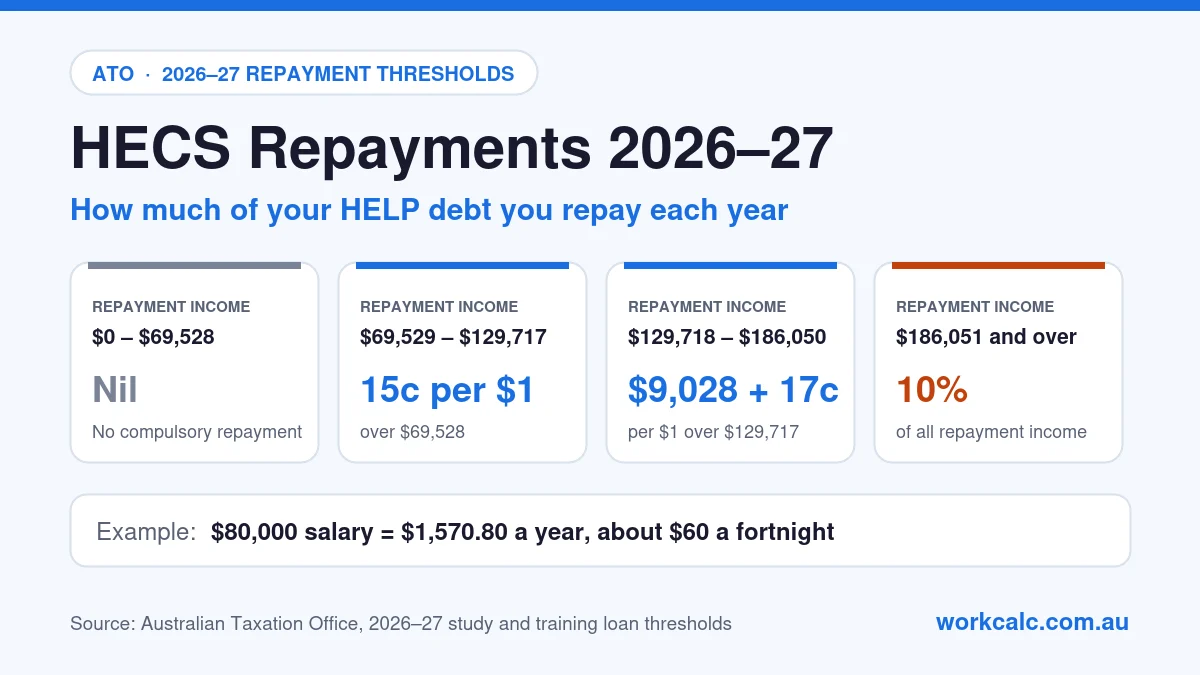
HECS repayment thresholds and rates 2026–27
From the 2025–26 income year, compulsory repayments use marginal rates. You only repay on the part of your repayment income above the minimum threshold, instead of a percentage of your whole income.
| Repayment income (2026–27) | Compulsory repayment |
|---|---|
| $0 – $69,528 | Nil |
| $69,529 – $129,717 | 15c for each $1 over $69,528 |
| $129,718 – $186,050 | $9,028 plus 17c for each $1 over $129,717 |
| $186,051 and over | 10% of your total repayment income |
2025–26 thresholds (for your 2026 tax return)
| Repayment income (2025–26) | Compulsory repayment |
|---|---|
| $0 – $67,000 | Nil |
| $67,001 – $125,000 | 15c for each $1 over $67,000 |
| $125,001 – $179,285 | $8,700 plus 17c for each $1 over $125,000 |
| $179,286 and over | 10% of your total repayment income |
Source: ATO, study and training loan repayment thresholds and rates. The thresholds rise each year in line with average weekly earnings. The same thresholds apply to HELP, VET Student Loans, Student Start-up Loans and Australian Apprenticeship Support Loans.
HECS repayments by salary (2026–27)
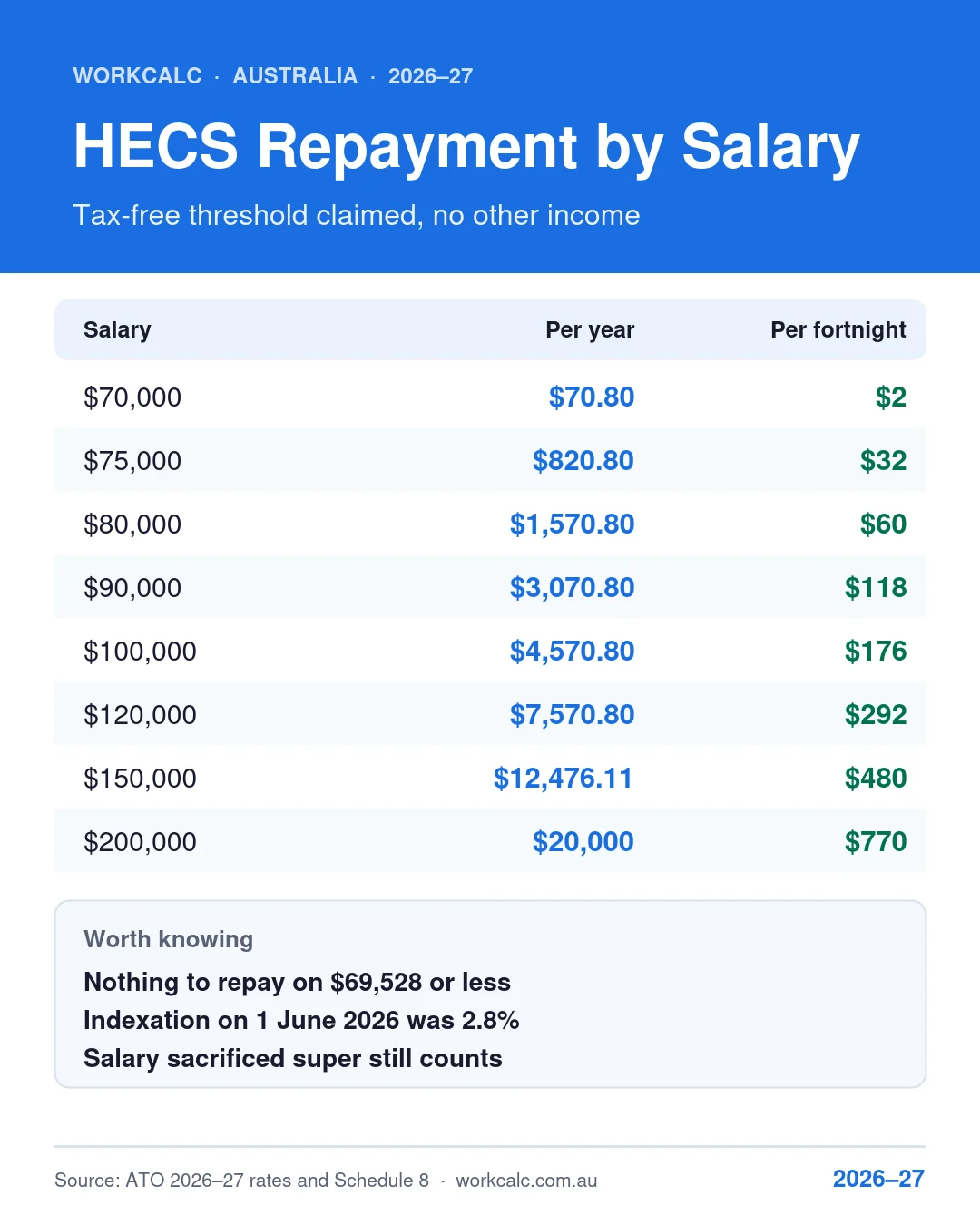
What you repay each year at common salaries, and how much your employer takes out of each pay if you claim the tax-free threshold and have no other repayment income.
| Repayment income | Yearly repayment | % of income | Per fortnight | Per week | 2025–26 repayment |
|---|---|---|---|---|---|
| $60,000 | $0 | 0% | $0 | $0 | $0 |
| $70,000 | $70.80 | 0.1% | $2 | $1 | $450 |
| $75,000 | $820.80 | 1.1% | $32 | $16 | $1,200 |
| $80,000 | $1,570.80 | 2.0% | $60 | $30 | $1,950 |
| $85,000 | $2,320.80 | 2.7% | $90 | $45 | $2,700 |
| $90,000 | $3,070.80 | 3.4% | $118 | $59 | $3,450 |
| $100,000 | $4,570.80 | 4.6% | $176 | $88 | $4,950 |
| $110,000 | $6,070.80 | 5.5% | $234 | $117 | $6,450 |
| $120,000 | $7,570.80 | 6.3% | $292 | $146 | $7,950 |
| $130,000 | $9,076.11 | 7.0% | $350 | $175 | $9,550 |
| $150,000 | $12,476.11 | 8.3% | $480 | $240 | $12,950 |
| $180,000 | $17,576.11 | 9.8% | $676 | $338 | $18,000 |
| $200,000 | $20,000 | 10% | $770 | $385 | $20,000 |
Yearly repayments use the ATO's 2026–27 and 2025–26 marginal rates. Per-pay amounts use Schedule 8 for payments from 1 July 2026, with the tax-free threshold claimed. What's withheld over the year is close to, but not exactly, your repayment. The difference is sorted out when you lodge your tax return.
How your HECS repayment is worked out
Repayment income over $69,528 × 15%, up to $129,717
$9,028 + 17% of repayment income over $129,717, up to $186,050
10% of all your repayment income from $186,051
- $85,000: ($85,000 − $69,528) × 15% = $2,320.80
- $140,000: $9,028 + ($140,000 − $129,717) × 17% = $10,776.11
- $200,000: $200,000 × 10% = $20,000
Repayment income is more than your salary
HECS is based on your repayment income, which is your taxable income plus:
- reportable super contributions, including salary sacrificed super and personal super contributions you claim a deduction for
- reportable fringe benefits
- total net investment losses, including net rental losses
- exempt foreign employment income.
That means salary sacrificing into super, or negatively gearing a rental property, lowers your taxable income but doesn't lower your HECS repayment. If you earn $80,000 and salary sacrifice $5,000 into super, your taxable income is $75,000 but your repayment income is still $80,000.
How much HECS comes out of each pay
If you tell your employer you have a study loan, on your tax file number declaration or a withholding declaration, they withhold extra tax from each pay using the ATO's Schedule 8 tables. It's an estimate of your yearly repayment, spread across your pays. The money isn't sent to your loan straight away. It's credited towards your tax bill when you lodge your return, and the ATO then works out your actual repayment.
- Main job, tax-free threshold claimed: nothing is withheld until your pay is about $1,337 a week ($2,674 a fortnight). On $80,000 a year, it's $60 a fortnight.
- Second job, no tax-free threshold: withholding starts at about $987 a week, so more comes out of each pay. On $80,000 a year, it's $166 a fortnight. This helps cover the repayment on your combined income.
Paid off your HELP debt? Give your employer a new withholding declaration so the extra withholding stops. Anything withheld after the debt is repaid comes back to you when you lodge your tax return.
Indexation: why your HECS balance goes up
HECS doesn't charge interest. Instead, on 1 June each year the ATO indexes any part of your loan that's been unpaid for more than 11 months, so it keeps its real value. The rate is the lower of the Consumer Price Index (CPI) and the Wage Price Index (WPI).
| 1 June | Indexation rate |
|---|---|
| 2026 | 2.8% |
| 2025 | 3.2% |
| 2024 | 4.0% (reduced from 4.7%) |
| 2023 | 3.2% (reduced from 7.1%) |
| 2022 | 3.9% |
| 2021 | 0.6% |
Source: ATO, study and training loan indexation rates. The 2023 and 2024 rates were cut after the government capped indexation at the lower of CPI and WPI, backdated to 1 June 2023, and loan balances were adjusted.
Your compulsory repayment for an income year is only applied once you lodge your tax return, which is after that year's 1 June indexation. Voluntary repayments that reach the ATO before 1 June reduce the amount that's indexed. Allow up to 4 business days for an electronic payment to be processed.
The 20% HECS debt cut
Study and training loans that existed on 1 June 2025 were reduced by 20%. The ATO has finished applying the cut, and you can see it in your loan account in ATO online services. If the reduction left your account in credit, the ATO refunds the extra, as long as you don't owe other tax or Commonwealth debts. The balance you enter in the calculator should be your current balance, after the cut.
Should you pay off HECS early?
It depends on your situation, and there's no single right answer. Things to weigh up:
- No interest, only indexation. Your balance grows by indexation (2.8% in 2026), which is usually lower than home loan or credit card interest.
- No discount or tax deduction. Voluntary repayments aren't tax deductible and can't be refunded once made.
- It shortens the loan. In our example, a $30,000 balance on an $80,000 salary (rising 3% a year) takes about 20 years to repay and adds about $10,242 of indexation. Adding $2,000 a year clears it in about 9 years with about $3,935 of indexation.
- Timing matters. A payment that reaches the ATO before 1 June avoids that year's indexation on the amount you pay. If you're paying off the whole balance, pay before you lodge your tax return.
This is general information, not financial advice. Consider your own circumstances or speak to a licensed adviser.
Moving overseas with a HECS debt
You still have to repay your loan if you live overseas. If you plan to live overseas for 183 days or more in any 12 months, you must lodge an overseas travel notification with the ATO within 7 days of leaving Australia. Each year, report your worldwide income by 31 October, or lodge a non-lodgment advice if your worldwide income is low. If your worldwide income is above the repayment threshold, you'll need to make a compulsory repayment or pay the overseas levy.
HECS repayment FAQs
How much HECS will I repay in 2026–27?
You repay 15c for each $1 of repayment income over $69,528, up to $129,717. From $129,718 to $186,050 it's $9,028 plus 17c for each $1 over $129,717, and from $186,051 it's 10% of your whole repayment income. On $80,000, the 2026–27 repayment is $1,570.80.
What is the HECS repayment threshold for 2026–27?
$69,528 of repayment income. If your repayment income is $69,528 or less, you don't make a compulsory repayment for 2026–27. The threshold for 2025–26 was $67,000.
How much HECS comes out of my pay?
If you claim the tax-free threshold and earn $80,000 a year, your employer withholds $60 a fortnight for HELP ($30 a week or $130 a month). On $100,000 it's $176 a fortnight. It's an estimate. Your actual repayment is worked out when you lodge your tax return.
Does salary sacrificing into super reduce my HECS repayment?
No. Salary sacrificed super contributions are reportable super contributions, and they're added back into your repayment income. If you earn $80,000 and salary sacrifice $5,000, your repayment income is still $80,000.
When is HECS indexed, and what was the 2026 rate?
On 1 June each year, on any part of your loan that's been unpaid for more than 11 months. The rate is the lower of CPI and the Wage Price Index. It was 2.8% on 1 June 2026 and 3.2% in 2025.
Was my HECS debt cut by 20%?
Yes, if you had a study or training loan on 1 June 2025. The ATO has finished applying the 20% reduction to those loans. If the cut left your account in credit, the ATO refunds the extra, as long as you don't owe other tax or Commonwealth debts.
Should I pay off my HECS debt early?
It depends on your situation. HECS has no interest, only indexation, and voluntary repayments aren't tax deductible or refundable. Extra repayments do shorten the loan and reduce the indexation you pay. For example, adding $2,000 a year to a $30,000 balance on an $80,000 salary clears it in about 9 years instead of 20. This is general information, not financial advice.
What happens if I earn less than the repayment threshold?
You don't make a compulsory repayment for that year, and if your pay stays under the threshold, your employer shouldn't withhold anything extra for HELP. Your balance is still indexed on 1 June, so it grows unless you make voluntary repayments.
Do I have to repay HECS if I move overseas?
Yes. If you plan to live overseas for 183 days or more in any 12 months, you must tell the ATO within 7 days of leaving Australia and report your worldwide income each year by 31 October. If your worldwide income is above the repayment threshold, you make a compulsory repayment or pay the overseas levy.