
Resignation Letter Template Australia
Fill in your details and get a resignation letter you can copy, email, or download as Word or PDF. It works out your last day from your notice period. Most awards ask for 1 to 4 weeks' notice, depending on how long you've worked there, and notice starts the day after you hand the letter in.
Resignation letter builder
Pick a style and fill in the blanks. Your letter updates as you type, and anything you leave out shows in [brackets] so you can add it later.
Resignation letter templates to copy
Prefer to write it yourself? Copy one of these and replace the parts in [brackets]. Each one says the three things a resignation letter needs: that you're resigning, from which job, and your last day.
Simple resignation letter template
The standard version. It gives notice, offers a handover and asks for your final pay to be confirmed.
![Simple resignation letter template for Australia: "Please accept this letter as notice of my resignation from my position as [job title] at [Company name]. I am giving two weeks' notice. My last day of work will be [your last day]." It then offers a handover, asks for final pay and unused annual leave to be confirmed, and thanks the employer.](https://workcalc.com.au/wp-content/uploads/simple-resignation-letter-template.webp "Simple Resignation Letter Template (Australia)")
Formal resignation letter template
For workplaces that expect formal wording, or when you want a clear paper record.
Short resignation letter template
Two sentences. It says you're resigning and when you finish, which is all a resignation letter has to do.
Resignation letter with thanks
For when you're leaving on good terms and want to say so.
Resignation email template
Put the subject line in the email's subject field and paste the rest into the body.
Resignation letter with no notice
For casual employees, who don't have to give notice, or when your employer has agreed you can finish straight away.
What to put in a resignation letter
A resignation letter is a record of the date you gave notice and the date you finish. Keep it short. It needs:
- The date you hand it in. Your notice period is counted from this date.
- Who it's to: your manager's name and the company.
- A clear statement that you're resigning, and from which role.
- Your last day of work.
- Your name, and your signature if it's on paper.
You can also thank your employer, offer to hand over your work, and ask them to confirm your final pay. You don't have to give a reason for leaving.
Fair Work's advice: you can resign verbally or in writing, but it's best practice to give notice in writing and to include the day that will be your last day of employment.
How much notice to give when you resign
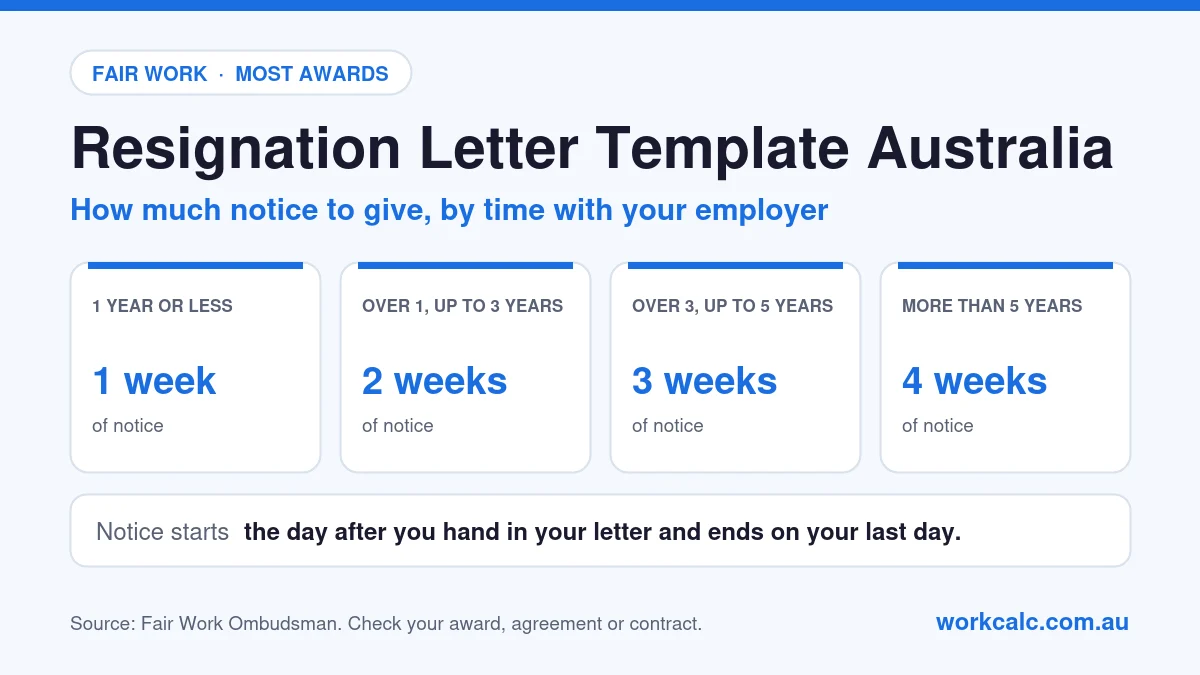
Your notice period comes from your award, enterprise agreement or employment contract. Most awards use the same scale, based on how long you've worked for your employer:
| Time with your employer | Notice you give |
|---|---|
| 1 year or less | 1 week |
| More than 1 year, up to 3 years | 2 weeks |
| More than 3 years, up to 5 years | 3 weeks |
| More than 5 years | 4 weeks |
Source: Fair Work Ombudsman, Resignation (award notice periods, for example Clerks Award clause 41.1). Your award, agreement or contract can set a different period, so check it.
- Notice starts the day after you give it and ends on your last day of employment. Hand in your letter on a Monday with 2 weeks' notice, and your last day is the Monday two weeks later.
- Casual employees don't have to give notice. It's still good practice to tell your employer your last day.
- If no award or agreement covers you, you don't have to give notice unless your contract says so. If your contract says nothing about notice, you may still need to give reasonable notice.
- Public holidays during your notice count as part of it. They don't extend it.
To check the notice your employer has to give you, or to count out a last day, use the notice period calculator.
If you don't give enough notice
Most awards let your employer deduct up to one week's wages from your final pay if all of these apply:
- you're 18 or older
- you didn't give the notice your award requires
- your employer didn't agree to a shorter notice period
- the deduction isn't unreasonable in the circumstances.
The deduction can only come from wages owed under the award. It can't come from your annual leave or other entitlements. A few awards have different rules, and an enterprise agreement can have its own.
Want to leave sooner? Ask. If your employer agrees to a shorter notice period, there's nothing to deduct. The builder above can add a line offering to finish earlier by agreement.
After you hand in your resignation
- Your employer can't refuse it. A resignation isn't something an employer accepts or rejects, though it's good practice for them to acknowledge it.
- You normally work out your notice on your usual pay and conditions.
- You might finish earlier. You and your employer can agree on an earlier date, or your employer can end your employment during the notice period and pay out the notice.
- Annual leave during notice is allowed if your employer agrees to it.
- Sick leave during notice is allowed if you tell your employer as soon as you can and give evidence, such as a medical certificate, if they ask.
What you're paid when you leave
Your final pay includes:
- Wages for the hours you've worked, including penalty rates and allowances.
- Unused annual leave, with leave loading if you would have received it when taking leave.
- Long service leave, if you've worked long enough to be paid out under your state or territory's rules.
Unused sick and carer's leave isn't paid out. Most awards require final pay within 7 days after your last day. Check your award, agreement or contract for the exact rule.
Work out what you're owed with the final pay calculator, see the tax on your leave with the leave payout tax calculator, and read how annual leave is paid out when you resign.
How to hand in your resignation
- Check your notice period in your award, enterprise agreement or contract before you choose a last day.
- Tell your manager first, in person or on a call if you can.
- Give them the letter or email the same day, so the date you gave notice is on record.
- Keep a copy for yourself.
- Ask for your last day and final pay to be confirmed in writing.
Resignation letter FAQs
How do I write a resignation letter in Australia?
Say that you are resigning, name your role, and give your last day of work. Add the date, your manager's name and your own name. You don't have to give a reason. The Fair Work Ombudsman says it is best practice to resign in writing and to include your last day of employment.
How much notice do I have to give when I resign?
It depends on your award, enterprise agreement or contract. Most awards ask for 1 week if you have worked there 1 year or less, 2 weeks for more than 1 year and up to 3 years, 3 weeks for more than 3 years and up to 5 years, and 4 weeks for more than 5 years. Casual employees don't have to give notice.
Does a resignation have to be in writing?
No. You can resign verbally or in writing. The Fair Work Ombudsman says it is best practice to give notice in writing and include your last day, so there is a clear record.
When does my notice period start?
The day after you give notice. It ends on your last day of employment. If you hand in your letter on a Monday with 2 weeks' notice, your last day is the Monday two weeks later.
Can my employer refuse my resignation?
No. An employer can't accept or reject a resignation. They can agree with you on an earlier finish date, or end your employment during the notice period and pay out the notice.
What happens if I don't give enough notice?
Most awards let an employer deduct up to one week's wages if you are 18 or older, you didn't give the notice your award requires, your employer didn't agree to a shorter period, and the deduction isn't unreasonable. It can only come from wages owed under the award, not from your annual leave.
Do I get paid my annual leave when I resign?
Yes. Unused annual leave is paid out in your final pay, including leave loading if you would have received it when taking the leave. Unused sick and carer's leave isn't paid out. Long service leave may be paid out, depending on your state or territory and how long you have worked there.
When do I get my final pay after resigning?
Most awards require final pay within 7 days after your last day of employment. Check your award, enterprise agreement or contract for the exact rule.
Can I resign by email?
Yes. Notice can be given verbally or in writing, and an email is a written record with a date on it. Check your contract or agreement in case it says how notice has to be given.
Do casual employees have to give notice?
No. Casual employees don't have to give notice when they resign. The Fair Work Ombudsman says it is still best practice to tell your employer what your last day will be.