
Pro Rata Long Service Leave: Can You Access Leave Before 10 Years?
Most employees think long service leave only kicks in after 10 years. The reality: in every Australian state you can receive a pro-rata payout well before that — if you know the thresholds, the qualifying reasons, and the calculation.
Long service leave is one of Australia's most valuable workplace entitlements — and one of the most commonly misunderstood. Most employees assume it's an all-or-nothing deal: reach 10 years, get two months off. But every Australian state has a pro-rata threshold that lets you access a proportional payout well before the full qualifying period, if your employment ends in the right circumstances.
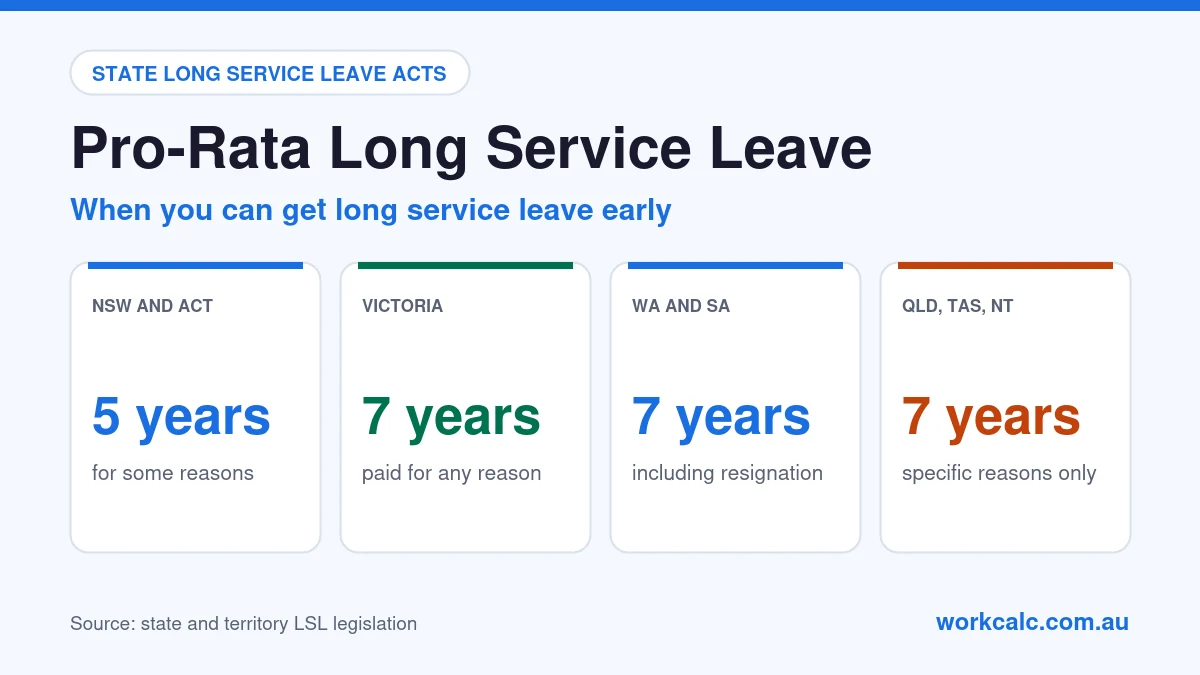
- NSW & ACT: pro-rata from 5 years if your employer ends your employment (not for serious misconduct) or you leave because of illness, incapacity or a pressing necessity. Not on an ordinary resignation.
- VIC: after 7 years, unused leave is paid out whatever the reason you leave, including resignation. Nothing before 7 years.
- WA & SA: pro-rata from 7 years, including on resignation, unless you are dismissed for serious misconduct.
- QLD, TAS & NT: pro-rata from 7 years, but only for specific reasons such as redundancy, illness or a pressing necessity. Not on an ordinary resignation.
- Serious misconduct: rules out pro-rata in every state. After the full qualifying period, leave is still paid in NSW, VIC and QLD.
- The formula: years × accrual rate × ordinary weekly pay (SA and the NT count completed years only).
What is pro-rata long service leave?
Long service leave accrues continuously from the first day of employment. In most Australian states, the accrual rate is 0.8667 weeks per year — meaning after 10 years you've built up 8.6667 weeks (2 months) of leave. But that accrual is happening every day, not just at the 10-year mark.
Pro-rata long service leave means receiving a payout for the leave you've already accrued when your employment ends before the full qualifying period. The "pro-rata" simply refers to the fact that you're getting a proportion of the full entitlement, calculated on your actual years of service.
How to calculate pro-rata long service leave
The calculation has three inputs: your years of continuous service, your state's accrual rate, and your ordinary weekly pay. Here's how it works in practice.
NSW example 7 years service, $1,500/week
SA example 7 years service, $1,200/week
For your exact figure — including the eligibility check — use the Long Service Leave Calculator. Select your state and reason for leaving and it will tell you immediately whether you qualify for pro-rata and what the gross payout is.
Pro-rata LSL eligibility checker
LiveEnter your state, years of service, reason for leaving and ordinary weekly pay to see whether you qualify for pro-rata LSL and what the gross payout is.
Pro-rata rules by state — the full comparison
This is where things get complicated. The same years of service and the same reason for leaving can produce completely different outcomes depending on which state's legislation applies to you.
| State | Pro-rata threshold | Resignation | Redundancy | Illness / necessity | Misconduct |
|---|---|---|---|---|---|
| NSW | 5 years | No ✗ | Yes ✓ | Yes ✓ | No ✗ |
| VIC | 7 years | Yes ✓ | Yes ✓ | Yes ✓ | Paid after 7 yrs |
| QLD | 7 years | No ✗ | Yes ✓ | Yes ✓ | No ✗ |
| WA | 7 years | Yes ✓ | Yes ✓ | Yes ✓ | No ✗ |
| SA | 7 years | Yes ✓ | Yes ✓ | Yes ✓ | No ✗ |
| TAS | 7 years | No ✗ | Yes ✓ | Usually ✓ | No ✗ |
| ACT | 5 years | No ✗ | Yes ✓ | Yes ✓ | No ✗ |
| NT | 7 years | No ✗ | Yes ✓ | Yes ✓ | No ✗ |
State-by-state accrual rates at a glance
South Australia and the Northern Territory are significantly more generous than every other state — 13 weeks at 10 years vs 8.6667 weeks everywhere else. Their pro-rata entitlement at 7 years (9.1 weeks) is actually higher than a full 10-year entitlement in NSW, VIC or QLD.
NSW: pro-rata from 5 years (for the right reasons)
NSW (with the ACT) has the earliest pro-rata threshold in Australia: 5 years. Under the NSW Long Service Leave Act 1955, pro-rata LSL between 5 and 10 years is paid if your employer ends your employment for any reason other than serious and wilful misconduct, or you resign because of illness, incapacity or a domestic or other pressing necessity, or on death. An ordinary resignation doesn't qualify until 10 years.
For example, an NSW employee made redundant after 5 years and 6 months has accrued 5.5 × 0.8667 = 4.77 weeks of LSL. At $1,400 a week, that's a gross payout of $6,677, well before the 10-year mark. Many people don't realise redundancy at 5 years can trigger a payout.
Related guide Long Service Leave Calculator NSW — the full step-by-step calculation for the 5-year rule →Victoria's 7-year rule — and why it's different from the others
Victoria's Long Service Leave Act 2018 operates on a continuous accrual model rather than a lump-sum entitlement. This means leave has been accumulating since day one at 1 week per 60 weeks (≈ 0.8667 weeks per year), and the entitlement becomes payable once 7 years of continuous service is reached.
Crucially, once you reach 7 years in Victoria, unused leave is paid out when you leave for any reason, including resignation. WA and SA also pay pro-rata on resignation after 7 years. A Victorian employee who resigns after 7 years receives their full accrued balance, calculated at the 0.8667 rate.
Related calculator Victorian Long Service Leave Calculator — 7-year rules, pro-rata and worked examples → Related guide Long Service Leave Victoria — entitlements, the 7-year rule and portable schemes in full →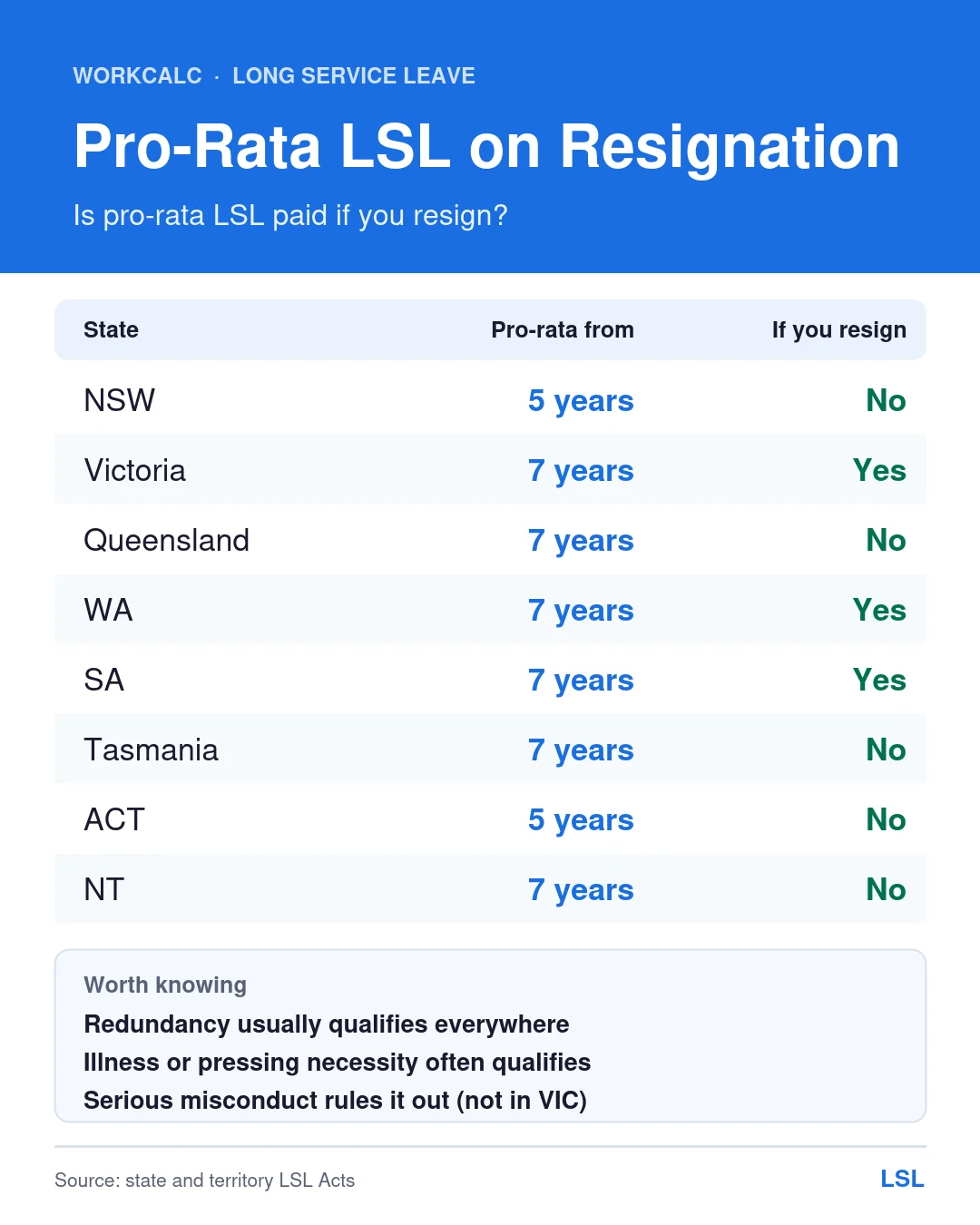
Portable long service leave schemes — when the clock follows you
A significant subset of Australian workers in high-turnover industries don't accumulate LSL with a single employer — they carry it across jobs through a portable long service leave scheme. These schemes exist because employees in industries like construction, cleaning and community services frequently move between employers, and the traditional model of tying LSL to tenure with one employer would mean most never qualify.
The major portable schemes in Australia:
- Building and construction: CoINVEST (VIC), QLeave (QLD), MyLeave (WA), and state equivalents. Service with any registered employer in the industry counts toward your LSL entitlement.
- Contract cleaning: Portable schemes operate in VIC (CoINVEST equivalent), QLD (QLeave), and ACT.
- Community services: QLeave covers community services workers in QLD. Similar schemes exist in ACT.
- Security industry: Covered by portable schemes in VIC and ACT.
- New ACT schemes (from 1 July 2026): The ACT expanded its portable scheme framework to cover hairdressing, beauty, food and accommodation services.
If you work in one of these industries, check with your state's relevant scheme administrator before assuming your LSL rests with your current employer. You may have entitlements you're not aware of — and which don't appear on any payslip.
What breaks continuous service — and what doesn't
Pro-rata LSL depends on continuous service — which is a legal concept, not simply unbroken employment. Several things people assume break continuity actually don't:
- Paid leave (annual, sick, carer's): Does not break continuity and counts toward accrual.
- Parental leave: Paid parental leave does not break continuity. Unpaid parental leave generally doesn't break continuity but may not count toward accrual, depending on the state Act.
- Unfair dismissal and reinstatement: If you are dismissed and then reinstated, the period of dismissal is usually treated as if you remained employed.
- Business transfer: If your employer sells the business and you transfer to the new owner, your continuity typically carries across under the Fair Work Act.
- Genuine redundancy and re-engagement: A break in employment due to redundancy, followed by re-engagement with the same employer, may reset the LSL clock — check the relevant state Act.
- Unpaid leave: Generally doesn't break continuity but does not count toward accrual — meaning the qualifying period is extended by the duration of unpaid leave.
Common mistakes employees make with pro-rata LSL
- Assuming the 10-year rule applies everywhere. The full entitlement is 10 years in most states — but pro-rata kicks in much earlier. Leaving without checking is the most common way employees leave entitlements unclaimed.
- Resigning in QLD without checking. Queensland's restriction on general resignation is the most common pro-rata trap in Australia. If you're in QLD and approaching 10 years, the timing of your resignation matters.
- Using the wrong state's rules. The state where you perform the work — not where your employer's head office is — determines which LSL Act applies.
- Including overtime in the rate. LSL is paid at the ordinary rate, excluding overtime, discretionary bonuses and allowances unless your award specifies otherwise.
- Forgetting about portable scheme entitlements. Construction and cleaning workers who have changed employers may have accumulated entitlements in a portable scheme without realising it.
This article reflects state LSL Acts. Pro-rata rules can be affected by portable schemes, enterprise agreements and specific award conditions — always verify against the applicable state legislation or consult the relevant state authority. WorkCalc Australia is independent and not affiliated with Fair Work Australia or any state government.
Pro-rata long service leave — frequently asked questions
Plain-English answers on how pro-rata LSL works, which states allow it on resignation, and how the calculation works.
Can you get long service leave before 10 years?
Yes, in the right circumstances. In NSW and the ACT, pro-rata can be paid from 5 years if your employer ends your employment or you leave because of illness or a pressing necessity. In VIC, leave is paid out after 7 years for any reason. In WA and SA, pro-rata is paid from 7 years even on resignation. In QLD, TAS and the NT, pro-rata from 7 years is limited to specific reasons, not an ordinary resignation. Use the eligibility checker above to see what applies in your state.
What is pro-rata long service leave?
Pro-rata LSL is a proportional payout of the long service leave you have accrued when employment ends before the full qualifying period. The formula is the same as a full entitlement — years × state accrual rate × ordinary weekly pay — just applied to fewer years of service. It's called "pro-rata" because you're receiving the fraction of the full entitlement that corresponds to your actual years of service.
How is pro-rata long service leave calculated?
Years of continuous service × state accrual rate × ordinary weekly pay. For most states (NSW, VIC, QLD, WA, TAS, ACT) the accrual rate is 0.8667 weeks per year. For SA and NT it is 1.3 weeks per year. Example: an employee in NSW with 7 years of service earning $1,500/week receives 7 × 0.8667 × $1,500 = $9,100.50 gross.
What reasons qualify for pro-rata long service leave?
Pro-rata rules differ by state. NSW and the ACT pay pro-rata from 5 years if your employer ends your employment or you leave because of illness or a pressing necessity. Victoria pays out all unused leave after 7 years for any reason. WA and SA pay pro-rata from 7 years, including on resignation. Queensland, Tasmania and the NT pay pro-rata from 7 years only for specific reasons such as redundancy, illness or a pressing necessity. Serious misconduct rules out pro-rata everywhere.
What happens to long service leave if I resign before 10 years?
It depends on your state. An ordinary resignation before 10 years gets pro-rata leave in WA and SA (from 7 years), and in Victoria everything accrued is paid out once you pass 7 years. In NSW, the ACT, Queensland, Tasmania and the NT, an ordinary resignation before the full qualifying period (10 years, or 7 in the ACT) doesn't trigger pro-rata. It is paid only for specific reasons such as illness, a pressing necessity or your employer ending your employment.
Does pro-rata long service leave apply to casual employees?
Yes — all eight Australian jurisdictions include casual employees in their LSL Acts, provided service has been regular and systematic. The entitlement is calculated on average hours worked across the period. The casual loading is generally included in the ordinary rate for LSL calculation purposes.
What is a portable long service leave scheme?
A portable scheme allows workers in certain industries — building, cleaning, community services, security — to carry their LSL entitlement across employers within the same industry. Service with different employers in the industry accumulates toward a single LSL entitlement managed by an industry fund rather than individual employers. Major schemes include CoINVEST (VIC construction), QLeave (QLD), and MyLeave (WA construction).
How to calculate long service leave?
The formula is: years of continuous service × state accrual rate × ordinary weekly pay. The accrual rate is 0.8667 weeks per year in NSW, VIC, QLD, WA, TAS and ACT (giving 8.6667 weeks at 10 years). SA and NT use 1.3 weeks per year (13 weeks at 10 years). Use the Long Service Leave Calculator to get your exact figure for any state.