
How to Calculate Your Take-Home Pay in Australia: Step-by-Step Formula and Worked Examples
The exact five-step process behind every Australian payslip — income tax, LITO, Medicare levy and HECS/HELP — with real numbers, verified against the ATO's own published example.
The five-step formula
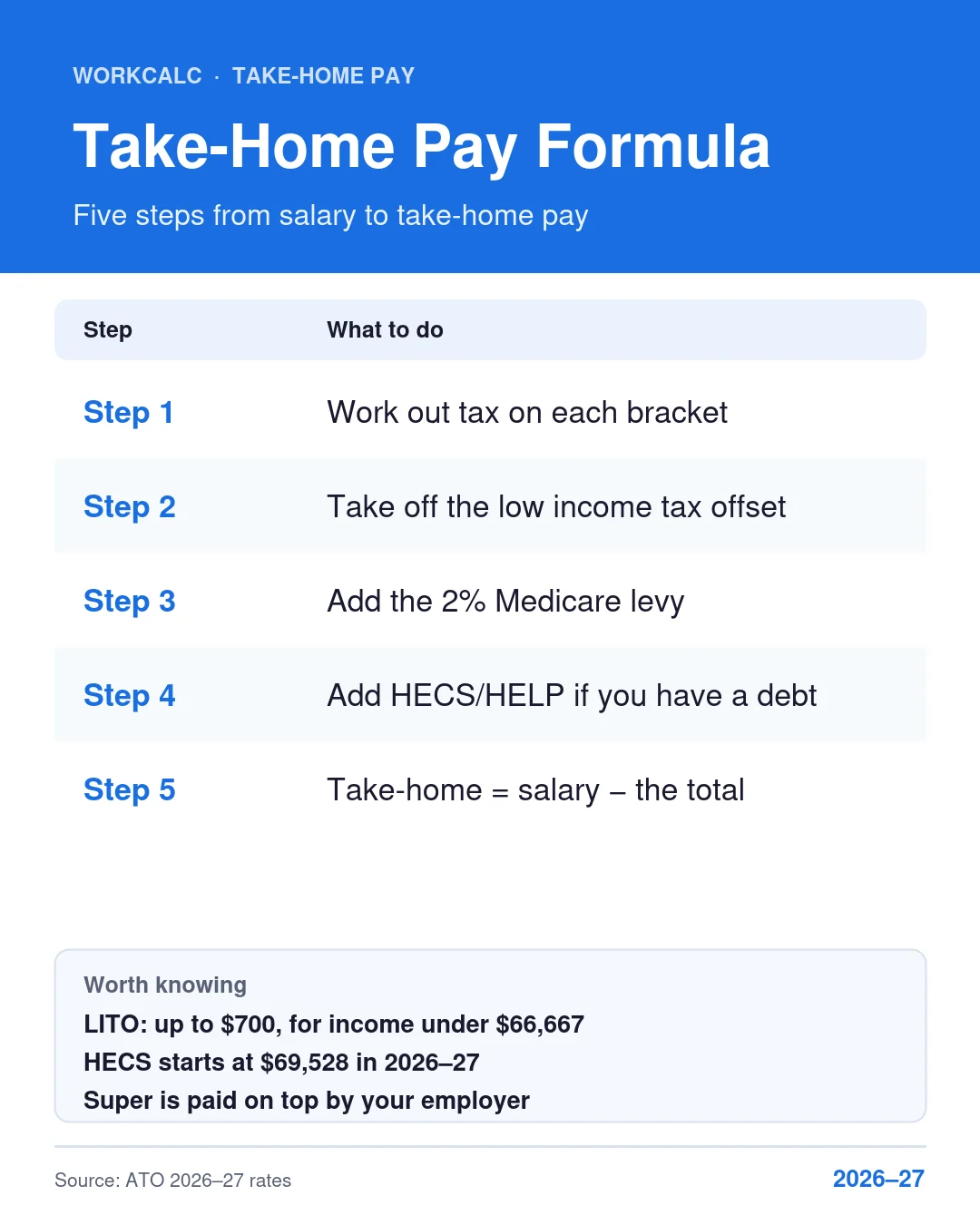
Every take-home pay calculation in Australia follows the same five steps, whether you're doing it by hand or a calculator is doing it for you:
Step-by-step walkthrough
2026–27: 0% to $18,200, 15% to $45,000, 30% to $135,000, 37% to $190,000, 45% aboveMax $700, phases out between $37,500 and $66,6672% of taxable income (most residents)2026–27 threshold: $69,528Take-home = Gross − Tax − Medicare − HECSSkip the manual maths
Enter your salary once and see your exact take-home pay by week, fortnight, month or year.
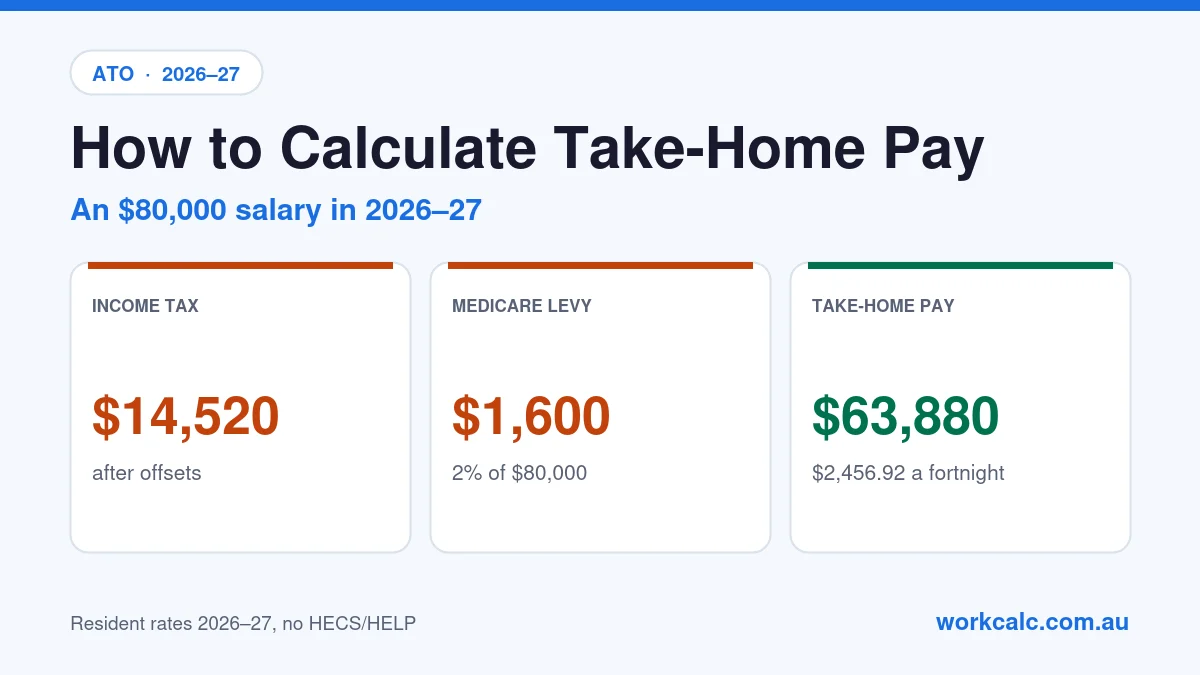
Worked example — $80,000 salary, no HECS/HELP
Australian resident, $80,000 gross salary, FY2026–27, no study loan debt
That works out to an effective tax rate of 20.15% — despite the top marginal rate on this income being 30%, because only the portion of income above $45,000 is taxed at that rate, not the whole $80,000.
Worked example — including HECS/HELP repayment
Here's the same calculation with a HECS/HELP debt, using a real income level that crosses the 2026–27 repayment threshold of $69,528:
Australian resident, $86,380 gross salary, FY2026–27, with HECS/HELP debt
Step 1 in detail — marginal tax brackets
The most common misunderstanding about Australian income tax is thinking your entire salary is taxed at your highest bracket rate. It isn't. Each bracket only applies to the slice of income that falls within it. You can see the split for any income with our tax bracket calculator, and the tax taken out of each pay in the 2026–27 tax tables. The 2026–27 brackets are:
| Taxable income | Tax rate on this portion |
|---|---|
| $0 – $18,200 | 0% |
| $18,201 – $45,000 | 15% |
| $45,001 – $135,000 | 30% |
| $135,001 – $190,000 | 37% |
| $190,001 and over | 45% |
On an $80,000 salary, only the $35,000 between $45,001 and $80,000 is taxed at 30%. The first $18,200 is tax-free, and the next $26,800 (to $45,000) is taxed at 15%. This is why effective tax rates are always meaningfully lower than the top marginal rate for that income.
Step 2 in detail — the Low Income Tax Offset
LITO reduces the tax payable, not your taxable income — it's applied after step 1, as a direct reduction to your tax bill. The maximum offset is $700:
- Up to $37,500 taxable income: full $700 offset
- $37,501–$45,000: reduces by 5 cents for every dollar above $37,500
- $45,001–$66,667: reduces further by 1.5 cents for every dollar above $45,000, reaching zero
- Above $66,667: no LITO benefit at all
This is applied automatically by the ATO when you lodge your return — you don't claim it separately.
Step 3 in detail — the Medicare levy
Most Australian residents pay a flat 2% Medicare levy on their taxable income. There's a reduced-rate shade-in zone and a full exemption for lower income earners, meaning very low income earners pay a reduced levy or none at all.
Step 4 in detail — HECS/HELP repayment
If you have a HECS/HELP debt, an additional compulsory repayment applies once your repayment income exceeds the annual threshold (work out yours with the HECS repayment calculator). From the 2025–26 year onwards, this uses a marginal system — similar in structure to income tax brackets:
| Repayment income | Repayment rate |
|---|---|
| $0 – $69,528 | Nil |
| $69,529 – $129,717 | 15c per $1 over $69,528 |
| $129,718 – $186,050 | $9,028 plus 17c per $1 over $129,717 |
| $186,051 and over | 10% of total repayment income |
Importantly, "repayment income" is broader than taxable income — it also includes reportable fringe benefits, net investment losses, and reportable super contributions (including salary sacrifice above your compulsory super). This is why salary sacrifice does not reduce your HECS repayment, even though it does reduce your taxable income.
Related tool Salary Sacrifice Calculator — see the tax saving and net advantage of sacrificing to super →Why your take-home pay might be lower than expected
A few common reasons your actual pay doesn't match a rough mental estimate:
- Bracket creep: a pay rise or bonus can push part of your income into a higher marginal bracket, meaning that portion is taxed at a higher rate than the rest of your income. If you're about to ask for one, the pay rise letter template shows the increase in dollars.
- LITO phasing out: as your income rises through $37,500–$66,667, your Low Income Tax Offset shrinks, effectively increasing your marginal tax rate through that range.
- HECS/HELP threshold crossed: once your income exceeds $69,528, a new deduction appears on your payslip that wasn't there before.
- Irregular pay withholding: employers annualise each pay period to estimate your yearly tax — an unusually large pay period (bonus, overtime, back pay) can trigger higher-than-usual withholding for that period specifically, even though it evens out at tax time.
What's not included in this calculation
This five-step formula covers the standard case — an Australian tax resident with a single employer and no other complications. It doesn't account for the Medicare Levy Surcharge (an extra 1–1.5% for higher earners without private hospital cover), multiple income sources, or work-related tax deductions that reduce your final tax bill at year-end. For the full withholding picture across pay frequencies, see the PAYG Withholding Calculator.
All figures in this guide use ATO-published 2026–27 income tax brackets, the LITO formula, and the official Study and Training Support Loans repayment thresholds and rates, cross-checked against the ATO's own published worked example.
Frequently asked questions
Common questions about calculating take-home pay in Australia.
How do you calculate take-home pay from salary in Australia?
Take-home pay = gross salary − income tax (after LITO) − Medicare levy − HECS/HELP repayment. Use the Take-Home Pay Calculator to get your exact figure instantly, or follow the five-step formula in this guide to work it out by hand.
What is the step-by-step formula to calculate take-home pay?
1) Calculate income tax on marginal brackets. 2) Apply LITO if income is under $66,667. 3) Add the 2% Medicare levy. 4) Add HECS/HELP repayment if applicable. 5) Subtract all of these from gross salary.
How do I calculate take-home pay after tax from my salary?
Apply the marginal tax brackets to your gross salary, subtract your LITO entitlement from that tax, add the Medicare levy, add any HECS/HELP repayment, then subtract the total from your gross salary. See the worked $80,000 example above for the full calculation.
Why is my take-home pay lower than expected?
Common causes: bracket creep from a pay rise, LITO phasing out between $37,500–$66,667, crossing the HECS/HELP repayment threshold, or irregular pay (bonus, overtime) triggering higher withholding for that specific pay period.
Does calculating take-home pay include superannuation?
No. Super (12% SG) is paid by your employer on top of your gross salary — it's never deducted from take-home pay. Take-home pay calculations only involve income tax, Medicare levy, and HECS/HELP.