
Fair Work Information Statement Australia: Complete Guide to FWIS, CEIS and FTCIS
What the Fair Work Information Statement covers, who must receive it, exactly when it's required, and how it differs from the Casual and Fixed Term Contract versions — all in one place.
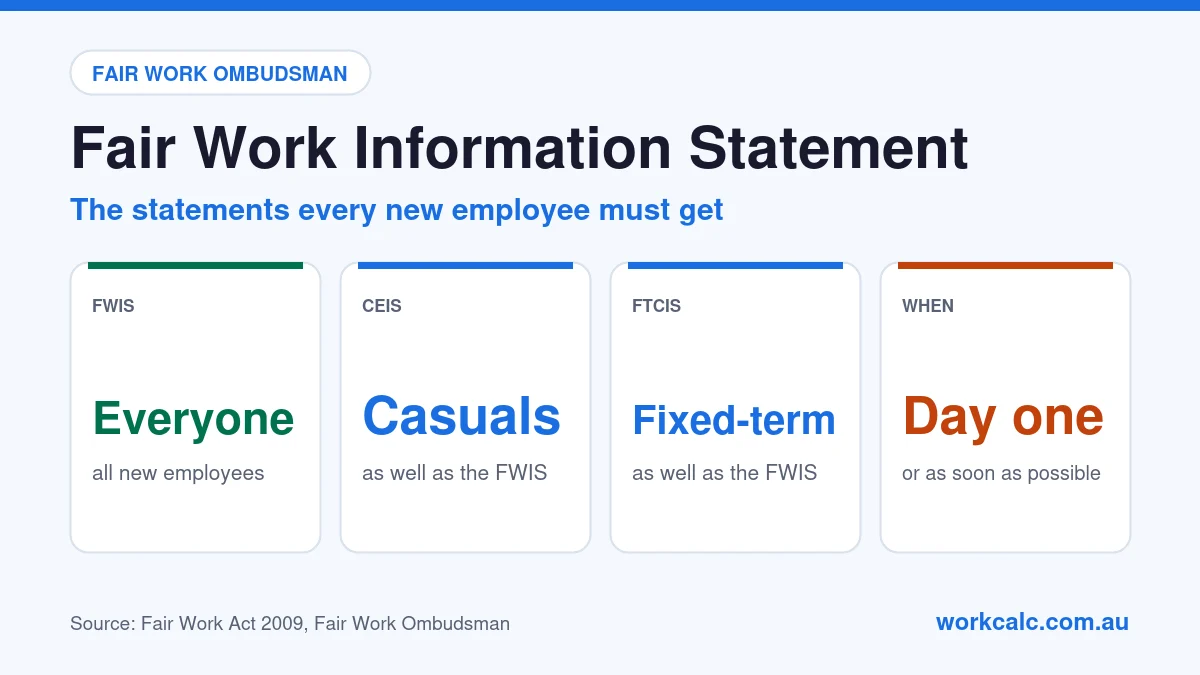
The Fair Work Information Statement (FWIS) is a document every Australian employer must legally give to every new employee, before or as soon as possible after they start work. It summarises the 11 minimum entitlements under the National Employment Standards. Casual employees must also receive a second document — the Casual Employment Information Statement (CEIS) — and employees on fixed-term contracts must receive a third — the Fixed Term Contract Information Statement (FTCIS).
What is the Fair Work Information Statement?
The Fair Work Information Statement is mandated under section 125 of the Fair Work Act 2009 — it isn't optional or a matter of employer preference. It's a plain-English summary of the key rights and entitlements that apply to every employee in Australia's national workplace relations system, published and regularly updated by the Fair Work Ombudsman (FWO).
The statement covers the National Employment Standards, coverage under awards and enterprise agreements, individual flexibility arrangements, freedom of association and workplace rights, termination of employment, and the Fair Work Ombudsman's role. It's available for free download from the FWO website, and in more than 40 languages.
Related tool Starting a new job? Take-Home Pay Calculator — see your full net pay before you begin →The three information statements compared
This is where most guides — including, frankly, the government's own website — split the information across separate pages. Here's the full picture in one table:
| Statement | Who must receive it | When | Repeats? |
|---|---|---|---|
| Fair Work Information Statement (FWIS) | Every new employee — full-time, part-time, casual, fixed-term | Before, or as soon as practicable after, starting work | No — one-off, at the start |
| Casual Employment Information Statement (CEIS) | Every new casual employee, in addition to the FWIS | Before, or as soon as possible after, starting work | Yes — see timing table below |
| Fixed Term Contract Information Statement (FTCIS) | Every employee entering a fixed-term contract, in addition to the FWIS | Before, or as soon as possible after, entering the contract | No — one-off, per contract |
When the Casual Employment Information Statement must repeat
Unlike the FWIS, the CEIS isn't a one-off document — casual employees must receive it again at set intervals, and the schedule depends on the size of the employer:
| Employer size | CEIS timing |
|---|---|
| Small business (fewer than 15 employees) | At start, then again after 12 months |
| Other employers (15+ employees) | At start, then after 6 months, then after 12 months, then every further 12 months |
This repeat requirement exists because casual employment status and conversion rights can change over time — regularly reminding casual employees of their rights, including their potential eligibility to convert to permanent employment, is the specific policy purpose behind the repeated timing.
Understand casual conversion rights in full
The Employee Choice Pathway, eligibility, and how employers can (and can't) refuse.
What's actually inside the Fair Work Information Statement
The FWIS summarises all 11 National Employment Standards — the legal minimum entitlements every employee is entitled to, regardless of what their contract says. Here's each one, with links to a calculator or detailed guide where WorkCalc covers it:
Recent updates to the statement
The FWIS isn't a static document — it's updated whenever relevant legislation changes, which in practice happens most years:
- November 2024: substantially updated to reflect the new casual employment definition, the right to disconnect, and updated penalty amounts under the Closing Loopholes reforms.
- 1 July 2026: updated to reflect that year's National Minimum Wage increase.
What happens if an employer doesn't provide it
Failing to provide the FWIS (or the CEIS/FTCIS where applicable) is a breach of the National Employment Standards, and can expose an employer to civil penalties under the Fair Work Act 2009. Beyond the direct legal risk, there's a practical cost too: the employee starts their job without a clear, official summary of their minimum rights, which can contribute to disputes or misunderstandings later in the employment relationship — precisely the kind of situation this document exists to prevent.
Related guide Pay in Lieu of Notice — how it's calculated and taxed when employment ends →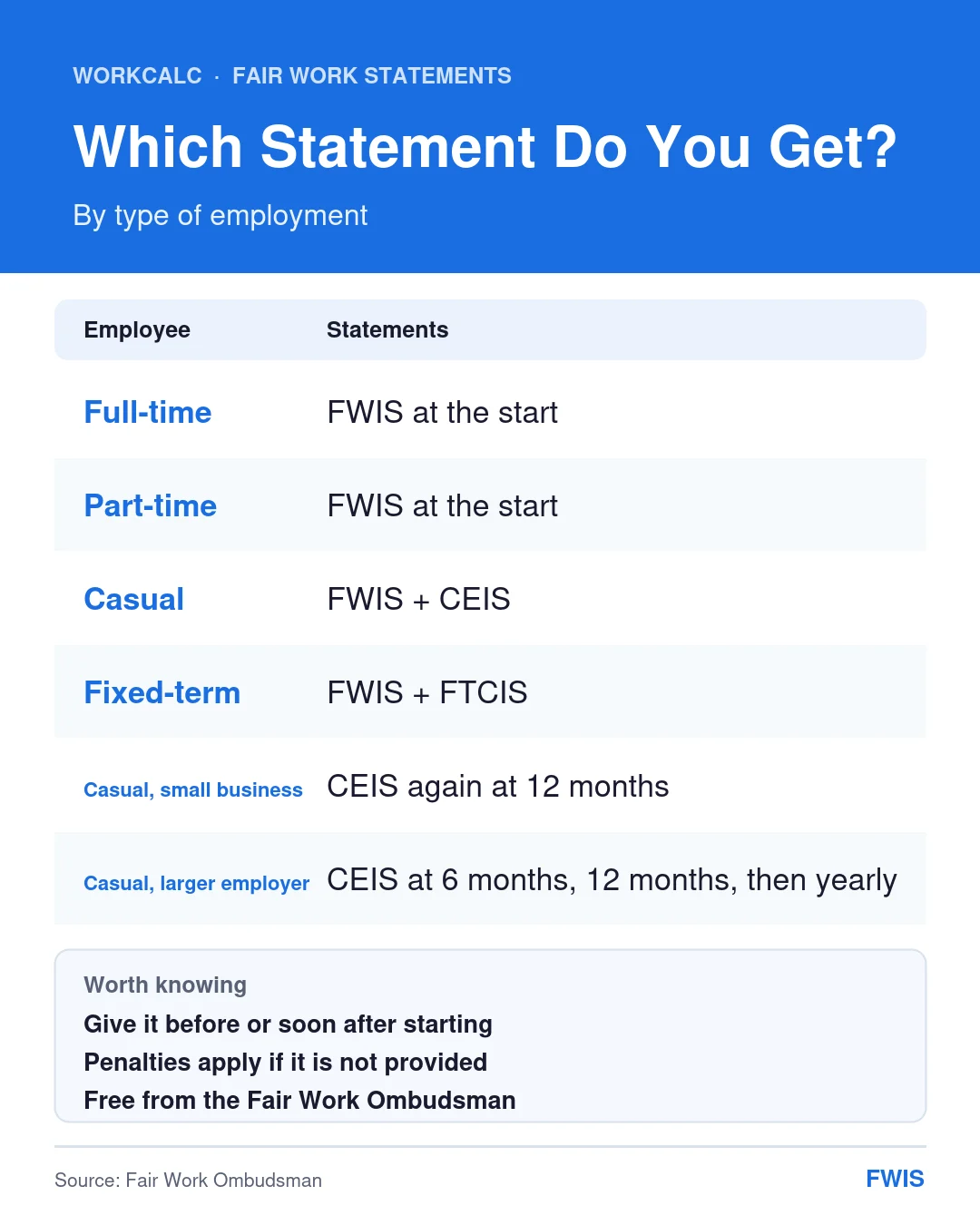
Employer checklist
Before onboarding a new employee
Employee checklist
Did you receive what you should have?
This guide reflects the Fair Work Information Statement as published by the Fair Work Ombudsman. The FWIS, CEIS and FTCIS are updated periodically — always check fairwork.gov.au for the current official version.
Frequently asked questions
Common questions about the Fair Work Information Statement.
What is the Fair Work Information Statement?
A document every employer must give every new employee, under s125 of the Fair Work Act 2009. It summarises the 11 National Employment Standards, awards, agreements, workplace rights and termination information. Given before, or as soon as practicable after, starting work.
Do casual employees need the Fair Work Information Statement?
Yes — every new employee needs the FWIS, including casuals. Casuals must also receive the separate Casual Employment Information Statement (CEIS) at the same time, and again at further intervals during employment.
When must an employer give the Casual Employment Information Statement?
At the start of employment, then again — for small businesses (under 15 employees), after 12 months; for other employers, after 6 months, 12 months, and every further 12 months.
What happens if an employer doesn't give the Fair Work Information Statement?
It's a breach of the National Employment Standards, which can result in civil penalties under the Fair Work Act. It also means the employee misses an official summary of their rights at the start of employment.
What is the difference between the FWIS, CEIS and FTCIS?
FWIS goes to every new employee generally. CEIS is an additional document specifically for casual employees, covering casual conversion rights. FTCIS is an additional document for fixed-term contract employees. Some employees need more than one.
Does the Fair Work Information Statement change every year?
It's updated whenever relevant law changes — most recently substantially in November 2024 (casual definition, right to disconnect) and again from 1 July 2026 (minimum wage update). Always use the current version, not an old saved copy.