
Pay in Lieu of Notice Australia: How It's Calculated, Taxed and What You're Owed
How payment in lieu of notice is worked out, why it's taxed differently to normal wages, and the surprising truth about whether super still applies.
What is payment in lieu of notice?
When an employer ends your employment, they must give you the notice period you're entitled to — or pay you instead of making you work it. Payment in lieu of notice is that payment: a lump sum equal to what you would have earned working your notice period, paid upfront so your employment can end immediately. This is part of the broader termination-of-employment entitlement covered in the Fair Work Information Statement, which every new employee must be given.
Employers typically choose payment in lieu when they want an employee to leave straight away — during a restructure, a workplace dispute, or simply because having the employee continue working through notice isn't practical or desirable for either party.
How much notice are you owed?
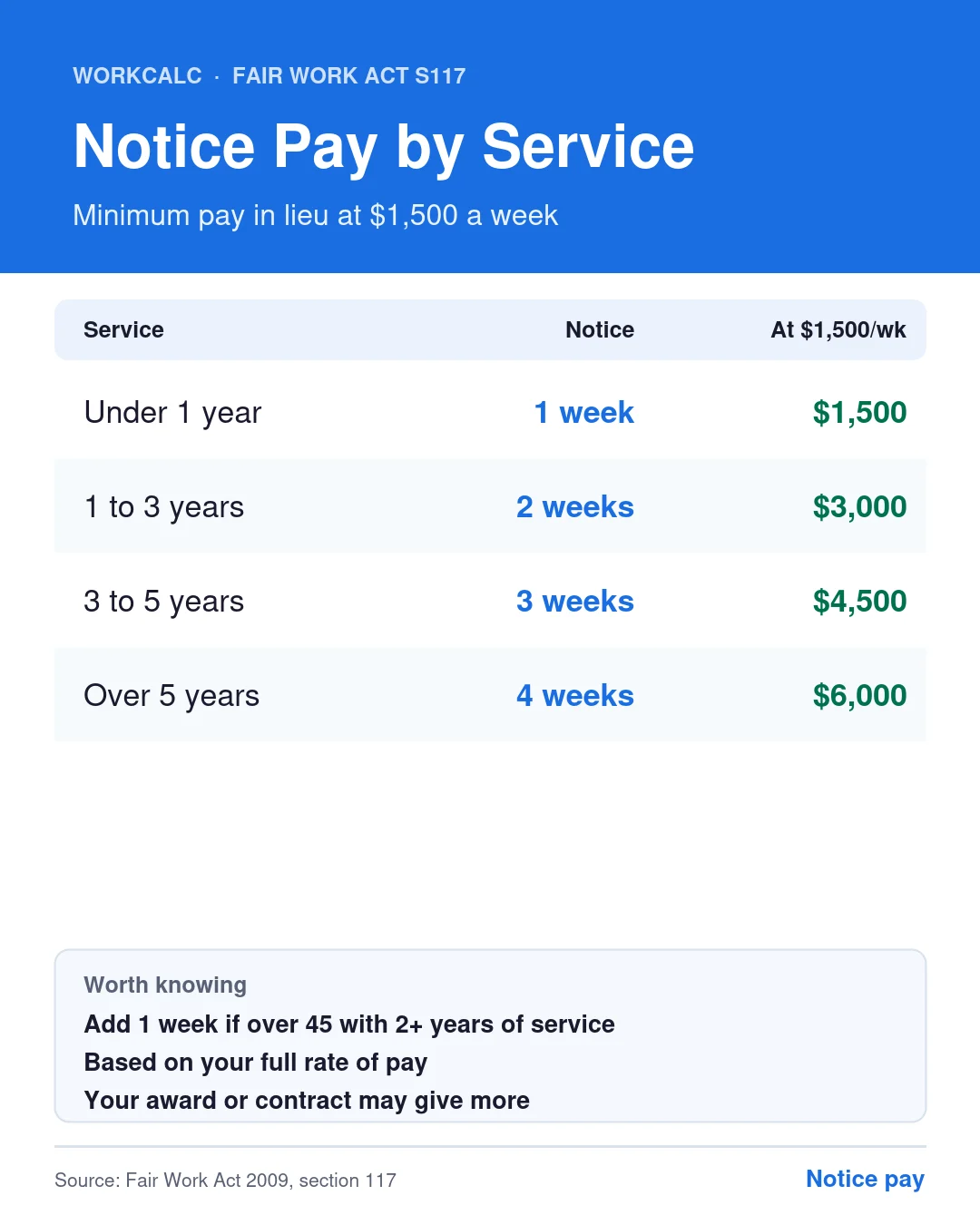
The starting point is your NES minimum notice entitlement under section 117 of the Fair Work Act 2009 — though your award, enterprise agreement, or employment contract may specify more:
| Period of continuous service | Minimum notice |
|---|---|
| Less than 1 year | 1 week |
| 1 year to less than 3 years | 2 weeks |
| 3 years to less than 5 years | 3 weeks |
| 5 years or more | 4 weeks |
An additional week applies if you're 45 or older with at least 2 years of continuous service. For the full breakdown including this age bonus, see the Notice Period Calculator.
Calculate your notice entitlement and pay in lieu
Enter your years of service and weekly pay for an instant estimate.
Worked example — gross payment in lieu
Employee owed 4 weeks notice, $95,000 salary ($1,826.92/week)
How is payment in lieu of notice taxed?
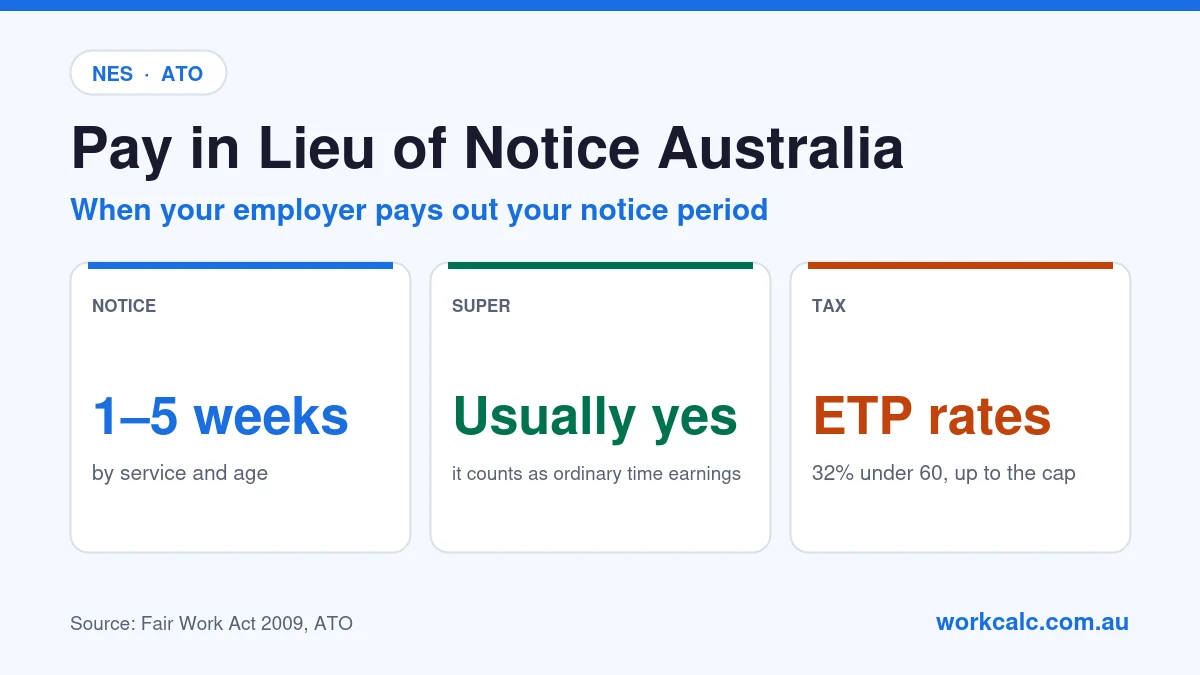
This is where most people get caught out. Payment in lieu of notice is not taxed the same way as your ordinary wages. The ATO classifies it as a non-excluded Employment Termination Payment (ETP) — the same broad category as a golden handshake, gratuity, or severance pay — and it's taxed concessionally rather than at your normal marginal rate.
| Your situation | ETP amount | Tax rate |
|---|---|---|
| At or above preservation age | Up to the ETP cap ($270,000 for 2026–27) | 17% |
| Below preservation age | Up to the ETP cap | 32% |
| Either situation | Above the ETP cap | 45% + Medicare levy |
Worked example — tax on the payment in lieu
Same employee, $7,307.68 gross payment in lieu, below preservation age
For most people earning above $45,000, this 32% ETP rate is actually lower than their standard marginal tax rate — so despite feeling like a big deduction, the concessional ETP treatment is often a tax advantage compared to being taxed on the same amount as ordinary salary.
Related guide Tax on Redundancy Pay Australia — ETP caps and concessional rates explained in full →The surprising part: super usually still applies
Here's the detail almost everyone gets wrong, including some payroll systems. Despite being taxed as an ETP, payment in lieu of notice is usually still classified as Ordinary Time Earnings (OTE) for superannuation purposes — which means your employer is still required to pay the 12% Superannuation Guarantee on it.
This happens because tax classification and super classification are assessed under completely separate rules. The ATO's own guidance treats payment in lieu of notice as OTE because it substitutes for the ordinary hours you would have worked during the notice period — even though, for tax withholding purposes, that same payment is bundled into the ETP category alongside genuinely different payments like golden handshakes and severance.
Same $7,307.68 payment in lieu — superannuation payable separately
This super amount is paid directly into your super fund — it doesn't reduce your take-home cash payment, and it doesn't affect the ETP tax calculation on the payment itself.
Notice paid vs notice worked — the tax difference matters
If your employer requires you to work out your notice period instead of paying in lieu, that period is taxed completely differently — as ordinary wages at your normal marginal rate, exactly like any other pay period. There's no ETP concession available, because you're simply being paid your regular salary for regular hours worked.
| Notice worked | Notice paid in lieu | |
|---|---|---|
| Tax treatment | Ordinary marginal rate | Concessional ETP rate (17–32%) |
| Superannuation | Payable | Usually still payable |
| Paid as | Normal fortnightly/weekly wages | Single lump sum |
Depending on your income level, one of these can leave you slightly better or worse off after tax — though the difference is usually modest, and the choice of which method to use rests with your employer under section 117 of the Fair Work Act, not with you.
Employers can also use a combination
An employer isn't limited to an all-or-nothing choice. Under the Fair Work Act, an employer can require you to work part of your notice period and pay the remainder in lieu — for example, having you work 2 weeks and paying out the remaining 2 weeks if you're entitled to 4 weeks total.
Payment in lieu of notice is separate from redundancy pay
If you're being made redundant, payment in lieu of notice and redundancy pay are two separate, cumulative entitlements — receiving one doesn't reduce or replace the other. Notice pay compensates for the notice period itself; redundancy pay is a distinct NES entitlement based on your years of service. Both typically appear as separate line items in your final payout.
Related tool Redundancy Pay Calculator — a separate entitlement, paid in addition to notice →Tax treatment of payment in lieu of notice can vary depending on whether it forms part of a genuine redundancy package and the specific circumstances of your termination. The ETP cap of $270,000 applies for the 2026–27 financial year and is indexed annually. This is a genuinely complex area of tax law — for anything beyond a general estimate, verify your specific payment classification with your employer's payroll department or a registered tax agent.
Frequently asked questions
Common questions about payment in lieu of notice in Australia.
What is payment in lieu of notice?
A lump sum paid when an employer ends your employment immediately instead of requiring you to work your notice period. It equals what you would have earned working that period — notice weeks owed × your ordinary weekly base pay.
How is payment in lieu of notice calculated?
Notice weeks owed × ordinary weekly base pay, excluding overtime, bonuses and allowances. For example, 4 weeks at $1,826.92/week = $7,307.68 gross. Use the Notice Period Calculator to find your exact entitlement.
Is payment in lieu of notice taxed as an ETP?
Generally yes — it's classified as a non-excluded Employment Termination Payment, taxed concessionally at 17% (at/above preservation age) or 32% (below preservation age) up to the ETP cap, rather than at your normal marginal rate.
Does superannuation apply to payment in lieu of notice?
Yes, usually. Despite being an ETP for tax purposes, it's generally still classified as Ordinary Time Earnings for super — so your employer must still pay the 12% Superannuation Guarantee on it. This is different to most other termination payments, which don't attract super.
Can an employer choose between notice worked and payment in lieu?
Yes. Under section 117 of the Fair Work Act, the employer can have you work the notice, pay it out, or use a combination of both — for example working half and being paid the rest in lieu.
Is payment in lieu of notice the same as redundancy pay?
No — they're separate entitlements paid in addition to each other. Notice pay compensates for the notice period; redundancy pay is based on years of service under the NES. See how redundancy pay is calculated for the full breakdown.