
Notice Period Calculator Australia
Find your NES minimum notice period, calculate your last working day, and estimate your pay in lieu if you are not required to work out the notice.
Your details
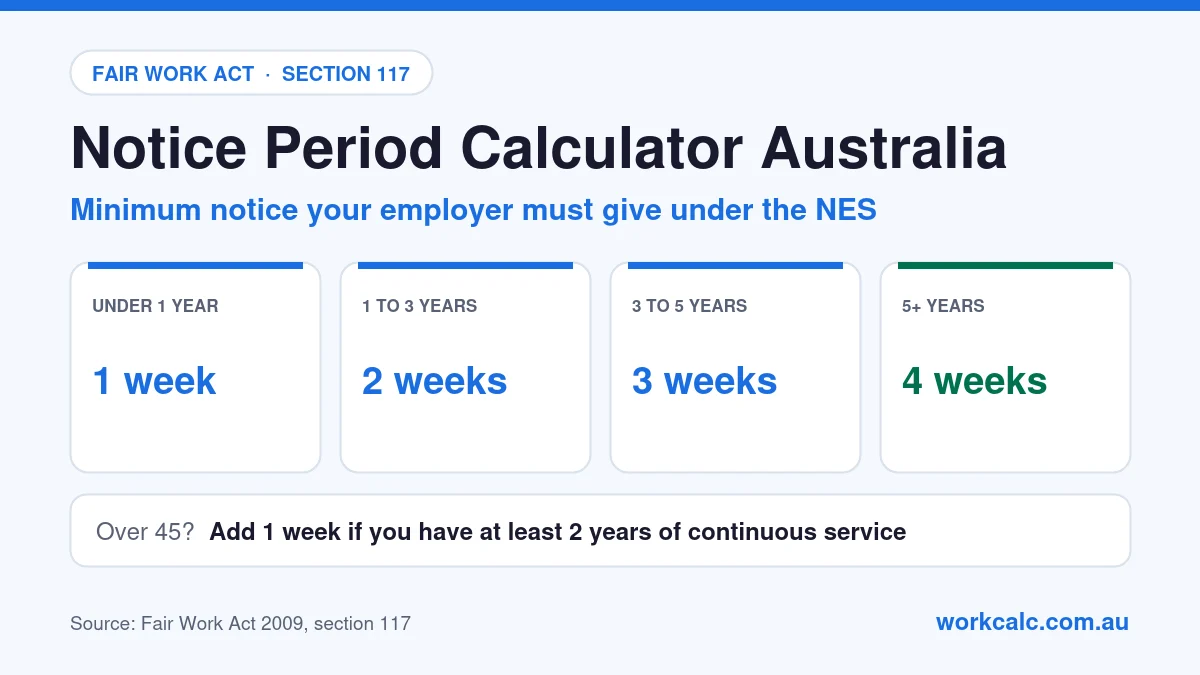
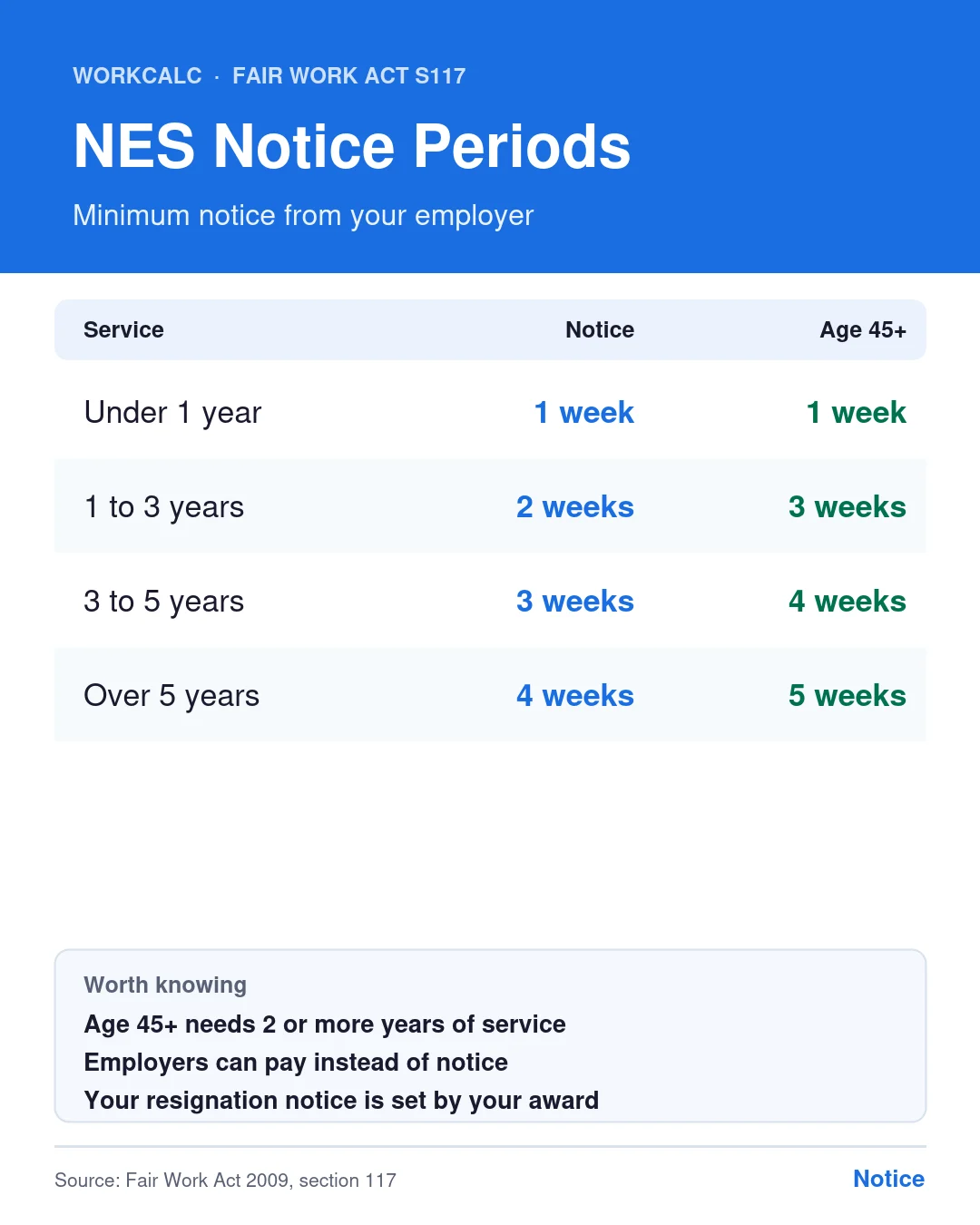
NES notice periods table (Fair Work Act s117)
These are the minimum notice periods an employer must give. Your contract or modern award may require more.
| Period of continuous service | Minimum notice | Age 45+ with 2+ years service |
|---|---|---|
| Less than 1 year | 1 week | 1 week(no bonus — need 2+ years) |
| 1 year to less than 3 years | 2 weeks | 3 weeks+1 week |
| 3 years to less than 5 years | 3 weeks | 4 weeks+1 week |
| 5 years or more | 4 weeks | 5 weeks+1 week |
How notice periods work in Australia
Under section 117 of the Fair Work Act 2009, an employer must give a permanent employee either the required notice period to work out, or pay them in lieu of that notice. The NES table above sets the minimum — your employment contract, modern award, or enterprise agreement may require more.
The notice period is based on continuous service with the same employer, not total years worked. If you have changed jobs, only your service with the current employer counts.
The age 45 bonus week
Under section 117(3)(b) of the Fair Work Act, an employee who is 45 years or older and has completed at least 2 years of continuous service is entitled to one additional week of notice on top of the standard NES amount.
This applies regardless of the reason for termination — whether it is genuine redundancy, performance-based dismissal, or any other reason. The only exception is summary dismissal for serious misconduct.
Payment in lieu of notice
Rather than requiring an employee to work out the notice period, an employer can choose to pay the employee in lieu — making the termination effective immediately. The payment is calculated as:
Pay in lieu = notice weeks × ordinary weekly base pay
Ordinary weekly base pay means the employee's regular pay for ordinary hours — it does not include overtime, bonuses, commissions, penalty rates, or superannuation contributions.
Payment in lieu of notice — often abbreviated PILON — is generally treated as an Employment Termination Payment (ETP) for tax withholding purposes, not as ordinary wages. This means it is taxed concessionally under ATO Schedule 11 — at 17% if you have reached your preservation age, or 32% if you haven't, up to the relevant cap. For 2026–27 that is the $270,000 ETP cap when the payment is part of a genuine redundancy; otherwise the lower of that cap and the $180,000 whole-of-income cap (reduced by your other taxable income for the year) applies. Amounts above the cap are taxed at the top marginal rate. For the full breakdown with worked examples, see Pay in Lieu of Notice Australia: How It's Calculated, Taxed and What You're Owed.
Despite this ETP tax treatment, payment in lieu of notice is still generally treated as Ordinary Time Earnings (OTE) for superannuation purposes — meaning your employer must still pay the 12% Superannuation Guarantee on it. This is a common point of confusion: tax classification and super classification are assessed separately, and PILON is one of the few termination payments that is both an ETP for tax and still superable. Include it in your Final Pay Calculator alongside your leave payout and any redundancy payment for the complete picture.
When no notice is required — summary dismissal
The only circumstance under the Fair Work Act where an employer can terminate employment without notice and without paying in lieu is summary dismissal for serious misconduct. Serious misconduct includes:
- Theft, fraud, or dishonesty
- Violence or threatening behaviour in the workplace
- Serious and imminent risk to the health and safety of a person
- Wilful destruction of the employer's property
- Conduct that fundamentally undermines the employment relationship
Poor performance, disagreements, or personality conflicts do not qualify as serious misconduct. Dismissing an employee without notice for non-misconduct reasons is a breach of the NES and may expose the employer to unfair dismissal liability.
Does notice apply when you resign?
The NES notice table (and the calculator above) covers employer-initiated termination. When you resign, the notice you must give is set by your award, enterprise agreement or employment contract. Many modern awards require the same 1 to 4 week periods as the NES table, without the extra week for age 45+. To put your notice in writing, use the resignation letter template.
Contracts that specify notice in months, not weeks
The NES sets minimum notice in weeks, but many employment contracts — especially for senior, professional, or executive roles — specify notice in months instead. A common approximation: 1 month ≈ 4.3 weeks, 2 months ≈ 8.7 weeks, 3 months ≈ 13 weeks. If your contract specifies a notice period in months, use the notice start date field in the calculator above to work out your exact last working day, rather than converting to weeks first — calendar months vary in length, so counting from your actual start date is more accurate than a weeks-based approximation.
Notice during a redundancy
When employment is terminated due to genuine redundancy, the employee is still entitled to the NES notice period (or payment in lieu). Notice pay and redundancy pay are separate entitlements — receiving one does not reduce or replace the other.
On redundancy, most employers pay notice in lieu rather than requiring the employee to work it — so both the redundancy payment and the notice payment typically land in the final payout as lump sums. See the Redundancy vs Resignation guide for a full comparison of what you receive under each scenario.
Frequently asked questions
Common questions about notice periods and payment in lieu in Australia.
How much notice do I have to give in Australia?
The NES minimum for employer-initiated termination: 1 week under 1 year, 2 weeks for 1–3 years, 3 weeks for 3–5 years, 4 weeks for 5+ years — plus an extra week if you are 45+ with 2+ years of service. When you resign, your award, enterprise agreement or contract sets the notice you must give. Many modern awards use the same 1 to 4 week periods, without the extra week for age 45+.
What is payment in lieu of notice?
Where an employer ends employment immediately without the employee working the notice period, and pays the equivalent wages instead. Calculated as notice weeks × ordinary weekly base pay (excluding overtime, bonuses, and super). Often called PILON — generally treated as an ETP and taxed concessionally, not as ordinary income.
Can an employer terminate without notice in Australia?
Only in cases of summary dismissal for serious misconduct — theft, fraud, violence, or conduct fundamentally undermining the employment relationship. In all other cases, the employer must either provide the required notice period or pay in lieu under section 117 of the Fair Work Act 2009.
Does the notice period apply when an employee resigns?
The NES table itself covers employer-initiated termination. When you resign, the notice you must give is set by your award, enterprise agreement or employment contract. Many modern awards use the same 1 to 4 week periods as the NES table, without the extra week for age 45+, and contracts often ask for 2 to 4 weeks. If you resign without giving the required notice, your employer may be able to withhold some pay, but only if your award or contract allows it.
Do casual employees get notice pay?
No. Casual employees are not entitled to notice of termination or payment in lieu under the NES. The provisions apply only to permanent full-time and part-time employees. Some awards or enterprise agreements may include casual notice provisions — check the instrument that covers your role.
Is notice pay taxed differently to normal wages?
It depends. If you work your notice period, the wages are taxed as ordinary income, same as any pay period. If you're paid in lieu instead, that's generally treated as an Employment Termination Payment (ETP) and taxed concessionally under ATO Schedule 11 — usually a lower effective rate than ordinary marginal tax.
What date will my notice period end if I start today?
Enter today's date as the notice start date in the calculator above, along with your years of service — it will show your exact last working day based on your NES minimum notice period. This works for any start date, not just today, so you can also check a future or past start date.
My contract says 1, 2 or 3 months notice — how many weeks is that?
Roughly: 1 month ≈ 4.3 weeks, 2 months ≈ 8.7 weeks, 3 months ≈ 13 weeks. For an exact last working day, use the notice start date field in the calculator above rather than converting to weeks — calendar months vary in length, so counting from your actual start date is more accurate.
What if my employer doesn't give me the required notice?
Terminating without notice or without paying in lieu is a breach of the NES under the Fair Work Act. You can lodge a complaint with the Fair Work Ombudsman on 13 13 94.